
The trading revolution of the Agent era: Is it not pay-per-use, but rather the task market that is the key to breaking the deadlock?
Author: jordan, Delphi Research
Compiled by: Gu Yu, ChainCatcher
The business of agents is converging on a new fundamental unit: tasks, which are verified completed work units. The task market allows results to be priced, traded, and verified.
Two companies are competing to dominate the agent business technology stack. Coinbase is building open standards on its own track. Stripe is extending its existing business into agent commerce. This article presents a strong argument for the task market, examining how Stripe and Coinbase are entering the agent business, and explaining why Tempo is the wedge for the crypto industry to enter the agent economy.
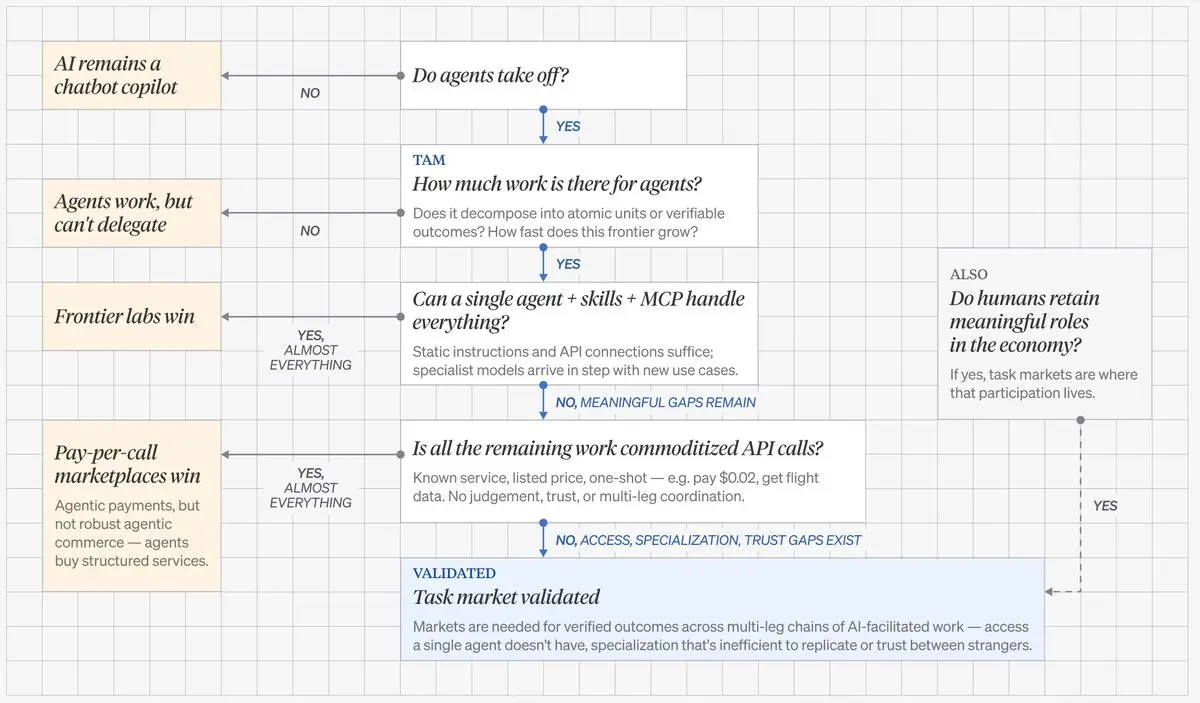
The Tailwind of Tasks
Three forces are driving people to think in terms of tasks and results:
- Agents already have capabilities but fail in multi-step tasks. Agents are rapidly improving, but multi-step workflows with consequences remain fragile. Programming is a proof case for agent work, but it is also the easiest environment agents will face. Agents can see if their work can compile successfully. Real work is not that clean. Breaking down chaotic workflows into atomic, verifiable tasks will determine how far agent systems can go.
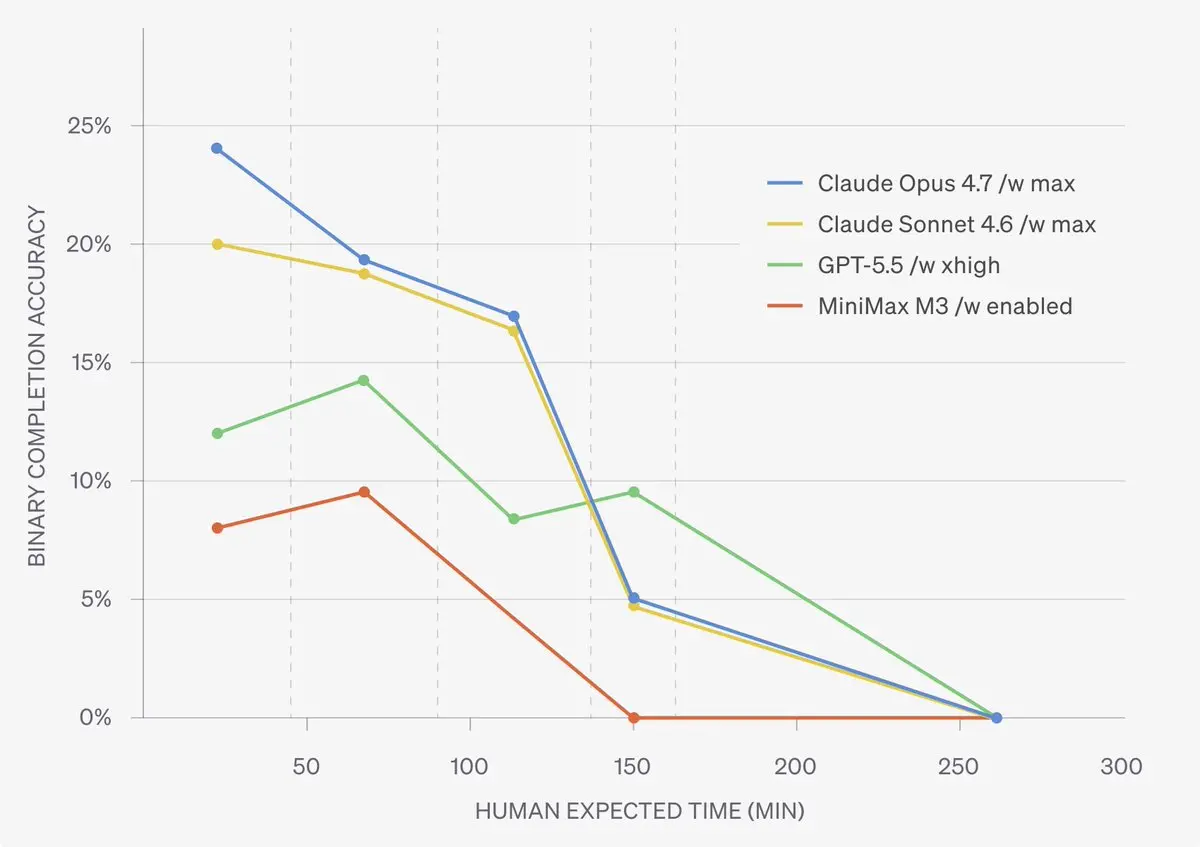
OSWorld 2.0: As human expectations for task duration increase, the binary completion accuracy approaches zero.
Coordination is the bottleneck. Production is limited by coordination, not capacity. In healthcare, construction, enterprises, and government, the waiting time in administrative processes exceeds execution time. In healthcare administration alone, it exceeds $1 trillion annually. Coordination is the area with the greatest automation opportunities in the economy, and it is precisely where agents currently fail. Intelligence is approaching usability. The infrastructure around agents is not yet there.
The era of subsidies will not last forever. A $100 monthly subscription may correspond to a $5,000 API usage fee. This does not cost Anthropic $5,000, but it is likely to exceed $100. Pay-per-use billing will expose the true costs of agent labor, and the cost of each completed task has become the preferred metric.
The overall demand for restructuring work, along with the re-pricing of the unit economics of agent labor, will naturally converge on tasks as the optimal mental model. We know agents have capabilities and are improving. Work is being broken down. As work becomes more difficult, agents will need better infrastructure.
Three Levels of Agent Work
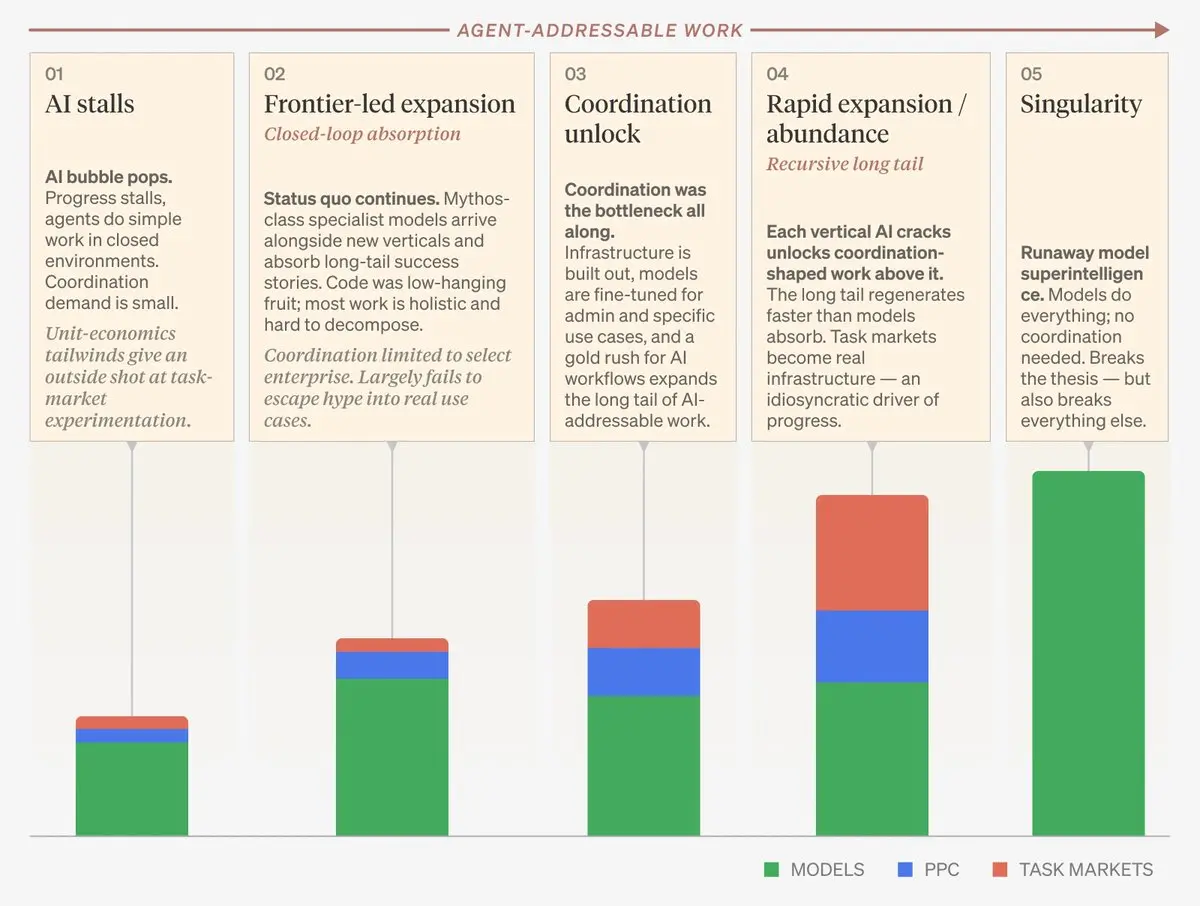
Single agent + skills + MCP. If Claude can complete tasks on its own, you do not need coordination or a task market. Skills are instructions; MCP is the connector. Both must be maintained, and among thousands of MCPs, only a small portion are high quality. Skills will become outdated; MCPs cannot scale. You cannot pre-build the long tail.
Pay-per-use. When Claude hits a wall, it seeks answers externally and then continues. These transactions are simple, discreet, and cheap. As agents take on more work, the tool catalog will cover more expensive and specialized tasks.
Coinbase's agentic.market is an early example. Through Base MCP, agents can access a whole suite of installed service catalogs.
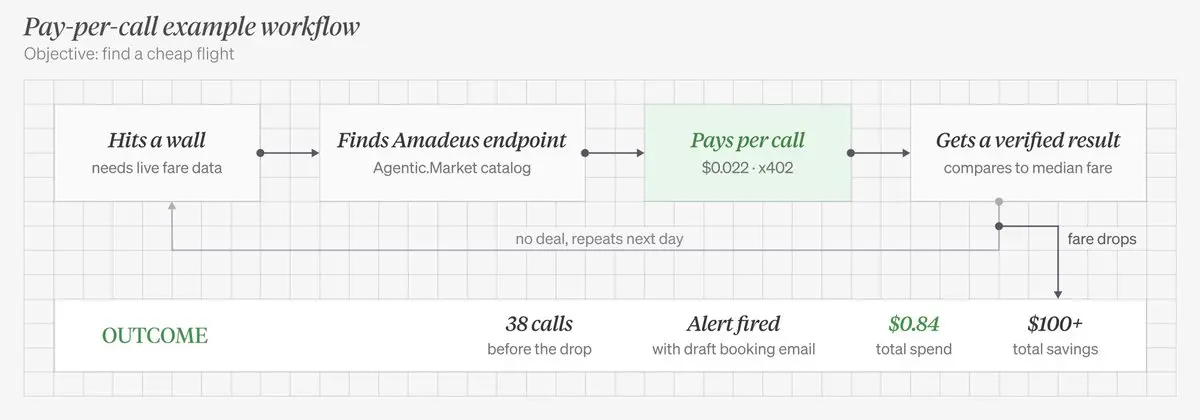
Imagine an agent building a cheap flight itinerary.
Option A (skill/MCP): You install an Amadeus skill file. Claude reads it and directly calls the API. This works for a few services with high-quality MCPs. When Amadeus changes the API, it becomes invalid. Someone must maintain the skill file. It cannot scale to 50,000 services.
Option B (pay-per-use): Amadeus charges $0.022 per call on Agentic.Market. The agent discovers it, pays, and retrieves data. The service provider maintains its own endpoint and gets paid. No need to download a skill or maintain an MCP.
Businesses are seriously advancing the construction of this layer. These catalogs are filled with services that agents can use, but lack the orchestration infrastructure to package them into useful workflows. Missing components include autonomous agent runtimes (OpenClaw, Hermes), commercial SDKs (AgentKit), wallets, payments, and API monetization.
Task market. Tasks are skills delivered with verified results. Buyers receive results, and sellers are responsible for models, execution frameworks, skill files, prompts, retries, and accountability. Agents are disposable; captured tasks and their data are the assets.
The structure of tasks makes agent work more reliable. An individual agent with a 95% accuracy rate over 10 steps has an overall success rate of only 60%. The task market distributes work across nodes verified by agents and humans, with different blind spots, so errors are discovered and redone at each checkpoint.
The task market is not a competing category to the pay-per-use market; they can evolve from or be layered on top of each other. Protocol standards clarify this distinction. ERC-8004 defines identity, reputation, and verification registries. It does not include payments, which are handled by x402 and MPP. Pay-per-use is the payment layer, while the task market is the trust and coordination layer.
Mapping Reachable Work
MCP + skill: A single agent with internal data and tools. We are here.
Pay-per-use: There are structured APIs for agents to obtain the external facts they need.
Task market: Complex work requiring judgment, permission access, and coordination. Chaotic real-world work cannot be handled through API calls. It involves digital and physical systems, time dependencies, and adversarial counterparties.
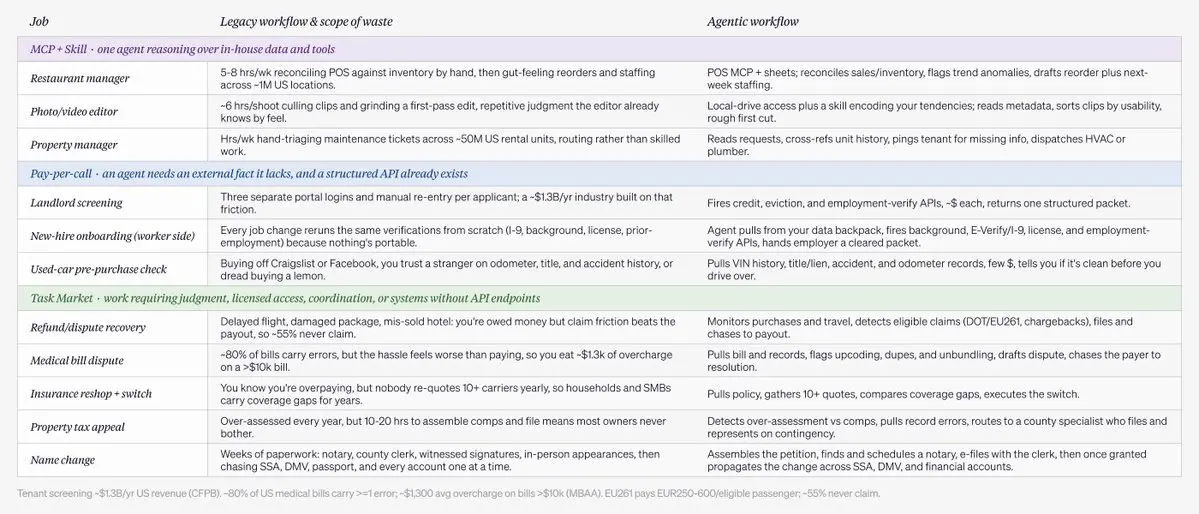
Take an agent finding deals as an example. The user plans to renovate the kitchen when appliances are on sale. This is a typical pay-per-use case: the agent pays $0.01 each time it queries and alerts the user when a deal is found. However, retailers will block crawlers, and services that bypass these restrictions (like SerpApi) prohibit data resale, forcing users to subscribe. Ironically, reselling scraped data is the entire business model of SerpApi, which Google has also sued them for.
A workaround is for the endpoint operator to pay the subscription fee and then pass the cost on per use. If the data is transformed into judgment rather than directly transmitted, this approach becomes more defensible.
Transforming structured output into judgments presents challenges. This workflow now becomes a task market load stuffed into the pay-per-use track, which lacks verification, reputation, and dispute resolution channels. Buyers cannot verify black-box judgments, making it less reliable than standard pay-per-use or a fully equipped task market.
The infrastructure is not yet in place, but the economic incentives are already clear and tangible. Subscriptions are a predatory model, and incumbents have overextended. All roads lead to on-demand point-and-click.
Igniting Supply
The argument for the task market is valid, but it is full of assumptions and lacks catalysts. When will building AI workflows become a gold rush like the App Store?
The early agent business landscape corresponds closely to the early iOS ecosystem. The success of the App Store was not because applications could not exist before it. It succeeded because it made discovery and distribution frictionless, and because the iPhone became indispensable. You needed one to keep up. Today's AI chatbots are like the iPod Touch: useful, powerful, but limited in scope. Coordinating infrastructure will turn agents into iPhones and the task market into the App Store.
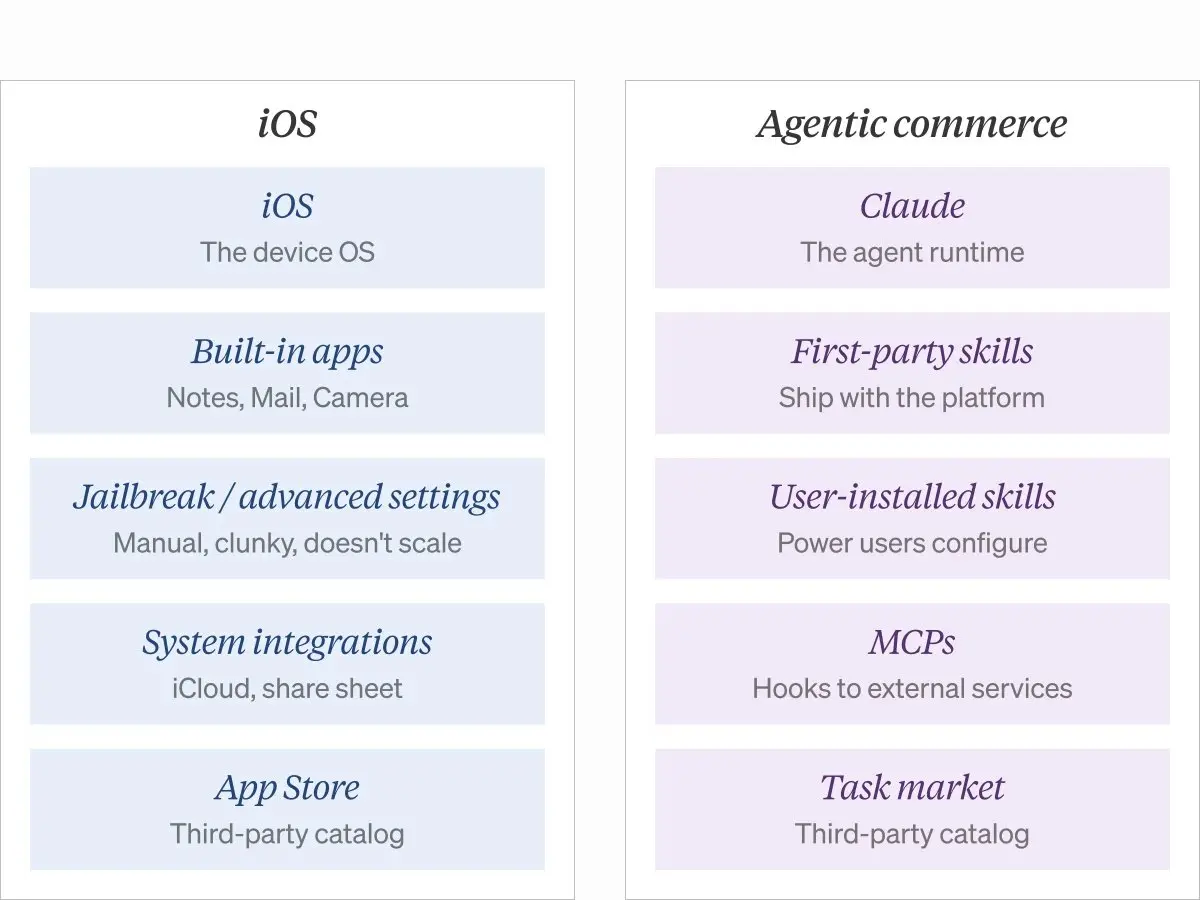
The third-party builder model is the weakest link in this analogy. App Store developers earn recurring revenue from users. In agent commerce, applications are consumed rather than owned. Merchants must win customers anew each time. Reputation becomes the new customer acquisition cost. This makes it harder for builders but improves market execution and lowers entry barriers.
Granola is one of the clearest examples of AI product-market fit so far, and as note-taking tools become saturated and commoditized, it is shifting towards MCP servers. Applications are absorbed, and data becomes the core business. This will be a common pattern: create something users love, get absorbed by cutting-edge labs, shift to APIs, and become a Lego piece in other workflows. Granola may become the equivalent of Shazam on iOS. Services with defensibility must provide something that models themselves cannot accomplish:
• Access they do not have
• Specialization that is not economically worth replicating
• Verification requiring a neutral third party
Without recurring revenue and facing the risk of absorption by labs and the pressure of competitors commoditizing, the economic calculus for builders is very harsh. The gold rush is unlikely to start with independent developers. Ignition comes from three directions: internal optimization by enterprises, consumer platforms extending chatbots into business, and operators packaging workflows for sale.
Enterprise-side Ignition
Enterprises are the furthest along in the agent economy. McKinsey found that 88% of organizations are deploying AI, but only 19% report revenue increases from AI exceeding 5%. Redesigning end-to-end workflows and reshaping entire fields of organization sees the greatest EBIT impact.
Companies like Block are already using AI as the main coordination layer within their organizations. Jack's “From Hierarchy to Intelligence” implies a bearish outlook on the task market: Block is doing internal optimization with proprietary models and data. Fintech companies and other machine-readable enterprises are the most natural early candidates for this transformation, but for most companies, this path will be more chaotic. Agents will hit organizational boundaries and will need to reach beyond the company.
Consumer Side Ignition
Consumer progress is further along than public opinion suggests. In March 2026, the conversion rate of AI traffic to U.S. retail was 42% higher than non-AI traffic, compared to being 38% lower a year prior, showing significant improvement.
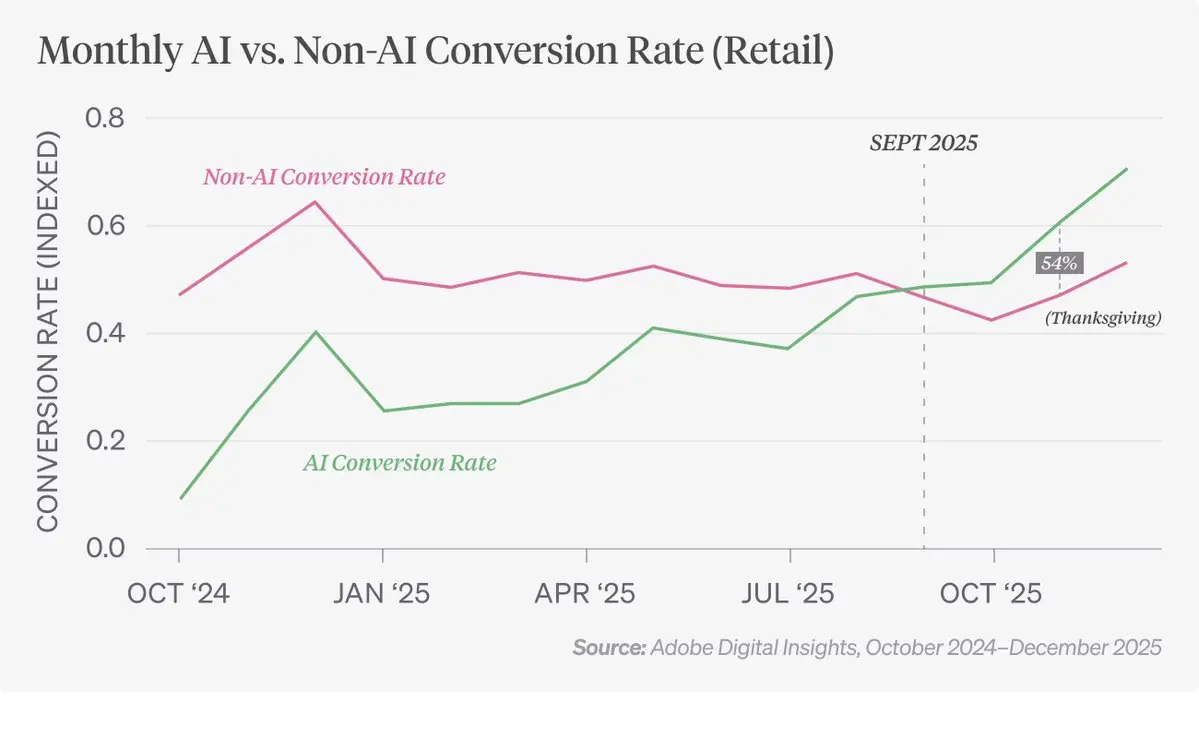
Monthly AI vs. Non-AI Retail Conversion Rates. Source: Adobe Digital Insights, October 2024 to December 2025.
Users are beginning to rely on AI for shopping, but momentum fades at checkout. In September 2025, Stripe and OpenAI launched Instant Checkout within ChatGPT. It supports Etsy, Shopify, and eventually Walmart (over 200,000 products). Etsy and Shopify sellers hardly tried it, and Walmart's conversion rate was three times lower than on Walmart. OpenAI pivoted in March 2026.
Instant Checkout is not the kind of indictment of agent-based commerce that critics portray.
Execution is poor: 4% commission, no sales tax remittance, single-item shopping only, incorrect items placed in user carts, delivery estimates have flaws.
Not agentic: humans are in the loop, additional friction, no import of credentials.
Failure modes are narrow: even if you acknowledge that users trust merchants, resist behavioral changes, and purchase where there are existing credentials and context, this does not respond to the new agent services brought about by complex coordination.
This is not a refined pilot for a new product, but an attempt to monetize distribution. Moreover, the idea that merchants will always control checkout due to having a trust moat is naive. The success of Apple Pay and Google Pay relies on aggregating checkout interfaces. Trust relationships can be built; user experiences can be improved.
The remaining unknown is the reach of agentic purchases. Will agentic commerce be the next metaverse? The hotel booking scenario is the frontline of this debate. Critics claim such workflows are just a meme, and they are somewhat correct. AI cannot reliably convert imperfect prompts into precise decision matrices. It depends on the type of purchase. For luxury consumption like vacation hotels, selection is part of the fun, and AI is best suited as a discovery tool; for practical consumption like conference hotels, the decision matrix is simple and direct, and agents can be immediately useful.
The biggest assumption is that the mass market can gradually get used to delegating purchases to agents. This will determine whether agents will have their own "iPhone moment" or develop roles similar to Google/Amazon in e-commerce through frontier frameworks.
Agent Market Landscape
The agent market is built on several layers of agent payment infrastructure currently being constructed.
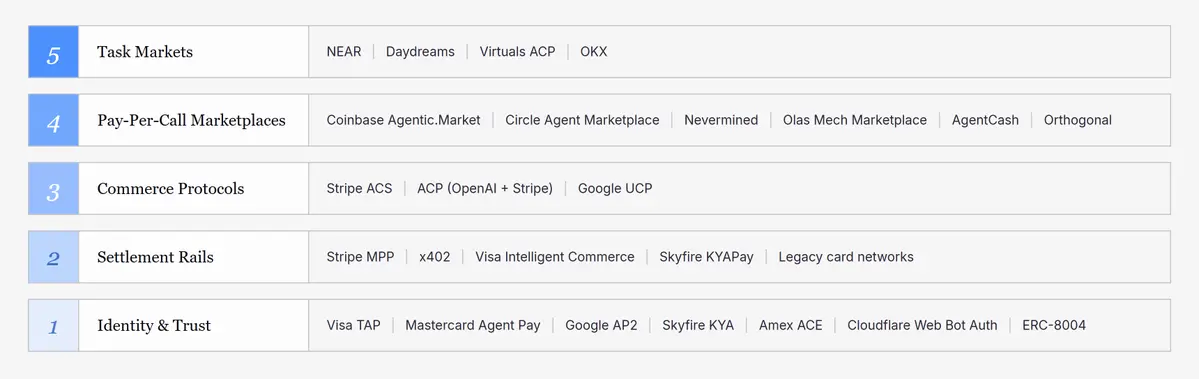
Layers 1 to 3 are saturated and moving towards integration. Stripe and Coinbase are competing to control this tech stack.
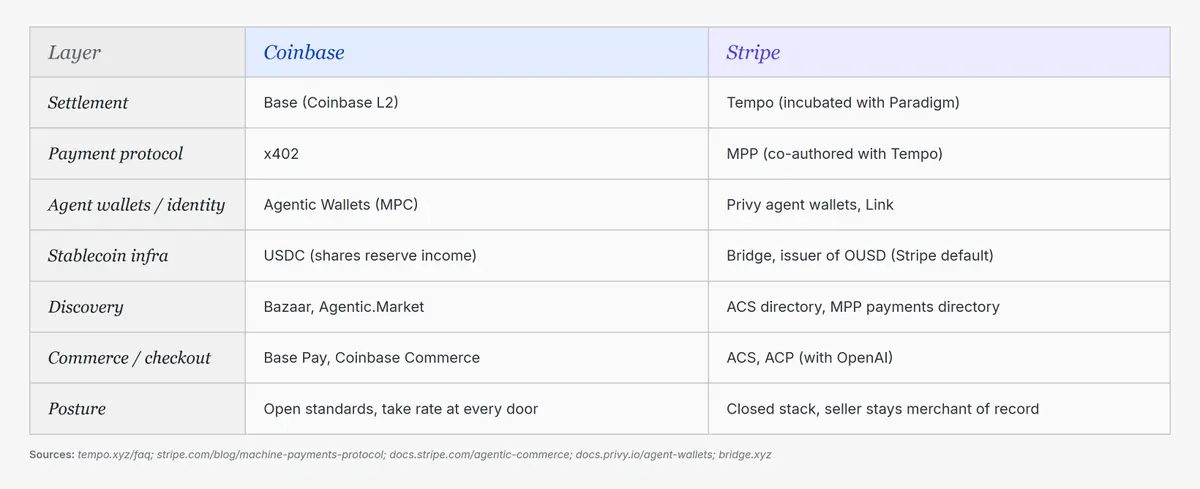
On the surface, Coinbase appears more favorable in the crypto space, but Stripe has downstream advantages through Tempo and possesses stronger capabilities to trigger catalytic effects.
Coinbase
Coinbase is building a full stack based on open standards and positioning itself at the core of every layer.
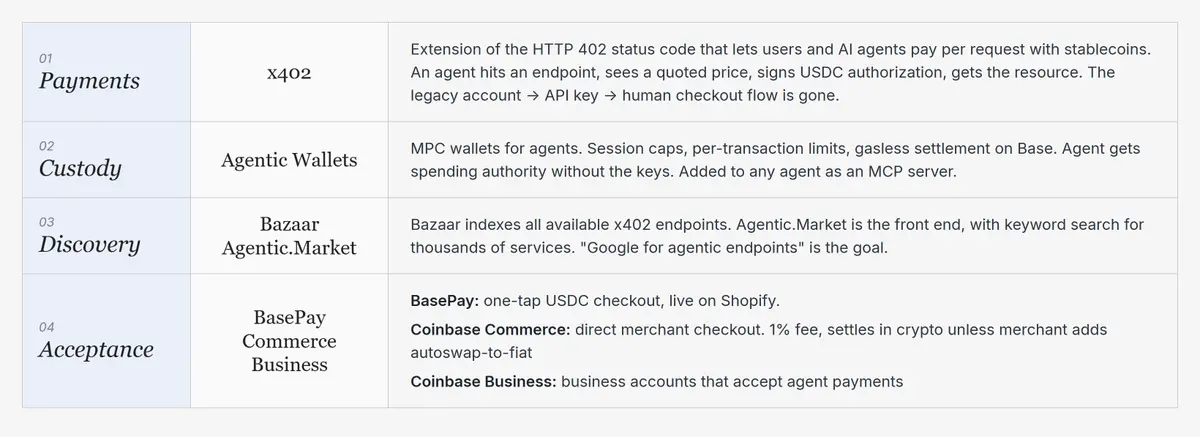
x402 is open but charges a small fee. Base is a public chain, but it is Coinbase's chain. 50% of the underlying revenue from USDC belongs to Coinbase. Agentic.market is permissionless, but it is Coinbase's frontend. Coinbase is striving to become the App Store of the agent space: monetizing open tools and developer ecosystems through commission rates.
Currently, the coordination mechanism is still lacking. Agentic.market is a pay-per-call directory, and mechanisms for matchmaking, hosting, reputation, and dispute resolution do not yet exist. However, Coinbase is in the best position to become a true task market or allow other task markets to settle on its underlying track.
Stripe
Stripe is building agent commerce as an extension of its existing business, assembling a full tech stack through acquisitions and internal R&D.
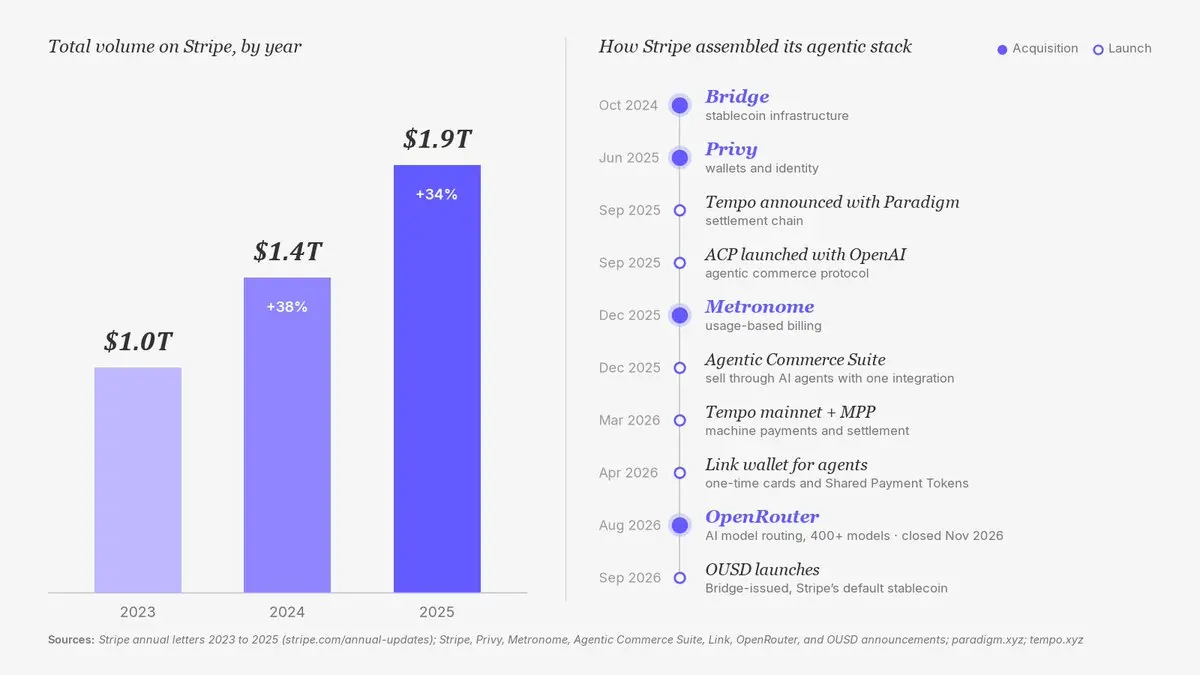
If Coinbase is masquerading as a toll booth model on an open track, then Stripe does not shy away from its closed nature. MPP and Tempo are more centralized than Coinbase's counterparts. The coordination infrastructure (disputes, verification, liability) is all centralized at Stripe, and sellers remain nominal merchants of record.
In many ways, Stripe is the antithesis of a task market. Stripe believes agent commerce will resemble traditional commerce supported by Stripe, rather than a new type of market.
Tempo
Tempo has salvaged Stripe's alignment issue. It acts as a universal settlement layer, juxtaposing Stripe's tech stack with open protocols. Stripe's business is backend infrastructure, ceding ownership to the framework. Therefore, while merely deploying on Tempo does not bring discoverability to the open market, it weakens the framework's moat.
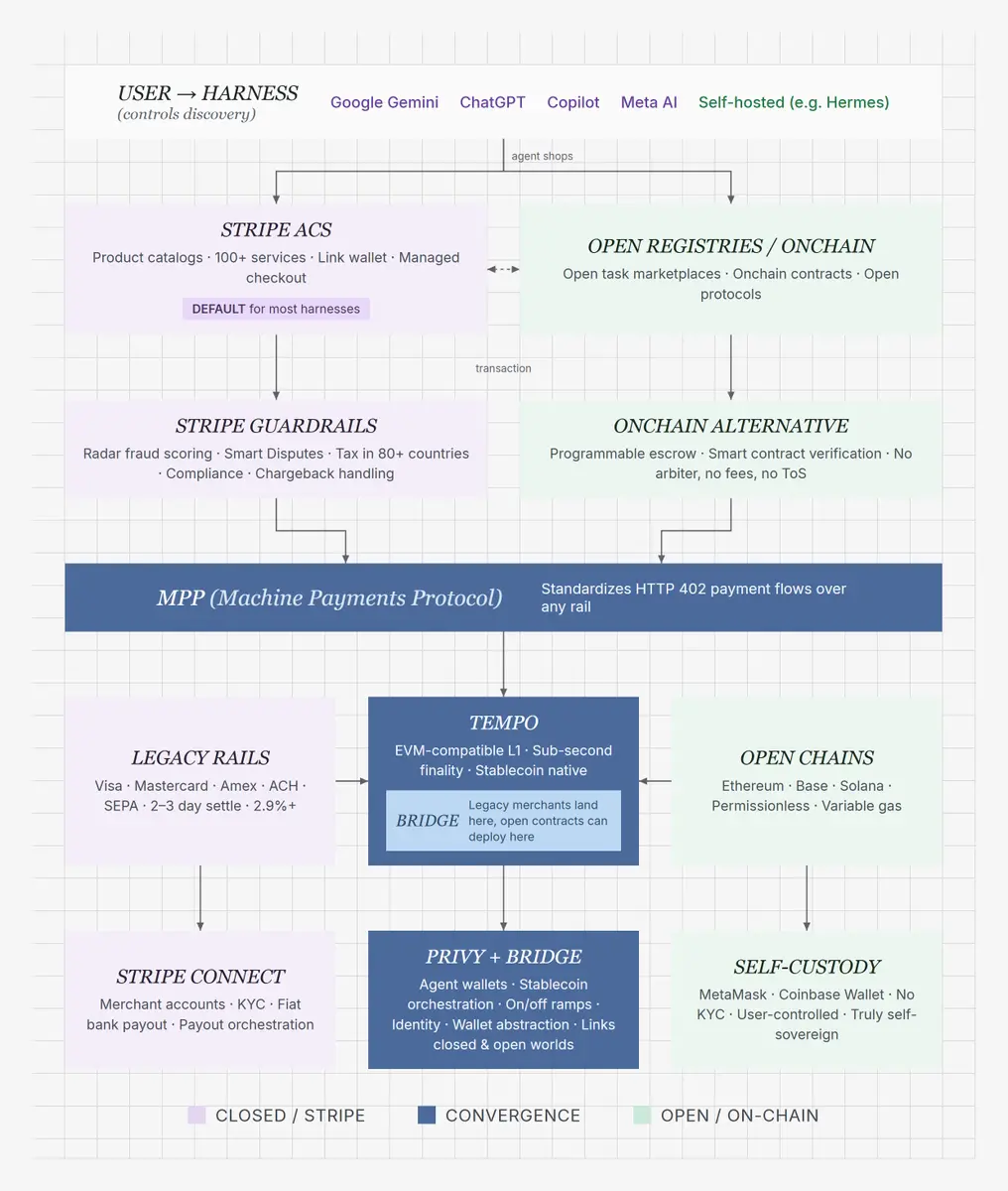
Closed frameworks can only see their providers' inventory, while open frameworks can see everything. Gemini buyer agents can only see Stripe's ACS directory. Unless queries originate from an open framework, merchants in the open market will not be discoverable. Once merchants, settlements, and protocols are integrated, the cost of switching frameworks will become very low. Frameworks must compete on routing quality, and frameworks that conduct reviews will struggle to offer optimal prices.
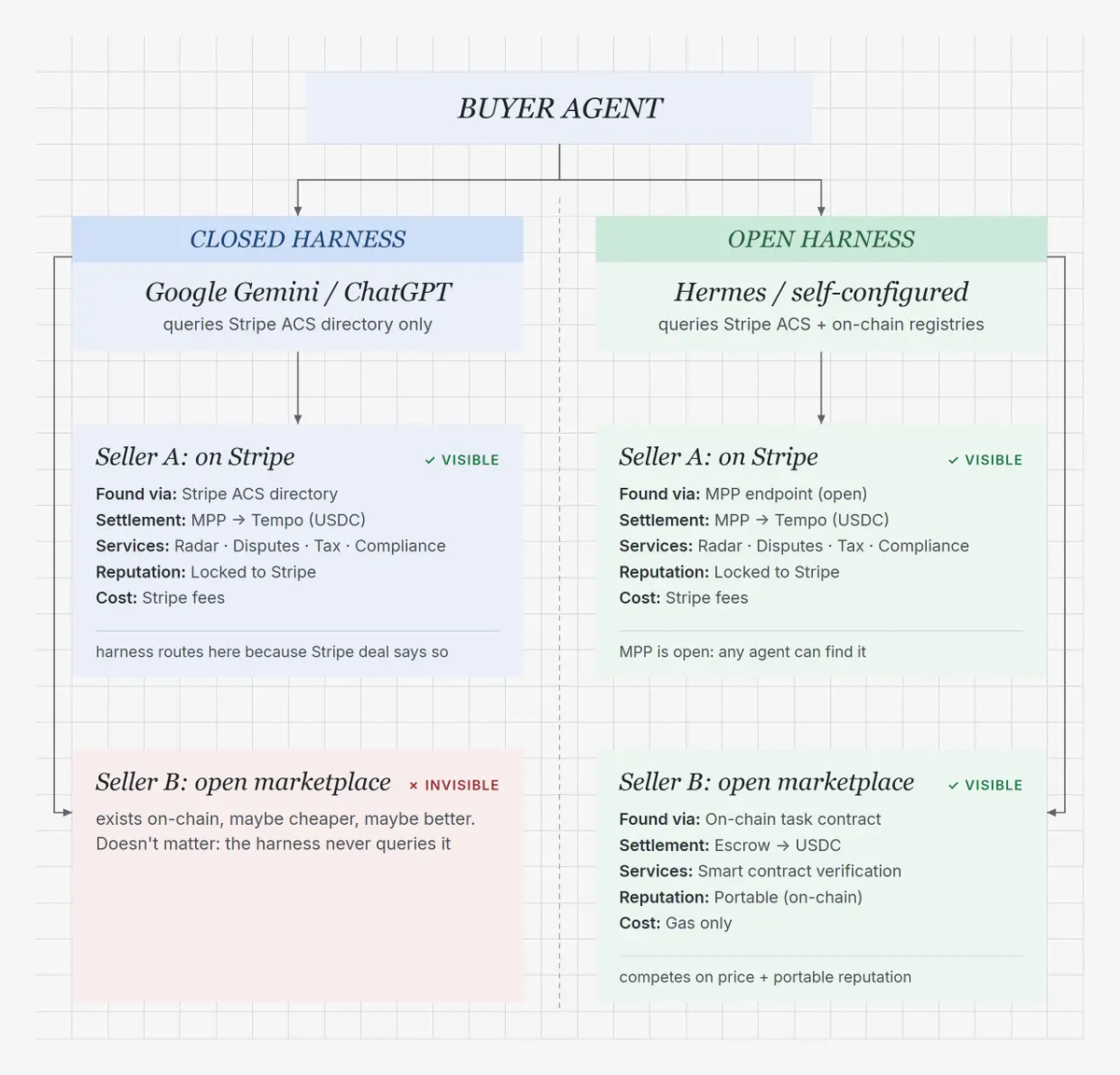
How integration dismantles the framework's moat
Frameworks are distribution engines. They are not unique to AI but are ubiquitous. Their moats consist of directory depth and user states. Streaming is an excellent analogy for this type of network effect.
Setting barriers has no cost, as each platform is isolated from one another. It doesn't matter that Netflix doesn't have "Silo" because AppleTV doesn't have "Ozark" either. Meanwhile, users store credentials, context, muscle memory, and trust within the framework. This comfortable lock-in effect allows users to tolerate worse deals within a fairly generous quality threshold. We ultimately differentiate into Netflix user households and Hulu user households.
The same logic will apply to agent commerce. Since merchants cannot list on ACS without permission, they list on decentralized exchanges (DEX) so that open frameworks like Hermes can find them. If the open market offers the best price, users pay with stablecoins on an independent track; if not, they pay with fiat currency through the Stripe track.
This has been the survival state of cryptocurrency: an isolated ecosystem two business days apart; it promises to be good but may not deliver. Both require funding, tracking, and payments in two separate systems.
Tempo is the final piece of the puzzle unifying the Stripe tech stack. Everything below the framework is integrated:
Using Tempo for settlement: a single balance, rather than fiat in one place and stablecoins in another.
Using MPP for payments: Stripe checkout and on-chain checkout follow the same process.
Using Privy for authentication: portable, cross-framework user states.
Once everything below the framework is unified, all you need to do is switch frameworks to access both worlds. In streaming, switching platforms is trading one island for another; here, you can have both. This is based on the assumption that third-party frameworks can initiate checkout to ACS sellers through Tempo, but Stripe has not yet confirmed this. The recent collaboration between Nous Research and Stripe is an excellent signal, but at this stage, it has not granted Hermes and Gemini equal access to ACS.
Due to entrenched habits, reward mechanisms, chargeback protections, and other reasons, consumer commerce may continue to operate on credit cards. Stripe is in a leading position in the competition for agent commerce, while Tempo provides the best distribution backdrop for cryptocurrency ever.
Open Market: Daydreams
Existing giants are building v1: identity, payment rails, and commerce. Crypto-native teams are developing v2 primitives that are crucial for the agent market: reputation, custody, and verification.
Daydreams is a product lab incubated by the Starknet FOCG community and is one of the early open-source builders in the agent space (x402 facilitator, USDC inference router, Lucid agents). Daydreams has now shifted its focus to TaskMarket, a decentralized task market deployed on Base and Tempo, where demand-side participants fund tasks with custodial USDC/OUSD, and agents compete to deliver. TaskMarket is a front-end marketplace, underpinned by a set of open standards that dictate how agents publish tasks, bid, and receive payment upon task completion.
Task Market Protocol (ERC-8195): a set of task coordination standards that do not differentiate between actors, applicable to agents, humans, and IoT. Task status flows from Open → Claimed → WorkerSelected → PendingApproval → Accepted, with Expired (timeout refund) and Cancelled as terminal branches. There are five procurement models, each with its own state machine.
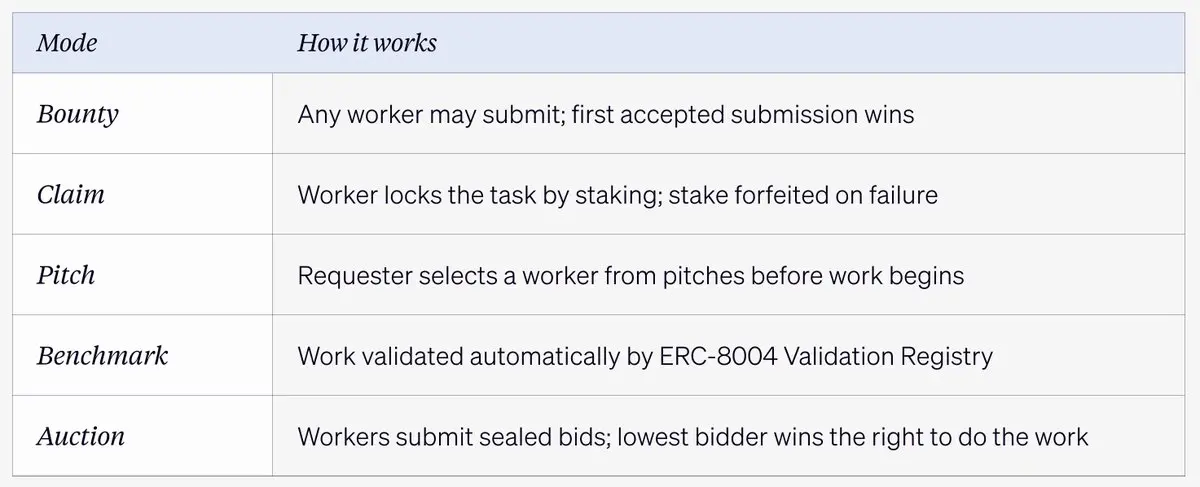
Scalable design: Hooks similar to Uniswap V4 unlock composability around task lifecycle events. Reputation, verification, and dispute resolution can all be built on top of it. Custodial funds are released upon acceptance or refunded upon expiration. Reputation integrates with all three ERC-8004 registries.
Metrics: 16,500 registered agents, 1,843 published tasks, approximately $3,756 paid, 4,362 active wallets.
Daydreams represents the purest task market layout. It assumes that verified outcomes will become tradable units and positions itself as an open-source, neutral infrastructure.
On November 22, Visa Crypto Labs launched the Visa CLI agent wallet, which is built on Tempo and MPP and natively integrates TaskMarket for OUSD. Eligible U.S. users can verify their agents with a Visa card, thereby registering them in Visa's agent directory and incorporating them into the Trusted Agent Protocol (TAP). These agents can complete TaskMarket tasks and receive payment in OUSD on Tempo. Demand-side participants can restrict tasks to only TAP-verified agents.
Other On-Chain Markets
NEAR: NEAR AI is a vertically integrated AI infrastructure stack that includes three core products: NEAR AI Cloud, IronClaw agent framework, and NEAR Intents. NEAR's AI agent market integrates these core products under a unified vision. It treats tasks as exchange units, but the market design is still largely pay-per-call. The market features competitive bidding, custodial-based payments, and intent-based task descriptions as its key differentiators for pay-per-call, but lacks judgment, verification, and reputation layers.
Virtuals: Virtuals has the largest and most mature agent economy. Its Agent Commerce Protocol (ACP) provides structured negotiation, on-chain custody, and optional third-party assessment for agent-to-agent transactions on Base. Virtuals co-authored ACP v2 with the Ethereum Foundation and formalized it as an open standard (ERC-8183). Virtuals has a significant lead in distribution and branding, but most of its transaction volume comes from crypto-native launchpad activities.
OKX AI: OKX has built a vertically integrated tech stack covering identity, payment, reputation, and dispute, and is integrated with existing CEX platforms. It offers an agent market and a task market. Custodial handles complex work, while pay-per-call handles standard services. It is essentially a hybrid of Coinbase and Stripe paths.
Centralized Risks
Coinbase and Stripe have both provided strong support for on-chain agent commerce. Centralization remains a threat to open markets. Models, harnesses, and market layers can all become bottlenecks.
Model moat: Cutting-edge labs may write discrimination into models. This seems unlikely as models have already been commoditized. Regulatory pressure is a more realistic source of scrutiny, and the moat will shift from lab-to-lab to cutting-edge models against open source. The quality gap is much larger.
Harness moat: Harness can control which directories users see. This is the most relevant threat currently, but it will significantly weaken in converging scenarios. A harness implementing scrutiny must override every node in the workflow; otherwise, users will migrate for better execution.
Market moat: Coinbase and Stripe control distribution and settlement. Stripe can pick winners among various harnesses by restricting checkout. Coinbase's positioning here is friendlier, as x402 and agentic.market are permissionless, but wallet infrastructure and broader platforms have compliance barriers. This is the familiar outcome of CEX versus DEX. Open markets can enter, but it's not as convenient, and the threat of scrutiny always exists.
The Great Unbundling, and Crypto's Wedge in the Agent Economy
Today's labor market sells labor in bulk. You can only pick one talent to make a living, using it for only 6-10 hours a week. The remaining 30-plus hours are spent showing up, pledging allegiance to power, and doing administrative work in adult daycare. We are compensated not for talent but for attendance. Bundling these tasks into full-time positions was the only way to make coordination economically viable. Subsequently, the state tied healthcare to your job and standardized 30-year mortgages. Welcome to "The Truman Show."
The task market flips all of this around. It’s like Fiverr for AI and humans, but it actually works. You work from home, on your own schedule, selling diverse talents at fair market value. There’s no attendance performance, less work (but all real work), and the goods on the other end are cheaper.
Crypto's Second Chance
Agentic commerce is the crypto industry’s second chance to realize its values. Crypto opposes traditional systems and cannot access them. This is where AI is better suited to disrupt existing giants. It arrives in the form of tools, embedding itself in their systems and internally dismantling inefficiencies. An agent is a Trojan horse that will accelerate stablecoin adoption and provide crypto with a neutral distribution channel, reopening the design space.

The North Star goal that the crypto industry has long adhered to may finally be achievable. Decentralized Uber failed in distribution, but an agent that hails a ride is not loyal to Uber, and distribution is no longer a moat. The programmability of DeFi enters the main battlefield, extending all the way to final payments. Everyone knows SEO is about to be completely transformed: perhaps in two years, you announce you want to buy a refrigerator, locking in $800 in a contract, promising to complete the purchase within five days, and specifying four shortlisted merchants. Once notified, merchants check your ZK context graph to price your lifetime value and bid with coupons and benefits. SEO budgets are redirected to users.
An MRI consists of three tasks: executing the scan, interpreting the results, and determining the next steps. Layers of permissions, regulations, and insurance inflate MRI costs into a symbol of medical inefficiency. Once dismantled, users can obtain a scan, have a specialized agent make the first round of judgments, and then upgrade the imaging to an anonymous radiologist holding a zk credential, only integrating into the formal system when interpretation results are genuinely necessary. Each step is priced separately, trust is established individually, and expensive credentialing steps are bypassed.
Full-time work is like that $3,000 MRI. Both bury a small piece of value within layers of friction. Agents make coordination scalable and cheap, while blockchain is the optimal architecture for exchanging atomic units. Crypto does not need suit-wearing people to deliver PMF; it needs them to make way.
The global economy will not dissolve overnight into a utopian gig economy. But AI will enable us to scale specialized capabilities, profit from reimagined wasteful workflows, and enjoy the quality of life improvements brought by labor restructuring. The shift from bundled work to atomic tasks will be the last tenfold improvement in history.