
SemiAnalysis revises AI computing power capital expenditure forecast: down 41% for 2029, only $923 billion remaining in 2030
As the global AI computing power sector faces a severe downturn, the semiconductor research institution SemiAnalysis has stepped in again.
In its latest model update, it has significantly revised down the global AI accelerator capital expenditures, shipments, HBM demand, and power demand.
Among these, the adjustments for the years 2028 to 2030 are the most notable: the capital expenditure forecast for 2028 has been cut by 28%, while the forecasts for 2029 and 2030 have been reduced by 41% and 40%, respectively.
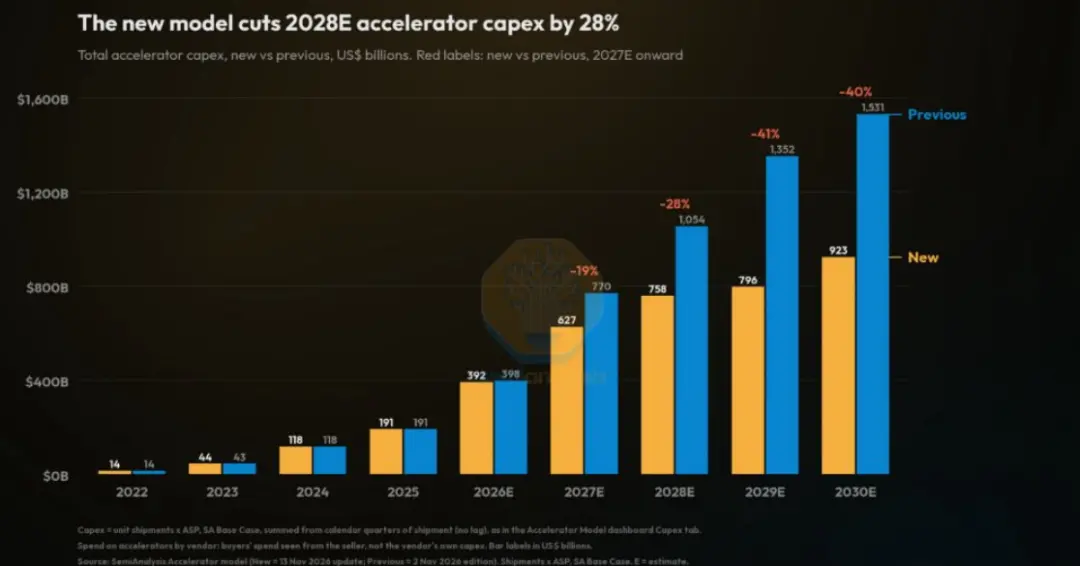
According to the new model calculations, global AI accelerator capital expenditures in 2030 are expected to drop from the previous forecast of $1.531 trillion to $923 billion, a decrease of $608 billion.
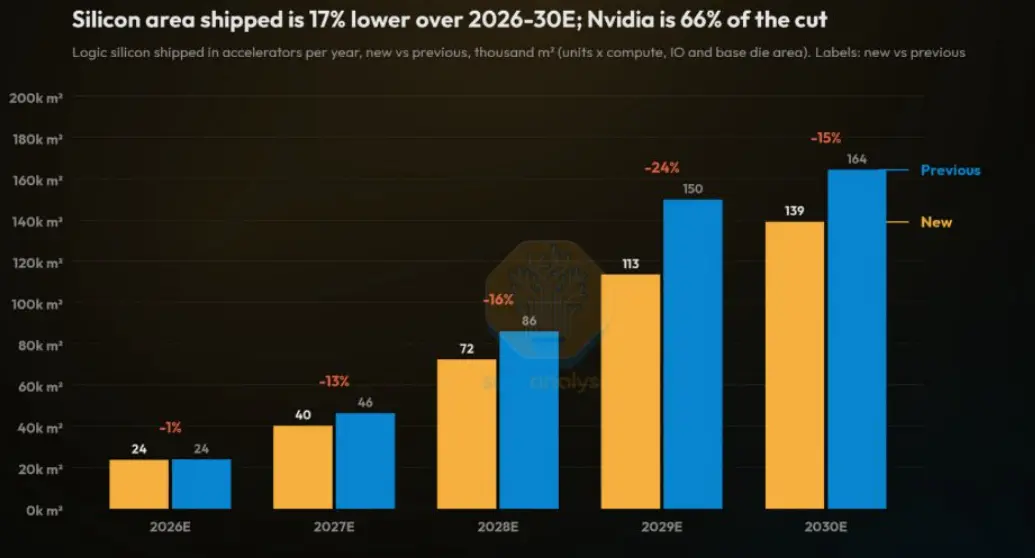
At the same time, the cumulative forecast for the shipment area of accelerator logic chips from 2026 to 2030 has been revised down by 17%, with NVIDIA accounting for 66% of this reduction.
The impact of these figures is first reflected in the disruption of the market's previous narrative of "unlimited expansion" for AI infrastructure.
Over the past two years, the capital market has generally assumed that cloud vendors and AI labs would continue to invest heavily in computing power, thereby driving the revaluation of GPUs, HBM, optical modules, data center power, and liquid cooling.
However, SemiAnalysis's revision indicates that capital expenditure expectations are basically stable for 2026, with a significant turning point occurring after 2027, especially for the originally projected annual investment scale of over $1 trillion in 2029 and 2030, which has now been revised down to the range of $800 billion to $900 billion.
There are three main reasons behind the downward revision:
First, the growth of AI revenue is slowing. The annual recurring revenue growth rate for leading AI labs in the third quarter has declined, prompting institutions to reassess whether token revenue can continue to cover high computing power costs.
Second, the financing environment is tightening. Debt and equity investors are becoming more cautious about projects lacking long-term procurement commitments from cloud service providers, which will affect the development of data center land, power, and construction.
Third, U.S. regulatory and grid connection constraints are intensifying, with an estimated 5.8 GW of data centers expected to be delayed among those scheduled to go into production in the second half of 2027 to the first half of 2028.
The impact on the industry chain is not evenly distributed.
NVIDIA is facing the greatest shock, not only with a significant downward revision of shipment forecasts but also with a notable reduction in the average selling price assumptions for the new generation Feynman series products.
For example, the average selling price of Feynman has been reduced from about $110,000 to about $78,000, and Feynman Ultra has been cut from about $175,000 to about $98,000.
This indicates that competition in AI chips is shifting from "who has the capacity" to "who offers better cost performance," with alternative platforms like TPU, Trainium, and AMD GPUs weakening NVIDIA's pricing power.
The simultaneous downward revision of HBM and power demand is also noteworthy.
The global HBM shipment forecast for 2028 has been cut by 30%, and the power consumption demand for AI accelerators in 2030 has been reduced by 34%.
This does not mean that the storage and power segments are losing value; rather, it indicates that the industry chain is shifting from competing for capacity and power to allocating capacity based on returns.
HBM still holds a significant share in the bill of materials for AI accelerators, and HBM4, advanced packaging, and customized storage still present structural opportunities; the bottleneck on the power side will not completely disappear, but the order rhythm will rely more on the specific project grid connection progress.
For the market, this round of downward revision feels more like an early calibration of defoaming.
Previously, the market easily interpreted AI computing power investments as a one-sided upward curve, but in reality, it is influenced by revenue validation, financing constraints, grid connection, chip efficiency, and competitive landscape.
Moving forward, it will be crucial to observe the capital expenditure guidance from cloud vendors, the visibility of accelerator orders, changes in HBM contract prices, data center grid connection queue times, and the proportion of inference loads in total computing power.
If inference demand continues to grow, unit computing power costs decrease, and effective utilization rates improve, the industry chain will still receive structural support; however, if long-term project returns are difficult to validate, capital expenditure forecasts may continue to be revised.
Currently, the global AI computing power sector is undergoing a painful phase of valuation revision and bubble bursting.
Even so, it remains uncertain whether this phase is complete; although valuations appear to have dropped significantly, the issue lies in whether the predictive parameters in the valuation model have been revised down in sync. If not, then the valuations may not seem undervalued.
The best approach is still to patiently wait for the market to clear itself.
What can be anticipated is that market inertia often leads to overcorrections; although there are many negative factors and the AI computing power sector has significantly retreated, if the market overcorrects and truly pushes valuations to extreme lows, combined with various leveraged funds and sell-offs being cleared, while short positions are at historically high levels, it may actually lead to a profitable rebound.
As for when this opportunity will arise, that can only be answered by the market.