
Anthropic launches IPO roadshow, with the earliest listing next week
Author: Li Hailun, Tencent Technology
Editor: Xu Qingyang, Tencent Technology
As the IPO approaches, Anthropic's recent actions have become increasingly frequent.
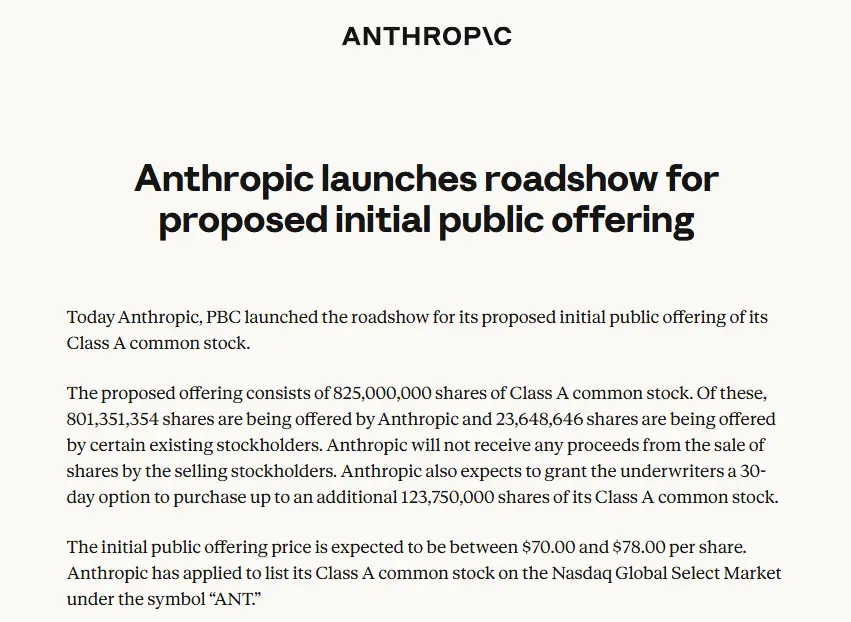
On November 9, U.S. local time, Anthropic released two new models, Claude Fable 5.2 and Claude Mythos 5.2, in one go. Just a day later, on November 10, the company announced the official launch of its initial public offering (IPO) roadshow, planning to issue 825 million shares at a price of $70 to $78 per share, intending to list on NASDAQ under the stock ticker ANT.
Based on the post-issue capital calculation, Anthropic's maximum valuation is approximately $1.02 trillion. Several foreign media outlets reported that if options, restricted stock, and other potential shares are included, the fully diluted valuation could reach $1.4 trillion.
Another more eye-catching aspect of this IPO is that seven tech companies, including Google, NVIDIA, AMD, and Microsoft, will invest $26 billion through private placements. Among them, Google and NVIDIA each committed to investing $10 billion.
If the public offering and strategic placements are completed as planned, Anthropic's fundraising scale is expected to exceed $90 billion.
However, the capital market is not solely optimistic.
On one hand, the Claude business is growing rapidly, with Anthropic's revenue reaching $33.2 billion in the first three quarters; on the other hand, the company has signed long-term procurement and leasing commitments totaling approximately $900.9 billion, most of which are related to computing power infrastructure.
This AI star company is using an IPO to answer a question: how high can the valuation of a rapidly growing AI business support?
01 IPO Valuation Finally Confirmed
The most noteworthy aspect of Anthropic's IPO is that the issue price and valuation finally have a clear answer.
According to the latest issuance documents, the company plans to issue 825 million Class A common shares, with a pricing range of $70 to $78 per share. Of these, approximately 801.35 million shares will be issued by the company, and another 23.65 million shares will come from existing shareholders.
Based on the highest issue price of $78, the public offering fundraising scale is approximately $64.4 billion. The underwriters also have an over-allotment option to purchase an additional 123.75 million shares.
In terms of valuation, two different metrics need to be distinguished.
Based on approximately 13.087 billion shares outstanding after the IPO and private placements, Anthropic's corresponding valuation is approximately $916 billion to $1.02 trillion. If options, restricted stock, and other potential shares are further included, the maximum valuation could reach approximately $1.4 trillion.
Therefore, the $1 trillion and $1.4 trillion figures appearing in the market are not two different issuance plans, but rather different calculations of equity.
Even under the fully diluted metric, $1.4 trillion is still lower than the previously discussed market valuation expectations of $1.5 trillion to $2 trillion.
In May of this year, Anthropic completed a round of financing of $65 billion, achieving a post-money valuation of $96.5 billion. Within just a few months, the company began to push into the public market, and its valuation transitioned from the previous private market pricing to a more stringent public market test.
Yahoo Finance estimates that according to SEC rules, if the fastest process is adopted, Anthropic could start trading as early as the week of November 16. For reference, SpaceX took 23 days from publicly submitting IPO documents to officially listing this year. If Anthropic follows a similar pace, its stock could start trading on November 18. However, the specific listing date is still subject to official confirmation.
For Anthropic, going public is not only a large-scale fundraising effort but also a test in the public market as the AI capital frenzy gradually enters a phase of rational pricing.
02 Seven Tech Giants Join Forces to Bet
Another important highlight of Anthropic's IPO is the collective entry of tech giants.
According to the issuance documents, Anthropic plans to issue Class N common shares to seven technology and semiconductor companies through private placements after the IPO, raising a total of $26 billion.
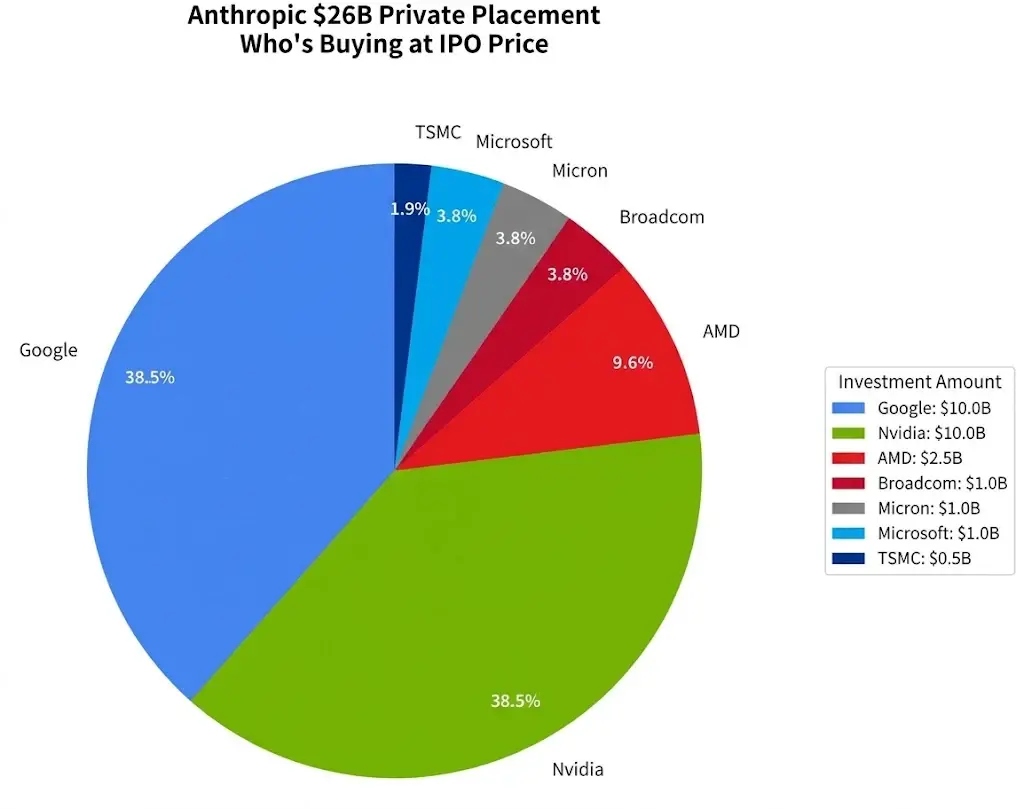
Among them, Google and NVIDIA each committed to investing $10 billion, AMD invested $2.5 billion. Broadcom, Micron, and Microsoft each invested $1 billion, while TSMC invested $500 million.
The seven companies span cloud computing, AI chips, semiconductor manufacturing, and storage industry chains, almost covering the core infrastructure needed for Anthropic's development.
If both the public offering and private placements are successfully completed, the total financing amount for Anthropic will reach approximately $90.4 billion. Including the over-allotment, the scale may further expand.
The significance of this money is not just to increase cash reserves.
Google and Amazon are not only important investors in Anthropic but also its cloud computing and computing power suppliers. NVIDIA and AMD are core participants in the AI chip industry chain. Microsoft also has commercial cooperation with Anthropic in the cloud computing and AI market.
These companies are both partners of Anthropic and competitors in the AI market.
The intertwining of investment and procurement relationships means that Anthropic's growth is deeply bound to the entire AI infrastructure industry chain.
However, this arrangement also requires investors to further assess: is the strategic investment a recognition of Anthropic's business prospects, or is it a layout by large tech companies to secure AI computing power needs?
03 Computing Power Bills Approaching One Trillion
The core supporting Anthropic's trillion-dollar valuation is still the rapid expansion of the Claude business.
The latest issuance documents show that as of the first three quarters ending September 30, 2026, Anthropic achieved revenue of $33.24 billion, a year-on-year increase of approximately 12 times. Among them, the third-quarter revenue reached $16.96 billion, a quarter-on-quarter increase of 47%. As of the end of September, the company's revenue over the past 12 months was approximately $35 billion.
The number of enterprise customers is also rapidly increasing. As of the end of September, there were over 11,900 customers who contributed at least $100,000 in revenue over the past 12 months, with more than 1,900 customers contributing over $1 million in revenue, and about 250 customers contributing over $10 million in revenue.
This indicates that Claude is no longer just a chat tool for individual users but is gradually establishing scaled revenue in enterprise software, development tools, and business workflows.
However, on the other side of revenue growth is the rapid expansion of computing costs.
In the third quarter, Anthropic's computing and infrastructure costs reached approximately $9.9 billion. As the demand for model training and inference continues to grow, the company needs to continuously procure more computing resources. During the same period, the gross margin of the computing business dropped from 52% in the second quarter to 42%, and the adjusted operating profit margin also fell from 19% to 15%.
Revenue is growing, but profit margins are being squeezed by computing costs.
The greater pressure comes from long-term contracts.
According to the updated prospectus on November 10, as of September 30, 2026, and thereafter, the total amount of procurement commitments and leasing agreements signed by Anthropic is approximately $900.9 billion, most of which are related to computing power and infrastructure.
Of this, approximately $451.6 billion is expected to occur before the end of 2030, with the remainder mostly distributed between 2031 and 2045. According to the prospectus's statistical criteria, approximately $70.7 billion will mature within 12 months after September 30, 2026.
It should be explained that the $900.9 billion is not the debt that Anthropic has currently formed, nor is it an amount that needs to be paid immediately, but rather the total amount of long-term procurement and leasing arrangements that have been signed. Some of these commitments still come with termination rights or performance conditions.
Anthropic has approximately $95.6 billion in cash and cash equivalents, as well as $36.3 billion in short-term investments, providing a considerable scale of funding reserves. However, in the face of long-term infrastructure investments, the company still needs to rely on continuously growing revenue and financing capabilities to maintain expansion.
04 Three Questions Behind the Trillion Valuation
Anthropic's IPO will actually become an important opportunity for the public market to test the AI business model.
First, can growth be sustained? The revenue in the first three quarters increased year-on-year by approximately 12 times, which is enough to prove that Claude is rapidly opening up the market. However, the quarter-on-quarter growth rate of revenue in the third quarter was 47%, lower than the 144% in the second quarter. As the revenue base continues to expand, maintaining an extremely high growth rate in the future will also become more challenging.
Second, can computing power investment be converted into profit? The approximately $900.9 billion in long-term procurement and leasing commitments means that Anthropic must continuously expand commercial revenue to support the massive infrastructure system. The decline in the gross margin of the computing business in the third quarter also indicates that revenue growth will not automatically translate into higher profits.
Finally, what about corporate governance and shareholder rights? Anthropic has adopted a multi-class share structure. The issuance documents show that the F-class special shares held by founder-related entities will have 50.1% of the total voting rights after the transaction is completed. The long-term interest trust will also have significant influence over the composition of the board of directors and the appointment and removal of directors.
This means that while public market investors can share in the economic benefits brought by the company's growth, they may not have control rights that match their shareholding ratios.
For a company with AI safety as its core philosophy, the governance structure after going public will also become a continuous concern for investors.
Looking back at Anthropic's IPO, the most noteworthy aspect is not whether it can become another trillion-dollar company, but whether it can prove that the commercialization of AI has entered a stage where it can sustainably create profits.
Previously, the market was willing to pay a high premium for model capabilities, user growth, and future imagination. Now, as Anthropic lays out hundreds of billions in revenue, nearly a trillion in long-term computing commitments, and public market valuations on the table, investors finally have the opportunity to conduct a more complete pricing of this business model.
The capital frenzy in the AI industry is entering the next phase.