
SemiAnalysis Dissects the Computing Power Crisis: OpenAI and Anthropic Are Snatching Up Global New Computing Power
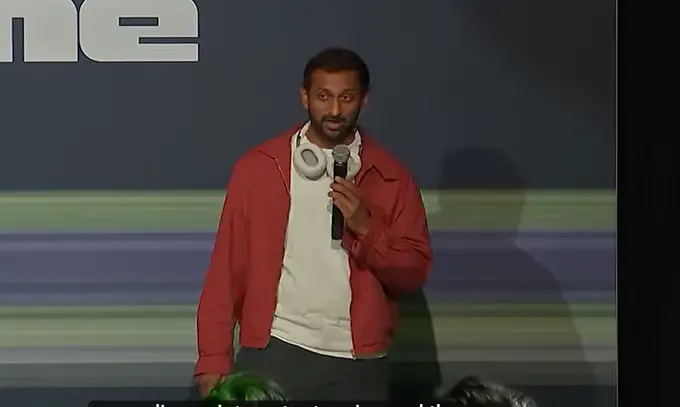
On November 3, Dylan Patel, founder and CEO of the semiconductor research firm SemiAnalysis, delivered a speech at Runtime 2026, focusing on computing power, capital, and who can truly deliver computing power.
He stated that OpenAI and Anthropic are booking a significant amount of computing power, with the two companies accounting for 25% to 40% of the new computing power available in 2027. Under pressure from demand, the one-year contract price for Nvidia H100 data center chips has risen from a low of $1.70 per hour last October to around $2.80. For other companies, being able to afford computing power does not mean they can actually obtain it.
The funding side is also tight: in the past two months, U.S. Treasury yields have risen sharply, with the 10-year yield exceeding 5% at the beginning of October, making it increasingly difficult for emerging cloud providers that rely on borrowing to build data centers to secure funding.
This speech occurred a week after Anthropic publicly submitted its S-1, and the market had just seen the computing power accounts behind a leading lab. Patel mentioned that Nvidia has stepped in to support about 6.5 gigawatts of computing power, but this only represents a small portion of the new computing power before 2030, which he described as "a drop in the bucket."
01 A Large Portion of New Computing Power is Booked by Two Labs
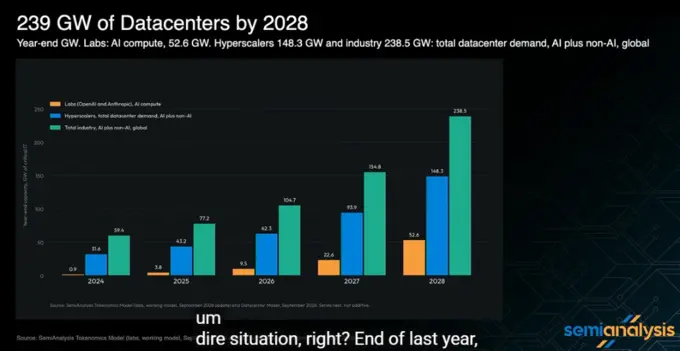
The tightness in computing power originates from the concentration of buyers. The total global computing power has been increasing rapidly: approximately 60 gigawatts by the end of 2024, exceeding 100 gigawatts by the end of this year, nearly doubling in two years. Patel stated:
"By the end of 2024, there will be 60 gigawatts of computing power globally, and by the end of this year, it will exceed 100 gigawatts, almost doubling in two years."
The largest buyers of this incremental power are OpenAI and Anthropic. The total computing power held by the two companies was about 4 gigawatts at the end of last year, around 10 gigawatts this year, and expected to exceed 20 gigawatts next year. Breaking it down into increments, the two companies are expected to add about 12 gigawatts in 2027, while the total global increment that year is about 40 gigawatts, accounting for about 30%. By 2028, Patel claims that AI labs will need to add about 30 gigawatts in a single year.
Patel estimated:
"They are taking 25%, 30%, or 40% of the new computing power."
"At the end of last year, OpenAI and Anthropic's revenues soared with the launch of Claude Code, prompting them to buy computing power aggressively, and Meta also started buying aggressively."
"For many people now, it is already impossible to buy computing power."
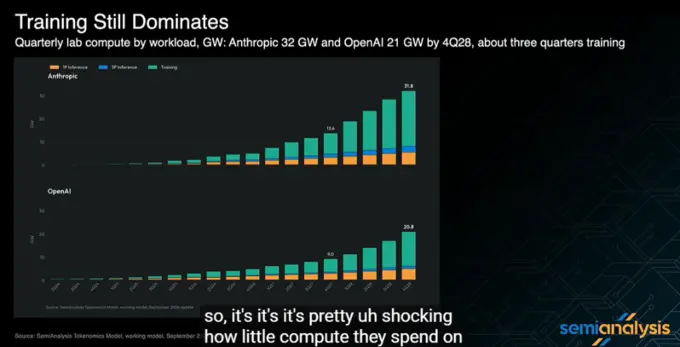
Another detail worth noting is that this computing power is mainly used for training, not for serving users (inference). Patel mentioned that Anthropic currently has 4 gigawatts, but only about 1 gigawatt of that is used for serving the entire Claude Code, with the computing power spent on inference being "surprisingly low" compared to training. This means that even if user demand stabilizes, the budget for labs to train new models will continue to consume chips.
02 Selling Inference for Open Source Models is Highly Profitable, Driving Up Rental Prices
With more buyers, prices will rise. Patel believes another driving force behind the rising rental prices is the high profit margins of the business of selling tokens (the unit of measurement for model outputs), which means that there are many more willing to rent GPUs at high prices than just the two labs.
He provided calculations based on megawatts. Building a B300 cluster, spreading the construction and five years of operation costs, amounts to about $9 million per year; renting from cloud providers, "if you can get $14 million a year, consider yourself lucky." On the other hand, using this megawatt of computing power to run the open-source model DeepSeek V4.1 Flash, with a utilization rate of 60%, the annual revenue is about $70 million. This means that even if the rental price is 50% higher than the self-built cost, the revenue from selling inference is still five times the rental cost. (The $70 million is revenue, not accounting for labor and other costs.) He said:
"Even if you say the utilization rate is only 30%, you will still make ridiculous money."
"I know dozens of people whose business is renting some GPUs and then selling inference, and they have made a lot of money."
This calculation is based on the InferenceX benchmark open-sourced by SemiAnalysis, using containers that anyone can download, and only utilizing two open-source inference software, vLLM and SGLang, with a team of "only four engineers," without engaging in speculative decoding or further optimization.
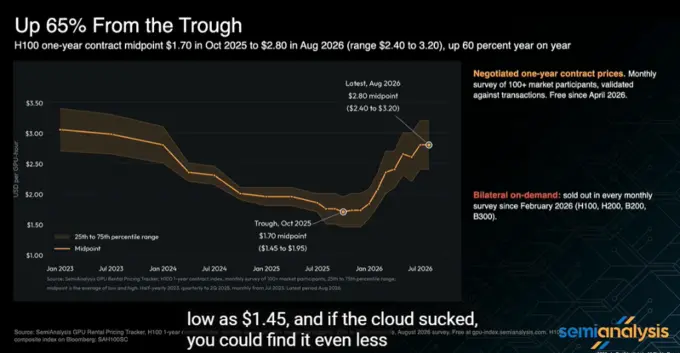
The price data aligns with this logic. Patel stated that last October was the low point, with H100 at about $1.70, and the lowest price found was $1.45; now the transaction price is between $2.40 and $3.20, with a median of $2.80:
"If you had signed at this price two years ago, you would have been considered crazy; now people are rushing to sign contracts in this range."
SemiAnalysis's own one-year contract index was already at $2.35 in March this year, and the listed prices from vendors like Nebius continued to rise in October. Readers should note that Patel mentioned SemiAnalysis also engages in computing power matchmaking, so they have access to real transaction prices, which also reflects a conflict of interest.
His judgment for the next steps is:
"If H100 rises above $3 and B300 rises above $7, I wouldn't be surprised."
For buyers, his advice is more direct:
"If you can find a B300 for $6 an hour, you should sign it and then sell tokens. This price is outrageous, but it's the right decision."
The obstacle is that cloud providers require prepayment, which is even harder for startups: one-year contracts are difficult to obtain, and startups often cannot guarantee they will still be around a year later. As for closed-source models, he mentioned that Anthropic's revenue from serving Fable and Opus 5.5 "exceeded $100 million," based on materials disclosed to investors during its IPO process, though the transcript did not specify the unit, which should be annual revenue per megawatt based on context.
03 Even if You Can Afford It, Cloud Providers May Not Deliver
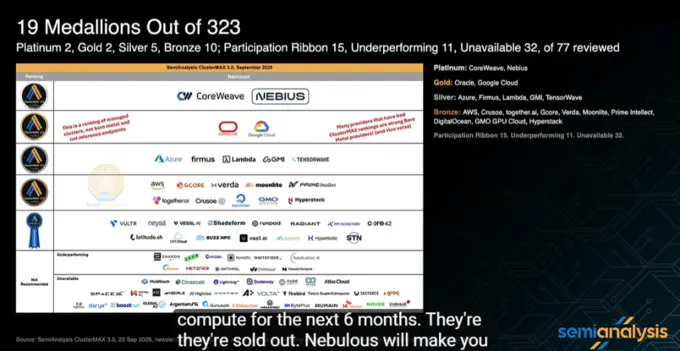
Renting computing power is just the first step; the usability of the cluster ultimately determines its actual value. SemiAnalysis conducted an evaluation called ClusterMAX, tracking 323 cloud providers and assessing 77 of them, awarding medals (recognition) to 19.
In Patel's view, the best are CoreWeave and Nebius, but both have very poor availability:
"They will not sell you computing power for the next six months; they are sold out. Nebius will require you to prepay for a whole year or six months, and the prices are outrageously high, but that is the only way to get computing power from them."
Oracle and Google were also rated highly, with Google upgrading from a bronze medal in the first round. More providers were downgraded: as evaluation standards tightened, Azure dropped to silver, Together and AWS dropped to bronze, and Crusoe was also downgraded. AWS's issues are more experiential:
"To get a cluster, you have to deal with about ten people, and it takes a long time; the network is also a bit difficult to manage."
The most glaring issue in the evaluation was security. SemiAnalysis allowed AI models to attack these clouds:
"Some vulnerabilities are already publicly known on the internet, and the models can directly find and exploit them, then access other customers' storage."
On one occasion, they used an open-source model that was "behind OpenAI and Anthropic" to gain access to the entire cluster's Slurm (a commonly used cluster scheduling system) permissions, seeing job names from a national defense industry and national security intelligence agency. They immediately halted the testing and published a report titled "Most Neoclouds are Terrible at Security." Another test involved injecting faults into GPUs (the Nvidia error code XID 719 he mentioned) to observe how long it took cloud providers to detect them. The result was:
"Many clouds only realize it after you remind them, and some take days to respond even after you remind them."
He referred to this as a minimum standard test: GPUs will inevitably encounter issues, and cloud providers should rely on their own monitoring to detect and fix them.
04 Rising Interest Rates, New Players Can't Borrow Money, Nvidia's Support is Just a Small Piece
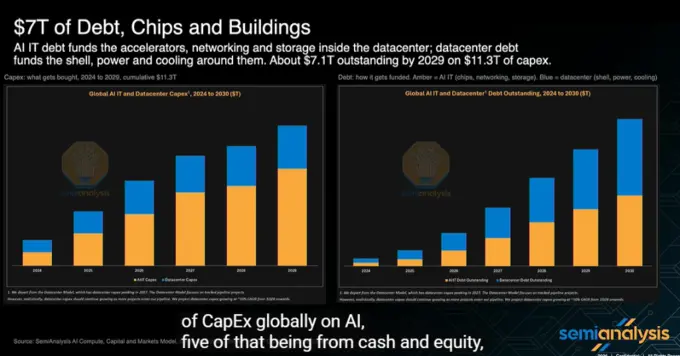
Increasing supply requires capital, and the cost of capital is rising. Patel reiterated that by the end of 2029, global AI capital expenditure will be about $11 trillion, with approximately $7 trillion coming from debt. Most of the money is spent on chips, with the rest on data centers, energy, and on-site power plants built for faster production.
In such an interest rate environment, the flow of loans shows a clear bias. The 10-year U.S. Treasury yield has risen from 3.96% this year to 5.31% at the beginning of October, and AI-related debt issuance clearly cooled in September. Patel described the situation of a Neocloud with a scale of 100 megawatts wanting to expand to 1 gigawatt:
"Who would lend them money? The only way is to sell that 1 gigawatt to a hyperscale cloud provider, which would then finance through the debt market; you get the loan, but none of that computing power can enter the market for the entire industry."
As a result, of the computing power already contracted for next year, "about 65% to 70%" is flowing to hyperscale cloud providers and AI labs. For startups, renting clusters requires paying half upfront, with delivery taking three to nine months:
"Go find any new lab that recently raised a lot of money; for them, obtaining computing power is hell."
Nvidia's approach is to provide a safety net for clusters, which Patel summarized into three categories:
SoftBank Energy: Only guarantees land, power, and buildings. This is a 9-gigawatt facility in Ohio, expected to be operational around 2030, fully reserved for OpenAI.
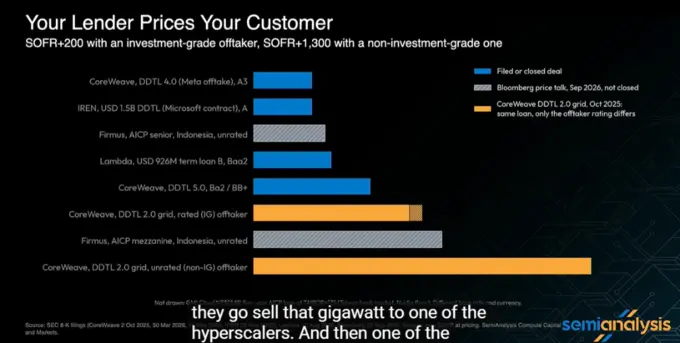
Firmus: Nvidia promises to rent the cluster at a certain price, ensuring the other party "doesn't make money but also doesn't lose money," but with this guarantee, others are willing to lend. For every dollar per hour above that price, Nvidia takes half, which Patel said is "very smart, I like it."
Residual value guarantee: He only mentioned this type without elaborating.
In terms of scale, NVIDIA has secured about 6.5 gigawatts, which will be sold to the open market rather than just supplied to laboratories and large-scale cloud vendors. The upper limit he provided is 45 gigawatts, "even so, it only accounts for a small portion of the new computing power added before 2030." He believes that companies like Fireworks and Modal, which focus on inference, as well as many new laboratories, are turning to build their own clusters, taking loans, and seeking endorsements from NVIDIA.
At the end of the speech, he provided his assessment of the scale of tokens: several providers combined process over 100 trillion tokens daily, with each company's annual revenue on the rise. His closing remark was:
"I hope they can secure computing power; otherwise, we are all slaves to Anthropic and OpenAI."
This article does not constitute personal investment advice, does not represent the platform's views, the market has risks, and investment requires caution. Please make independent judgments and decisions.