
Strategy earned nearly 20 billion USD this quarter, Bitcoin is being bought more and more, but the holdings per share are decreasing
Author: Huo Huo
The rise in Bitcoin has made Strategy's profit statement look good again.
On October 29, this Bitcoin reserve company released its third-quarter financial report. The company achieved a net profit of $19.53 billion, while it was continuously losing money in the first half of the year. There is also a less noticeable figure in the financial report: as of October 25, Strategy's year-to-date BTC Yield has fallen to negative values.
The amount of Bitcoin held has increased, but the per-share Bitcoin calculated by the company has decreased compared to the beginning of the year. Profits, holdings, and shareholders' stakes are telling three different stories.
Where Does the Profit Come From?
According to Strategy's third-quarter financial report, the company recognized digital asset gains of $20.91 billion for the quarter. This figure is almost equal to the operating profit and explains why the profit statement jumped from a loss in the first half to a profit.
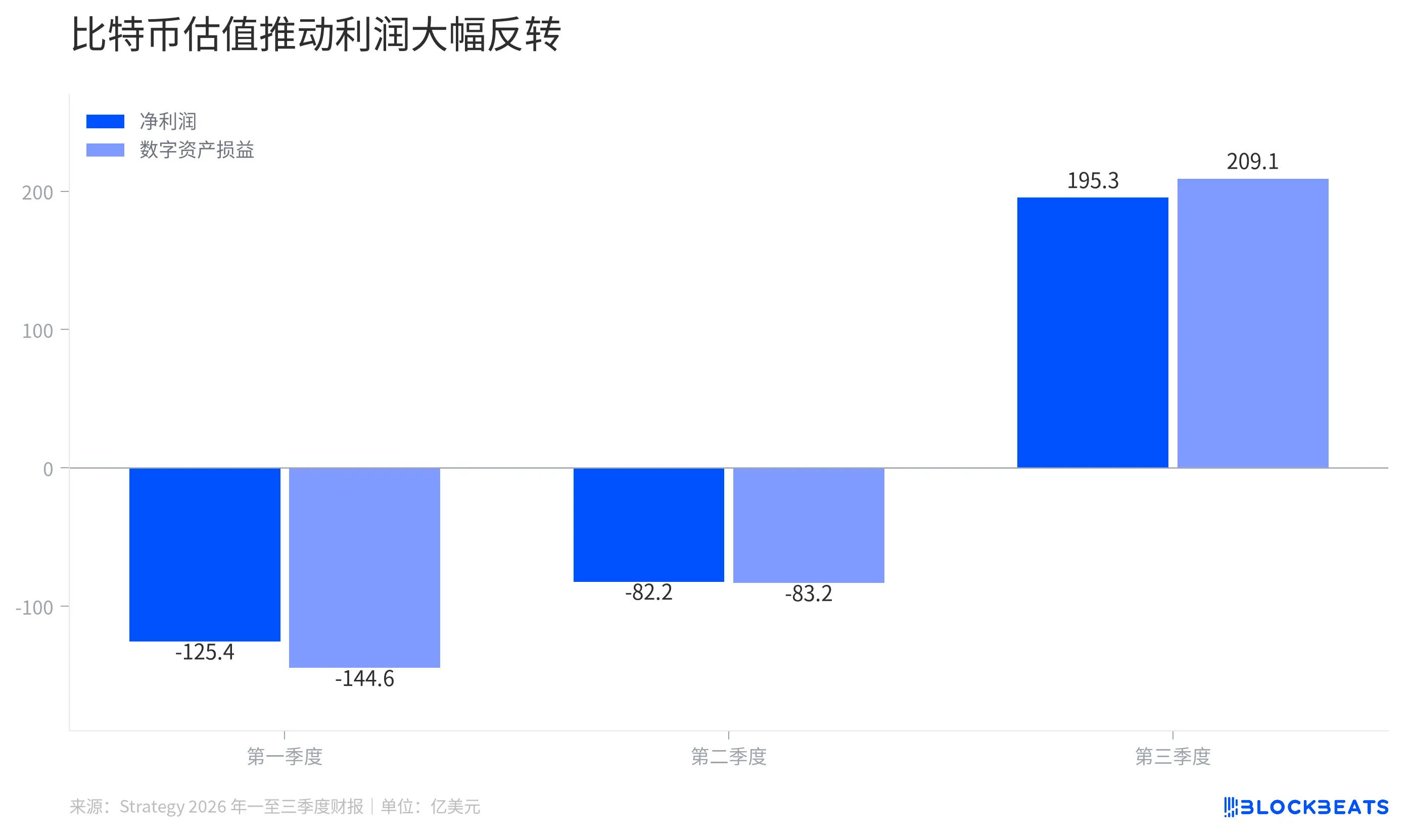
Strategy's Quarterly Profit and Digital Asset Gains and Losses for 2026
The two sets of bars in the chart cannot be added together. Digital asset gains and losses have already been included in the company's operating results, while net profit is the result after considering other income, expenses, and taxes. The two figures are very close, indicating that changes in Bitcoin valuation are sufficient to dominate a company's quarterly performance.
This volatility comes from accounting treatment. According to Strategy's second-quarter financial report, the company measures Bitcoin at fair value and includes value changes during the reporting period in the current profit and loss. An increase in coin price can lead to book gains, while a decrease will bring losses into the profit statement, even if the company has not sold all its holdings.
Meanwhile, revenue from software and other businesses in the third quarter was $125.4 million, a decrease of 3% year-on-year. When looking at revenue alongside digital asset gains, the former resembles the company's daily operating income, while the latter reflects changes in asset prices; the two cannot be understood in the same way of making money.
A large net profit does not equate to the same scale of cash inflow. The company needs to use cash to pay preferred stock dividends and debt interest, while the book gains generated by the rise in Bitcoin prices do not automatically turn into dollars in the account.
Why Has the Per-Share Metric Decreased Even Though More Coins Are Bought?
As of October 25, Strategy held approximately 848,500 Bitcoins, an increase of 26% compared to the beginning of the year. This is a change in total holdings, but shareholders also need to look at another denominator: the shares issued or potentially issued by the company.
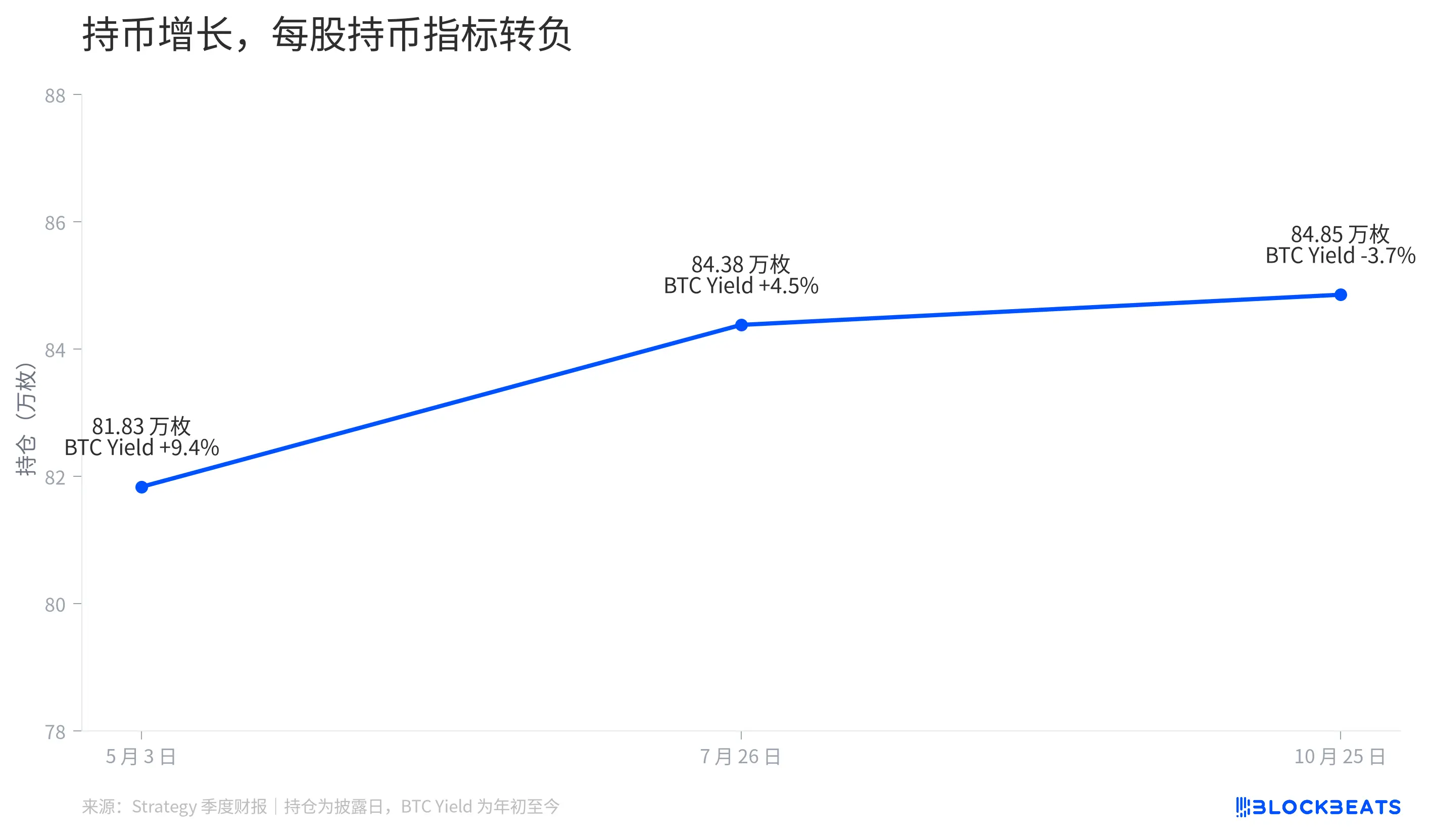
Number of Coins Held and Year-to-Date BTC Yield
Strategy uses BTC Yield to measure the change in Bitcoin holdings relative to the assumed diluted share count. You can think of it as a continuously growing cake: the cake has grown, but if the number of slices increases faster, each slice may still correspond to a smaller piece of cake.
The BTC Yield disclosed by the company has dropped from a positive value in the first quarter report to the latest −3.7%. This figure indicates that, according to the company's assumed diluted share count, the number of Bitcoins per share has decreased compared to the beginning of the year; it does not mean that Bitcoin itself has dropped this much, nor is it equivalent to the investment return of MSTR stock. Strategy's first and third-quarter reports disclosed data for these two points in time.
This metric also has boundaries. The company notes in the financial report that BTC Yield does not fully account for the priority claims of debt and some preferred shareholders. Financing to buy coins may increase the per-share holding metric while also increasing claims or dividend requirements that rank ahead of common stock. One metric cannot replace an investor's review of the balance sheet.
Beyond Book Profit, Where Does the Cash Come From?
Strategy's financing tools are not limited to common stock. The company has issued various preferred stocks that require continuous dividend payments. It is also repurchasing floating-rate preferred stock STRC to support its trading price close to the nominal amount of $100 per share.
According to the third-quarter financial report, as of October 25, the company has repurchased approximately $2.04 billion of STRC year-to-date. This figure includes shares that have been repurchased but not yet settled and cannot simply be equated to all cash paid on that day.
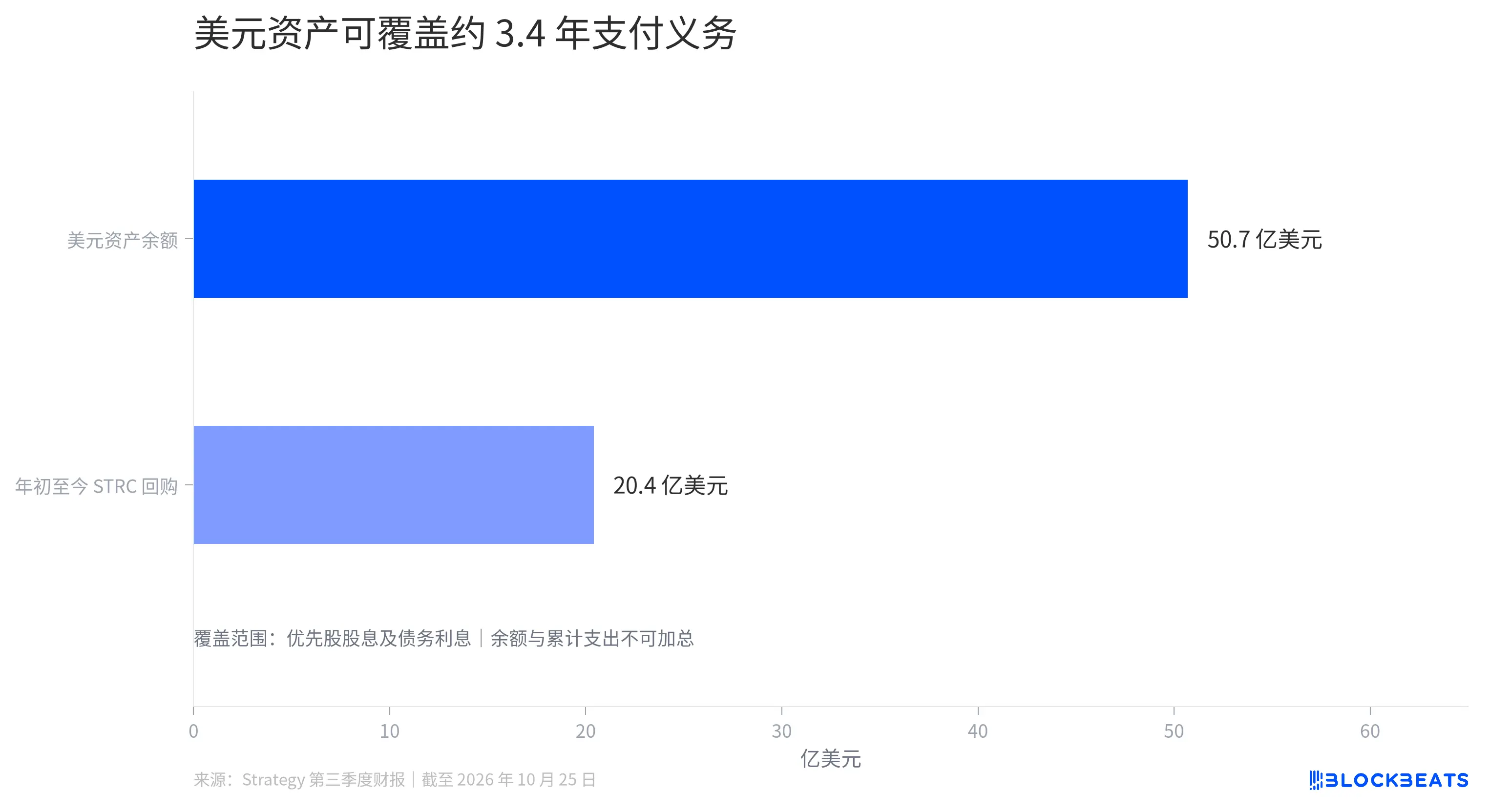
Dollar Asset Balance and STRC Repurchase Scale
At the same time, the company disclosed that its dollar assets were approximately $5.07 billion, which, according to the company's calculations, is equivalent to about 3.4 years of preferred stock dividends and debt interest. This coverage period is based on the calculations at the time of disclosure and does not represent a fixed future payment scale, nor does it cover all possible funding needs. The dollar assets in the chart are a balance, while the STRC repurchase is a cumulative amount year-to-date; the two cannot be added together.
On the other side of the cash buffer, the company has already begun to liquidate some Bitcoin. The financial report shows that Strategy has sold approximately $432 million worth of Bitcoin year-to-date to pay some preferred stock dividends and for STRC repurchases. The company also retains the space to sell Bitcoin as authorized by the board to replenish reserves, pay related expenses, or support repurchases.
This does not mean the company has stopped buying coins. According to the same financial report, as of the disclosure date, Strategy has purchased approximately $14.33 billion worth of Bitcoin year-to-date. Buying and selling can occur simultaneously within the same year, with the distinction being the purpose and timing of the funds.
Strategy's quarterly profit statement follows the fluctuations in coin prices, while the total amount of coins held, per-share holdings, and available dollars for payment each have their own denominators.