
TVL has plummeted, and the points are retreating. How much capital can Predict.fun retain after issuing tokens?
Author: Zhou, ChainCatcher
On October 28, the prediction market project Predict.fun on BNB Chain announced the tokenomics of its native token PREDICT.
The most discussed aspect is the distribution method of the first season airdrop. This airdrop totals 70 million tokens, and users participating in the airdrop can only choose one of two options: receive 35% immediately or lock up for one year to receive the full 100%.
Binance contract data shows that the pre-market price of PREDICT once surged to $1.99, and as of the time of writing, it has retreated to around $1.35, still nearly 5 times the Binance wallet Prime Sale subscription price of $0.29, corresponding to a fully diluted valuation of approximately $1.35 billion.
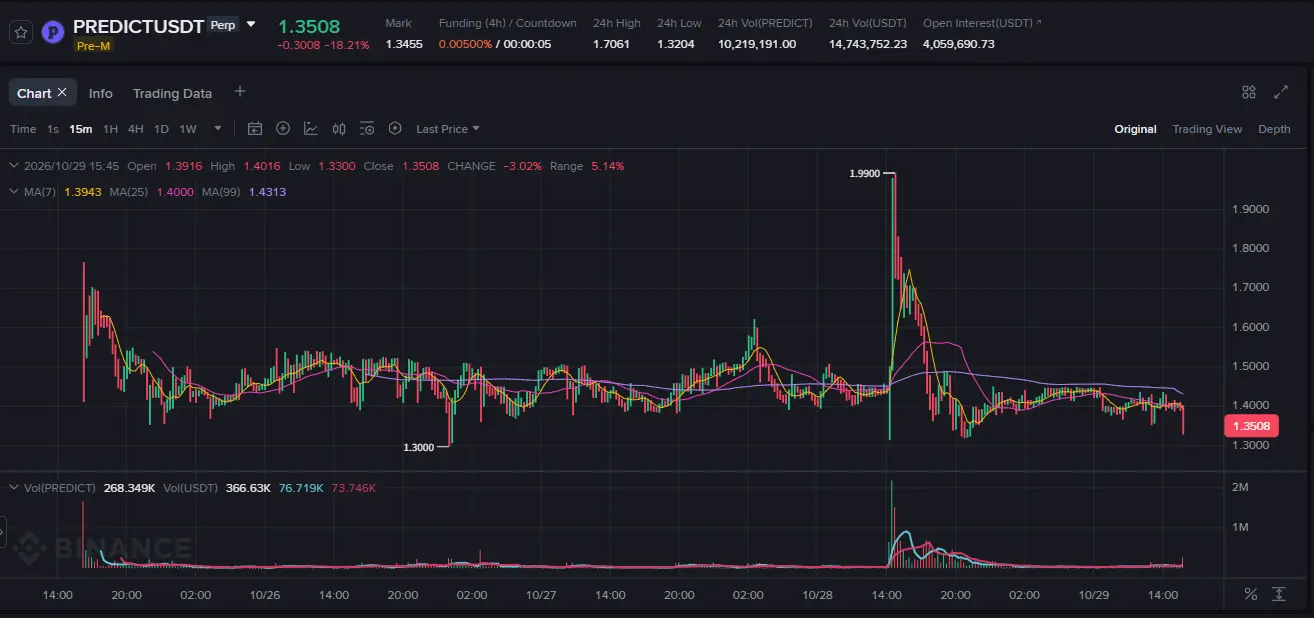
From incubation, integration to token issuance, Predict.fun is deeply tied to Binance at almost every step. Whether PREDICT can maintain its pre-market heat or will peak like most new tokens upon launch will directly determine which method of receiving tokens is more advantageous.
Leaving the Choice to Users
According to official information, the total supply of PREDICT is fixed at 1 billion tokens, with 51.95% allocated to the ecosystem and community, 26.05% to early supporters, 10% to core contributors, 8% to the treasury, and 4% to liquidity.
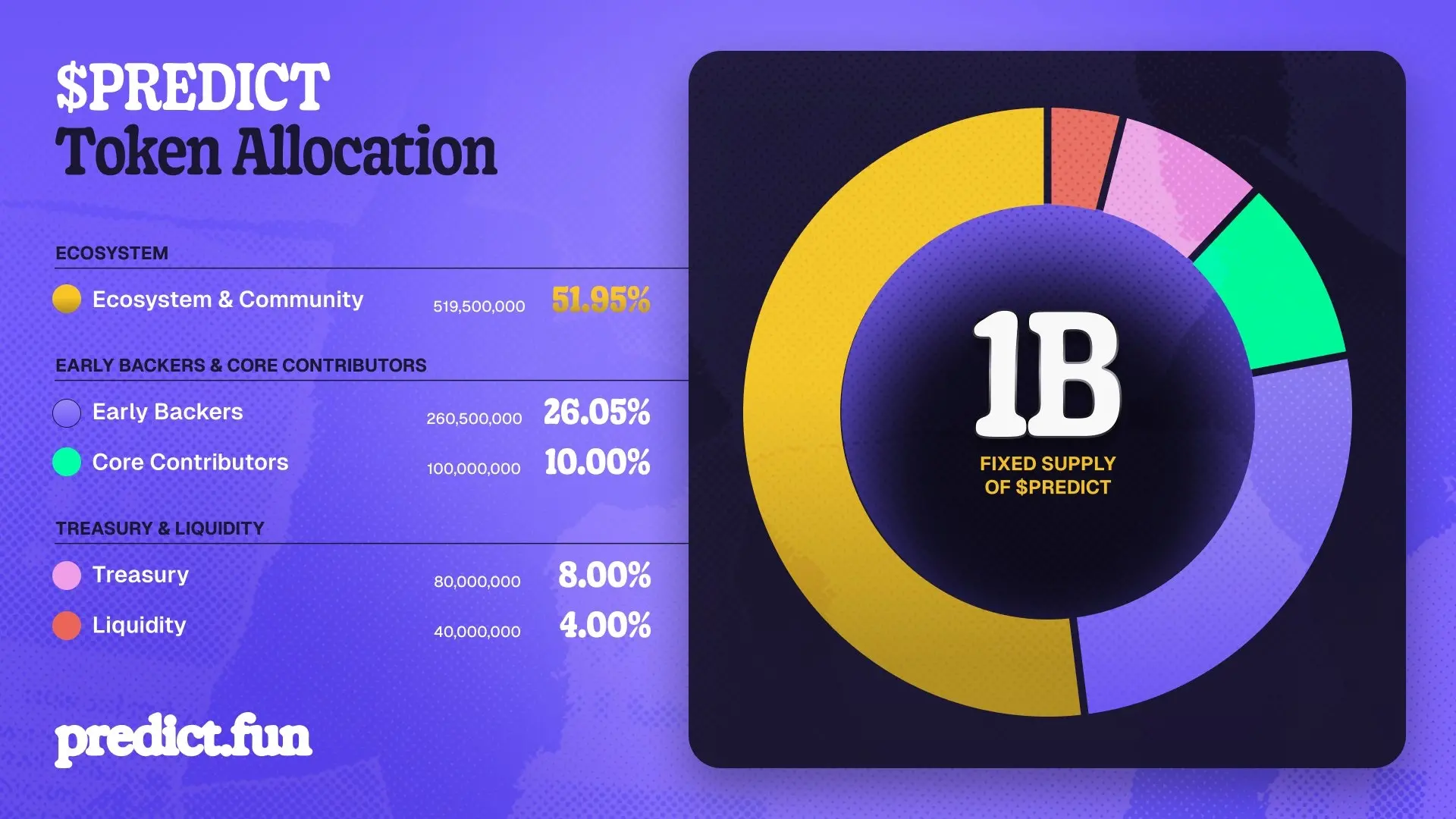
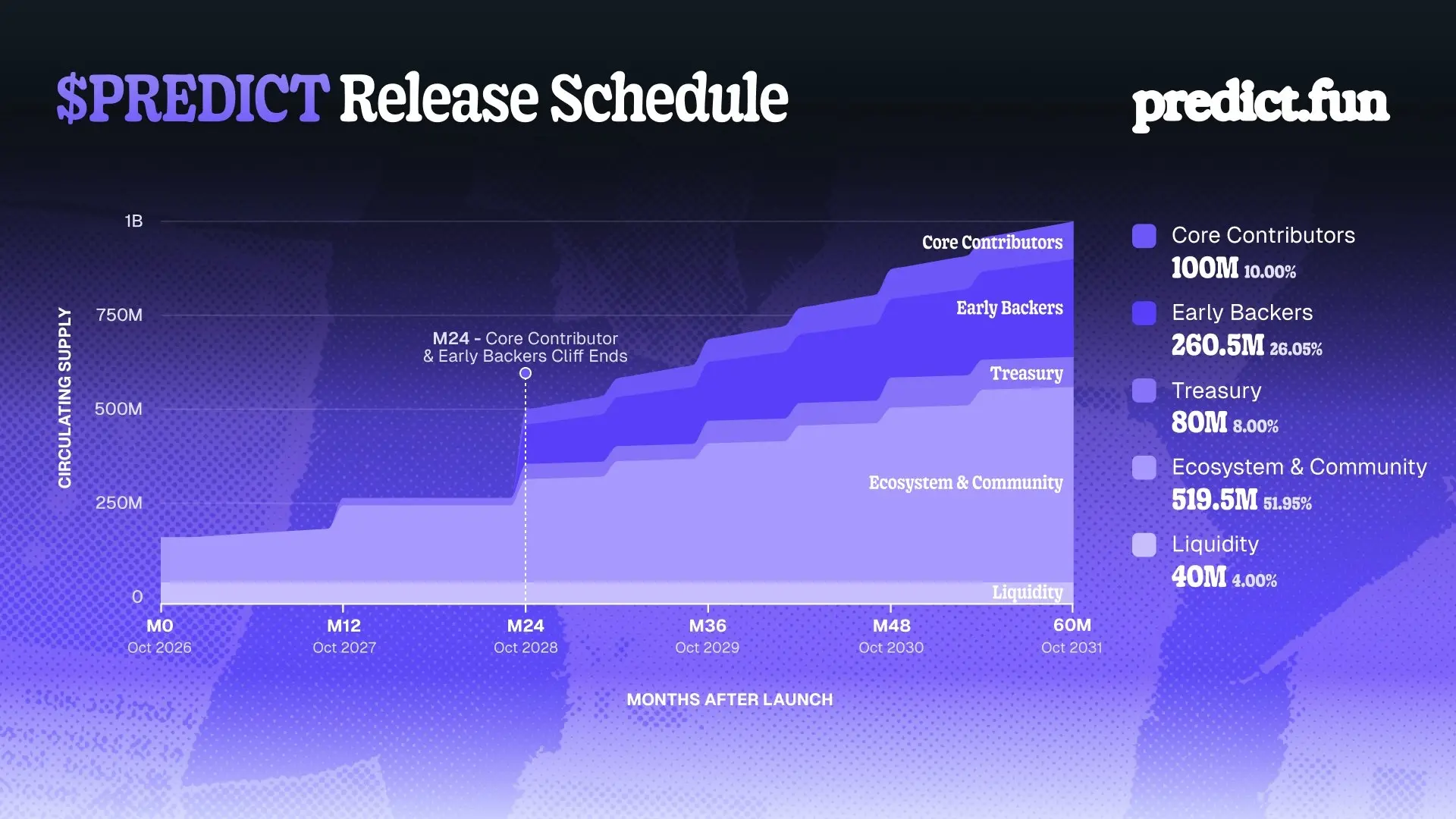
When the token goes live, 16% of the total supply will be unlocked. From the release curve, this approximately 160 million circulating supply consists of liquidity shares and part of the ecosystem and community shares, while the treasury, core contributors, and early supporters' shares have not been released. Core contributors and early supporters will first lock for 24 months, after which their shares will be released over 36 months.
The 70 million tokens for the first season airdrop come from the ecosystem and community shares, accounting for about 7% of the total supply, distributed according to the first season Predict Points. These points mainly come from activities such as trading, providing effective liquidity, holding positions, and early market participation.
There are only two ways to receive tokens. If users choose to receive immediately, they can get 35% of their entitled amount, while the remaining 65% will be voided. If they choose the 12-month vesting option, they can receive the full amount.
The official announcement states that users who choose vesting can still switch to immediate receipt within one month after the token goes live. Once the claim period opens, eligible users have one month to make their choice; any tokens not claimed by the deadline will be voided.
Users participating through Binance have different rules. Binance's announcement specifies that each user holding Predict Points can only submit one form, and once submitted, it cannot be modified. If not submitted by November 26 at 5 PM, the system will default to a one-year lock-up, and users can only claim the full amount after one year.
Users who want to receive tokens immediately on the launch day must submit their forms by October 29 at 5 PM; late submissions will be included in the weekly batches distributed on November 6, 13, 20, and 27. Binance also reminds that the forfeited 65% cannot be reclaimed from the project team, and how this portion of tokens will be handled has not been specified by the official.
In other words, if a user sells the 35% received immediately, as long as the token price a year later does not drop more than 65% from that time, it would be more advantageous to lock up for the full 100%; otherwise, receiving immediately would be better.
Binance Prime Sale, Amplifying Community Disparity
Alongside the airdrop, Binance Wallet's Prime Sale is also underway.
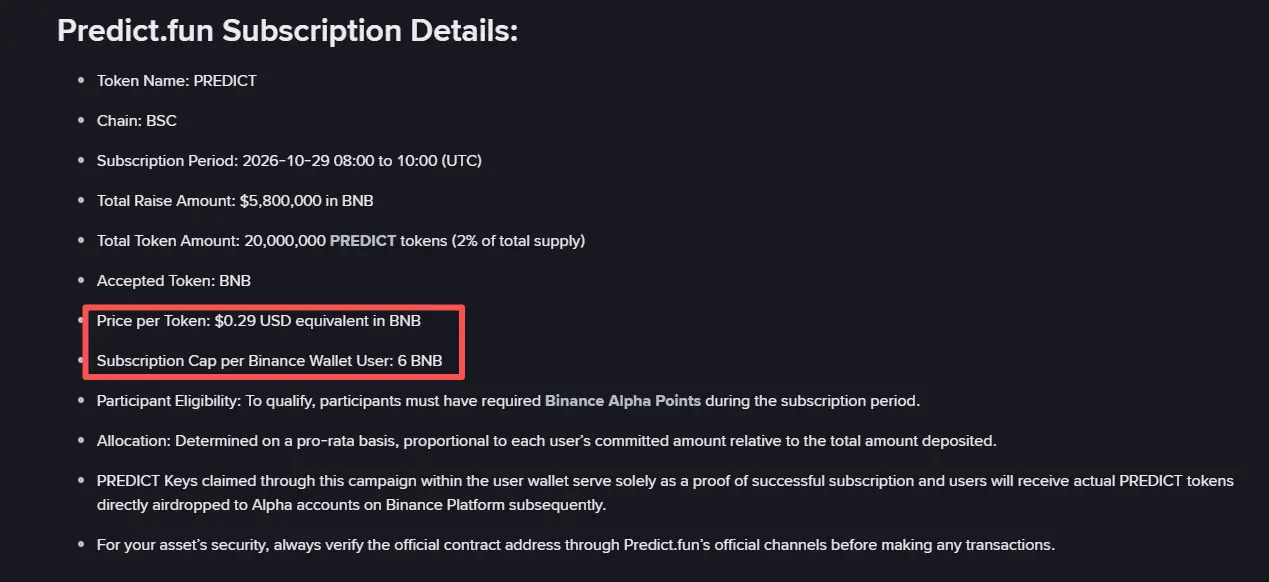
According to the Binance Wallet event page, a total of 20 million PREDICT tokens are being sold, accounting for 2% of the total supply, at a unit price of $0.29, raising $5.8 million. Users holding Binance Alpha points can participate, with a purchase limit of 6 BNB per person, distributed proportionally.
At $0.29, PREDICT's fully diluted valuation is $290 million, about one-fifth of the current pre-market valuation.
This has further intensified community dissatisfaction. A user participating in the airdrop, 0xFEI, pointed out that although the ecosystem and community account for 51.95% of the total supply, if all participants in the first season airdrop choose to receive immediately, the community can only receive a maximum of 2.45% of the total supply when the token goes live.
Some airdrop bloggers indicated that many in the community previously expected each point to be worth $0.3 to $0.5, but based on the current pre-market price, each point is only worth about $0.1. They also admitted that most participants did not incur losses, but their returns were far below expectations.
The transparency of the distribution has also been questioned. The official did not specify the exact composition of the 16% unlocked at the token launch. Even if the first season airdrop is counted at the full 7%, plus the 4% for liquidity and 2% for the Prime Sale, there is still about 3% of the usage that has not been explained.
Some users also questioned that Binance Alpha users can buy 2% of the shares at a low price, which is not much different from the community airdrop amount. In response, the Predict.fun community administrator stated that this portion of the allocation is decided by Binance on how to distribute it to Alpha users, not designated by the project team.
Most New Tokens Drop Below Launch Price in the First Week
Choosing between locking up or immediate receipt ultimately depends on the judgment of PREDICT's price a year later, and the general trend of new tokens over the past two years can provide some reference.
The blockchain data company Bitquery tracked 51 large airdrops since 2026. Among the 46 tokens that have been live for a full month, 35 are below their first-week price, with a median drop of 48%.
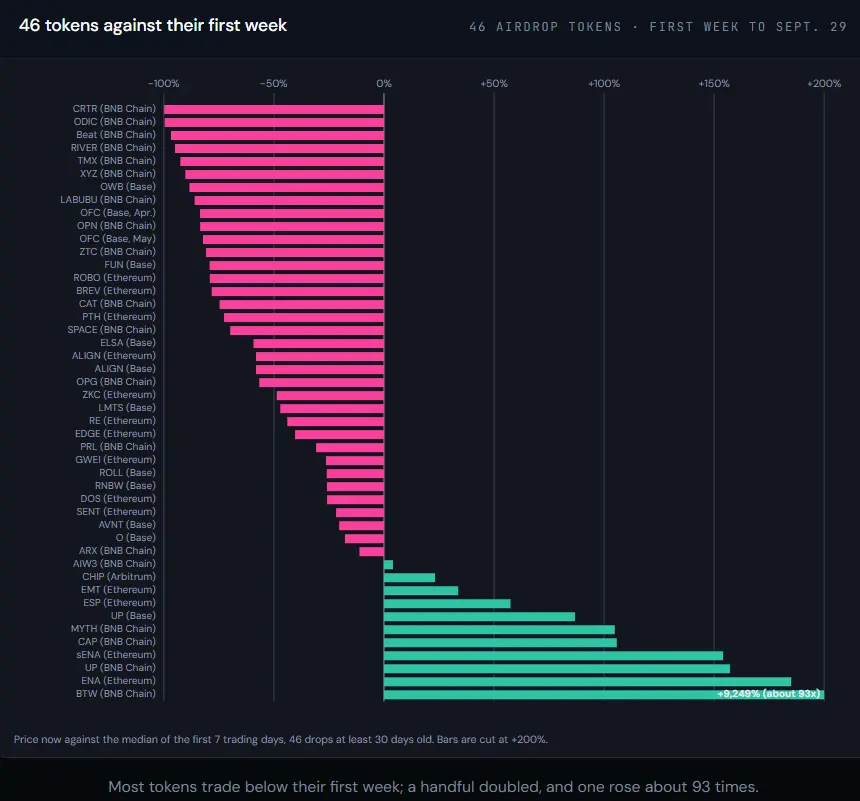
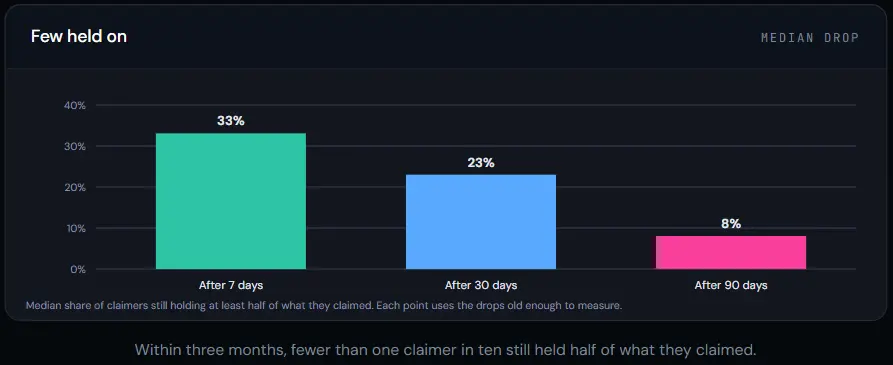
In the median airdrop, 73% of recipients transferred their tokens within one day, and only 23% held at least half after 30 days, dropping to 8% after 90 days.
Notably, Bitquery found that among the four airdrops distributed through Binance Wallet reward contracts, half to 70% of recipients exchanged their tokens within one day using the wallet's exchange function.
In terms of valuation, the research institution Memento Research counted 118 token generation events in 2025, and by the end of that year, 84.7% of token prices were below their launch valuations. Among the 28 projects with a fully diluted valuation exceeding $1 billion on the first day, none were profitable.
In addition to industry trends, the release rhythm of PREDICT itself is also worth noting. According to the official release curve, a significant increase in circulating supply of about 70 to 80 million tokens will occur in October 2027, coinciding with the expiration of the one-year lock-up for the first season airdrop. For users choosing to wait, the month of receipt may coincide with a batch of concentrated releases.
Further down the line, in October 2028, the lock-up period for core contributors and early supporters will end. The official announcement states that this portion will be released monthly thereafter, and the release curve shows that the circulating supply will increase from about 260 million tokens to about 500 million tokens in the month the lock-up period ends, nearly doubling.
After the Points Tide Recedes, Predict.fun's Funding Challenge Begins
Beyond price, another question is whether Predict.fun can retain funds after the token launch. According to DefiLlama data, its TVL has dropped from about $21.7 million in January this year to about $10.17 million now, a decrease of about half.
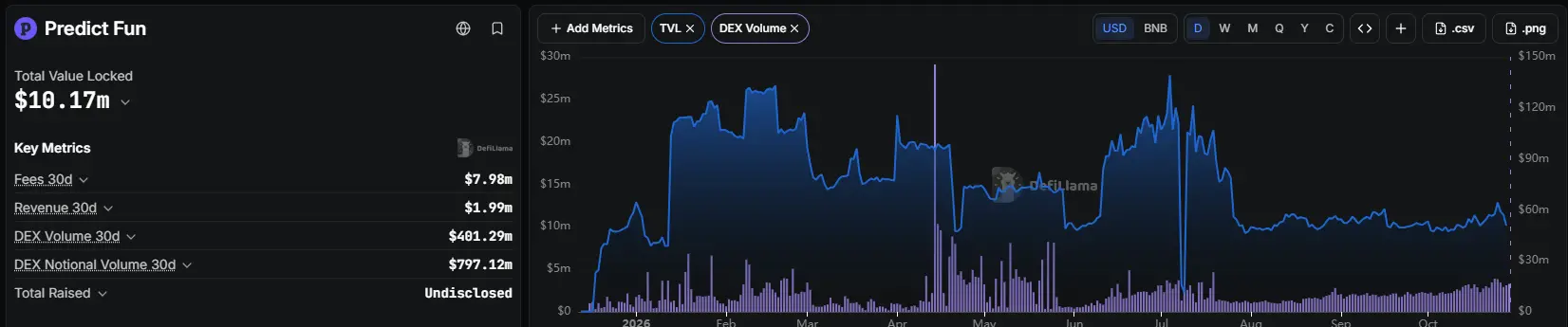
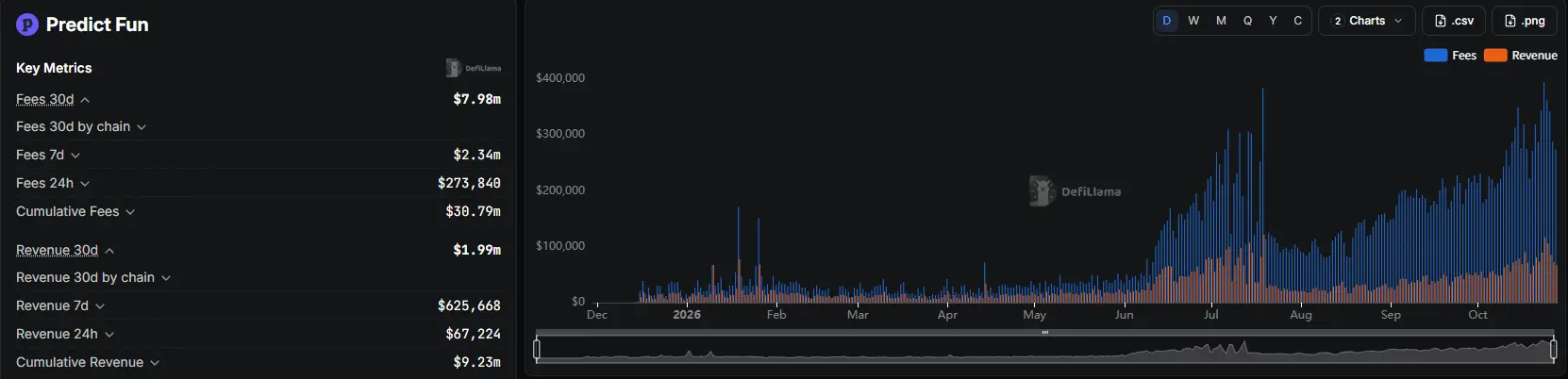
However, its transaction fees have shown an opposite trend. Since August, Predict.fun's daily transaction fees have continued to rise, reaching the highest recorded value in October, close to the token issuance. In the past 30 days, its transaction fees were about $7.98 million, with protocol revenue of about $1.99 million.
The peak trading volume occurred earlier in April when Binance launched the prediction market feature within the app and covered the on-chain transaction and settlement fees for users, leading to a peak in trading volume for Predict.fun for the year.
Whether these data can be maintained after the token launch can be referenced by the previous project on the same chain, Opinion. Opinion, also supported by YZi Labs, had a TVL of about $155 million in January this year, about 7 times that of Predict.fun at that time.
After closing the first season airdrop registration at the end of February and launching the token in early March, Opinion's funds quickly flowed out, and its TVL is now only about $3.01 million. In Bitquery's new token first-week data, the price of OPN dropped by 83%.
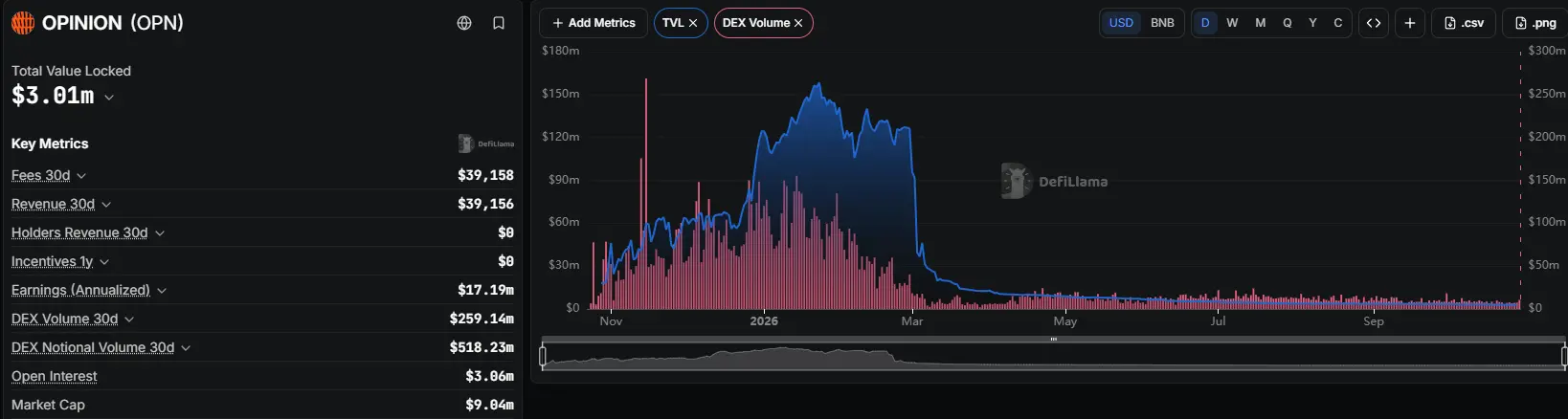
A small number of relatively optimistic users believe that the community's expectations for Predict are higher than for Opinion, and the coin price may be more stable than OPN.
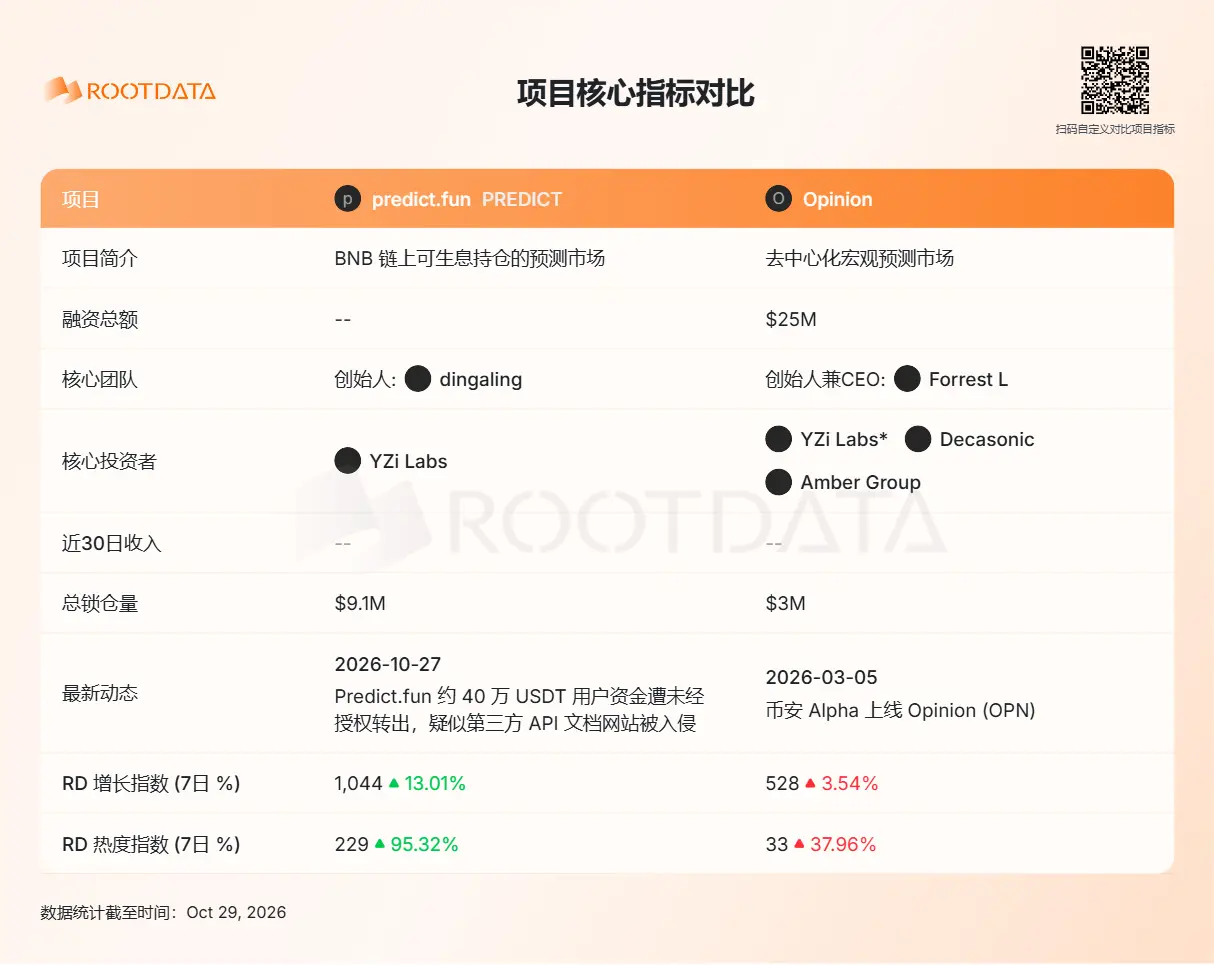
Currently, the snapshot of the first season points for Predict.fun has been completed. The funds and transactions obtained for points previously will depend on whether they remain on the platform based on future incentive designs.
According to the official announcement, the second season LP points will be calculated based on the duration of the orders and the actual transaction volume. Orders that do not have transactions or have insufficient transaction amounts will not receive points for the transaction portion.
Whether this set of rules that only rewards real transactions can retain funds will be answered by the data in the coming weeks. Previously, Opinion's TVL significantly declined in the weeks following the end of the first season airdrop registration and the token launch.
This observation period coincides with the users' decision-making window. The selection form for the Binance channel will close on November 26. Users who are still observing can wait to see the data from the first month after the launch before making a decision.