
South Korea's largest IPO plummeted 3.2% on its first day: the profitable "New Cloud" company also cannot escape the winter of AI data centers
Author: Zhao Ying
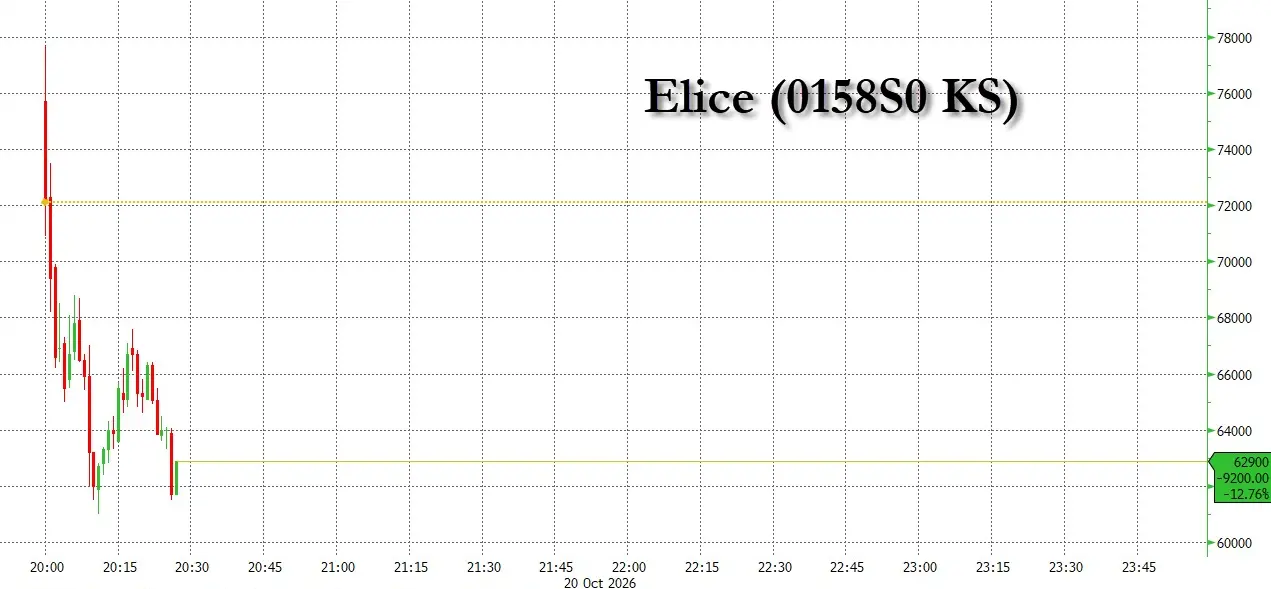
The South Korean data center company Elice plummeted 32% on its first day of trading on Kosdaq, becoming the latest example of an AI computing infrastructure IPO failing. This company, which claims to be "neocloud" (a new type of computing cloud) and is rarely profitable, went public at a valuation only a fraction of its peers, yet still could not escape the sell-off, marking a shift in the market's pricing logic for AI data center assets from "growth expectations" to "capital expenditures."
Elice priced its shares at the upper limit of the offering range at 90,500 Korean won, raising 201 billion won (approximately 151 million USD). After listing, its market capitalization slightly exceeded 1 trillion won, making it the largest IPO on Kosdaq this year. Retail investors in South Korea invested about 10.3 trillion won (approximately 7.7 billion USD) in subscription funds, with oversubscription exceeding 400 times------equivalent to freezing about 51 times the entire offering amount in accounts awaiting allocation.
But it collapsed at the opening. The stock price briefly surged to about 78,000 won (which was still 14% lower than the offering price) before quickly diving, hitting a low of 61,400 won, down 32% from the offering price; as of the time of writing, it hovered around 62,900 won, about 30% lower than the offering price, evaporating approximately 300 billion won in market value in less than half an hour.
This is not an isolated case. Previously, the Australia-based data center company Firmus, supported by NVIDIA, withdrew its IPO after lowering its offering price by 25%. Nscale's $30 billion fundraising request was cut nearly in half by investors, and Blackstone's AirTrunk postponed its Singapore REIT listing. However, unlike other similar companies that have failed, Elice is actually a profitable company, with its revenue in the first half of the year surging by 200%, and an operating profit margin of about 30%. Its valuation is also relatively moderate. Yet, these advantages did not prevent the market from voting with their feet.
The failure of this IPO further solidified the market's systemic doubts about the AI data center sector. According to Bloomberg, Goldman Sachs analyst Rich Privorotsky recently pointed out in a research report that "the market is realizing that while demand for computing power can grow exponentially, the available capital to support this growth cannot expand in tandem."
Even the cheap and profitable one cannot sell
Elice is an outlier among this group of failures: it is genuinely making money. The prospectus shows that the company's revenue in the first half of the year increased by 200% year-on-year to 34.4 billion won, turning a profit with an operating profit of 10.3 billion won, and EBITDA grew more than 11 times year-on-year to 23.2 billion won. Douglas Kim from Smartkarma expects its revenue to increase by another 83% in 2026, with an operating profit margin of about 33%.
Based on the IPO pricing, the company's valuation is about 14.5 times its annualized revenue, which further dropped to about 10 times after opening. In contrast, Nscale had previously sought a valuation of $30 billion at about 107 times its sales ratio, while losing $1.02 billion in the first half of the year. Elice is not a bubble example of high valuation, yet it still lost a third of its market value in the time it takes to drink a cup of coffee.
Kim Dojoon, CEO of Zian Investment Management, believes that market sentiment may have weakened due to the CoreWeave incident, but Elice's financial structure is entirely different from CoreWeave, and investors do not need to view it as particularly high risk. Albert Yong from Petra Capital pointed out that sentiment in the AI infrastructure sector is highly volatile and often disconnected from fundamentals.
Rising capital costs, new cloud models trapped in structural contradictions
Goldman Sachs analyst Rich Privorotsky's summary hits the nail on the head: the market is realizing that while demand for computing power can grow exponentially, the capital available to finance it cannot. Elice CEO Jae Won Kim admitted that the funds raised from the IPO will be used to build more AI data centers in South Korea and abroad, and this IPO is to provide financial firepower for execution.
In an interview with Bloomberg, Elice CEO Jae Won Kim acknowledged that the IPO proceeds will be used to build more AI data centers in South Korea and abroad, stating, "We are fully committed to becoming a global leader in full-stack AI infrastructure, and the significance of this IPO is to provide ammunition for our execution."
Morgan Stanley's latest calculations show that the combined free cash flow of hyperscale cloud providers and neocloud will reach its lowest point by 2027, with a gap of nearly $600 billion when accounting for leases------the year with the highest capital expenditures will also be the year with the largest financing gap. Gartner further predicts that by 2030, cost pressures and a lack of differentiated business models will force more than 80% of neocloud providers to cease independent operations.
Financing costs are also rising. Goldman Sachs economists expect the Bank of Korea to remain hawkish this week, with a potential rate hike of 25 basis points in the first quarter of 2027; Goldman estimates that global interest rates are at their highest level since 2007. The Korea Electric Power Corporation (KEPCO), with debts of 210 trillion won (approximately 148 billion USD), is also seeking to raise electricity prices, further squeezing the core electricity costs of data centers.
Global data center IPO winter: list of setbacks continues to expand
In just four weeks, global data center IPOs have consecutively failed: SoftBank's SB Energy postponed its IPO for raising funds for the world's largest data center on September 22; NVIDIA-supported Firmus withdrew after lowering its offering price by 25% on October 8; Blackstone's AirTrunk postponed its $1.5 billion Singapore REIT to 2027 on October 14; Nscale, after Microsoft exited its UK deal, was asked by investors to cut its $30 billion fundraising request by nearly half; CoreWeave's stock price has halved from its May peak, and its bonds entered distressed territory last week, with CDS implying a 63% probability of default within five years.
About 12 hours before Elice's opening, Goldman Sachs' Gabriela Borges upgraded CoreWeave's rating to buy but lowered the target price from $139 to $106, clearly assuming that the company would expand with debt at about a 10% cost (1000 basis points). The market responded with nearly immediate sell-offs to this report.
The next to be tested is Firmus's partner DayOne in Batam, which is still seeking to raise up to $5 billion through a U.S. stock listing, with a roadshow potentially starting as soon as this Wednesday------if this deal can still go through, it will become the next litmus test to observe whether this financing window is completely closed.