








Myriad, co-founded by Tom Lee and Loxley: Advertising is dead, predicting the market is the ultimate goal of media monetization
Apr 10, 2026 17:37:28


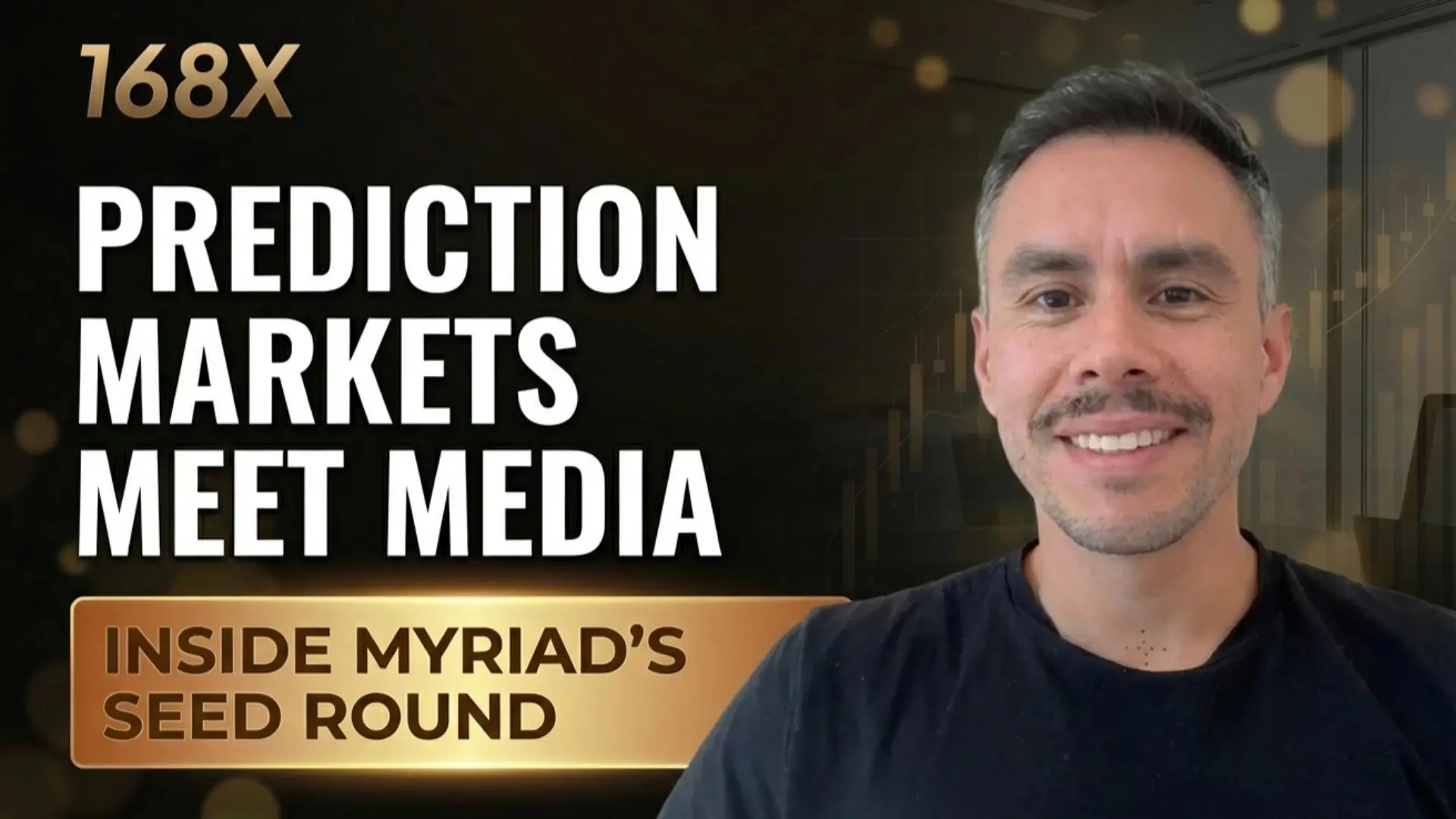
"Knowledge is not free. If you have a judgment in your mind, it should be priced and traded." Loxley Fernandes, co-founder and CEO of DASTAN, deeply analyzes how prediction markets will disrupt the business model of digital advertising from the perspective of a media group leader in an exclusive interview on the East-West Capital dialogue program "168X" — and why the endgame of this track is far more than just "a better Polymarket."
This serial entrepreneur leads DASTAN — the parent company of crypto media Decrypt and Rug Radio, with its prediction market Myriad set to launch in early 2025. In March 2026, Myriad completed its seed round financing, with investors including MoonPay Ventures, Auros, EVG, and individual investors such as Fundstrat co-founder Tom Lee and Pudgy Penguins CEO Luca Netz. The overall trading volume of the prediction market sector skyrocketed from $15.8 billion in 2024 to $63.5 billion in 2025 — Loxley believes this explosion is just beginning.
This article is a summary of highlights from the 168X program (@168X_Fortune) — a top dialogue platform that deeply connects Eastern wisdom with Western innovation, focusing on cutting-edge fields such as AI, blockchain, robotics, space technology, and bioengineering, exploring how technology, capital, and human wisdom will reshape the future of human civilization.
Host: Victor (@vcmktasa) · Guest: Loxley Fernandes (@Loxley_eth)
When Users Become Immune to Ads: Cracks in the Media Monetization Model
The rise of prediction markets is not driven by self-evolution within the crypto circle, but rather a crisis in the media business model that is currently unfolding.
As the parent company of Decrypt and Rug Radio, DASTAN is at the forefront of digital media. The industry reality Loxley sees is that while the overall volume of digital advertising is still expanding, the profit margins of individual media companies are being systematically compressed.
The root of the problem lies in the shift in industry paradigms. In the past, brands paid for "exposure" — CPM (cost per thousand impressions) drove everything. But advertisers increasingly demand that every penny can be tracked to conversions. For media such as podcasts, social content, and news reports, the effectiveness of cramming ads next to information is diminishing.
"Users no longer want to see banner ads. No one wants to be sold something," Loxley bluntly states. "If you're doing a live broadcast on financial markets and you interrupt with a Nike shoe ad — the conversion rate will be terrible, the quality of content will suffer, it's bad for consumers and bad for the brand. Everyone loses."
This is not just a dilemma for one company, but a structural problem for the entire digital media industry. As the logic between content and advertising becomes increasingly disconnected, the industry needs a completely new monetization paradigm.
Loxley believes that prediction markets precisely fill this gap.
Belief Pricing: When the Judgments of 8 Billion People Become Tradeable Assets
The 2024 U.S. presidential election made prediction markets famous, but Loxley believes the industry's imagination for this track is still severely lacking.
In his framework, the essence of prediction markets is not "better gambling," but rather the infrastructure for the financialization of information.
He illustrates this with a simple example. An ordinary person believes that Apple's new iPhone is the best product ever and thinks this will drive up the stock price. But there is a huge gap between "having a judgment" and "being able to trade": understanding sales expectations and supply chain economics, opening a brokerage account, and making choices between stocks, options, and futures. The entry barrier is extremely high.
"But prediction markets can simplify all of this into one question: Will Apple sell 100 million iPhones in Q4 this year? Yes or no. Then I show you an article that historically, Apple has sold 101 million units every Q4. What would you do?"
The way to participate in financial markets has been compressed into the most instinctive human behavior — making a judgment about something.
This is what Loxley refers to as "Belief Gets a Price." When the tokenized object shifts from an asset to pure information and opinions, the market's addressable scale expands from Wall Street to every person on Earth with internet access. "8 billion people, as long as the majority can go online and have even $1 of value, can participate. This total potential market is essentially infinite."
This is not a theoretical deduction. Kalshi's latest valuation is $22 billion, Polymarket's valuation is $20 billion — Wall Street and Silicon Valley have already voted with real money. Prediction markets have transformed from a niche experiment in the crypto circle to mainstream financial infrastructure.
Polymarket's Self-Built Chain and Stablecoin: Prediction Markets Moving Towards Vertical Integration
168X host Victor mentioned that just before this interview, Polymarket announced the launch of its own stablecoin Polymarket USD to replace USDC.e, interpreted as a prelude to its migration to a self-built Layer 2. Loxley provided a clear judgment on this.
"This is 100% the right direction," he said. "When you have that level of critical mass and control the infrastructure layer — especially with Polymarket's integration with ICE (the parent company of the New York Stock Exchange) — you inevitably need to build a complete set of CFTC-compliant financial derivatives. Building a self-built chain to carry all transactions, settlements, and compliance processes is completely logical."
This is a noteworthy industrial signal. The leading players in prediction markets are evolving from "applications" to "infrastructure." Self-built chains, self-generated stablecoins, and self-controlled clearing and settlement essentially replicate the vertical integration logic of traditional exchanges.
The paths of Polymarket and Kalshi indicate that the competition in this track is no longer just a product-level contest, but is unfolding at the level of underlying financial infrastructure.
However, Loxley also pointed out that the future of this track will not have just one form. "The current narrative is dominated by Polymarket and Kalshi, while others are on the margins. But I believe there is huge space for different platforms to rise and carve out completely different market layers."
Embedding Information Streams: The Native Distribution Logic of Media and Community
DASTAN's approach is indeed completely different from the aforementioned paths. Loxley is not trying to compete directly with Polymarket on trading infrastructure, but rather starting from its strongest capability — media distribution and the content creator ecosystem.
"Other prediction markets are competing for crypto-native users, but we have grown out of this community," he said. "We are the players of CryptoPunks, Bored Apes, and Pudgy Penguins. The trenches are our origin."
This "community-native" gene determines Myriad's differentiated path: not building a trading platform first and then looking for users, but embedding the prediction market into existing content streams and social networks. On Decrypt's article pages, traditional Google ad spaces are gradually being replaced by prediction market modules. When readers read a Bitcoin report, there is no longer an irrelevant display ad next to it, but a market they can directly participate in.
"Decrypt is completely removing Google ads," he revealed. "Because every position that previously had display ads, when replaced with prediction markets, has generated higher revenue." Not only has monetization improved, but user dwell time, click-through rates, and bounce rates have also improved simultaneously.
More critically, this model is not limited to DASTAN's own media; by integrating SDKs, any media brand or content creator can access the prediction market. Content matching algorithms automatically inject relevant prediction markets into information streams, and distributors earn a share of transaction fees based on volume.
"Platforms are often predatory, only focusing on their own interests," Loxley said. "Content creators are the heroes. When creators win, we can all win together."
In his vision, prediction markets should ultimately be as ubiquitous as water and electricity — on article pages, in live broadcast rooms, social feeds, and even group chats among friends. "Group chats are also a medium. When you are chatting with five friends, the ability to deploy a prediction contract should be within reach."
Asia's Absence: The Next Battlefield for Prediction Markets
In this industry competition, a severely underestimated variable is geography.
Polymarket and Kalshi's core stronghold is the North American compliant market, with product design, regulatory connections, and user profiles all centered around the U.S. But Loxley points out that the vast user base and liquidity of the Asian market are currently being severely undervalued.
Myriad is gradually migrating event contracts to BNB Chain and using the USD1 stablecoin from World Liberty Financial, associated with the Trump family for settlement — this choice carries clear Asian intentions. Loxley himself has years of experience in South China, Shenzhen, Hong Kong, and Taipei, and DASTAN has regarded Asia as a strategic focus since the Rug Radio era.
He revealed that category design targeting the Chinese-speaking market is currently under research, with esports performing particularly strongly. "The prediction markets for events like League of Legends have extremely high participation among Chinese-speaking users."
From a broader perspective, Asia is currently in the "pre-regulatory" stage for prediction markets — Taiwan is in a gray area, and most Asian countries have yet to establish clear frameworks. Loxley believes this is both a challenge and an opportunity: players who establish user bases and distribution networks first will gain a first-mover advantage once regulations become clearer.
Endgame: From Alternative Casinos to Structural Finance of Information
The current market narrative for the prediction market sector still revolves around "Polymarket vs. Kalshi," but Loxley believes that the endgame of this track far exceeds existing imaginations.
"Right now, prediction markets look like alternative casinos — people come here to place bets. But that is not the endpoint."
He describes an evolutionary path from "speculative tools" to "financial infrastructure": the underlying mechanisms of prediction markets — crowdsourced information aggregation and pricing — will penetrate the core areas of traditional finance. Structured products, insurance tools, weather markets (allowing insurance companies to hedge against natural disaster risks), credit default swaps — these traditional territories of Wall Street are waiting for disruption by on-chain prediction markets.
"Open-source intelligence, on-chain settlement, low entry barriers, crowdsourced financial hedging — this is the true future of prediction markets. It's not just sports betting; it's much bigger than that."
Of course, there remains a critical infrastructure gap between vision and reality. Loxley admits that currently, most prediction markets, including Myriad, face the biggest bottleneck of liquidity. A $5,000 prediction could significantly impact market prices, which is far from the depth of traditional financial markets. From "interesting on-chain experiments" to "institutional-grade financial products," the entire sector still requires years of infrastructure development and public awareness accumulation.
However, Loxley's judgment is also clear: the direction is irreversible. From the CFTC's strong support for federal regulation of prediction markets to Polymarket's collaboration with financial media group Dow Jones, from Robinhood's global expansion of prediction market services to Wall Street's acceptance of event contracts as formal financial instruments, this track is moving from the margins to the mainstream at a pace far beyond expectations. And the real competition has only just begun.
Latest News
ChainCatcher
Apr 10, 2026 23:55:07
ChainCatcher
Apr 10, 2026 23:39:58
ChainCatcher
Apr 10, 2026 23:32:01
ChainCatcher
Apr 10, 2026 23:11:02