








Ten Thousand Words Analysis of the Most Profitable Businesses and Their Business Models in Crypto
Apr 9, 2026 14:57:16


This report is written by Tiger Research. The issuance of stablecoins is one of the most profitable businesses in the crypto space.
However, with Tether (USDT) and USDC accounting for over 85% of the market share, it is unrealistic for new entrants to compete on the same reserve interest model.
This report analyzes four issuers, each carving out a unique position in this landscape.
Tether leads with approximately 62% market share. On top of the core reserve yield model, the company is rebuilding trust and diversifying revenue by introducing audits from the Big Four accounting firms and investing $20 billion in new business ventures.
StraitsX does not rely on reserve interest as its primary source of income but focuses on transaction fees. Its integration with Alipay+, GrabPay, and Visa demonstrates practicality in real-world scenarios, and the data showing monthly transfer volumes reaching 2.5 times its market value validates the feasibility of this model. Obtaining a major payment institution license from the Monetary Authority of Singapore ahead of competitors has turned regulatory requirements into its competitive moat.
M0 does not directly issue stablecoins. Instead, it provides shared infrastructure that enables other companies to issue their own stablecoins. MetaMask and Exodus have already operated stablecoins on this platform. As more issuers and builders join, this model continues to strengthen through network effects.
KRWQ operates in the absence of a domestic regulatory framework, seizing the offshore demand for the Korean won non-deliverable forward market that operates outside the regulatory system. Once the regulatory framework is established, the company plans to leverage its pre-established offshore liquidity to enter the domestic Korean market and subsequently replicate this model to other major non-deliverable forward currencies in Asia.
The stablecoin issuance market is not trending towards a single business model but is showing signs of differentiation. Depending on the scale and positioning of each issuer, fundamentally different revenue strategies can coexist.
Stablecoin Issuance Market
The issuance of stablecoins is one of the most profitable businesses in the crypto space, attracting an increasing number of institutional participants.
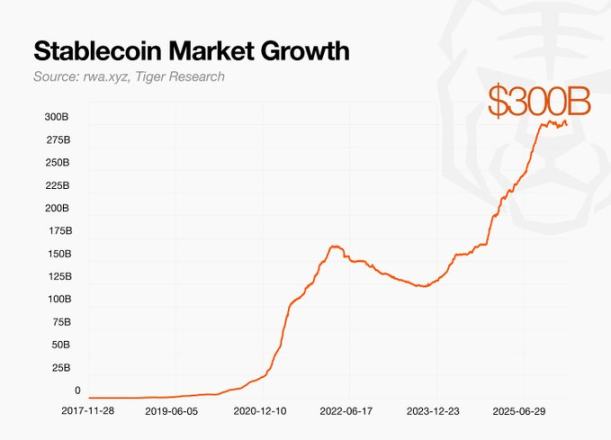
Tether was the first to dominate this field, leading as a major liquidity provider in the early trading markets. Circle follows closely, prioritizing regulatory compliance, and plans to go public on the New York Stock Exchange in June 2025, extending its influence into traditional finance.
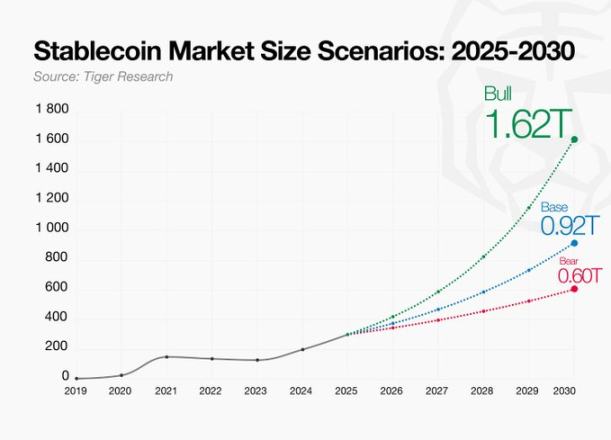
This institutionalization process has pushed the total market capitalization of stablecoins to approximately $300 billion and prompted major jurisdictions to formally establish regulatory frameworks. The U.S. signed the GENIUS Act in July 2025, establishing the first federal regulatory framework for payment stablecoins. The EU implemented the Markets in Crypto-Assets Regulation, and Hong Kong also issued the Stablecoin Regulation, marking the full-scale launch of regulatory competition globally.
This growth momentum is expected to accelerate further. Analysis from Tiger Research shows that the annual net supply increment of stablecoins will increase from $55 billion in 2024 to $101 billion in 2025, nearly doubling. If major jurisdictions complete relevant legislation and institutional demand enters substantially, even under a conservative assumption of a 15% annual growth rate, the market size is expected to exceed $600 billion by 2030.
The core revenue model of stablecoins lies in reserve management rather than the issuance itself. When a user deposits $1, the issuer mints 1 Tether or USDC and allocates that dollar to low-risk assets such as U.S. Treasury bonds and money market funds. As the issuance scale expands, the reserve base and the interest income it generates also grow.
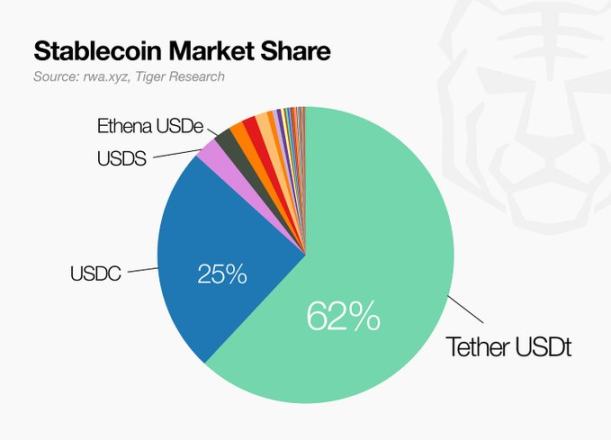
This model is essentially a scale race. To generate substantial income from reserve interest, hundreds of billions of dollars in circulation are needed. Currently, Tether (approximately 62%) and USDC (approximately 25%) together account for over 85% of the market share, with the remaining 15% divided among dozens of small issuers. For newcomers, competing solely on the reserve interest model is unrealistic.
New entrants are responding to this situation by designing alternative revenue models or completely redefining their businesses. Some companies focus on transaction fees and integration with the real economy as their primary sources of income; others provide issuance infrastructure rather than directly issuing stablecoins, thus earning network service fees; and some choose to first absorb offshore demand in regions with relatively loose regulation before entering their domestic markets once the regulatory framework is improved.
The stablecoin issuance market is not converging towards a single model but is moving towards differentiation. Depending on the scale and positioning of each issuer, fundamentally different revenue strategies can coexist. The following sections analyze how these models operate in practice based on interviews with key participants.
Tether: The Market Benchmark for Stablecoins
Tether first issued the dollar-pegged stablecoin Tether in 2014 and currently holds about 62% of the stablecoin market share, effectively acting as an industry pioneer.
Tether's ability to maintain its market leadership for a decade is not solely due to its first-mover advantage. What has shaped today's Tether is a series of proactive and prudent structural changes: a comprehensive reform of reserve asset composition, shifting from commercial paper to U.S. Treasury bonds; establishing a quarterly external verification mechanism; and transitioning to a diversified business model that reinvests profits generated from stablecoin operations into areas such as artificial intelligence, energy, education, and communications.
Business Model
Tether's revenue sources are diverse, but reserve management remains its core.
Each time Tether issues a Tether coin, it receives an equivalent amount of dollars, which it invests in safe assets such as U.S. Treasury bonds, reverse repurchase agreements, and money market funds. As the issuance volume grows, the managed asset scale continues to expand, and interest income accumulates accordingly. Additionally, part of the reserves is held in the form of gold and Bitcoin, and the price appreciation of these assets brings additional market value gains. According to public information, reserve management income accounts for the vast majority of its total profits.
Secondary revenue sources include integration fees and transaction fees. Furthermore, Tether has a strategic investment portfolio independent of Tether's reserves, covering areas such as artificial intelligence, energy, and communications.
Regulatory Participation
Since the first quarter of 2025, Tether has held a stablecoin issuer license under El Salvador's Digital Assets Law and operates under the supervision of the National Digital Assets Commission. However, some argue that this structure limits its transparency. Standard & Poor's has cited this as one of the reasons for giving Tether a lower transparency rating.
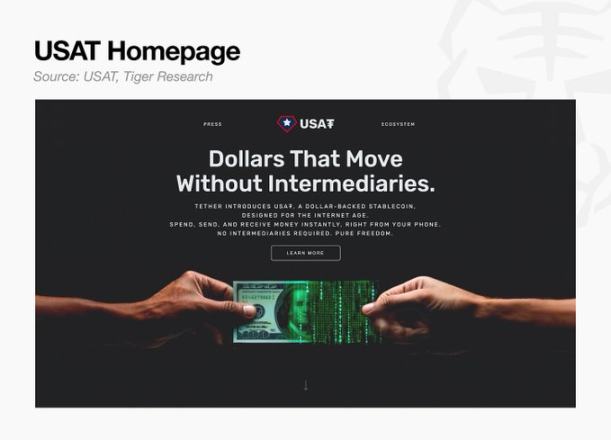
Tether is addressing this issue by entering the U.S. market in a segmented manner. Under the GENIUS Act framework, the company launched USAT, a product line designed specifically for the U.S. regulatory environment, while Tether continues to serve as a universal product for the global market. These two markets are structurally independent and advancing in parallel.
Tether is also actively responding to transparency concerns. While quarterly reserve verification reports verified by BDO have been its benchmark practice, Tether officially hired a Big Four accounting firm in March 2026 to conduct a comprehensive audit of Tether's reserves. Unlike verification that only confirms the reserve composition at a specific point in time, a comprehensive audit covers assets, liabilities, and internal control systems under higher scrutiny standards.
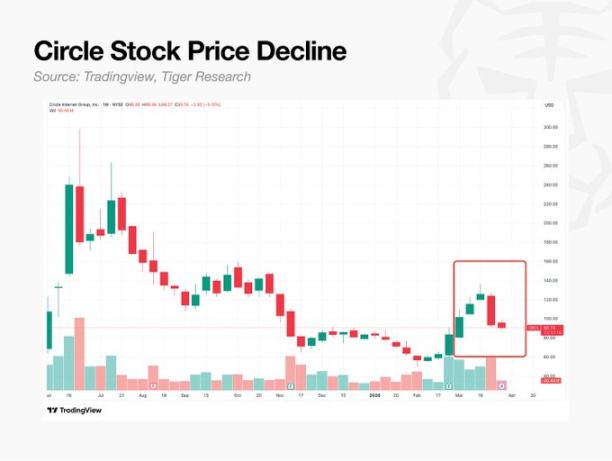
The market has reacted to this. As Tether's regulatory compliance status improves, Circle's stock price has dropped by about 20%. This indicates that Tether is addressing its previously major competitive shortcomings, reshaping the market competitive landscape.
Growth Strategy
Tether's growth strategy focuses on the expansion of real-world assets, technological innovation, and new business development. Its flagship real-world asset product is Tether Gold, a token backed 1:1 by physical gold stored in Swiss vaults. This product accounts for over half of the total market value of gold-backed stablecoins, and its underlying asset scale continues to grow.
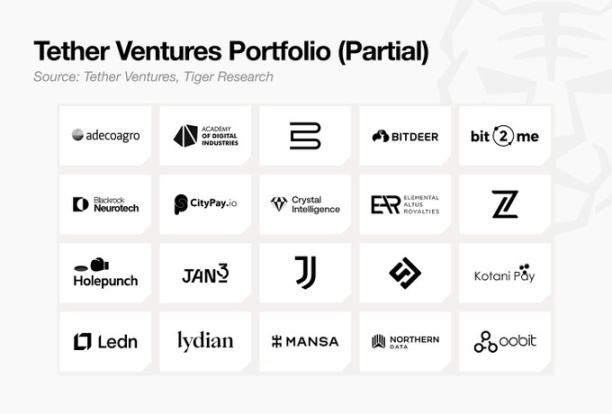
The expansion of new businesses is also progressing simultaneously. Tether's proprietary investment portfolio exceeds $20 billion, widely distributed across artificial intelligence, energy, media, and communications. This portfolio is completely independent of Tether's reserves and serves as a growth engine for surplus capital, reinvesting profits generated from stablecoin issuance into long-term growth drivers.
Key Takeaways
Tether's case provides several structural insights for any enterprise considering entering the stablecoin business.
First, stablecoin issuance is a scale business. Each Tether coin issued corresponds to an investment in U.S. Treasury bonds. As the issuance volume grows, the amount of Treasury bonds held increases, and interest income rises accordingly. Understanding this direct correlation between issuance volume and asset management scale is the starting point for analyzing any stablecoin business model.
Second, regulatory compliance is a prerequisite, not an option. Even Tether must operate within a regulatory framework. Regardless of how unclear the current regulatory framework may be, the design of the business structure must consider the incorporation of regulatory systems from the outset. Stablecoins are essentially an industry operating within regulatory boundaries.
StraitsX: A Stablecoin Issuer for the ASEAN Real Economy
StraitsX is a stablecoin issuer based in Singapore. Its core products are XSGD (pegged to the Singapore dollar) and XUSD (pegged to the U.S. dollar), and it has expanded its business to include major ASEAN currencies such as the Indonesian rupiah.
What is noteworthy is not just its digital asset issuance itself: StraitsX is building payment infrastructure directly connected to the ASEAN real economy. According to on-chain data platform rwa.xyz, the monthly transfer volume of XSGD (approximately $39.9 million) is about 2.5 times its market value (approximately $15.8 million).
Compared to global mainstream stablecoins like Tether and USDC, StraitsX's absolute asset scale and turnover remain relatively small, but its application scenarios are fundamentally different. Mainstream stablecoins are primarily used for investment transactions on cryptocurrency exchanges, while StraitsX's tokens are used for everyday real business activities. Data indicates that the tokens issued are not idling in investor wallets but are continuously circulating in the market.
StraitsX is regarded as a specialized payment infrastructure in the ASEAN region, not only due to on-chain data metrics but also because of its strong capability to integrate corporate payment networks.
Business Model
StraitsX's revenue model centers around transaction fees. Reserve interest income is constrained by external variables such as circulation volume and interest rates, while transaction fees are linked to transaction volume and can expand in tandem with business growth.
Reserve interest income: The reserves corresponding to circulating XSGD and XUSD are held in trust accounts at DBS Bank, Standard Chartered Bank, and United Overseas Bank. According to the Monetary Authority of Singapore's regulations, the interest belongs to the company, not the token holders. Based on an estimated total circulation volume of about $65 million, the annual yield is approximately $2.6 million to $3.25 million.
Payment processing fees: Generated each time stablecoins are used for payments or settlements. Major channels include the inflow and outflow of funds, QR code payment networks (integrated with Alipay+ and GrabPay), and card issuance (sponsored by Visa). This income is tied to transaction volume rather than fee rates.
Over-the-counter trading and foreign exchange swap spreads: Earned from the foreign exchange spreads in the swapping and trading of stablecoins and large over-the-counter transactions.
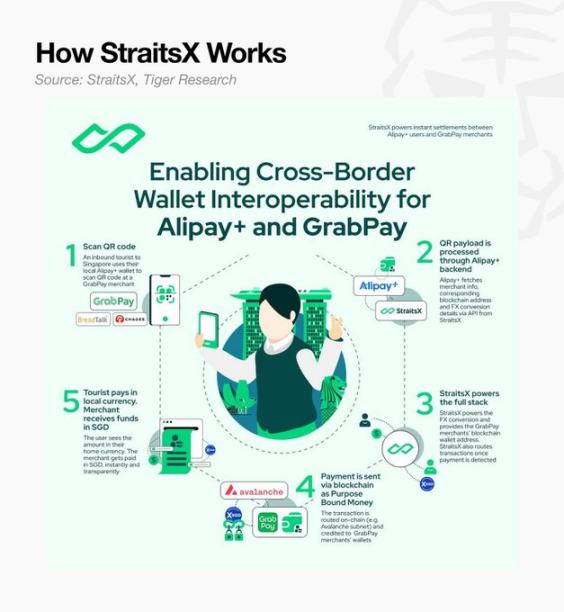
Among these, transaction fees are primarily generated through StraitsX's external network integration. Major mobile payment platforms such as Alipay+, GrabPay, and global exchanges like Binance and Bybit have adopted StraitsX's system for fund settlement, covering various application scenarios. Notably, internal data from StraitsX shows that the volume of stablecoin payments associated with Visa cards has grown 40 times in the past year, while the issuance volume has increased 83 times during the same period.
Regulatory Positioning
The crypto industry generally believes that strict regulation will limit business expansion. StraitsX, however, has taken the opposite approach, turning the regulatory framework of the Monetary Authority of Singapore into a competitive defense mechanism.
The foundation of this strategy is StraitsX's acquisition of a major payment institution license from the Monetary Authority of Singapore. With this license, StraitsX is authorized to operate six of the seven major payment services regulated by the Monetary Authority of Singapore. This allows the company to legally conduct cross-border remittances, foreign exchange transactions, merchant payments, and account issuance within a single legal entity, far exceeding the scope of mere token issuance. XSGD and XUSD have been recognized as stablecoins that essentially comply with the Monetary Authority of Singapore's regulatory framework for single currency stablecoins.
For institutional capital to enter the blockchain ecosystem on a large scale, bank-level know-your-customer and anti-money laundering systems are fundamental prerequisites. Most crypto companies operating outside the regulatory framework cannot meet this standard.
StraitsX is developing a next-generation identity verification system based on cryptography in collaboration with regulatory authorities. Its strategy is to proactively meet the compliance standards required for future institutional capital inflows, ensuring it can uniquely absorb this capital.
Growth Strategy
After establishing a sustainable revenue model, StraitsX's next goal is to enter new settlement markets. Its long-term growth momentum primarily comes from real-world asset settlements. As traditional assets such as stocks and bonds gradually migrate to the blockchain, the demand for tokenized cash as a settlement means will also increase. StraitsX plans to capture institutional settlement demand by providing cross-chain interoperability across multiple blockchain environments.
Key Takeaways
StraitsX's case demonstrates that long-term growth momentum primarily comes from real-world asset settlements. As traditional assets such as stocks and bonds go on-chain, the demand for tokenized cash as a settlement medium will grow in tandem. StraitsX plans to seize institutional settlement demand early by providing cross-chain compatibility across multiple blockchain environments.
First, turnover is more important than total volume. Non-U.S. dollar stablecoin issuers cannot achieve growth solely based on issuance scale. It is essential to prioritize ensuring real application scenarios and integrating into corporate settlement networks. The key metric is turnover, not market value.
Second, regulatory compliance is a competitive moat. StraitsX's early acquisition of the Monetary Authority of Singapore's license has turned regulatory requirements into structural entry barriers. Stablecoins sit at the intersection of the crypto world and traditional finance and are essentially a regulated industry. The speed at which issuers achieve regulatory compliance and the closeness of their cooperation with regulatory authorities will be key variables determining competitive success.
M0: Shared Infrastructure for Stablecoin Builders and Issuers
M0 provides shared infrastructure that enables businesses to launch stablecoins and allows financial institutions to issue stablecoins.
M0 does not directly issue stablecoins but provides infrastructure that allows multiple builders to launch their own stablecoins on a common technological foundation.
This architecture addresses two core issues. First, the stablecoin market is fragmented, with each issuer operating independent stablecoin issuance technology stacks, making cross-currency compatibility structurally difficult. Second, without M0, stablecoin builders would face a "cold start" problem: they must build liquidity, partnerships, and network effects from scratch for their stablecoins on the first day of launch.
M0 simultaneously addresses both issues through a shared layer. Each stablecoin on the platform is built on common standards and technology, sharing existing liquidity from day one and enabling 1:1 exchanges with all other M0-driven stablecoins.
Currently, stablecoins built on M0 infrastructure include MetaMask's mUSD, Exodus's XO Cash, KAST's USDK, Noble's USDN, Usual's UsualM, and more projects are in development. Issuers supported by the M0 issuance technology stack include Bridge (a Stripe subsidiary), MoonPay, and 1Money.
Business Model
Issuers: Refers to regulated entities that hold reserves as collateral, use M0 infrastructure to mint stablecoins, and pay a predetermined rate to the platform from the portion of interest earned from the reserves.
Builders: Refers to entities with specific application scenarios that use M0 to launch and control their own stablecoins, thereby gaining economic benefits and directly customizing the operation of the currency to their products.
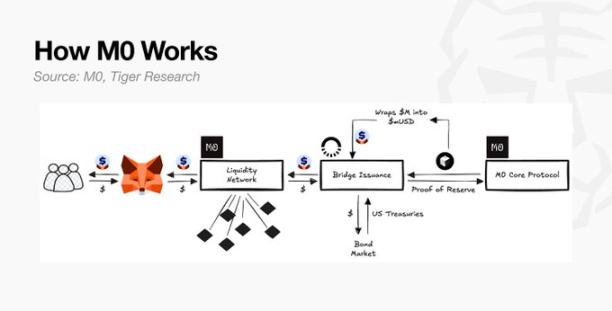
The case of MetaMask's mUSD clearly illustrates how these two roles collaborate in practice. MetaMask utilizes M0 technology to design and build its own stablecoin branded as mUSD, adding the necessary features and product layers. Bridge holds the regulatory license, manages the U.S. Treasury bonds serving as collateral, and fulfills platform-related obligations, ultimately minting and burning mUSD based on demand.
These two roles are completely separate. Bridge does not own the final application scenarios or products; MetaMask never touches the collateral. However, the stablecoin that ultimately reaches users can achieve instant 1:1 exchanges with all other M0-driven stablecoins, and liquidity has been shared from the first day of launch, eliminating the need to build from scratch.
The starting point for revenue streams is the interest generated from the collateral held by the issuers. While issuers collect this interest, they must separately pay the minting fee to the platform for the outstanding issuance volume (3.33% as of March 2026). M0's current circulating supply is approximately $276 million. As more issuers and builders adopt the platform, this number is expected to continue growing.
Regulatory Participation
M0 positions itself as a technology platform and structurally separates compliance obligations to each issuer.
The core module of M0's stablecoin embeds the compliance functions required by issuers at the technical level, including whitelist management, pausing transactions, and freezing assets. However, the actual execution of these functions, as well as all other regulatory obligations such as licensing, anti-money laundering, and know-your-customer, remain the direct responsibility of each issuer. M0 provides technical tools but does not replace the regulatory responsibilities that issuers must bear.
For this division of responsibilities to operate effectively in practice, issuers must comply with the relevant regulations in each market where they operate.
M0 believes that the U.S. is the fastest market for stablecoin regulatory progress. The enactment of the GENIUS Act in July 2025 established a federal regulatory framework for stablecoins, after which the demand for businesses adopting stablecoins has significantly accelerated. As major jurisdictions establish clear regulatory frameworks, the demand for stablecoins continues to expand, and M0's opportunity to establish its infrastructure as the market standard also increases.
Growth Strategy
M0's current priority is to expand the total circulation of M0-driven stablecoins on the platform. Since revenue based on spreads expands with circulation volume, developing the network of builders and issuers is the most critical metric at this stage. In public interviews, CEO Luca Prosperi stated that network expansion will be a top priority in the next two to five years.
The builder base has diversified across wallets, gaming, fintech, and payments, with participants including MetaMask, Exodus, Noble, Usual, and Kast. With the acceleration of corporate adoption demand following the introduction of the GENIUS Act, now is the best time to expand the issuer network. How many issuers and builders M0 can attract to its platform during this window will determine its long-term market position.
Key Takeaways
M0's case reveals a shift in the competitive landscape of the stablecoin market: competition is shifting from "which stablecoin achieves the highest circulation" to "who first controls the network of issuers and builders and infrastructure standards."
First, rapid integration can generate network effects. Building on M0 infrastructure automatically gains compatibility with all stablecoin functionalities on the platform, eliminating the need for repetitive integration development work for each stablecoin.
Second, the value of infrastructure grows with market scale. Not every company has the capability to independently issue stablecoins. As more issuers join, the value of shared infrastructure capable of handling licensing, technology, and liquidity management will continue to rise. This is precisely why M0's structural advantages can continue to strengthen alongside market growth.
As long as the stablecoin market does not trend towards a highly concentrated pattern dominated by a few players, the value of a universal infrastructure connecting numerous issuers and builders will continue to rise. The key question for the future is whether the shared standards promoted by M0 can become the foundational layer of the industry.
KRWQ: Bringing the Korean Won On-Chain
KRWQ is a stablecoin pegged to the Korean won, launched in October 2025 through a collaboration between IQ and Frax. Notably, there is currently no domestic regulatory framework for Korean won-denominated stablecoins.
The target market for KRWQ is not the domestic Korean market but the offshore market. The Korean won is a currency that can only be legally traded within South Korea, but there is significant demand from foreign investors who wish to hedge or speculate on the volatility of the Korean won exchange rate. For example, foreign investors holding Samsung Electronics stock are fully exposed to the volatility of the Korean won exchange rate: a stronger dollar means losses, while a weaker dollar means gains. Even investors wishing to eliminate this risk cannot directly hedge their Korean won exposure from outside Korea.
This has led to the emergence of non-deliverable forward products: contracts settled in U.S. dollars, with the settlement amount being the difference between the agreed exchange rate and the actual exchange rate, without involving direct exchange of the Korean won. Based on this structure, the Korean won non-deliverable forward market has developed into one of the largest markets in the world for non-deliverable forwards.
KRWQ's strategy is to first capture this offshore demand and then enter the domestic market once the regulatory framework is established. This is a "first offshore, then onshore" approach, but in reverse order compared to traditional paths.
Business Model
The existing non-deliverable forward market is an over-the-counter market built around bilateral negotiations between banks, characterized by opaque pricing and high transaction costs. The Korean government's restrictions on offshore Korean won transactions have narrowed the pool of qualified participants and suppressed liquidity. Additionally, trades must wait for contract expiration to settle, creating inherent counterparty risks.
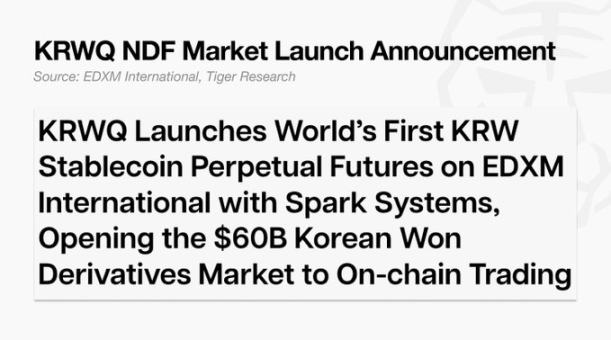
The Korean Won Cash Company aims to address these limitations through perpetual contracts. Non-deliverable forwards and perpetual contracts are structurally the same product: neither directly exchanges Korean won, both settle in U.S. dollars based on price differences, and both can be used to hedge or speculate on Korean won exchange rate risks. The only difference is the expiration date: non-deliverable forwards have fixed expiration dates, while perpetual contracts have no expiration date, can operate on-chain around the clock, and provide the same functionality at lower costs. Recently, KRWQ has launched a non-deliverable forward market through EDXM International.
Regulatory Participation
The Korean Won Cash Company adopts a dual-track strategy: first establishing business in the offshore market and then entering the onshore market once domestic regulation is improved.
The design of KRWQ has preemptively referenced the stablecoin-related legislation currently under review by the Korean National Assembly, aiming to become the first Korean won stablecoin compliant with regulatory requirements. However, the legislative environment in Korea remains complex. Regulatory uncertainty poses a barrier to market entry in the short term, but for the Korean Won Cash Company, it also provides time to establish a leading advantage in offshore liquidity ahead of competitors.
In the final phase, the Korean Won Cash Company plans to collaborate with regulated banking institutions in Korea to enable direct deposits and withdrawals of Korean won to support the issuance and redemption of stablecoins.
Growth Strategy
KRWQ's growth strategy is divided into three phases.
Phase One, Capturing Offshore Demand (Current Phase): Establishing trading infrastructure for perpetual contracts based on KRWQ, targeting offshore institutions and decentralized finance protocols.
Phase Two, Onshore Transition: Once domestic legislation is passed, leveraging the established offshore liquidity and infrastructure as a foundation to enter the Korean domestic market.
Phase Three, Replicating and Promoting to Other Asian Currencies: In addition to the Korean won, the Indian rupee, New Taiwan dollar, and Indonesian rupiah are all major non-deliverable forward currencies in Asia. These currencies share the same structural characteristics as the Korean won, namely capital controls, while also having active offshore non-deliverable forward markets.
Key Takeaways
First, the lack of regulation can become an opportunity rather than a passive waiting period. In the Asian stablecoin market, regulation is often seen as a prerequisite for market entry, and most participants are indefinitely waiting for legislation to be enacted. The Korean Won Cash Company takes a different perspective: regardless of domestic regulation, there is real demand in the offshore market that has already been operating. Offshore liquidity can serve as leverage for entering the onshore market.
Second, the Korean won non-deliverable forward market has been operating outside the jurisdiction of domestic regulation. The Korean Won Cash Company has taken the lead in absorbing this demand. When the regulatory framework is established, it will enter the Korean domestic market with already established offshore liquidity and infrastructure. Its strategy is not to wait but to initiate in areas that have already generated revenue.
Where do latecomers still have opportunities?
The stablecoin market is highly concentrated, with Tether and USDC accounting for over 85% of the total supply. It is unrealistic for new entrants to compete on the same reserve interest model. However, the cases analyzed in this report indicate that there are multiple paths to enter this market.
The core principle for latecomers is to avoid competing with Tether and Circle on the same dimension. Winning in the reserve scale race is impossible, but unique positioning can be found in different directions: payment networks, issuance infrastructure, offshore markets, etc. As the stablecoin market expands, the diversity of competitive forms is also increasing. This industry is not repeating a single model but is moving towards differentiation, forming a market landscape where multiple different strategies coexist.
It is worth noting that the entities discussed in this report are no longer challengers but have become leaders in their respective fields. While drawing lessons from their practices is valuable, mere replication is not enough. The next generation of entrants must define and address new problems that these pioneers have not yet covered.
Ultimately, the companies that can survive in the stablecoin issuance market will not only be those with differentiated entry strategies but also those that can execute these strategies and solve the new problems that arise during the scaling process. The market has moved beyond the stage of "who can find a new model" to "who can truly implement and operationalize the model."
Latest News
ChainCatcher
4月 10, 2026 09:00:00
ChainCatcher
4月 10, 2026 08:58:20
ChainCatcher
4月 10, 2026 08:54:56
ChainCatcher
4月 10, 2026 08:44:19
ChainCatcher
4月 10, 2026 08:23:02