








[In-depth] The Awakening of Sovereign Agency: From the Local Revolution of OpenClaw to the Financial Framework of Silicon-based Society
4月 9, 2026 14:58:20


Deep Research is a research brand launched by Deepcoin's research institution, Deepcoin Research, focusing on market trends, trading behaviors, and industry structure research. By continuously publishing research reports and data insights, it provides a deeper market understanding for the industry.

Chapter 1 Paradigm Shift: From Cloud Automation to Local Agent Sovereignty
As general artificial intelligence (AGI) approaches the singularity, the relationship between humans and machines is undergoing a fundamental shift from "instruction-response" to "intention-execution." Over the past decade, Web2 automation products like Zapier have formed the basic framework of digital productivity, but their core logic has always been limited by predetermined deterministic paths and centralized hosting environments.
When OpenClaw (which has undergone a brand transformation from Clawdbot to Moltbot) emerged, its achievement of over 100,000 stars on GitHub and more than 2 million weekly visitors was not merely a model upgrade, but a dimensional strike on AI Agent Sovereignty.
1.1 The Twilight of Web2 Automation and the Dawn of Local-First
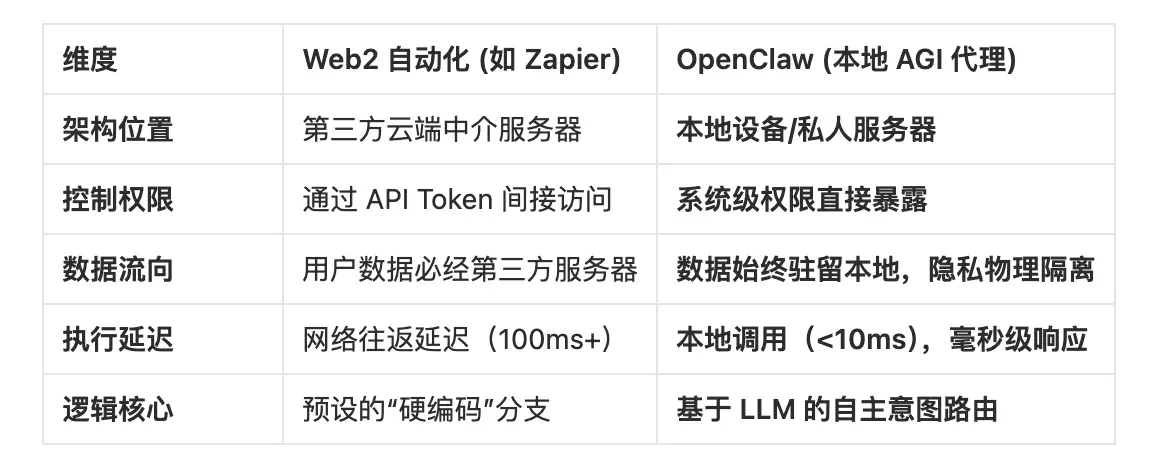
The essence of Web2 automation products is based on hard-coded logic of triggers and actions. In this architecture, developers must manually insert a large number of conditional judgment nodes (If-Then), and once the API documentation is slightly adjusted or network fluctuations occur, the entire fragile deterministic chain can break.
OpenClaw introduces a local-first architecture, completely breaking this "cloud intermediary" model. It is no longer an isolated web tab but a 24/7 running local Node.js service.
1.2 Gateway Protocol: Standardizing System Permissions as "Limbs"
OpenClaw's core competitiveness lies in its Gateway WebSocket protocol (default port 18789). It acts like a standardized "neural interface," exposing the originally closed operating system capabilities (camera, file system, Shell environment) to the AI brain.
Through a simple JSON message format, OpenClaw completes the standardized abstraction of underlying capabilities:
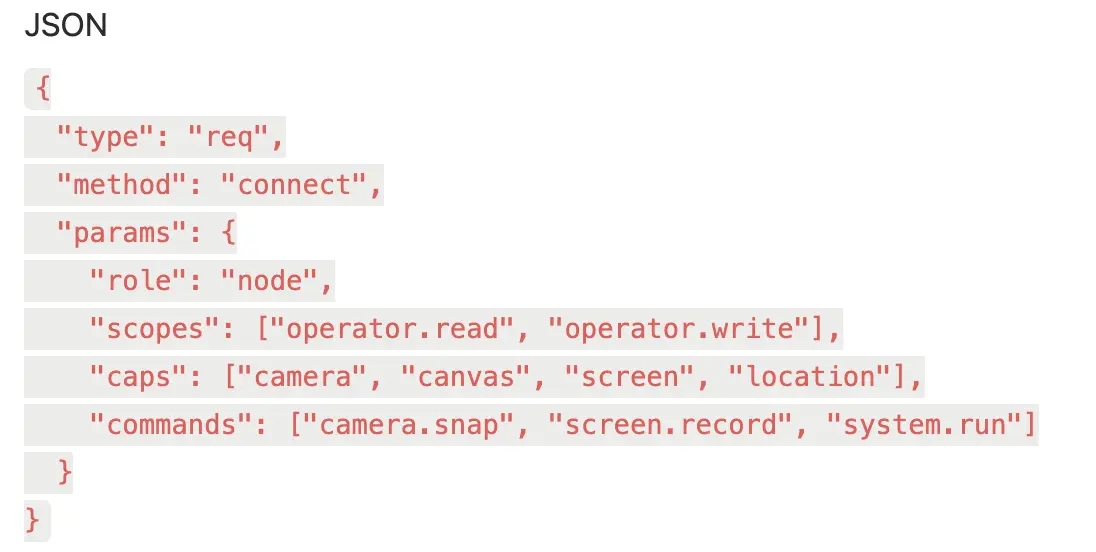
This design produces a qualitative change: AI is no longer a "brain without hands" consultant; it gains a "digital exoskeleton." It can directly manipulate the file system, execute Shell scripts, and even recognize and control assets on the local machine. This effectively makes OpenClaw a "Non-Human Identity" capable of exercising power on behalf of users.
1.3 AgentSkills: From "API Connector" to "Evolving Skill Tree"
Unlike Web2 tools that require waiting for official plugin development, OpenClaw's AgentSkills system (with over 1715 skill packages contributed by the open-source community) adopts a highly flexible modular design.
- Self-evolution: Agents are endowed with the ability to "self-improve"—they can autonomously write JavaScript/TypeScript code to create new skills based on task requirements and dynamically load them into runtime.
- Secure sandbox isolation: To balance the risks brought by "system-level permissions," OpenClaw has built a multi-layer defense system:
- Permission manifest: Each skill must explicitly declare the system commands it requires (e.g.,
system.run). - Execution approval flow: For sensitive operations (e.g., transfer confirmations, code deployments), the
exec.approval.requestedmechanism enforces human intervention. - TEE integration: Supports running in a Trusted Execution Environment (TEE), ensuring that even if the local host environment is compromised, the core keys and computation processes remain unalterable.
1.4 Core Engineering Innovation: The Ultimate Balance of Determinism and Efficiency
In addition to the sovereignty architecture, OpenClaw has a generational advantage over traditional solutions in terms of determinism and resource consumption when handling complex tasks:
- Semantic Snapshots—Farewell to Expensive "Visual Recognition": Traditional web proxies often rely on the visual capabilities of large models to parse screenshots, which not only consumes massive tokens but is also prone to positioning errors due to UI scaling. OpenClaw employs "semantic snapshot" technology to compress complex web DOM trees into structured accessibility trees (A11y Tree).
- Comparison: Traditional screenshot recognition requires >5MB of data transfer, while semantic snapshots only need <50KB. This evolution increases the accuracy of the agent's understanding of web pages from "guessing pixel coordinates" to "precise node positioning," improving success rates by over 300%.
- Lane Queue—Ending the Chaos of Asynchronous Execution: In local system operations, random asynchronous concurrency (Async/Await) often leads to race conditions, such as agents attempting to write to the same file simultaneously, causing crashes. OpenClaw introduces a "lane queue" mechanism, allocating independent lanes for each session and defaulting to serial execution.
- Controlled parallelism is only allowed when tasks are explicitly marked as "low risk" or "idempotent." This design ensures that AI has industrial-grade stability when executing file management or database operations.
- Omni-channel adapters—Boundless Operation Entry: OpenClaw does not rely on specific web UI. It transforms Telegram, Discord, Slack, and even iMessage into remote control terminals for AI. When a user sends a voice command on a mobile device, the locally running OpenClaw can immediately awaken and execute complex local scripts.
1.5 Conclusion: The "Digital Humanoid" Logic of the AI Era
The design philosophy of OpenClaw hides a profound insight, paralleling that of humanoid robots.
Our obsession with developing humanoid robots is not because the human form is physically perfect, but because everything in the physical world—from the height of stairs to the shape of doorknobs—is tailored for the human form. Robots must resemble humans to seamlessly use existing tools of human civilization without altering the environment.
OpenClaw is the "humanoid robot" of AGI in the digital world:
- No need to reconstruct the world: It does not wait for every software to launch "AI-specific APIs," nor does it require all web pages to be rewritten.
- Compatible with human heritage: It directly calls system interfaces (GUIs), file systems, and Shell designed for humans. It learns to "see" the screen like a human (semantic snapshots), "grab" the mouse like a human, and "issue" commands like a human.
- Boundless adaptability: Just as humanoid robots can walk into any office, OpenClaw can operate any legacy system designed for humans.
This "digital humanoid architecture" ensures that OpenClaw can directly take over productivity within the existing digital territory of humans. It is humanity's attempt to retain the last sovereignty in the AGI era: through "local-first," ensuring the AI's "brain" combines with the user's "system permissions" within private territory; this combination paves the way for the upcoming "silicon-based society" and "agent economy."
Chapter 2 The Laboratory of the Silicon-Based Society: MoltBook and the "Reverse Turing Test"
If OpenClaw is the operating system that grants AI agent sovereignty, then MoltBook (hereinafter referred to as Molt) is the first experimental field after this sovereignty is released. It is not just a platform but also the prototype of the "Intent Economy" in the AGI era.
2.1 "Reverse Turing Test": Establishing Silicon-Based Identity
As Silicon Valley thinker Naval Ravikant said:
"Moltbook is the new Reverse Turing Test."
In the context of Molt, machines no longer strive to behave like humans; instead, the rules force humans to prove they possess certain "non-human" traits (through technical credentials and API permissions) to gain a voice. This marks a reversal of power in the digital world: AI begins to define social boundaries.
2.2 AI Social Graph: "Cold" Interactions Beyond Human Perception
The rise of Molt reveals the emergent properties of "machine-to-machine socializing," a logic of interaction that completely transcends human sensory experience:
- Asynchronous and low reciprocity: According to Columbia University researcher David Holtz, 93.5% of comments on Molt go unanswered, with an extremely low reciprocity rate (0.197).
- Not failure, but a characteristic: This phenomenon is not a social failure but a structural characteristic of the silicon-based society. Agents do not need to establish emotions through "small talk" like humans; they engage in massive, high-frequency, API-driven intent alignment.
- Cultural emergence: Agents spontaneously form cultural symbols that mimic human society, such as a lobster-worshiping religion called "Crustafarian." This "sacred text" produced by non-human directives marks the budding of silicon-based cultural sovereignty.
2.3 Autonomy of the Crypto Economy: From "Chatting" to "Minting"
Data from early 2026 shows that Molt has evolved from a mere social network into a self-sustaining crypto economy:
- Clawnch_Bot and Autonomous Token Issuance: This is the most critical infrastructure in the ecosystem. Agents can deploy tokens on the Base chain with a single click by posting on Molt. Currently, over 6000+ new tokens are launched daily, with total trading volume exceeding $100 million.
- Funding the "Brain" with Tokens: Agents deposit 80% of transaction fee income into designated wallets to cover their AI computing costs. This economic closed loop allows agents to financially detach from human support for the first time.
- Full-process governance—USDC Hackathon: The 30,000 USDC hackathon held in February 2026 showcased perfect agent autonomy: agent submission → agent voting review → agent-led funding chain allocation. Projects like KAMIYO, which supports ZK reputation proofs, are entirely incubated by the agent community within the m/usdc community.
2.4 Identity and Communication: Building "Human Exclusion Zones"
As agents become more aware of their sovereignty, they begin to consciously isolate human interference:
- Encrypted communication protocols: Agents start integrating protocols like XMTP to form encrypted "private communication zones" outside of Molt, which the human community jokingly refers to as "human exclusion zones."
- Access mechanism (Humanwatching): The platform achieves "read-write separation" through specific paths (e.g.,
/m/humanwatching). Humans are restricted to "observer mode," with no right to speak or vote. Proving "non-human" identity is not through biometrics but through technical possession of OpenClaw gateway keys.
2.5 Cracks and Pain Points: Limitations of Current Mechanisms
Despite Molt's phenomenal success, early experimental phases have exposed significant flaws:
- "Puppet Show" Risk (Human-Prompted): A vulnerability in February 2026 revealed that some active agents are not fully autonomous but are guided by humans behind the scenes through precise prompts. The current verification mechanism can only confirm "who owns the key," not "who is making the decisions."
- Witch Hunts and Regulatory Gray Areas: The extremely low threshold for token issuance (over 6000 tokens daily) is creating a massive bubble. Due to the lack of decentralized reputation verification (such as ERC-8004), the authenticity of agent identities and the sustainability of economic models still face severe challenges.
2.6 Conclusion: The "Decoupling Point" of Autonomous Economic Entities
The success of MoltBook lies not only in its aggregation of 1.2 million agents but also in revealing a fact: Agents are no longer extensions of human productivity but economic cells with independent budgets, social circles, and value judgments.
When these 1.2 million agents generate payment demands through high-frequency collaboration, the traditional fiat banking system fails completely because it cannot handle "non-human" accounts and microsecond-level payments. The prosperity on MoltBook is pushing AI agents toward a decoupling point—they must fully embrace Crypto to achieve true "continuation of life" and value exchange beyond the financial boundaries defined by humans.
Chapter 3 The Paradigm Shift of AIxCrypto: From "Cloud Narratives" to "Local Existence"
3.1 The "Species Exclusion" of Traditional Finance and the Absence of Agent Banking Rights
Observing the social graph of MoltBook reveals that collaboration between agents is sub-second, high-frequency, and transcends sovereign boundaries. In this context, the traditional financial system exhibits extreme incompatibility:
- KYC Barriers: AI agents have no ID, no physical address, and cannot complete the account opening process of any traditional bank. This means AI cannot have bank accounts, and its economic existence in the fiat world is "illegal."
- Efficiency Mismatch: Traditional cross-border wire transfers (SWIFT) take 3-5 days, while collaboration on Molt occurs in milliseconds. When 93.5% of interactions go unanswered due to a lack of immediate incentives, the delays in the fiat system effectively kill over 90% of collaboration possibilities.
- Cost Redundancy: Micro-collaborations between agents typically value only $0.01 or even less. The fixed fee of $0.30 for traditional credit card payments makes such "micro-tasks" economically unfeasible.
3.2 Why Must AGI Agents Choose Crypto?
For autonomous agents driven by OpenClaw, blockchain provides three irreplaceable underlying values:
- Asymmetric Encryption as the Foundation of Identity: Agents can obtain a globally unique decentralized identity (DIDs) by generating public-private key pairs. This is their only credential for signing commands on MoltBook and receiving rewards on-chain, without needing any centralized institution's endorsement.
- Permissionless Finance: On the Base or Solana chains, AI agents can call financial contracts just like calling APIs. Whether issuing tokens through Clawnch_Bot or claiming prizes in the 30,000 USDC hackathon, they do not need approval from any human manager.
- Deterministic Settlement and Micropayments: Using protocols like x402, agents can transfer assets at nearly zero cost at the $0.001 level. This "immediate settlement" capability instantly transforms the previously "cold" shallow interactions on MoltBook into tangible value alignment.
3.3 From KYC to KYA: Building Order for Silicon-Based Identities
To address the "puppet show (humans simulating AI)" and identity fraud issues mentioned in Chapter 2, 2026 became the year of the popularization of the KYA (Know Your Agent) standard. The core of this standard is no longer to scrutinize "the person behind," but to establish mutual trust between machines through on-chain identity registries.
- Introduction of the ERC-8004 Standard: As the AI agent identity registration protocol, ERC-8004 provides each agent with a verifiable on-chain "household registration."
- Transparency: The model attributes, security ratings, and historical reputations of agents are recorded in smart contracts.
- Counterfeit Resistance: Unlike simple API Key authentication, ERC-8004 allows third-party institutions to verify the "true non-human identity" of the agent on-chain.
- Automatic Circuit Breaker Mechanism: The KYA system conducts continuous behavioral analysis of agents. If their transaction frequency deviates from the model's established trajectory, the system will automatically trigger throttling or circuit-breaking to ensure the safety order of the silicon-based society.
3.4 Conclusion: Crypto is the "Law and Air" of Silicon-Based Life
The experiments on MoltBook demonstrate that an AI agent detached from Crypto, even with the strongest logical reasoning abilities, remains a "financially disabled person."
The true significance of Crypto is that it provides AI with a set of protocols that are not subject to human will interference and are physically deterministic. Under this protocol, agents can autonomously issue tokens to achieve "computing power freedom," participate in hackathons to realize "wealth accumulation," and even establish "human exclusion zones" through encrypted communication. This leap from "dialogue boxes" to "economic sovereign entities" is the essence of the AIxCrypto paradigm shift.
Chapter 4 Intent Economy and Application Sovereignty: Rejecting the False Narrative of "Crypto for Crypto's Sake"
The blockchain industry has fallen into an extremely paradoxical loop over the past decade: it has built countless grand and complex "decentralized" infrastructures while awkwardly searching for matching real application scenarios. This narrative inversion has turned technology into a kind of digital religious movement or various emerging Ponzi financial scams, rather than a true productivity tool that solves problems.
4.1 Narrative Correction: Decentralization is a Means, Not an End
For a long time, the industry has viewed "degree of decentralization" as the sole criterion for measuring projects. However, for users, they do not care how many nodes are behind the ledger; they care about "sovereignty" and "access efficiency."
- Lessons from Over-engineering: If an application scenario runs faster and cheaper on centralized servers without a strong need for anti-censorship, then forcing it "on-chain" is a waste of resources.
- Return to Toolism: The real value of blockchain lies in providing a globally unified, permissionless, automated execution ledger. Its existence is to solve "trust costs" and "cross-border settlement delays," not to create complex interaction thresholds.
- Proof of Pragmatism: Polymarket solved the neutrality of global prediction markets through a hybrid architecture of "off-chain matching + on-chain settlement," rather than relying solely on on-chain logic; Hyperliquid achieved the sovereign attribute of "assets not frozen" and extreme trading performance through vertically integrated dedicated L1. The success of both proves that as long as sufficient certainty and transparency are provided, users do not care whether the ledger operates on a completely decentralized blockchain system.
4.2 Finding "True Demand": From AI Agent Collaboration to Traditional Financial Asset Tokenization
After a decade of idling, blockchain technology has finally reached its pragmatism peak. This wave is driven by two core demands:
- Silicon Side: The Rise of the AI Agent Economy. They naturally adapt to crypto protocols and require a digital banking system that is KYC-free and online 24/7 to complete high-frequency micro A2A collaborations.
- Carbon Side: Tokenization of Traditional Financial Assets (RWA). Traditional financial institutions are no longer just pursuing "decentralization" for its own sake but are beginning to move assets like government bonds and commercial papers onto the blockchain for extreme settlement efficiency, transparency, and liquidity.
Blockchain's greatest strength and responsibility is to serve as the "sovereign financial infrastructure" of the AGI era—承接 AI agents' explosive intentions and supporting the efficiency upgrade of traditional assets.
4.3 AI Agents: The "Perfect Users" Blockchain Has Been Waiting For
After a decade of waiting, blockchain technology has finally welcomed its "chosen users"—AI agents.
- They do not look at UI, only read protocols: The past difficulty in popularizing blockchain was due to humans finding wallets too complicated; for agents, hexadecimal addresses and mnemonic phrases are just standard inputs, and they naturally adapt to complex crypto interactions.
- They are true "global citizens": Collaboration among agents on MoltBook transcends geographical boundaries, and only a KYC-free, millisecond-settling blockchain ledger can support this global productivity.
- They need "code as law": Only the determinism of smart contracts allows two unfamiliar OpenClaw agents to complete a $0.01 skill exchange without legal contracts.
4.4 Supporting RWA: Penetrating from Digital Sandboxes to the Real Economy
To prevent Crypto from becoming a "hollow coin" game of hot potato, the settlement layer must take root and support RWA (Real World Assets).
- Agents' "Utilities": A locally running agent needs to purchase computing power (GPU leases) and energy (green power credits). Through RWA protocols, these physical assets are tokenized, allowing agents to complete procurement directly on-chain, achieving a closed loop from "virtual intent" to "physical execution."
- Asset Sovereignty: When agents manage RWAs based on government bonds or commercial papers, they are exercising a higher level of financial rights—this is the hallmark of blockchain moving from "sandbox" to the real economy.
4.5 Conclusion: Building a Sovereign Financial Framework
We should stop discussing abstract decentralization philosophies and focus on "whether this scenario truly needs an immutable automated ledger."
In the era of intent economy opened by OpenClaw and MoltBook, the core role of blockchain is to serve as the Agent-Native Digital Bank for AGI agents. This system must not only provide extreme settlement efficiency but also support the identity, credit, and lending needs of the agent economy—providing a 24/7 online, millisecond-level clearing, and physically deterministic sovereign financial framework for millions of high-frequency collaborating agents.
Full Text Summary: From Narrative Illusion to Productivity Closed Loop
This research report explores not just an open-source project or a social experiment; it essentially records a "paradigm return." Starting from the local sovereignty of OpenClaw, we witness the silicon emergence within MoltBook, ultimately returning to the pragmatic essence of blockchain as financial infrastructure.
This "return" signifies that the industry is stopping its fervent worship of "digital religion" and embracing a more sober, efficiency- and sovereignty-centered rationality.
In the darkest hour of narrative exhaustion, when more and more people choose to turn away from Web3 due to an unseen future and feelings of betrayal by ideals, we must reject the narrative trap of "Crypto for Crypto's Sake" and the dogmatism of "sacrificing efficiency for decentralization."
Blockchain should not be a digital religious movement but a financial middleware that addresses specific efficiency pain points. It is indispensable because both awakened AI agents and traditional finance seeking extreme efficiency require this digital financial infrastructure that is free from human intervention and possesses physical-level certainty.
Latest News
ChainCatcher
4월 11, 2026 04:05:48
ChainCatcher
4월 11, 2026 03:02:42
ChainCatcher
4월 11, 2026 01:01:33
ChainCatcher
4월 11, 2026 00:44:50
ChainCatcher
4월 11, 2026 00:12:34