








The Great Migration of Traditional Finance: A Financial Infrastructure Reconstruction in Progress
Apr 7, 2026 16:47:04


TL;DR
Background: The on-chain actions of traditional financial institutions have officially entered the "infrastructure-level deployment" stage from "pilot exploration."
Journey: Private chain → Public chain integration | Experiment → Production-level deployment | Technology-driven → Compliance-driven
Framework: Tokenized deposits/funds, trading and settlement, automation of corporate actions, collateral and custody systems fully on-chain. Ecosystem: Banks, asset management, clearing institutions, exchanges, custodians, and infrastructure providers are all participating. Risks: Fragmentation of interoperability | Regulatory uncertainty | High integration costs | Security still needs verification | Institutional adoption inertia. Opportunities: Large market expansion potential | Efficiency dividends are certain | New types of financial products are emerging | Lower barriers to investor access. Conclusion: The focus of competition is not "whether to go on-chain," but who can occupy a core position in the new infrastructure.
The on-chain actions of traditional financial institutions have officially entered the "infrastructure-level deployment" stage from "pilot exploration." This is not just a simple technological trial, but a fundamental restructuring of the global financial system: settlement has been shortened from T+2 to real-time, funds have transformed from static deposits to programmable assets, and cross-border payments have shifted from multi-day waits to completion in minutes. Ordinary investors may not have fully felt it yet, but this transformation is quietly reshaping the rules of wealth management, payment clearing, and asset allocation.
I. Background and Motivation: Why Do Traditional Financial Institutions Go On-Chain?
The inefficiency of the traditional financial system has long been an open secret. Stock settlement takes T+2, government bond trading requires manual reconciliation, cross-border remittances can take 3-5 days, and fees are layered on… According to a joint report by Boston Consulting Group (BCG) and Ripple, the implicit costs of inefficient settlement globally amount to hundreds of billions of dollars each year. Blockchain offers a "real-time, programmable, transparent" solution:
- Real-time settlement: On-chain transactions can achieve T+0 or even instant finality, reducing counterparty risk.
- Programmability: Smart contracts automatically execute corporate actions (dividends, redemptions), and manage collateral, reducing human error.
- Increased liquidity: 24/7 trading allows fragmented assets to circulate globally.
- Cost compression: Reduced intermediary steps; according to JPMorgan, inter-institutional payment costs can be reduced by over 80%.
- New business scenarios: The combination of tokenized deposits and stablecoins can create "bank-grade" on-chain currency, seizing the trillion-dollar blue ocean of DeFi and TradFi integration.
- Regulatory easing and competitive pressure: The 2025 U.S. GENIUS Act outlines a framework for stablecoins and tokenized products, the European MiCA regulation is implemented, and Hong Kong's HKMA Ensemble project and Singapore's Project Guardian provide sandbox support. These policy signals have shifted financial institutions from "wait-and-see" to "rushing ahead." BlackRock CEO Larry Fink stated in his 2026 outlook that tokenization will be a "turning point for global markets," akin to the internet in 1996.
For ordinary investors, this means: in the past, they could only buy traditional money market funds, but now they can achieve similar returns through on-chain products with real-time liquidity; corporate treasury management has shifted from "bank windows" to "on-chain wallets," significantly increasing fund utilization.
II. Development Process of Traditional Financial On-Chain
The on-chain process of traditional financial institutions is not a short-term explosion but a gradual evolutionary path spanning a decade, fundamentally a migration of financial infrastructure from a "closed system" to a "programmable open network."
(1) Germination and Validation Period (2015--2020)------"Can it be done?"
The core keyword of this stage is proof of concept, and financial institutions remain highly cautious during this period. JPMorgan launched the Onyx platform based on a consortium chain in 2016 (later evolved into Kinexys) to test inter-institutional payment and settlement efficiency; Ripple collaborated with several banks on a cross-border settlement network to validate the feasibility of distributed ledgers in international remittances; technology providers like Consensys and Chainlink promoted enterprise-level blockchain pilots.
Overall, this stage was still limited to private or consortium chain environments, with limited business scale, mainly addressing the question of "is the technology usable," rather than commercial implementation.
(2) Early Explosion of RWA (2021--2023)------"Can it be scaled?"
As the DeFi ecosystem matured and institutional awareness increased, on-chain activities began to enter the phase of real asset (RWA) implementation. Franklin Templeton launched the BENJI on-chain fund, achieving the first issuance and circulation of traditional fund shares on a public chain; multi-chain deployments began to emerge, marking that assets were no longer limited to a single chain environment; institutions began to explore the integration path of "on-chain + compliance."
A hallmark turning point of this stage is: assets truly "go on-chain," rather than merely simulating bookkeeping on-chain.
(3) Acceleration Transformation Period (2024--2025)------"Can it form a closed loop?"
Entering 2024, on-chain activities welcomed a critical leap, driven by two main factors: the gradual clarification of regulations (such as the U.S. GENIUS Act and European MiCA) and the maturity of technological infrastructure (Layer 2, cross-chain protocols). Against this backdrop, on-chain finance began to form a complete closed loop:
- Asset side: Tokenized government bonds, funds, deposits;
- Payment side: Stablecoins, tokenized deposits;
- Infrastructure side: On-chain clearing, custody, and collateral management.
Typical cases include: Europe's Societe Generale issuing compliant stablecoins through SG-FORGE, integrating into the Deutsche Börse clearing system; Hong Kong's Whale platform facilitating real corporate fund transfers between HSBC and Standard Chartered; the U.S. banking system beginning to test stablecoins and tokenized deposits based on public chains. The essence of this stage is: on-chain finance has transitioned from "point applications" to "system engineering."
(4) Infrastructure-Level Deployment Period (2026 to Present)------"Will it become the new standard?"
2026 marks the true entry of on-chain activities into the "production-level era." Key features include:
- Core financial infrastructure on-chain: DTCC promotes a government bond tokenization system;
- Multi-chain deployment becomes standard: BlackRock's BUIDL has expanded to multiple public chain ecosystems;
- Banks native to public chains: JPMorgan's tokenized deposits (JPMD) directly support Base and Canton Network;
- Market scale rapidly increases: The scale of RWA non-stablecoins grew from about $14 billion at the beginning of 2025 to about $27.5 billion, with a significant increase in institutional share.
The core change of this stage is: blockchain is no longer an "external tool," but has become part of the financial system itself.
Looking back at the entire development path, it can be abstracted into three key main lines:
- From private chain → public chain integration: Early emphasis on closure and control has gradually shifted towards open networks and interoperability;
- From experiment → production-level deployment: Transitioning from PoC validation to real capital flow and core business support;
- From technology-driven → compliance-driven: KYC/AML embedding, regulatory sandboxes, and audit systems provide institutional foundations for on-chain finance.
III. Current Status of Traditional Financial On-Chain Reconstruction and Representative Cases
The on-chain actions of traditional financial institutions are not a simple technological overlay but a reconstruction of the underlying logic of the financial system. The on-chain reconstruction of deposits/funds and trading settlement is just the starting point; blockchain is penetrating the operational backend, risk management, and custody, forming a closed loop.
1. Tokenization of Deposits/Funds
This direction is the "fundamental basis" of on-chain activities, focusing on converting traditional bank deposits and money market funds into 1:1 pegged blockchain tokens, supporting real-time transfers, automatic execution, and 24/7 liquidity.
According to the latest data from RWA.xyz, the value of RWA on-chain assets has reached $27.5 billion, with over 700,000 holders, nearly doubling since early 2025; among them, the scale of tokenized U.S. government bonds exceeds $12.86 billion, with a year-on-year growth of over 120%. BlackRock's BUIDL fund, JPMorgan's Kinexys platform, Hong Kong's Whale platform's tokenized deposits, and DTCC's upcoming government bond tokenization service… these once "pilot projects" have now become part of the core infrastructure of traditional financial institutions.
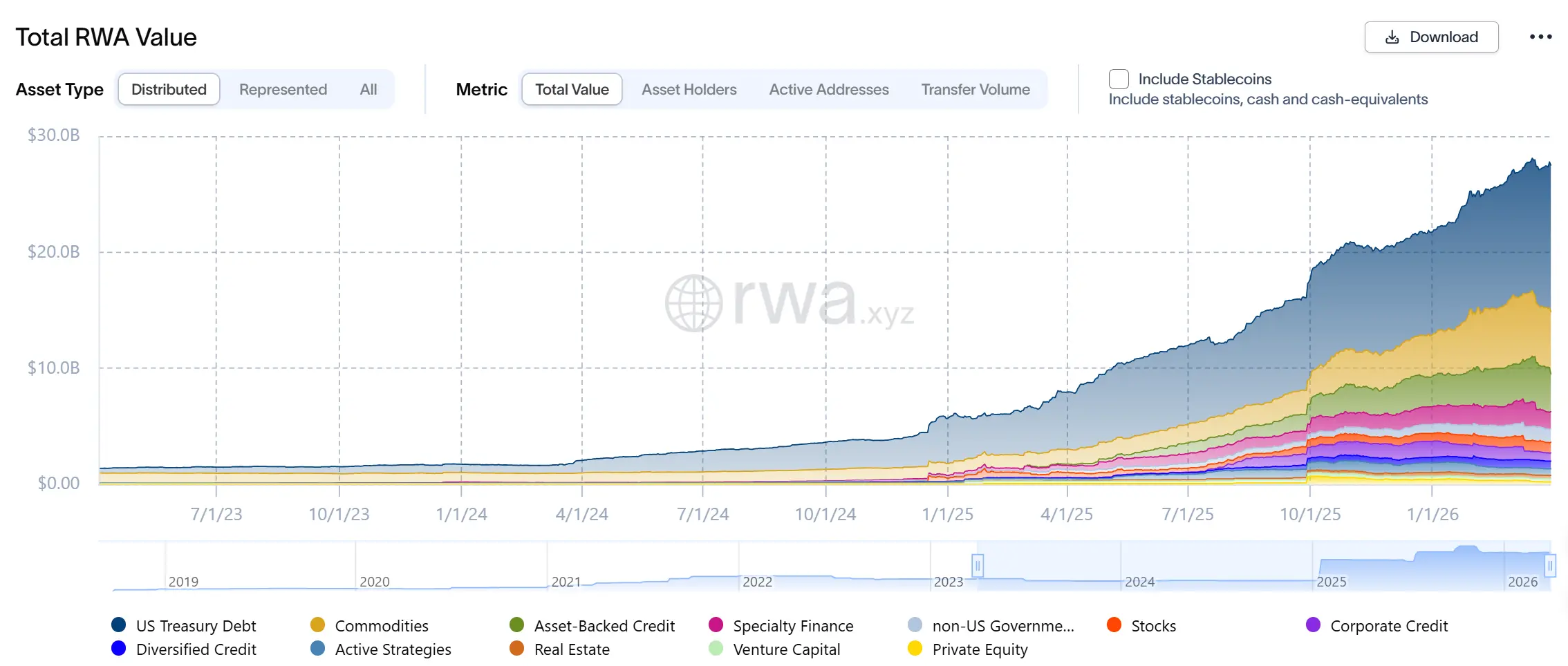
Source: https://app.rwa.xyz/
Representative Cases:
- JPMorgan Kinexys/JPMD: JPMD tokenized deposits are 1:1 pegged to bank deposits, supporting automatic issuance, transfer, and redemption, with the underlying still earning interest. By 2026, it has natively deployed on the Base public chain and Canton Network, achieving real-time multi-currency settlement between institutions, processing over $2 billion daily, with a cumulative total exceeding $15 trillion.
- BlackRock BUIDL Fund: A tokenized money market fund, with underlying assets in U.S. government bonds and cash equivalents, yielding approximately 3.5-4% annually. By early 2026, it expanded to five public chains: Polygon, Arbitrum, Avalanche, Optimism, and Polygon, supporting 24/7 trading and collateral usage, with a scale exceeding $2.2 billion, accounting for nearly 20% of the tokenized government bond market.
- Franklin Templeton BENJI Fund: Operates on multiple chains including Stellar, Ethereum, Polygon, and Solana, managing over $580 million, supporting daily dividends and compliant trading.
- Hong Kong Whale Platform: In collaboration with HSBC, Standard Chartered, and Ant International, it achieved cross-bank real-time transfers of tokenized deposits in HKD/USD/CNY offshore/SGD by the end of 2025 (single transaction of HKD 38 million), with corporate wallets allowing 24/7 fund transfers.
- Societe Generale SG-FORGE CoinVertible: A MiCA-compliant euro/USD stablecoin (essentially an extension of tokenized deposits), embedded in Deutsche Börse Clearstream for collateral management and securities settlement.
2. On-Chain Reconstruction of Trading and Settlement
The reconstruction of the trading and settlement side focuses on the blockchain upgrade of exchanges and clearing infrastructure, achieving 24/7 trading, instant (T+0) settlement, and stablecoin financing.
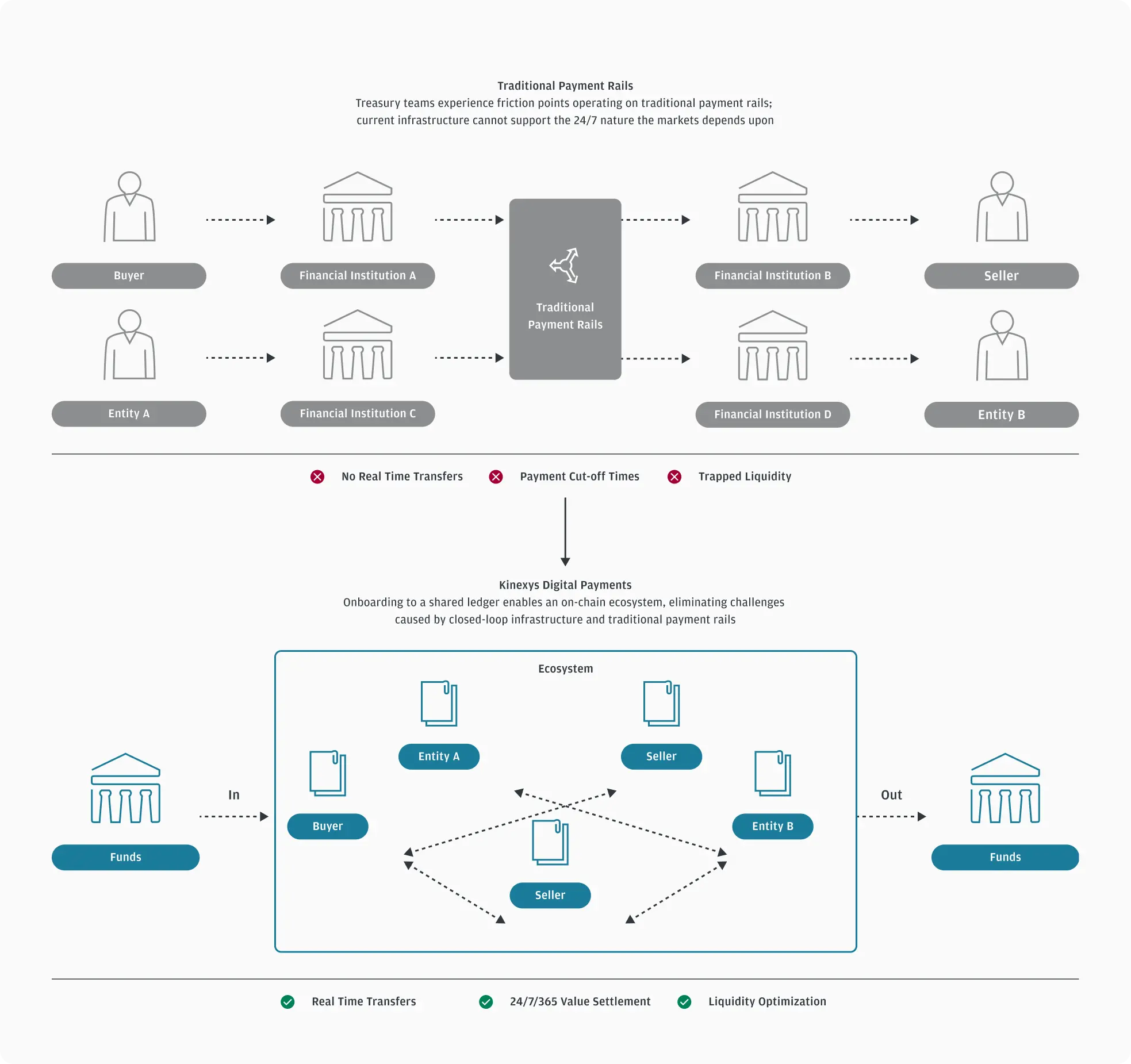
Source: https://developer.payments.jpmorgan.com/
Representative Cases:
- NYSE Digital Trading Platform: Announced on January 19, 2026, the independent development of a tokenized securities platform, supporting 24/7 trading and instant on-chain settlement for U.S. listed stocks and ETFs. In March 2026, it partnered with Securitize, which serves as the digital transfer agent responsible for minting blockchain-native securities. Collaborating with banks like BNY Mellon and Citi, it integrates tokenized deposits into clearing fund management, achieving atomic-level DvP (delivery versus payment).
- DTCC Canton Network Government Bond Tokenization: MVP launched in the first half of 2026, providing tokenization services for U.S. government bonds held in DTC custody. As the world's largest securities depository, this move directly transforms trillions in liquidity into programmable assets.
- Nasdaq Tokenized Stock Rules: Partially approved by the SEC, allowing tokenized versions of stocks to trade in parallel on existing exchanges.
This reconstruction allows institutional trading to shift from "workday T+2" to "global real-time," significantly reducing counterparty risk and capital occupation.
3. Automation of Corporate Actions and Asset Services
According to data from the U.S. Depository Trust & Clearing Corporation (DTCC), the cost of processing traditional corporate actions (dividends, voting, mergers) reaches $58 billion/year, and blockchain + AI can achieve data standardization and real-time distribution.
Representative Cases:
- Chainlink Global Industry Initiative: Involving 24 institutions, including Swift, DTCC, Euroclear, UBS, DBS Bank, BNP Paribas Securities Services, etc. AI extracts structured data from announcements, which is then verified by Chainlink CRE and converted to ISO 20022 standards, distributed cross-chain to traditional systems and on-chain smart contracts, achieving minute-level delivery.
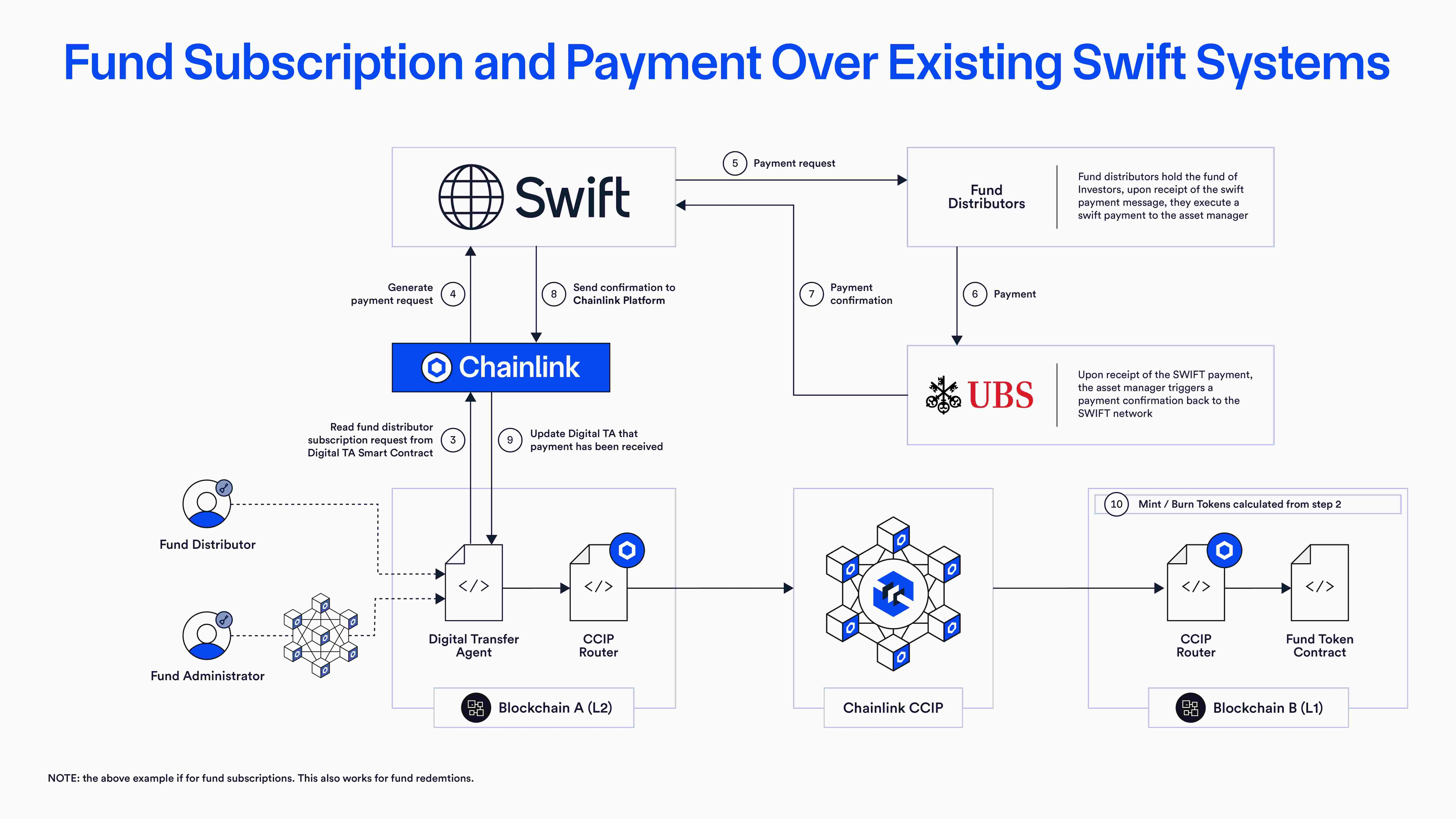
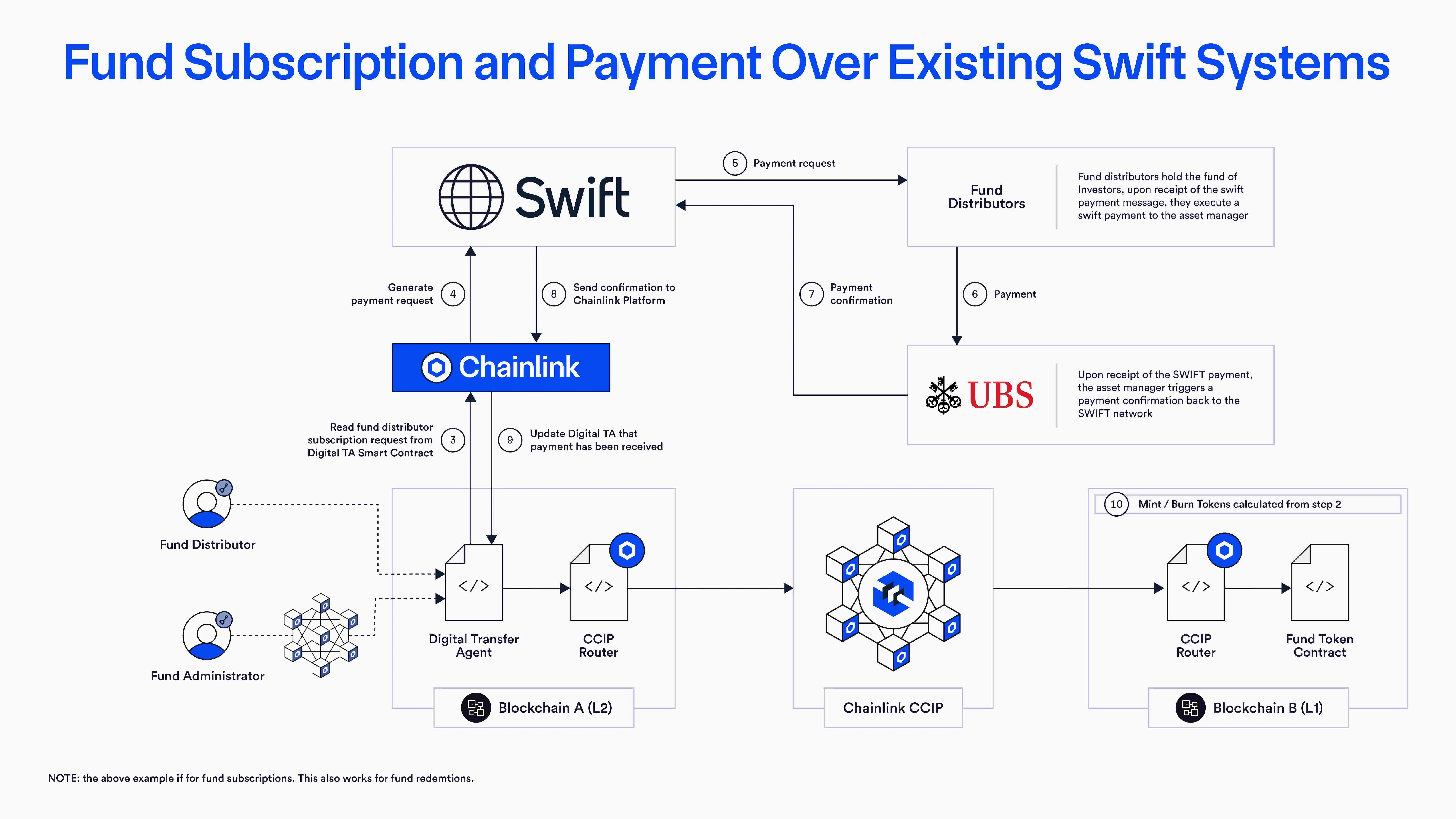
Source: https://blog.chain.link/
4. Collateral Management and Cross-Border Liquidity Optimization
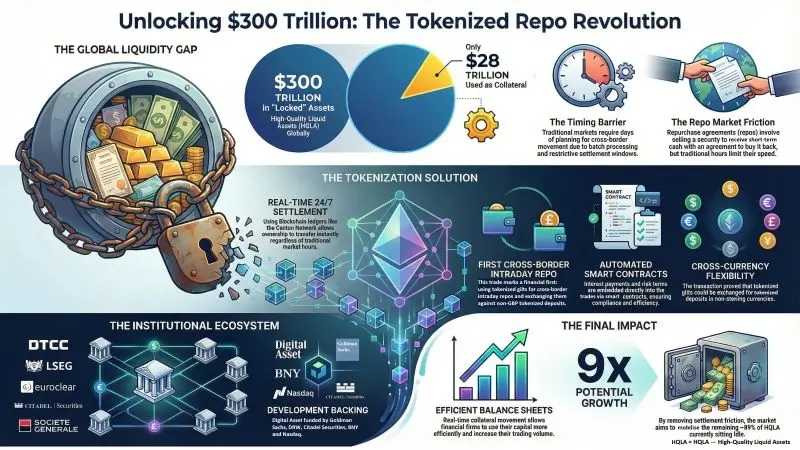
Currently, the utilization rate of collateral (government bonds and other HQLA) is very low. Blockchain can upgrade the traditional interbank "borrowing + collateral" operations into real-time, cross-border, 24/7, programmable smart transactions.
Representative Cases:
- Canton Network Industry Working Group: Involving DTCC, LSEG, BNY Mellon, Societe Generale, etc., achieving cross-border intraday repo (including tokenized UK Gilts vs. non-GBP deposits). Supporting multi-asset, multi-currency, 24/7 collateral reuse, the core goal is to awaken $300 trillion of high-quality global assets from "sleeping" status, allowing financial institutions' funds and collateral to flow faster, more flexibly, and at lower costs.
5. Expansion of Digital Asset Custody Services: Bank-Level Crypto Asset Custody
Traditional custodial banks are incorporating Bitcoin and other assets into existing platforms, achieving unified reporting, tax, and KYC.
Representative Cases:
- Citi: Plans to officially launch institutional-level Bitcoin custody within 2026, embedded in traditional custody systems.
- BNY Mellon: The world's largest custodian bank has already provided Bitcoin custody services, supporting secure storage and transfer for institutions.
The five dimensions of deposit/fund tokenization, trading settlement reconstruction, corporate action automation, collateral optimization, and digital asset custody are interwoven, collectively constructing the new blockchain infrastructure of traditional finance. By 2026, these actions have entered the production-level collaboration stage, with an expected release of $2-10 trillion in efficiency dividends by 2030.
IV. Challenges and Opportunities: Structural Constraints and Long-Term Space
As traditional finance moves into the infrastructure stage, its development is no longer dependent on "whether it is feasible," but on "whether it can be scaled and standardized." Current constraints and opportunities coexist.
1. Major Challenges: Structural Constraints
(1) Interoperability and Liquidity Fragmentation: Parallel development of multiple chains leads to fragmented asset distribution, making liquidity aggregation difficult. Cross-chain protocols (such as CCIP, LayerZero, etc.) provide solutions, but they are still in the early stages regarding security and standardization.
(2) Regulatory and Compliance Uncertainty: Different jurisdictions still have discrepancies in rules regarding stablecoins, tokenized assets, and on-chain settlements. Core issues include:
- Legal rights of on-chain assets
- Transaction reversibility and asset freeze mechanisms
- KYC/AML embedding methods in on-chain environments
(3) High Integration Costs with Traditional Systems: There are architectural differences between core banking systems, clearing systems, and blockchain, leading to high transformation costs and long cycles, with high demands on technology and compliance teams.
(4) Liquidity and Security Still Need Verification: Compared to traditional markets, the overall liquidity of RWA on-chain assets remains limited; at the same time, smart contract vulnerabilities and cross-chain bridge risks are still major security concerns.
(5) Institutional Adoption Inertia: Some traditional financial institutions still classify on-chain assets as high-risk categories in their risk models, and internal approval and risk control processes have not fully adapted.
2. Key Opportunities: Long-Term Drivers
(1) Clear Market Expansion Potential: Several institutions (BCG, Standard Chartered, etc.) predict that by 2030, the scale of tokenized assets is expected to reach trillions of dollars. In the approximately $130 trillion global fixed income market, even a 1% on-chain penetration rate corresponds to a trillion-dollar incremental increase.
(2) Efficiency Dividends Are Certain: On-chain settlement can significantly reduce cross-border payment costs and time delays:
- Settlement costs: Decrease by about 50%--80% (depending on the scenario)
- Fund turnover efficiency: Increase by 20%--30%
(3) Emergence of New Types of Financial Products: The integration of tokenized deposits and stablecoins forms "on-chain bank currency," with on-chain funds supporting 24/7 liquidity and collateral, driven by smart contracts for trade financing and asset management.
(4) Lower Barriers to Investor Access: On-chain RWA allows individual investors to directly participate in assets originally only available to institutions (such as government bonds and money market funds), enhancing global asset allocation efficiency.
It is evident that the core of going on-chain is not "assets going on-chain," but the reconstruction of the clearing layer and capital flow mechanisms. Its essence is to replace the traditional decentralized intermediary system with programmable infrastructure.
V. Outlook and Conclusion: From Asset Tokenization to Programmable Financial Systems
Looking ahead to 2026-2030, on-chain activities will transition from "point applications" to "systemic infrastructure," presenting the following three major trends:
- Full Asset Tokenization Continues to Advance: The scope of tokenization will expand from current government bonds and deposits to stocks and ETFs, private credit and structured products, real estate and commodities, etc. With the participation of DTCC, exchanges, and custodians, the on-chain mapping of traditional assets will become the norm.
- Deep Integration of DeFi and TradFi: DeFi is evolving from "yield-driven" to "asset quality-driven": RWA will become core collateral, stablecoins and tokenized deposits will reconstruct the payment system, and on-chain interest rates will gradually anchor to real-world interest rate systems. This means that DeFi will gradually embed into traditional financial structures rather than exist independently.
- Intensified Regional Regulation and Financial Center Competition: Different regions are gradually differentiating their positioning in on-chain finance: the U.S.: in a leadership position, with rapid scaling potential after regulatory clarity; Europe: MiCA promotes compliance standardization; Hong Kong and Singapore: leveraging regulatory sandboxes and cross-border finance as advantages. Regional differences will directly affect the deployment path of on-chain financial infrastructure.
Conclusion
The on-chain activities of traditional financial institutions are transitioning from "pilot exploration" to "production-level deployment." Its significance lies not in simply migrating finance to blockchain, but in: reconstructing clearing and settlement mechanisms, enhancing capital flow efficiency, and achieving programmable asset management. Under the premise of gradually clarifying regulations, the credit systems of traditional finance and the efficiency advantages of blockchain technology are merging, forming a new shape of financial infrastructure. This process is more akin to a long-term systemic evolution rather than a short-term technological replacement. The future focus of competition will no longer be "whether to go on-chain," but who can occupy a core position in the new infrastructure.
About Us
Hotcoin Research, as the core research institution of Hotcoin Exchange, is committed to transforming professional analysis into your practical tools. We analyze market trends through "Weekly Insights" and "In-Depth Reports"; leveraging our exclusive column "Hotcoin Selection" (AI + expert dual screening), we help you identify potential assets and reduce trial-and-error costs. Every week, our researchers will also meet you face-to-face through live broadcasts, interpreting hot topics and predicting trends. We believe that warm companionship and professional guidance can help more investors navigate cycles and seize the value opportunities of Web3.
Risk Warning
The cryptocurrency market is highly volatile, and investment itself carries risks. We strongly recommend that investors invest only after fully understanding these risks and within a strict risk management framework to ensure the safety of funds.
Latest News
ChainCatcher
Apr 8, 2026 01:42:00
ChainCatcher
Apr 8, 2026 01:09:42
ChainCatcher
Apr 8, 2026 01:05:40
ChainCatcher
Apr 8, 2026 00:59:40
ChainCatcher
Apr 8, 2026 00:39:48