








Tron Industry Weekly Report: March non-farm payrolls exceeded expectations, bets on interest rate cuts decreased again, detailed explanation of three major protocols: compliant yield-generating stablecoins + RWA infrastructure + AI operating systems
Apr 7, 2026 14:57:46


I. Outlook
1. Macroeconomic Summary and Future Predictions
In the past week, the macroeconomic focus has been on the chain of events where the Middle East conflict drives up oil prices → inflation expectations rise → interest rate expectations are repriced. The market has begun to shift from "soft landing + interest rate cut expectations" to "stagflation risks + prolonged high interest rates." Risk assets are generally under pressure and volatility has increased, with funds quickly switching between safe-haven and risk assets, indicating that the current macro environment remains highly uncertain, and liquidity has not improved marginally.
In the coming week, the core focus will still be on geopolitical developments and inflation/policy signals. If oil prices continue to rise or conflicts escalate, the market will continue to trade on stagflation logic, leading to weakness in risk assets; if there is a de-escalation or dovish policy signals, it may trigger a short-term rebound. The overall judgment is that it will be an event-driven range-bound market, with the trend direction still unclear.
2. Market Movements and Warnings in the Crypto Industry
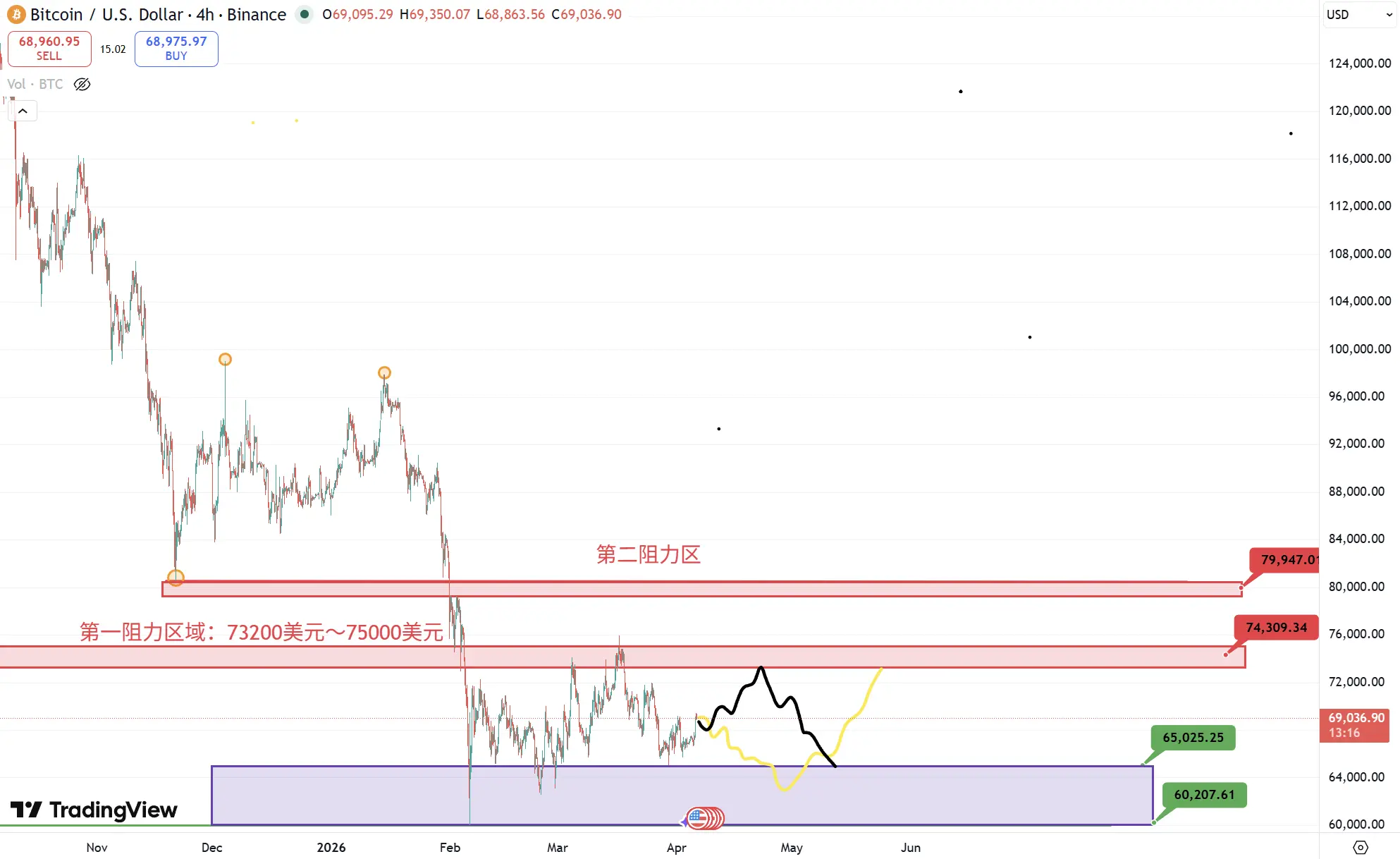
In the past week, the crypto market has been in a weak consolidation and low-level operation, with BTC fluctuating repeatedly in the $64,500 - $68,000 range. Multiple attempts to break above the $67k-$68k area have not stabilized effectively, while support around $65k has been tested multiple times, indicating weak buying support. The overall trend shows characteristics of "rebound without volume, smooth decline," compounded by the lack of significant improvement in ETF funds and stablecoin liquidity, keeping the market in a consolidation phase within a bearish structure.
In the coming week, key attention should be on several core price levels: strong resistance above at $67,500 - $69,000, with only a volume breakout potentially opening up rebound space to $70k+; short-term support below at $64,500, and if it effectively breaks down, the next support will look down to the $62,000 - $63,000 range, with extreme cases possibly testing the $60k round number. Given the current macro uncertainty, it is more likely to maintain a range-bound consolidation between $64k - $69k or a false breakdown to the downside, with a need to guard against accelerated downward risks after breaking support.
3. Industry and Sector Hotspots
This week, key projects are concentrated on three main lines: "compliant yield-generating stablecoins + RWA infrastructure + AI robotic operating systems": Zoth integrates off-chain RWA with on-chain DeFi yields through a layered architecture and "vault-of-vaults" mechanism, creating a compliant stablecoin bank with a payment closed loop; Cap introduces an excess collateral, re-staking, and liquidation mechanism through a dual-layer design of cUSD + stcUSD, achieving a stablecoin model of "yield + principal downside protection"; meanwhile, OpenMind (OM1) integrates AI with physical robotics, building a full-stack system from perception to execution through multi-LLM collaboration and modular architecture. Overall, the market is transitioning from a "pure DeFi narrative" to a new phase driven more by institutionalization, safety, and real-world applications (RWA, stablecoins, AI + hardware), but generally faces common challenges of complex structures, high dependence on external systems, and difficulties in engineering implementation.
II. Market Hotspot Sectors and Potential Projects of the Week
1. Overview of Potential Projects
1.1. Brief Analysis of Total Financing of $21.5 Million, Led by TAIZU, with Participation from Borderless and Ripple and Other Well-Known VCs — Creating a Compliant, Sustainable RWA On-Chain Yield Engine Zoth
Introduction
Zoth is building a privacy-centric stablecoin neobank for the Global South market and the emerging Agentic economy (intelligent agent-driven economy).
The platform has created an integrated financial infrastructure that combines yield management, payments, card services, liquidity, compliance, and security into a single institutional-grade platform, forming a complete financial service system.
The core of the Zoth ecosystem is USDZe, a "Liquid Yield Asset," which achieves sustainable yields through diversified RWA and DeFi strategies, built on a transparent, compliant, and auditable framework. USDZe is designed for both human and machine-native participants and can serve as programmable capital, seamlessly interacting with autonomous agents, global enterprises, and next-generation financial applications.
Zoth merges the convenience of a neobank, the transparency of blockchain, and institutional-grade fund management capabilities to build the next generation of financial infrastructure, providing:
Instant liquidity: Directly use USDZe balance through the Zoth Card.
Global instant settlement: Near-zero cost, borderless fund transfers, suitable for high-frequency and cross-border scenarios.
Core Mechanism Overview
Hierarchical Architecture
Zoth adopts a layered architecture, constructing an integrated financial technology stack consisting of four layers, seamlessly connecting institutional-grade fund management capabilities with decentralized blockchain technology, achieving the integration of traditional finance and on-chain finance.
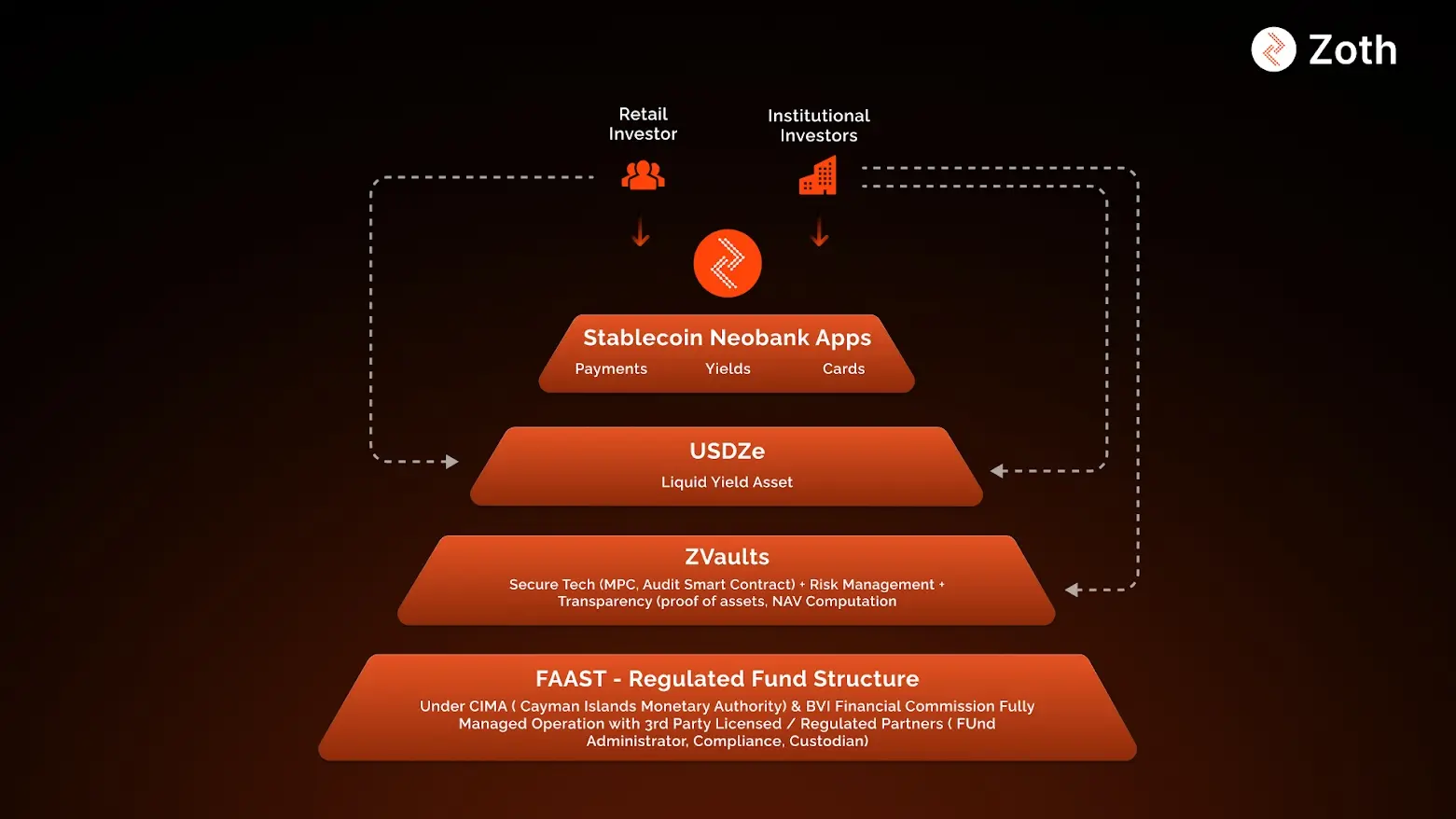
First Layer: FAAST (Foundation Layer)
At the bottom layer, FAAST serves as the infrastructure layer, providing a fund structure regulated by CIMA (Cayman Islands Monetary Authority) and BVI (British Virgin Islands), ensuring all operations are conducted within a complete legal and compliance framework, managed by licensed fund managers and custodians.
Its core functions include:
Global standard compliance structure: Supports simultaneous investment in RWA (real-world assets) and DeFi assets.
Institutional-level transparency: Managed by independent directors, legal experts, licensed fund managers, and auditing firms, ensuring clear auditing, asset verification, and proof mechanisms.
Risk isolation and bankruptcy remote mechanisms: Provides full protection for LPs (limited partners) and token holders, preventing bankruptcy risks at the protocol level from affecting assets.
Structured risk management: Establishes independent funds for different asset classes through asset and liability isolation mechanisms, achieving risk separation and management.
Second Layer: zToken Vaults (Technical Layer)
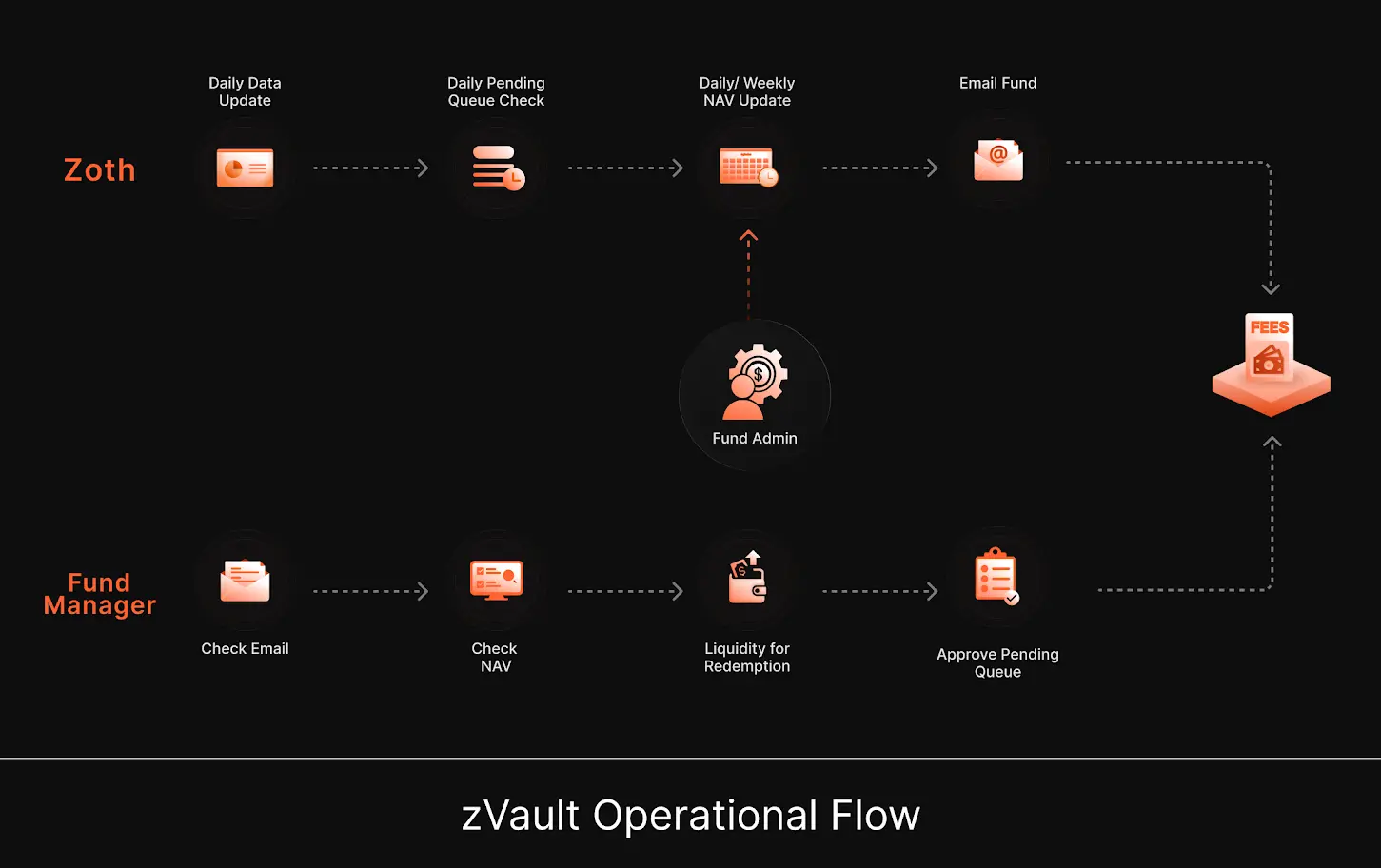
- Smart Contract Infrastructure
All zTOKEN Vaults are ERC-20 standard contracts, using a unified interface template to ensure ecosystem interoperability while supporting strategy-level customization.
Uses an upgradeable proxy model, allowing the protocol to upgrade and fix issues without migrating user assets.
Upgrade permissions are held solely by the Zoth Foundation, ensuring that fund managers cannot modify core logic, safeguarding investor security.
- Vault Creation and Access Mechanism
zTOKEN creation follows a permissioned process, requiring completion of KYB (Know Your Business) and compliance review:
Mature fund managers: Deploy customized Vaults after passing KYB review.
Emerging fund managers: Zoth provides one-stop construction services (company registration, legal documents, compliance framework, data systems), lowering access thresholds while maintaining institutional-level standards.
- Custody and Key Management
Mandatory use of MPC multi-party computation wallets for asset custody.
Distributed management of private keys to avoid single-point risks.
Aligns with security standards of the traditional asset management industry.
- Fund Management and Audit Mechanism
Each Vault is supervised by an independent fund administrator.
Audits holdings, verifies NAV, and proves performance.
Prices are updated bi-weekly through oracles.
Introduces traditional fund industry auditing and accountability mechanisms into the on-chain environment.
- Operational Autonomy
Within the protocol's security framework, fund managers have complete investment autonomy:
Can deploy funds to any supported DeFi protocols and on-chain networks.
Can trade digital or tokenized assets within the strategy scope.
Pursue excess returns (Alpha) within risk and compliance boundaries.
- Integration with USDZe
USDZe is a "Vault-of-Vaults."
After users deposit USDZe, the protocol actually holds shares of the underlying zTOKENs.
The value of USDZe directly reflects the comprehensive performance of the underlying Vaults.
Fund allocation is determined by:
Smart contract execution limits and rules
Zoth team rebalancing operations according to governance approval weights
Third Layer: USDZe (Yield Layer)
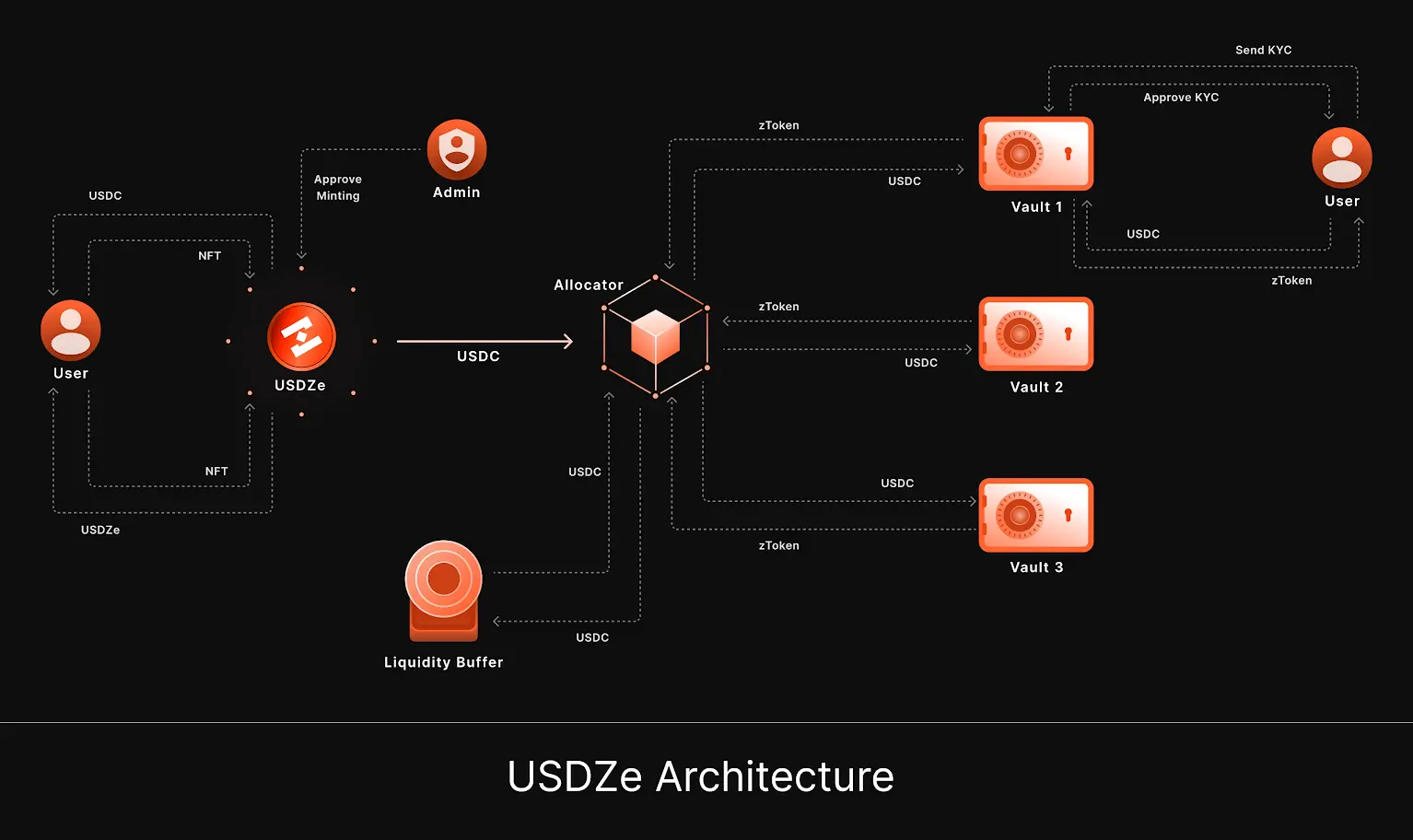
USDZe is a Liquid Yield Asset, with yields sourced from diversified real asset returns, including off-chain income sources and on-chain DeFi protocol integration. Unlike traditional and fiat-pegged stablecoins, USDZe achieves value growth over time through productive capital allocation while maintaining price stability and capital efficiency.
USDZe adopts an oracle-based pricing mechanism, with its value determined directly by on-chain oracle data rather than priced through AMM liquidity pools, thus achieving zero slippage trading and avoiding efficiency losses from large trades in liquidity pool models.
Its oracle infrastructure operates on a decentralized attestation network. Off-chain fund attestors reach consensus on the price of USDZe, updating it twice a week to ensure that on-chain prices can promptly reflect the value of underlying assets. Each Vault supporting USDZe has designated attestors and additional independent attestors to enhance verification reliability.
To ensure the accuracy of price reporting, attestors must bear financial responsibility for losses caused by erroneous price reports. Meanwhile, ZOTH token holders have governance rights to challenge abnormal or erroneous price attestations, forming a multi-party check-and-balance mechanism to safeguard the protocol and user interests.
Fourth Layer: Stablecoin Neobank (Application Layer)
The top layer, Stablecoin Neobank, serves as the user interaction interface, combining account abstraction smart wallets, the Zoth payment network, and the Zocto card to provide seamless savings, transfer, and consumption experiences for individual and institutional users, allowing their yield-generating assets to be directly used for daily financial activities.
This layer is built on two core pillars, redefining the cost and efficiency of global finance:
Zoth Payment Network (PayX7)
As a foreign exchange (FX) liquidity layer, this network achieves cross-border settlement and on/off-ramp through stablecoin rails. Its key upgrade is using USDZe as the core settlement asset. Since USDZe itself has yield attributes, its 5%-10%+ risk-optimized returns can partially offset fund transfer costs, enabling enterprises (such as remittance companies, insurance institutions) and individual users to achieve near-zero-cost global payments.Zocto Card
Provides physical and virtual card services, forming a "spend-to-earn" closed loop. Users can directly use USDZe for daily consumption, while their funds continue to generate yields until the moment of payment, thus maintaining efficient capital operation.
Tron Commentary
Zoth's core advantage lies in its construction of a compliant, layered, and institutional-grade stablecoin financial architecture. Through the FAAST fund structure, zTOKEN Vault asset management layer, and USDZe "vault-of-vaults" mechanism, it integrates off-chain real yields (RWA) with on-chain DeFi yields, achieving sustainable returns of 5%-10%+. Meanwhile, it balances security, transparency, and capital efficiency through MPC custody, independent fund administrator audits, decentralized price attestation mechanisms, and zero-slippage oracle pricing models, and connects the "yield---payment---settlement" closed loop through the Stablecoin Neobank (payment network + card).
Potential disadvantages include high structural complexity, dependence on off-chain compliance systems, auditing institutions, and price attestors; while the oracle and manual attestation mechanisms enhance transparency, their update frequency is relatively limited (bi-weekly), which may pose risks of price synchronization lag during extreme market volatility. Additionally, its institutional framework may not be as aggressive in decentralization as pure DeFi protocols. Overall, Zoth leans more towards a "compliant financial infrastructure upgrade solution" rather than a fully de-intermediated experimental protocol.
1.2. Interpretation of Total Financing of $24.9 Million, Led by Franklin Templeton and Triton Capital, with Participation from GSR and Others — Creating a Dual-Layer Stablecoin System with Verifiable Downside Protection Protocol Cap Labs
Introduction
Cap is a stablecoin protocol that provides trustworthy financial protection through two products: the dollar-denominated cUSD and the yield-generating stcUSD.
cUSD is a digital dollar issued on Ethereum, usable across any network. Its reserves are backed by blue-chip stablecoins, including USDC, USDT, pyUSD, BUIDL, and BENJI, all issued by regulated entities with transparent audit proofs. cUSD can be redeemed at a 1:1 ratio for any reserve asset.
stcUSD is a savings product obtained by staking cUSD, available to all cUSD holders. Its yields are generated by a layer of autonomous operator networks, where operators can freely participate or exit based on the yield thresholds set by the protocol. Yield risks are covered by the protocol, and users have complete downside protection that can be verified through code.
Architecture Analysis
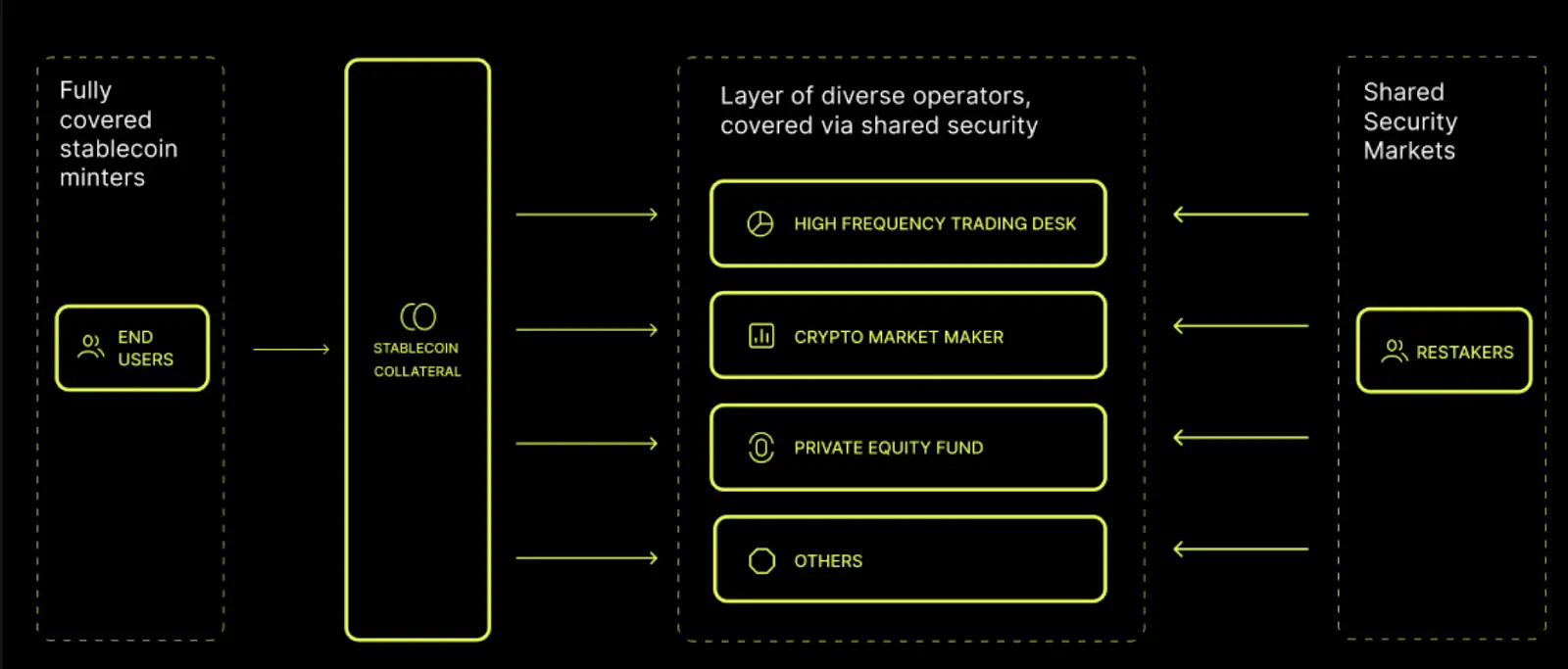
Cap is a self-operating three-party market platform based on economic incentive mechanisms. It outsources yield generation by introducing diversified institutional operators, including banks, high-frequency trading firms (HFT), and market makers.
By building a trust market mechanism through "Shared Security Networks," Cap can continuously generate competitive long-term yields in various market environments.
- cUSD Mechanism
cUSD is a stablecoin backed by dollar assets, redeemable based on reserve assets. Users can interact with cUSD in three ways:
Mint: Deposit reserve assets and mint cUSD at oracle prices.
Burn: Redeem reserve assets based on the highest deviation asset price.
Redeem: Maintain peg stability through a multi-collateral asset redemption mechanism.
Core Mechanisms
- Peg Stability Module (PSM)
The cUSD contract itself acts as a PSM, allowing users to directly mint, burn, and redeem against a diversified whitelist of collateral assets (such as USDC, pyUSD, BENJI, BUIDL).
The core goals of the PSM are:
Maintain cUSD market price stability around $1;
Manage the risk and distribution of underlying collateral assets.
This design ensures that cUSD always has liquidity and can be exchanged for any underlying asset at transparent, market-driven prices.
- Redeem Mechanism: Addressing Depeg Risks
When users redeem cUSD, the system proportionally allocates the underlying asset portfolio based on current asset weights and market prices.
This mechanism avoids the "last man standing problem," preventing later redeemers from being left with depegged assets.
If a certain underlying asset becomes depegged, losses will be "socialized" by the system, and the asset weight deviation mechanism will suppress excessive burning behavior, thus maintaining system stability.
- Fractional Reserves
When deposited assets are not actively lent out, idle funds will generate yields, including:
Revenue from underlying money market funds (MMFs);
Or earn yields through integrated crypto lending markets (such as Aave).
All assets in the fractional reserve vault continue to accrue interest until used for withdrawals, redemptions, or lending.
- stcUSD Mechanism
stcUSD is Cap's yield-generating stablecoin, creating yields for users through a decentralized lending framework while providing verifiable downside protection.
Basic Operational Logic
Minting and Staking
Users (like Alice) deposit stable assets to mint cUSD and stake it as stcUSD to participate in yield distribution.Idle Asset Yields
Idle funds in reserves can automatically earn yields through underlying asset returns or integrated lending protocols (such as Aave, Morpho).Operator Lending Mechanism
Operators must find investment opportunities above the protocol's "hurdle rate" (for example, 8%).
Lending must be over-collateralized, with collateral provided by "Restakers."
Borrowing is fully executed on-chain, without manual approval.
The borrowing interest rate consists of two parts:
Fixed rate for Restakers (risk premium)
Dynamic Hurdle Rate (depends on market interest rates and fund utilization rates)
Normal Path (Happy Path)
If the operator successfully profits and repays the loan:
Assuming a yield of 15%
8% (hurdle yield) is distributed to stcUSD holders
2% goes to Restakers
The remaining 5% is the operator's profit
All parties involved receive yields, and the system operates stably.
Abnormal Path (Unhappy Path)
If the following occurs:
The value of collateral assets falls below the safety line
The operator defaults
The system will trigger an automatic liquidation mechanism:
Liquidate the collateral assets of Restakers through a Dutch auction
Collateral assets are sold at a discount to buy back stablecoins
Recovered funds are reinjected into reserves
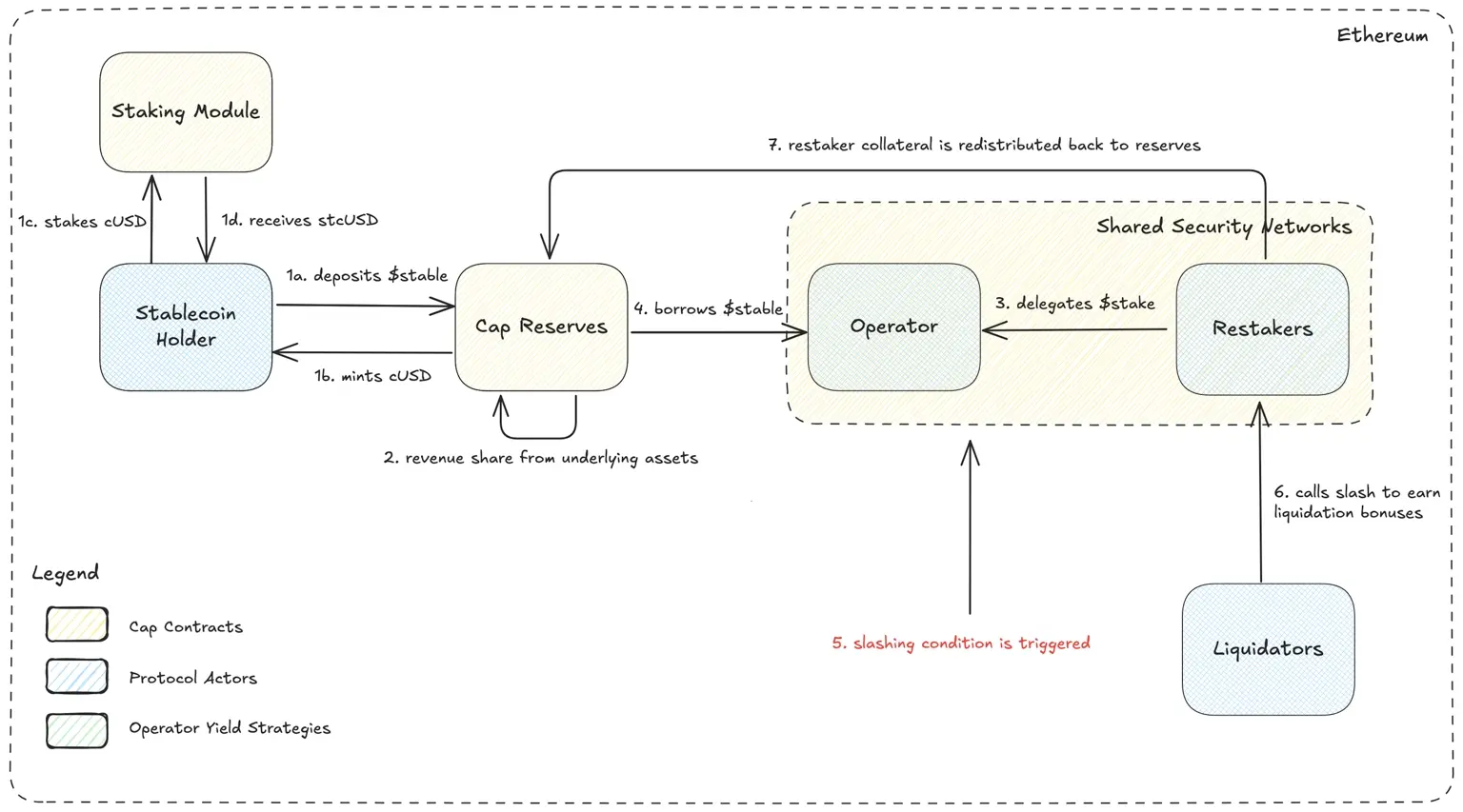
Result: stcUSD holders always maintain 1:1 full protection, with yield risks borne by Restakers, not stablecoin holders.
Lending Rate Mechanism
Lending Rate = Fixed Rate for Restakers + Dynamic Hurdle Rate
Where Hurdle Rate:
Benchmarked against external market interest rates
Increases stepwise with rising fund utilization rates
This mechanism ensures:
Always retains sufficient liquidity
Competitive borrowing costs
Automatically increases risk premiums during high utilization
Tron Commentary
Cap Labs' core advantage lies in its construction of a yield-generating stablecoin system with code-level downside protection: cUSD maintains 1:1 redeemability and anti-depeg capability through multiple blue-chip stablecoin reserves and the PSM mechanism; stcUSD achieves yield generation and principal risk isolation through "over-collateralization + re-staking (Shared Security) + automatic liquidation + dynamic hurdle rates," ensuring stablecoin holders always receive full protection. Meanwhile, by outsourcing yield generation to an institutional-level operator network (banks, HFTs, market makers), it maintains competitive yields across different market environments.
Potential disadvantages include structural complexity, dependence on external operators' capabilities, re-staking liquidity, and liquidation efficiency; fractional reserves and multi-asset collateral may face correlation risks and liquidity challenges under extreme market pressure. Overall, Cap leans more towards a "safety-first yield-generating stablecoin protocol," emphasizing the combination of verifiable protection and market-driven yield mechanisms.
2. Detailed Explanation of Key Projects of the Week
2.1. Detailed Explanation of Total Financing of $22 Million, Led by Pentera and Pi Network, with Participation from Coinbase & Amber — An Open Source AI Platform Connecting Cloud Intelligence and Physical Robots OpenMind
Introduction
OM1 allows AI entities to be configured and deployed simultaneously in the digital world and the real physical world. You can create an AI character that runs in the cloud while also deploying it to physical robotic hardware, such as quadrupeds, TurtleBot 4, or humanoids.
Through OM1, you can interact with OpenAI's GPT-4o (or Gemini, Claude, DeepSeek, Ollama local inference models) and achieve physical interaction through entities controlled by one or more large language models, such as shaking hands.
Intelligent agents/robots built on OM1 can integrate various data sources (web pages, X/Twitter, cameras, LIDAR, etc.) and perform tasks such as tweeting, exploring the home, or tutoring children in math homework.
As OM1 is an open-source system, users have complete control and can customize and optimize it based on home or work scenarios.
Core Analysis of OM1 System Architecture
OM1 adopts a layered modular architecture, enabling AI to perceive the environment, understand semantics, plan decisions, and ultimately control physical robots to execute actions.
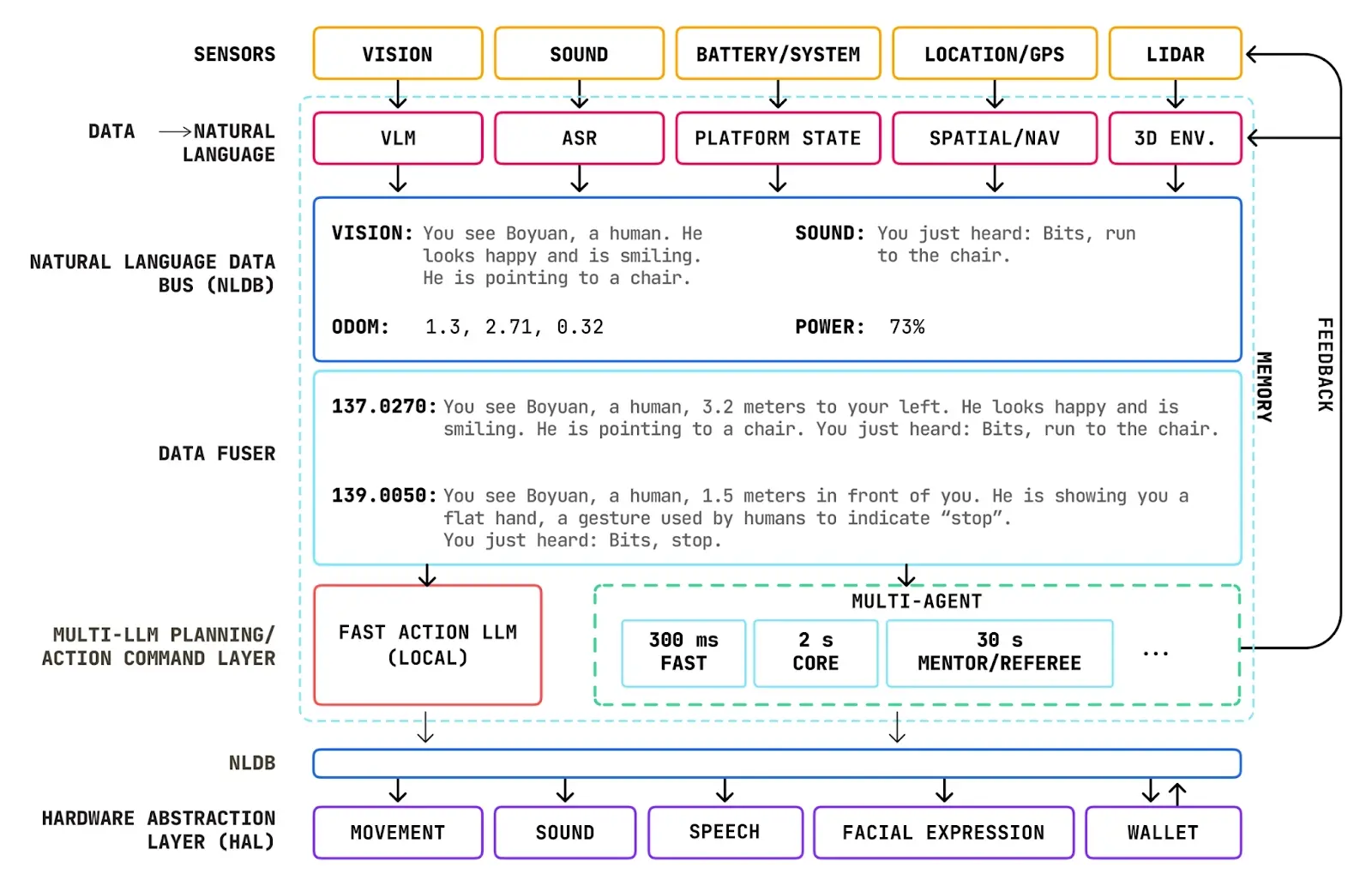
- Raw Sensor Layer
Responsible for collecting data on the robot's environment and its own status:
Vision: Cameras capture images
Sound: Microphones capture audio
Battery/System Status
Location/GPS
LIDAR: Laser radar for 3D mapping and navigation
- AI Captioning & Compression Layer
Transforms raw data into natural language descriptions:
VLM (Vision Language Model): Converts visual content into language descriptions
ASR (Automatic Speech Recognition): Converts speech to text
Platform State: Textual representation of internal system status
Spatial/NAV: Processing spatial and navigation information
3D Environment Interpretation: Analyzing data from LIDAR, etc.
The core function of this layer is to convert sensor data into "natural language that can be understood by large models."
- Natural Language Data Bus (NLDB)
A central language data flow management system:
Aggregates all semantic information
Standardizes formats
Available for subsequent module calls
For example:
"You see a person, and he is pointing to a chair"
"You hear: Bits, running towards the chair"
Current position coordinates
Battery level 73%
- State Fuser
Integrates scattered short information into a complete contextual description.
Functions:
Merges visual, audio, and spatial information
Provides a summary of environmental perception
Outputs a compact context for decision models to use
Equivalent to building an "abstract of the current world state" for AI.
- Multi AI Planning Layer
Collaborated by multiple LLMs:
Fast Action LLM (local or cloud)
Low latency response
About 300ms
Handles immediate actions
Core Cognitive LLM (cloud)
Complex reasoning
Long-term planning
Response time of about 2 seconds
Mentor/Coach LLM (cloud)
Third-party critique
Generates assessments every 30 seconds
Provides feedback to the core LLM
Special Design:
Robot behavior rules can come from configuration files
Or be stored on the blockchain (such as Ethereum)
Achieving an immutable "robot constitution" and transparent auditing
- Feedback Loop
The system dynamically adjusts parameters based on performance and environment, such as:
Adjusting camera frame rates
Optimizing resource usage
- Hardware Abstraction Layer (HAL)
Transforms AI decisions into specific hardware instructions.
For example:
"Pick up the red apple with the left hand" → Converts to servo and robotic arm action sequences
Supported modules include:
Move
Sound
Speech
Wallet (on-chain identity or economic interaction)
Typically interfaces with ROS2, CycloneDDS, or Zenoh middleware.
Overall Data Flow
Sensors → Semantic Transformation → Language Bus → State Fusion → Multi LLM Decision → Hardware Abstraction → Robot Execution
OM1 Fully Autonomous Architecture Analysis
OM1 supports running Full Autonomy Mode on Nvidia AGX and Nvidia Thor platforms, achieving advanced perception, mapping, navigation, and interaction capabilities, minimizing human intervention.
Platform Support Status
AGX Platform: Supports full autonomy features, but functionalities are relatively limited.
Thor Platform: Provides complete and comprehensive full autonomy support, recommended for deployment.
On the Nvidia Thor platform, OM1 integrates more advanced machine learning capabilities, including:
Face Recognition
Face Anonymization
Thor is fully optimized for ML-driven workloads, making it the preferred hardware platform in scenarios requiring advanced autonomy and perception capabilities.
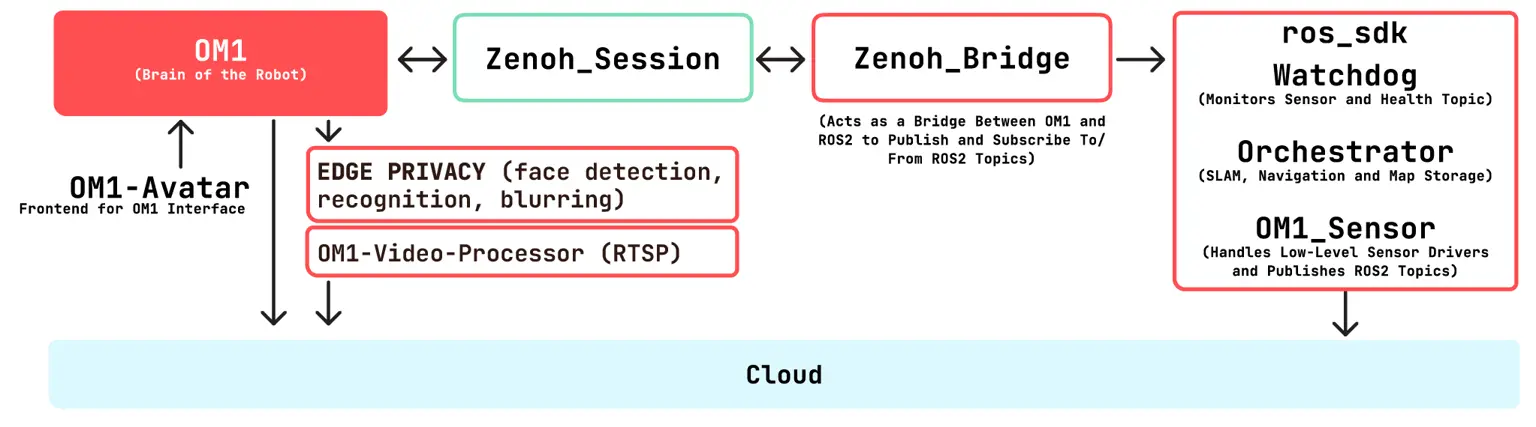
Architecture Features
OM1's fully autonomous system is built on a modular, containerized service architecture:
Each component runs in independent containers
Communicates through standardized interfaces
Supports flexible expansion and hot-swapping
Highly maintainable and upgradable
This architecture ensures:
The system can scale horizontally
Each module can be independently optimized
Strong adaptability to deployment environments
Tron Commentary
OpenMind (OM1)'s core advantage lies in its creation of an open-source full-stack architecture that bridges the digital intelligence and physical robot worlds. Through "sensor semanticization + multi-LLM collaborative decision-making + state fusion + hardware abstraction layer (HAL)," it achieves a complete closed loop from perception to execution and supports running in full autonomy mode on high-performance platforms like Nvidia Thor, with capabilities for face recognition, multimodal fusion, and containerized module deployment. Additionally, its open-source nature and the ability to anchor robot behavior rules on the blockchain provide innovative ideas for transparency and auditability.
However, its system architecture is complex, with a strong dependency on high-computing hardware, and multi-model collaboration brings challenges of latency and resource consumption; achieving stable and efficient long-term autonomous operation in real environments still requires strong engineering optimization capabilities. Overall, OpenMind resembles a foundational operating system framework aimed at the future direction of "AI × Robotics × Decentralized Control," being technologically advanced but with high engineering implementation barriers.
III. Industry Data Analysis
1. Overall Market Performance
1.1. Spot BTC vs ETH Price Trends
BTC
ETH
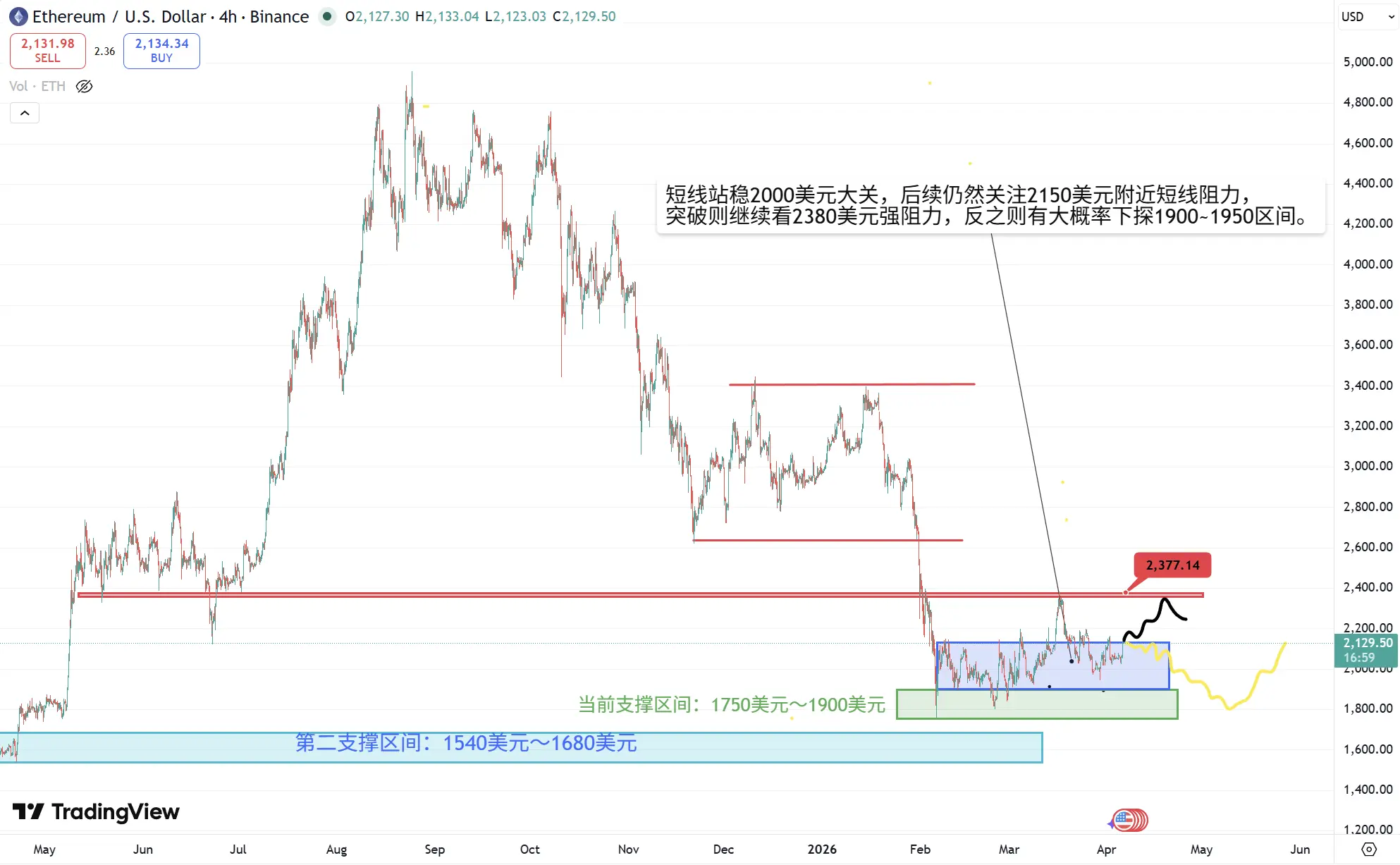
2. Summary of Hot Sectors
From March 30 to April 5, the crypto market hotspots were clearly concentrated in two directions: RWA and yield-generating stablecoins, as well as AI combined with on-chain/physical infrastructure. On one hand, projects represented by Zoth and Cap are promoting the upgrade of "yield-bearing stablecoins" by introducing real-world assets, layered fund management, and risk isolation mechanisms, enhancing the yield capacity and risk resistance of stablecoins, reflecting the preference for "low volatility + sustainable yield" assets in the current macro-uncertain environment;
On the other hand, the AI sector has extended from a purely on-chain agency narrative to a fusion form of "AI + Robotics + Blockchain" (such as OpenMind), emphasizing the closed-loop capability from perception to execution, with narratives leaning more towards infrastructure and long-term technological pathways.
Overall, the changes in hotspots during this time window reflect that the market is shifting from high-risk narratives to directions more focused on real yields, compliance, and feasibility: funds are no longer chasing pure concepts but are focusing on projects with cash flow support (RWA), risk control mechanisms (stablecoin upgrades), and practical application scenarios (AI + hardware). However, these sectors generally face common challenges of complex structures and long implementation cycles, reflecting more as thematic rotations rather than trend-driven main lines in the short term.
IV. Macroeconomic Data Review and Key Data Release Nodes for Next Week
Macroeconomic Data Review (March 30 - April 5):
On March 31 (Tuesday), China announced that the official PMI for March (50.4) returned to the expansion zone;
From April 1 to April 3 (Wednesday to Friday), Europe and the US successively announced manufacturing and services PMIs, with the US ISM services PMI falling into the contraction zone on April 3;
On April 4 (Friday), the US announced March non-farm employment (approximately 178,000) and unemployment rate (4.3%).
Combined with the entire cycle's Middle East conflict driving up oil prices, it formed a combination of "weak PMI + stable employment + rising inflation expectations."
Key Data Release Nodes for Next Week (April 6 - April 12):
April 8 (Wednesday): FOMC meeting minutes (core observation of policy path and inflation attitude)
April 10 (Friday): US CPI inflation data (the most critical event, determining interest rate expectations)
April 11 (Saturday morning/Friday evening): University of Michigan Consumer Confidence Index (important for inflation expectations)
Additionally, attention should be paid to PPI (usually the day after CPI, around April 11). Overall, the April 10 CPI is the absolute core pricing anchor for this week.
V. Regulatory Policies
🇺🇸 United States
Pension funds allowed to invest in crypto (March 30): The US Department of Labor proposed a new rule allowing 401(k) retirement accounts to invest in crypto assets and private equity, signaling a clear policy relaxation and expansion of institutional capital entry.
At the same time, regulatory focus continues on stablecoin frameworks and institutional participation, with the overall trend shifting from "enforcement-driven" to "legislation + market access opening," strengthening the path of bank and crypto integration.
🇬🇧 United Kingdom
- Restrictions on crypto political funding (around early April): The UK announced plans to ban the use of cryptocurrencies for political donations to prevent cross-border funding interference in politics, which is a reinforcement of anti-money laundering and national security regulation.
🇦🇪 United Arab Emirates / 🇭🇰 Hong Kong (Comprehensive)
- This week's trend continues to accelerate licensing and institutional access, including the advancement of regulatory frameworks for exchanges, custody, and payment systems, with the core goal of competing for the global crypto financial center status.
🇰🇷 South Korea
- No new implemented policies, but regulatory discussions continue to push for stricter exchange reserve and audit systems (such as cold storage ratios, insurance, audits), which belong to the policy preparation phase before implementation in mid-2026.
Latest News
ChainCatcher
Apr 7, 2026 19:57:58
ChainCatcher
Apr 7, 2026 19:53:52
ChainCatcher
Apr 7, 2026 19:49:56
ChainCatcher
Apr 7, 2026 19:48:56
ChainCatcher
Apr 7, 2026 19:42:47