








After making a passive income of 200 dollars, I stumbled upon these three "weather pitfalls" in the prediction market
Apr 3, 2026 18:41:53


Author: Changan I Biteye Content Team
In the previous article, the weather system used five methods to predict the maximum temperature, but the model will not always provide a unique solution: ECMWF calculated 14°C, WC calculated 13°C, and real-time correction gave 13.5°C. Which one would you bet on?
No matter how refined the weather system is, predictions will always be a range.
Moreover, the weather market has risks beyond predictions: data sources may not match, rules may change quietly, and the market may reverse in the last hour.
Therefore, predictions must be paired with trading strategies. After two weeks of practical experience, some made profits while others fell into traps, and I will share them all.
I. Beyond Predictions, There Are These Three Traps
The weather system in the previous article solved the prediction problem, but once in the market, it was discovered that the reasons for losing money sometimes had nothing to do with predictions.
Data sources not matching, rules changing quietly, and market reversals in the last hour—after stepping into these traps, it became clear that the risks in the weather market are not just at the prediction level; there are three layers in total:
1. Data Source Issues: WU and METAR Do Not Match
The rules of the weather market generally state that WU data is the standard.
WU is Weather Underground, a U.S. meteorological platform, with data directly sourced from observation records reported by weather stations around the world. For the weather market, WU reads data from local airport weather stations.
Airport weather stations issue a standardized weather report every half hour, called METAR, which is a format commonly used in global civil aviation. It contains information such as temperature, wind speed, cloud cover, and visibility, serving as an important basis for aviation scheduling. Theoretically, the airport temperature displayed by WU should come from this METAR report.
This is indeed the case for other cities, where WU readings and METAR generally align, with negligible errors. Many traders have thus developed the habit of directly monitoring METAR, treating it as a real-time preview of the settlement temperature.
However, WU data for Shenzhen Bao'an Airport often does not match METAR, with discrepancies of up to 2 degrees occurring.
This deviation does not need to be considered in other cities, but in Shenzhen, it can directly turn a potentially correct trade into a loss.
2. Frequent Rule Changes
Perhaps because WU and METAR have long been mismatched, Polymarket changed the data source for the Shenzhen market on March 29, switching the settlement data source from WU to NOAA.
There is an update record on the rules page, dated March 28, with only one sentence: "This market's resolution source has been updated."
NOAA uses data from weather.gov, which closely corresponds with METAR, often showing discrepancies with WU readings.
A user named ilovebigbiscuit placed a bet on No at the 27°C level, with an average price of 99.8¢, resulting in a loss of $7,883. The likely reason is that WU's data showed the temperature would not reach 27°C, leading to a sense of security, but the NOAA reading was different, resulting in a total loss at the end.
The Shenzhen weather market later reverted back to WU. In just a few days, the market changed its data source twice.
So, develop a habit: every time you enter a new weather market, the first thing to do is not to check the temperature, but to click on the Rules in the lower left corner to confirm which data source is used for settlement. Skipping this step could render all subsequent analysis futile.
3. Continuous Market Reversals
In the Shanghai weather market over the past two weeks, a recurring trend has emerged: a certain temperature level leads from the morning, with its probability steadily surpassing other levels, seemingly set to settle, only to suddenly reverse in the last hour, with another level jumping from nearly 10% to 100%.
For instance, on a certain day, 20°C was the leading level from the morning, rising to nearly 90% by 2 PM, appearing to be a done deal. However, after 3 PM, 21°C reversed from nearly 0% to 100%, ultimately settling at 21°C. Those who bet on 20°C were correct until the last hour, but were entirely wrong at settlement.
Spring weather in Shanghai is inherently unstable, and afternoon temperature trends are greatly influenced by cloud cover and wind speed; judgments made in the morning may become completely invalid by the afternoon. 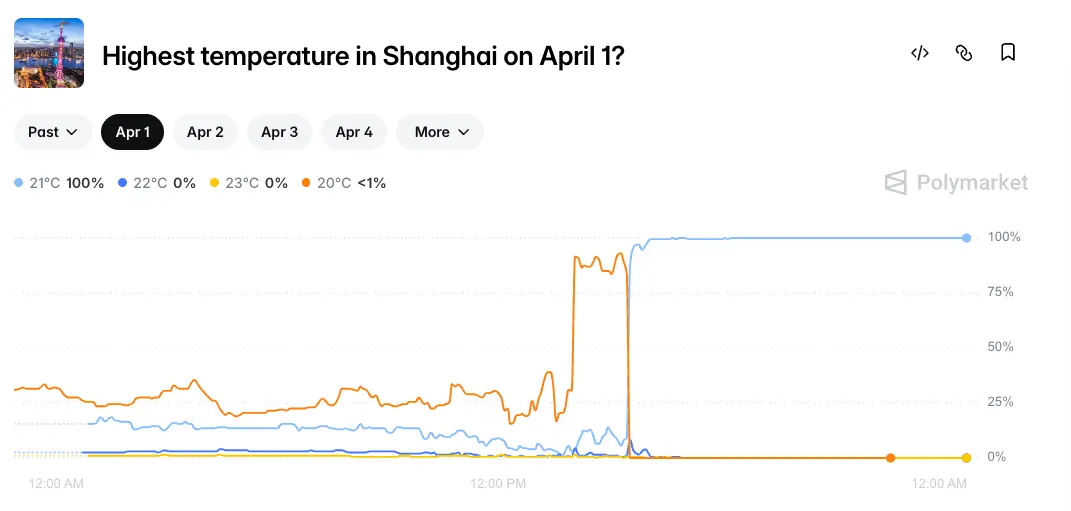
II. Four Trading Strategies Observed Over Two Weeks
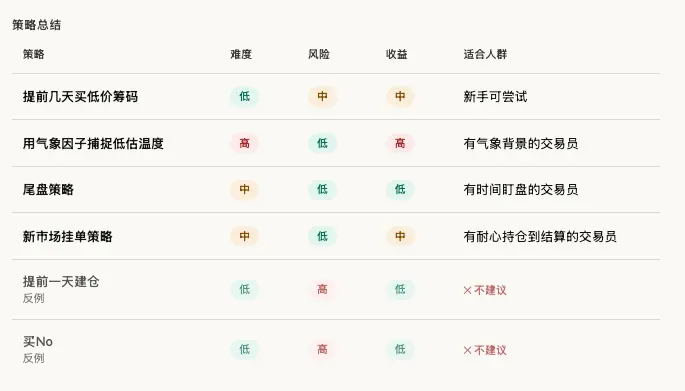
Betting on a single temperature is too difficult, so most players buy several adjacent levels simultaneously, as long as the total cost of these levels does not exceed $1, there is profit to be made. However, even with multiple temperature coverage, when to buy, how to buy, and which market to choose can lead to vastly different results. Here are several trading strategies observed over the past two weeks:
Strategy One: Buy Low-Priced Chips a Few Days in Advance
Another approach is completely different, leveraging the uncertainty of weather itself.
Polymarket's weather market opens trading four days in advance. The earlier the market opens, the more dispersed the pricing of each level, with many temperatures not being fully priced, often listed below 5¢.
Some players specifically take advantage of this time difference. Today is April 1, and they buy into the April 4 weather market, sweeping through all levels priced below 5¢, buying as long as they are cheap. The logic is simple: there are still three days until the forecast, and the weather can change at any time; a temperature that seems impossible today may become a popular level in two days, with a 5¢ chip potentially rising to 30¢, 50¢, or even higher.
The core of this strategy is betting that the weather will change. Holding positions until the day of settlement, as long as enough levels are covered and the total cost is kept under $1, the level that settles will recover $1, while the rest goes to zero, resulting in no overall loss. However, if a certain level rises significantly in the meantime, profits can be locked in by selling early.
Strategy Two: Use Meteorological Factors to Capture Undervalued Temperatures
Popular levels are usually fully priced, making entry costs high and odds compressed. However, there is a group of traders who specifically look for undervalued, less popular temperatures.
These traders observe real-time meteorological factors. For example, if it is currently 1 PM, they will look at the wind direction and speed for the next hour or two: a south wind typically brings warm, moist air with potential for warming; if wind speed, cloud cover, and pressure factors all point in the same direction, they will bet on temperature levels that the market has not yet reacted to.
Since these are less popular levels, prices are low, and entry costs are small; even if the judgment is wrong, losses are limited. But if the judgment is correct, the price increase of the low-priced chips can be substantial.
WU data updates every half hour; if the latest data shows that meteorological factors are not developing as expected, such as a change in wind direction or a halt in warming, they will sell to cut losses.
This strategy requires a high level of meteorological knowledge, needing a true understanding of how factors like wind direction and cloud cover affect temperature, not just a glance at the forecast. It is suitable for traders with a professional background or those who have been deeply involved in this market for some time.
Strategy Three: End-of-Session Strategy
There is a pattern in the Shanghai weather market: after 3 PM, warming basically stops, and the maximum temperature usually occurs before this time.
The end-of-session strategy takes advantage of this window. WU data updates every half hour, and after warming stops, traders monitor WU's data updates, entering the market the moment the data refreshes, at which point Polymarket's prices have not yet had time to react, usually yielding only a few points of profit.
There are two operational directions: buy Yes for the current temperature or buy No for the next higher temperature. These two operations are essentially the same, as warming has already stopped, leaving only these two possibilities; which one to choose depends on which side offers a better price.
The biggest risk of this strategy is changes during the warming period. The time when warming stops each day is not fixed; cloud cover, wind speed, and air masses can all affect the day's warming rhythm. If the judgment is made that warming has ended, but the temperature rises again, the end-of-session judgment will be completely invalidated.
Strategy Four: New Market Order Strategy
Polymarket's new weather markets have a clear characteristic: there are no market makers, resulting in a large spread. The buy price and sell price may differ by several dimes, for example, a buy price of 20¢ and a sell price of 60¢.
This spread represents an opportunity.
The specific operation is to place orders below popular temperature levels, waiting for buy orders to be filled. Because the spread is large, even if several popular levels are filled, the total cost can still be kept under $1.
However, this type of market has a crucial characteristic to note: extremely low liquidity. A few hundred dollars in trading can push down the probability of the currently most popular temperature, making it appear as if it is about to lose.
Therefore, the execution principle of this strategy is simple: once an order is filled, hold it until settlement, and do not operate frequently. Short-term price fluctuations in a low liquidity market have no reference value.
Strategy Five: Build Positions a Day in Advance (Counterexample)
WU releases the next day's maximum temperature forecast a day in advance. The most intuitive execution method is to refer to this forecast and buy the three levels near the predicted temperature a day in advance.
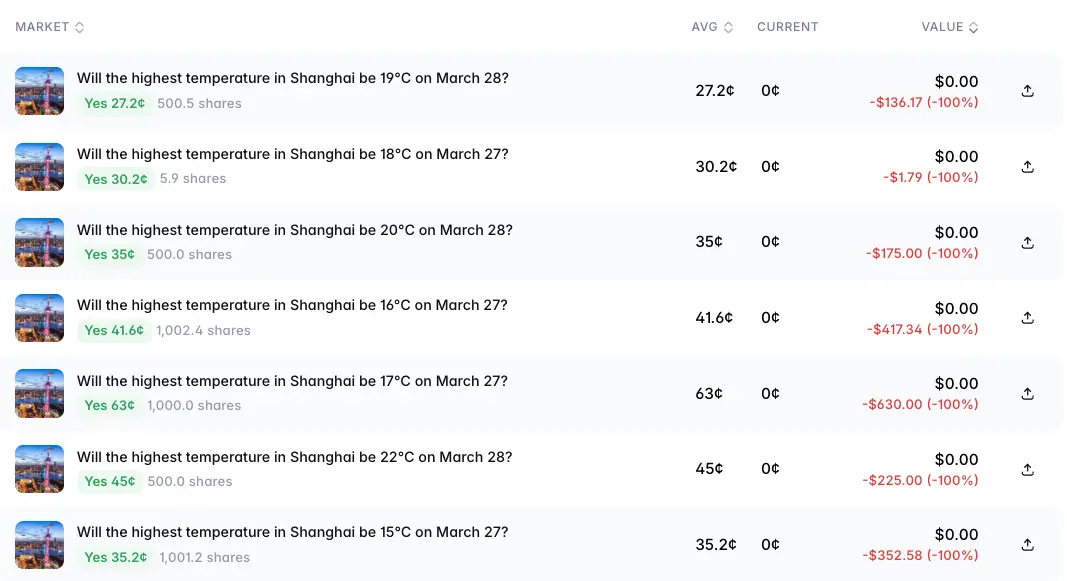
Some players operate this way. On March 27, they bought the 15°C, 16°C, and 17°C levels a day in advance, and on March 28, they bought the 19°C, 20°C, and 22°C levels, investing a few hundred dollars in each level, keeping the total cost under $1.
However, weather forecasts are not fixed; WU's predicted data is adjusted in real-time as weather changes. Today, the forecast may predict 22°C for tomorrow, but by tomorrow morning, it may have changed to 19°C. Building positions a day in advance locks in last night's forecast, but by the time of settlement, the temperature may have already deviated.
As a result, everything went to zero. The 19°C settled on the 27th, and the 21°C settled on the 28th, with the covered range differing by two to three degrees from the actual settlement.
The idea of multiple temperature coverage is correct, but entering too early, before the forecast stabilizes, is equivalent to betting today's results based on yesterday's information.
Strategy Six: The No Bet Win Rate Trap (Counterexample)
Some comments suggest that buying Yes is too difficult, and if you can't guess one, it is better to buy No for a higher win rate. But is that really the case?
The weather market usually has 11 temperature levels; buying Yes means guessing 1 out of 11, while buying No means guessing 10 out of 11. In terms of win rate, No has a natural advantage, which sounds reasonable.
However, the No bets on popular levels are usually priced above 80¢, with only a few levels having such prices. If all No bets priced above 80¢ are bought, assuming there are 4 popular levels:
Cost: 4 × 80¢ = $3.20
The settlement will most likely fall on one of these 4 popular levels, meaning 3 No bets win and 1 No bet loses:
Win: 3 × 20¢ = 60¢
Lose: 1 × 80¢ = 80¢
Net Result: Loss of 20¢
It is true that the win rate is high, but the odds completely offset the advantage of the win rate. Each win only earns a little, while guessing wrong once can negate several profitable outcomes. The price of No has already factored in the win rate, so buying No does not provide any extra advantage.
III. Predictions and Strategies Are Both Essential
The prediction system is your "eyes," and the trading strategy is your "armor." Together, they form a complete approach to navigating the weather market.
The weather market is still in its early stages, with unstable rules, changing data sources, and continuous market reversals. But precisely because of this, information gaps still exist, and opportunities remain.
Latest News
ChainCatcher
Apr 4, 2026 21:28:32
ChainCatcher
Apr 4, 2026 21:28:05
ChainCatcher
Apr 4, 2026 21:04:15
ChainCatcher
Apr 4, 2026 21:00:41
ChainCatcher
Apr 4, 2026 20:21:30