








Middle East crypto veteran Bill Qian: Witnessing the war in Dubai, local gold plummets, while Bitcoin rises instead
3월 19, 2026 15:45:49


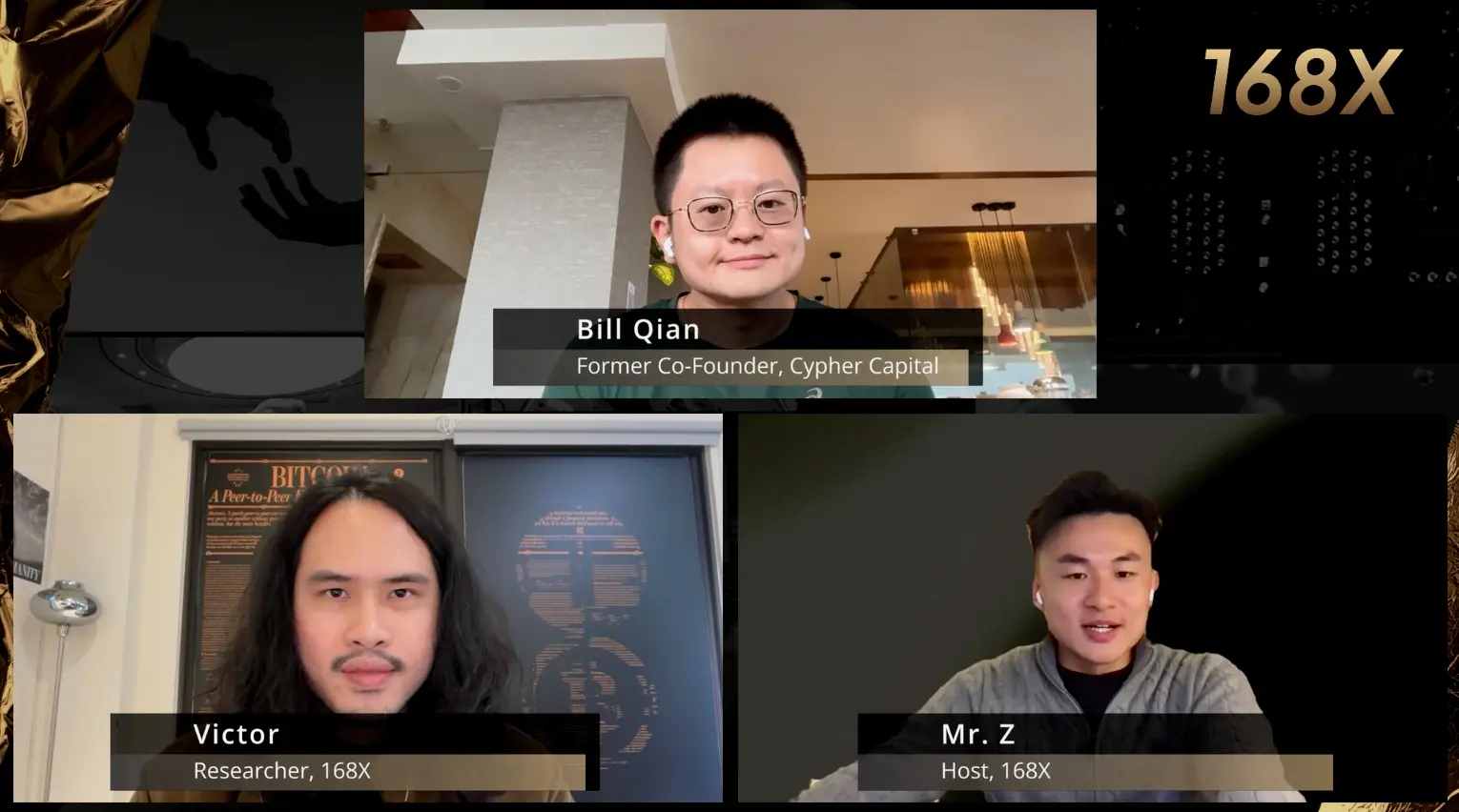
"The wholesale gold price in Dubai has seen a discount of $50 per ounce—war has come, and you can't take gold with you. But Bitcoin, during those days, showed its resilience." Bill Qian, former co-founder of Cypher Capital and former Chief Investment Officer of Phoenix Group, deeply analyzes the differences in performance between Bitcoin and gold in real crises, the philosophy of asset allocation in chaotic times, and the debate over the authenticity of the AI bubble from a frontline perspective shaped by his experiences in the Middle East in an exclusive interview on the East-West Capital Dialogue show "168X".
This investor, who has deployed and managed over $20 billion in assets throughout his career, previously served as the head of global investment and mergers at Binance, later co-founding Cypher Capital in Dubai and becoming the Chief Investment Officer of the Middle East's first publicly listed cryptocurrency company, Phoenix Group. Now, he has chosen to pause at a turning point in the cycle, focusing on the intersection of AI and crypto FinTech.
This article is a summary of the highlights from the 168X ( @168X_Fortune) program—a top dialogue platform that deeply connects Eastern wisdom with Western innovation, focusing on cutting-edge fields such as AI, blockchain, robotics, space technology, and bioengineering, exploring how technology, capital, and human wisdom will reshape the future of human civilization. The program is hosted by ex-banker Mr. Z.
Host : Mr. Z ( @168MrZ) · Guests : Bill Qian ( @billqian_uae) and Victor ( @vcmktasa)
The Collapse of Safe Havens: When Iranian Missiles Land Where You Save Money
Five years ago, when Bill Qian arrived in the UAE with Binance, the country was hailed as "the Switzerland of the 21st century." Russians, Brits, Asians, and Indians flocked in, global capital settled on Palm Island, and the crypto community found the most tolerant regulatory environment here.
Then war came.
"I am a loyal fan of the UAE, and I really like the government here, including people from all over the world," Bill admitted, "but when war happens, it happens, and we have to look at it objectively."
The US-Iran conflict brought unprecedented shocks to this "safe haven" city. Drone attacks continued to occur within Dubai, several banking apps temporarily crashed, and luxury home prices on Palm Island plummeted.
Before recording the 168X episode, Bill had just studied a set of historical cases—Tel Aviv in Israel, Kyiv in Ukraine, Moscow in Russia, Sarajevo in the 1990s, and New York after 9/11. "You can't say that after a war happens, the city is finished, but it needs to rebuild confidence and restore population flow, including financial tools, before housing prices can slowly come back."
What truly puzzled him was a logic that defied common sense.
"I never thought the Iranians would strike a place where they save money," Bill said. The Iranian leadership has substantial assets in the UAE—investment and trade companies, luxury homes on Palm Island, and bank deposits. After the missiles flew in, it was these assets that first plummeted.
"Perhaps when people become ruthless, they can't care about so much anymore."
This war revealed a deeper geopolitical paradox. In the past, everyone believed that the presence of US military bases was a form of "protection," a "blessing." But when Iranian missiles target these bases and their surrounding areas, this "protection" turns into a "curse."
Bill pointed out that this will fundamentally affect several major issues in the Middle East: first, whether there is still enough budget to invest in the US; second, how to reassess the cost of allowing US military bases to exist. For those who have bet their entire fortune on UAE real estate, this is an expensive lesson in risk management.
"Many people came to Dubai to buy property only after the real estate market in mainland China fell, but their hometown hasn't had problems yet, and Dubai's properties ran into issues first."
The Fatal Flaw of Gold: War is the Most Honest Stress Test
The conflict in the Middle East provided Bill with an excellent experimental ground to observe Bitcoin and gold.
He noticed a compelling detail: during the war, the wholesale gold market in Dubai saw a discount of $50 per ounce. The discount itself was not large, but the signal behind it was deafening—when a real crisis strikes, the "portability" advantage of physical gold nearly vanishes.
"Dalio says gold has strong anti-traceability, it can't be tracked, so gold must be good," Bill analyzed, "but when war breaks out, you will discover its shortcomings—can you really carry a lot of gold bars around? That's a difficult thing to do."
He attributed the limitations of gold to two fatal weaknesses: portability and confiscation resistance. The United States in 1933 was already the "beacon of the free world," but it once ordered the confiscation of all private gold nationwide. In extreme environments, the "safety" of physical assets is likely just an illusion.
In contrast, Bitcoin. During those war days, Bitcoin's price rose instead of falling. More importantly, the fundamentals: a surge in OTC trading among many Iranian citizens and residents of the Middle East, a spike in stablecoin exchange activities, and a skyrocketing volume of Bitcoin purchases.
"When a real crisis occurs, many banking systems in various regions fail, and several banking apps were unusable for a time. You will find that in such extreme situations, portability and confiscation resistance become particularly important. And these two points are precisely what gold has historically struggled to achieve."
However, Bill refuses to simply categorize Bitcoin as either a "safe-haven asset" or a "risk asset." "Why must we be controlled by this binary? Why can't some assets break out of this binary logic?"
"What Bitcoin is today is really hard to define. Up to now, we can only call it Bitcoin—it is just something new that needs a long time to observe."
A 17-year-old asset, it is neither a substitute for gold nor merely a shadow of tech stocks. It may exhibit completely different attributes at different historical stages, and our understanding of it is always temporary.
Cortisol Investment Rule: Buffett's Advice is Almost Unsuitable for Anyone
As 168X host Mr. Z discussed asset allocation with Bill, he introduced an unexpected dimension.
Most investors only consider two things when building a portfolio: returns and drawdowns. But Bill believes there is a severely overlooked third dimension—your own cortisol levels, or your sleep quality.
"This is a very important point," he emphasized. "Many people only think about how much financial leverage they have and how much volatility they can withstand, but many overlook how much health leverage they have."
He used Buffett's classic advice to illustrate the counterintuitive nature of this point. Buffett advises future generations to allocate 90% to S&P 500 index funds and 10% to bonds. This sounds conservatively impeccable.
"I later found that this combination is basically unsuitable for almost everyone in the world," Bill said. "Because the drawdown in US stocks can reach 30%—40%. You can imagine an ordinary person whose entire fortune drops 30%—40% in a year, and they only have 10% cash."
This combination is only suitable for one type of person—"trust fund babies," those who are extremely wealthy, have their funds locked in trusts, and do not need to touch the principal. For the remaining 99% of ordinary investors, even if the investment target is correct, the position ratio can be fatal.
"Investing in indices is correct, but investing 90% in an index is actually a very significant thing." The implication is that it requires a psychological endurance that most people do not possess.
This is also why Bill repeatedly emphasizes "buy when no one cares, sell when there is a lot of noise." He observed that in the summer of 2025, people were asking him daily whether they should buy Bitcoin, while in the past year, various people were studying how to buy gold. "At such times, you are following emotions, and it is best to go against the emotions."
He pointed out that the current sentiment around Bitcoin has entered a "relatively low mood." After experiencing a triple cleansing of killing bubbles, killing valuations, and killing logic, Bitcoin has shown its resilience in the past two to three weeks. This resilience is not supported by narratives but is validated by real demand in times of war.
AI is Not Tulips: The Hard Logic Behind 2 Billion Monthly Active Users
Shifting the topic to AI, Bill displayed a calmness unique to an investor who has experienced multiple cycles.
In response to doubts about the "AI bubble," he first provided his definition of a bubble: how large the gap is between price and value. From this framework, he believes that today's AI is far from being tulips.
"The tulip bubble had high prices, but the value was really limited," he distinguished. "The term bubble is actually very broad, ranging from slightly overvalued to completely absurd; everyone calls it a bubble in between."
He provided a set of key data: since the release of ChatGPT in November 2022, in just three and a half years, the number of global AI monthly active users has reached 2 billion. The global mobile internet user base is about 5 billion, with a total population of 8 billion.
Under this fundamental backdrop, the "bubble" of AI is fundamentally different from the internet bubble of 2000.
He used Amazon as an example: when the internet bubble burst in 2001, Amazon's stock price plummeted by 90%, but its GMV and user numbers were actually growing. "We should step back and look at one thing—whether it is the price that is relatively overvalued or whether there is really a big bubble?"
In Bill's analytical framework, crypto and AI are at entirely different stages. Crypto has entered a "growth phase," focusing on a few certain theses, with long-term growth but narrowing innovation space. Meanwhile, AI is simultaneously in a "growth phase" and an "innovation phase"—chips and large models are growing, and the application layer is still experiencing explosive innovation.
"Capital follows innovation; this is a cause-and-effect relationship."
During the interview, 168X researcher Victor raised the phenomenon of VC funds raising large amounts of capital and becoming highly concentrated in recent years—A16Z announced a new fundraising of $15 billion, Thrive raised $10 billion, and General Catalyst $10 billion. Bill analyzed that this is directly related to unicorn companies going public later and later. When a company reaches a $100 billion valuation and still does not go public, VCs naturally need larger funds to participate in later rounds.
"Since Masayoshi Son raised $100 billion for the Vision Fund, VC funds have been getting larger, which has been a phenomenon in North America. And these companies and funds are basically all in North America—because North America's addressable market is the global addressable market."
He concluded with a shocking comparison: the wealth of America's richest man, Musk, is an order of magnitude greater than that of Asia's richest man and possibly two orders of magnitude greater than that of Africa's richest man. "In North America, money has become another species."
This extreme concentration of capital towards North America also explains why liquidity in the crypto market is being diverted by AI. When the smartest money globally is chasing AI growth stocks with real cash flow, assets driven purely by valuation expansion must face a colder winter.
Survival Guide for the Year of the Fire Horse: Keep the Green Mountains
As the interview neared its end, host Mr. Z asked Bill to forecast the market direction for the second half of 2026.
Bill's judgment was straightforward: 2026 will be a year of extreme volatility.
From Eastern metaphysics to Western reality, the signals are highly consistent. 2026 is the Year of the Fire Horse, traditionally heralding severe turmoil. The real-world variables are even denser—Middle Eastern conflicts continue to escalate, oil prices plummeted by 20%—30% overnight, CPI rose to 3.6%, and the dual pressures of geopolitics and inflation are squeezing the certainty of all asset classes.
For different types of investors, he provided distinctly different survival strategies. "Unless you are a professional macro trader, you need to be relatively cautious this year." The lessons of 2022 are vivid—Long Only funds suffered massive losses, while macro traders made a fortune. High volatility is a paradise for macro strategies but a nightmare for directional investors.
As for the game between Trump and Iran, Bill tends to believe that TACO (Trump Always Chickens Out) will happen. The logic is simple: for an 80-year-old president whose entire family is deeply tied to the crypto industry, midterm elections and Bitcoin prices are far more important than winning a war.
"He is not an ideologically driven president; he looks at ROI. So he has the skin and flexibility to make a 180-degree turn quickly."
But regardless of how the geopolitical game ends, Bill brings everything back to the most fundamental survival wisdom—"margin of safety."
"Admit that you might make mistakes, acknowledge that what you bought might fall, and what you sold might continue to rise. Try to be humble."
This statement carries extra weight coming from Bill, who has witnessed the 20-year bull market in Chinese real estate turn into a crash, seen Dubai transform from a safe haven into a target, and watched Iranian citizens use Bitcoin to escape a collapsing banking system. "All in sounds cool, but do you really have the guts to bear all the volatility and outcomes?"
Peace, sunshine, water—these things we often overlook are actually the most precious. Investment is like this, and so is life.
"As long as the green mountains remain, one need not worry about firewood."
About Bill Qian
Bill Qian is a global investor spanning Web1, Web2, and Web3, with a career that has deployed and managed over $20 billion in assets. He previously served as the head of global investment and mergers at Binance and as the head of fintech investment at JD.com, later co-founding Cypher Capital and serving as Chief Investment Officer of Phoenix Group. Phoenix Group is the first publicly listed cryptocurrency group in the Middle East, with core businesses including one of the largest Bitcoin mining operations globally. Cypher Capital is a multi-strategy cryptocurrency investment firm based in the UAE, covering areas such as venture capital, public markets, node operations, and mining.
About 168X
168X is a top dialogue platform that deeply connects Eastern wisdom with Western innovation, dedicated to exploring how technology, capital, and human wisdom will reshape the future of human civilization. The program focuses on cutting-edge fields such as AI, blockchain, robotics, space technology, and bioengineering, engaging in dialogue with global leaders and thought builders to reveal the core drivers of future wealth and innovation from a unique dual perspective of East and West. The program is hosted by ex-banker Mr. Z.
Latest News
ChainCatcher
Mar 20, 2026 00:41:05
ChainCatcher
Mar 20, 2026 00:33:43
ChainCatcher
Mar 20, 2026 00:15:08
ChainCatcher
Mar 20, 2026 00:06:48