








Behind the Prosperity of Stablecoins: Trading Volume Exceeds 35 Trillion, Actual Payments Account for Only One Percent?
Jan 27, 2026 11:55:02


Original Title: Stablecoins in payments: What the raw transaction numbers miss
Original Author: Matt Higginson, McKinsey Financial Services
Original Translator: Web3 Xiao Lv
We are often misled by the exaggerated stablecoin transaction volumes in article titles, immersed in the excitement of surpassing Visa/Mastercard transaction volumes, dreaming of "plans to cancel, preparing to take over" SWIFT. Comparing stablecoin transaction volumes to Visa/Mastercard is like comparing the volume of securities settlement funds to Visa/Mastercard; they are not comparable.
Despite blockchain data showing enormous stablecoin transaction volumes, most of these do not represent real-world payments.
Currently, most stablecoin transaction volumes come from: 1) funding balances of trading platforms and custodians; 2) trading, arbitrage, and liquidity cycles; 3) smart contract mechanisms; 4) financial adjustments.
Blockchain only shows the transfer of value, not why they are transferred. Therefore, we need to clarify the actual funding pathways behind stablecoins used for payments, as well as the statistical logic. Thus, we compiled the article "Stablecoins in payments: What the raw transaction numbers miss" from McKinsey & Artemis Analytics, aiming to help us cut through the fog of stablecoin payments and see the reality.
According to Artemis Analytics, the actual scale of stablecoin payments in 2025 is estimated to be around $390 billion, doubling from 2024.
It is important to clarify that actual stablecoin payments are far lower than conventional estimates, but this does not diminish the long-term potential of stablecoins as a payment channel. On the contrary, it provides a clearer benchmark for assessing the current market situation and the conditions needed for the scaling of stablecoins. At the same time, we can clearly see that stablecoins do exist in the payment field, are growing, and are in the early stages. The opportunities are immense; we just need to measure these numbers correctly.
1. Overall Transaction Volume of Stablecoins
Stablecoins, as a faster, cheaper, and programmable payment solution, are gaining increasing attention. According to reports from Artemis Analytics, Allium, RWA.xyz, and Dune Analytics, their annual transaction volume reaches up to $35 trillion.
ARK Invest's 2026 Big Ideas data shows that by December 2025, the adjusted 30-day moving average of stablecoin transaction volume will be $3.5 trillion, which is 2.3 times the total of Visa, PayPal, and remittance businesses.
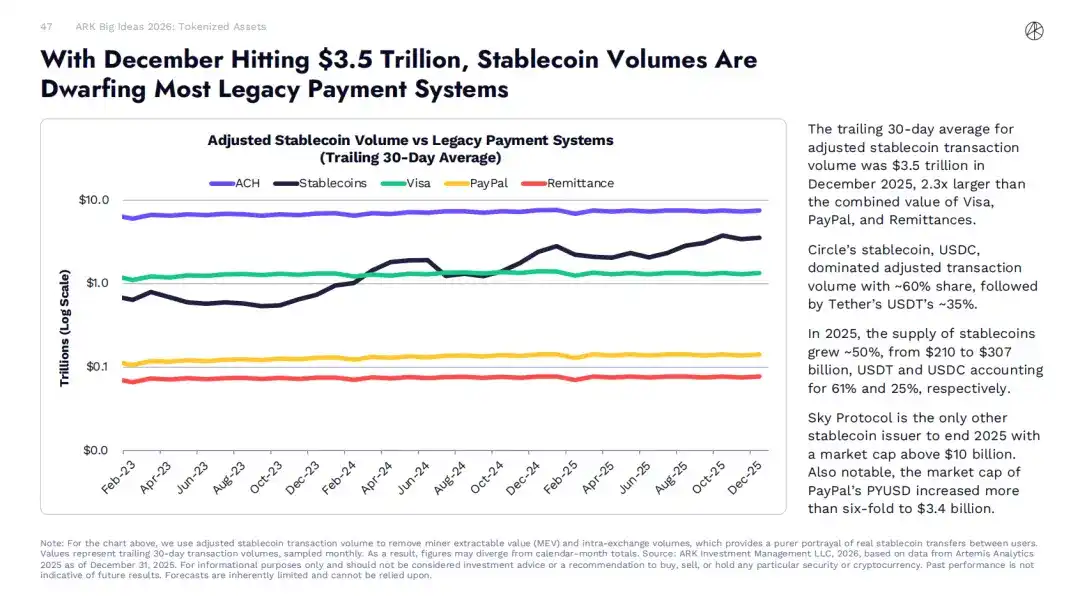
However, most of these transaction activities do not represent actual end-user payments, such as payments to suppliers or remittances. They mainly include trading, internal fund transfers, and automated blockchain activities.
To eliminate interference factors and more accurately assess stablecoin payment volumes, McKinsey collaborated with leading blockchain analytics provider Artemis Analytics. The analysis indicates:
Based on the current transaction speed (annualized figures based on stablecoin payment activities in December 2025), the actual annual stablecoin payment volume is approximately $390 billion, accounting for about 0.02% of global payment totals.
This highlights the need for a more detailed interpretation of the data recorded on the blockchain and that financial institutions need to make strategic investments guided by application scenarios to realize the long-term potential of stablecoins.
2. Strong Growth Expectations for Stablecoins
In recent years, the stablecoin market has expanded rapidly, with its circulating supply surpassing $300 billion, while in 2020, this figure was less than $30 billion (DeFillma data).
Public market forecasts show strong expectations for the continued growth of the stablecoin market. On November 12 last year, U.S. Treasury Secretary Scott Basset stated in a speech at a Treasury market conference that by 2030, the supply of stablecoins could reach $3 trillion.
Leading financial institutions have made similar predictions, estimating that the supply of stablecoins will be between $2 trillion and $4 trillion during the same period. This growth expectation has significantly increased financial institutions' attention to stablecoins, with many institutions exploring the application of stablecoins in various payment and settlement scenarios.
When you filter out payment-like behaviors, a completely different picture emerges, with adoption not being uniform. Typical scenarios include:
Global payroll and cross-border remittances: Stablecoins provide a highly attractive alternative to traditional remittance channels, enabling near-instant cross-border fund transfers at very low costs. According to McKinsey's Global Payments Map data, the annual payment scale of stablecoins in global payroll and cross-border remittances is approximately $90 billion, while the overall transaction scale in this area reaches $1.2 trillion, with stablecoins accounting for less than 1%.
B2B payments between enterprises: The cross-border payment and international trade sectors have long faced efficiency pain points such as high fees and long settlement cycles, which stablecoins can effectively address. Early adopters are optimizing supply chain payment processes and improving liquidity management using stablecoins, with small and medium-sized enterprises benefiting particularly significantly. According to McKinsey's Global Payments Map data, the annual scale of stablecoin payments between enterprises is approximately $226 trillion, while the overall scale of global inter-enterprise payments is about $1.6 trillion, with stablecoins accounting for only about 0.01%.
Capital markets: Stablecoins are reshaping the settlement processes in capital markets by reducing counterparty risk and shortening settlement cycles. Some asset management firms have issued tokenized funds that automatically distribute dividends to investors via stablecoins or reinvest dividends directly into the fund without going through banks for fund transfers. This early application scenario fully demonstrates that on-chain cash flow can effectively simplify fund operations. Data shows that the annual settlement transaction scale of stablecoins in capital markets is approximately $8 billion, while the overall settlement scale of global capital markets reaches $200 trillion, with stablecoins accounting for less than 0.01%.
Currently, the evidence cited to support the rapid adoption of stablecoins mostly relies on publicly available stablecoin transaction scale data, and people often assume that this data can reflect actual payment activities. However, to determine whether these transactions are related to payment behaviors, a deeper analysis of the actual implications of on-chain transactions is required.
(https://x.com/artemis/status/2014742549236482078)
Currently, most real stablecoin payment transaction volumes are highly concentrated in Asia, with regions like Singapore, Hong Kong, and Japan being at least one of the transaction channels. Global saturation has not yet been achieved.
Although the above market forecasts and early application scenarios confirm the enormous growth potential of stablecoins, they also reveal a reality: there remains a significant gap between market expectations and the actual situation that can be derived from surface transaction data.
McKinsey & Company, Global Payments Map: https://www.mckinsey.com/industries/financial-services/how-we-help-clients/gci-analytics/our-offerings/global-payments-map
3. Cautious Interpretation of Stablecoin Transaction Volumes
Public blockchains provide unprecedented transparency for transaction activities: every fund transfer is recorded on a shared ledger, allowing people to grasp the flow of funds between wallets and various applications almost in real-time.
In theory, compared to traditional payment systems, this characteristic of blockchain makes it easier for the market to assess the degree of stablecoin adoption—traditional payment system transaction data is scattered across various private networks, only disclosing aggregated data, and some transactions are not disclosed at all.
However, in practice, the total transaction volume of stablecoins cannot be directly equated with actual payment volumes.
Public blockchain transaction data can only reflect the amount of funds transferred but cannot represent the underlying economic purposes. Therefore, the raw stablecoin transaction volume on the blockchain actually includes various types of transaction behaviors, specifically including:
Cryptocurrency exchanges and custodians holding large reserves of stablecoins and transferring funds between their own wallets;
Automated interactions of smart contracts leading to the same funds being transferred repeatedly;
Liquidity management, arbitrage, and fund flows related to trading;
Technical mechanisms at the protocol level that break a single operation into multiple on-chain operations, resulting in multiple blockchain transactions, thus inflating the total transaction volume.
These behaviors are important components of the on-chain ecosystem and are likely to further grow with the widespread adoption of stablecoins. However, from a traditional definition perspective, most of these behaviors do not fall under the category of payments. If they are directly aggregated without adjustments, it will obscure the true scale of actual stablecoin payment activities.
This provides a clear insight for financial institutions assessing stablecoins: publicly available raw transaction volume data can only serve as a starting point for analysis; it cannot be equated with the degree of stablecoin payment adoption, nor can it be viewed as the actual revenue scale that stablecoin business can generate.
4. The Picture of Actual Scale of Stablecoin Payments
In collaboration with Artemis Analytics, our analysis conducted a detailed breakdown of stablecoin transaction data. The research focused on identifying transaction patterns that meet payment characteristics, including commercial fund transfers, settlements, payroll disbursements, and cross-border remittances, while excluding transaction data primarily related to trading, internal fund rebalancing, and automated cycles of smart contracts.
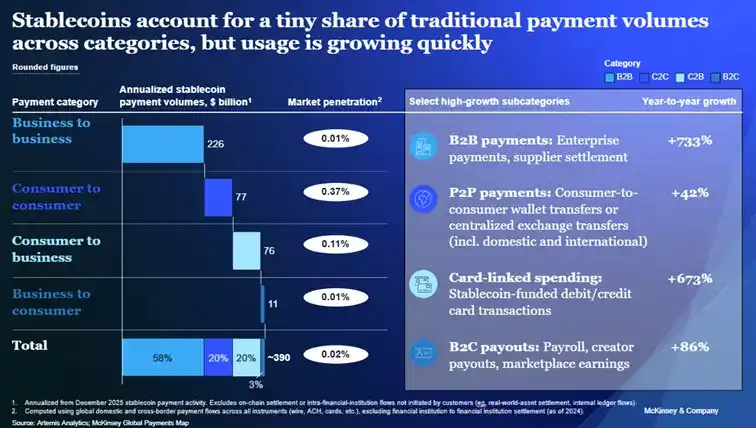
The analysis results show that the actual scale of stablecoin payments in 2025 is approximately $390 billion, doubling from 2024. Although the scale of stablecoin transactions remains relatively low in the overall on-chain transactions and global payment scale, this data is sufficient to confirm that stablecoins have formed a real and continuously growing application demand in specific scenarios (see chart).
(Stablecoins in payments: What the raw transaction numbers miss)
Our analysis yielded three prominent observations:
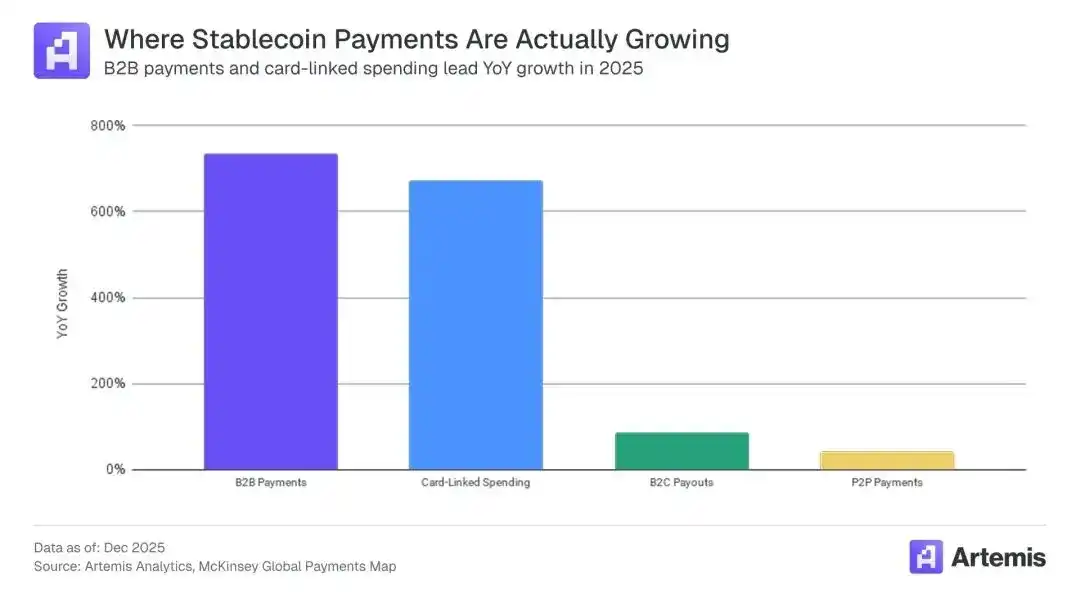
Clear value proposition. The increasing popularity of stablecoins is due to their significant advantages over existing payment channels, such as faster settlement speeds, better liquidity management, and lower user experience friction. For example, we estimate that by 2026, the spending on stablecoin-linked debit cards will grow to $4.5 billion, a 673% increase from 2024.
B2B leads growth. B2B payments dominate, amounting to approximately $226 billion, accounting for about 60% of the total global stablecoin payments. B2B payments have grown by 733% year-on-year, indicating rapid growth expected in 2026.
Transaction activity is most active in Asia. Transaction activities across different regions and cross-border payment channels are not balanced, indicating that transaction scales will depend on local market structures and constraints. Stablecoin payments from Asia are the largest source of transactions, amounting to approximately $245 billion, accounting for 60% of the total. North America follows with $95 billion, and Europe ranks third with $50 billion. Transactions in Latin America and Africa are both below $1 billion. Currently, transaction activities are almost entirely driven by payments from Singapore, Hong Kong, and Japan.
From the above trends, it is evident that the practical application of stablecoins is gradually taking root in a few validated scenarios, and whether they can achieve broader scaling depends on the successful promotion and replication of these mature scenarios to other regions.
Stablecoins possess substantial potential to reshape the payment system, and the release of this potential relies on continuous advancements in technology development, regulatory improvements, and market implementation. Their scaled application requires clearer data analysis, more rational investment layouts, and the ability to discern effective signals from public transaction data while filtering out ineffective noise. For financial institutions, only by harboring developmental ambitions while objectively recognizing the current state of stablecoin transaction volumes can they steadily position themselves for future development opportunities, seizing the initiative in the next phase of stablecoin applications and leading industry development.
Latest News
ChainCatcher
Jan 28, 2026 05:06:50
ChainCatcher
Jan 28, 2026 05:06:29
ChainCatcher
Jan 28, 2026 05:04:49
ChainCatcher
Jan 28, 2026 04:50:43
ChainCatcher
Jan 28, 2026 04:47:43