2026 Crypto TradFi Landscape Report: How Is Competition Evolving Amid Explosive Growth? | RootData Research
Trading volume surpassed $1.3 trillion in the first half of 2026, with derivatives accounting for 98.6%.

Author: RootData
Introduction
In 2026, TradFi assets are becoming a new battleground for crypto exchanges.
As precious metals such as gold and silver, as well as global stock markets including U.S. and South Korean equities, have become increasingly active, more crypto exchanges are moving TradFi products from peripheral businesses into their core product lines. Assets that were once available only through traditional brokerages and financial markets are now entering crypto trading platforms in forms such as tokenized assets and perpetual contracts.
Crypto exchanges are also using this opportunity to open up new avenues for growth and break free from the crypto market’s long-standing cyclical constraints. This has made TradFi a new competitive variable among major exchanges.
Against this backdrop, RootData examines the current development of TradFi in the crypto market and the evolving competitive landscape among major exchanges from multiple dimensions, including market size, trading structure, exchange competition, and the key submarket of equity derivatives (contracts).
This report is based on data from the TradFi segments of major exchanges including Binance, Hyperliquid, OKX, Gate, and Bybit. It primarily covers derivatives and spot trading related to tokenized assets and does not include actual stock trading through traditional brokers. Because liquidity and users in TradFi trading are currently still highly concentrated on major crypto trading platforms that have already launched such products, comparing these core platforms provides a representative view of the current size, structure, and competitive landscape of the crypto TradFi market.
I. Overview of the Crypto TradFi Sector
1. H1 2026 Trading Volume Exceeds $1.3 Trillion, Entering a Phase of Explosive Growth
In the first half of 2026, the crypto TradFi sector moved from “testing the waters at the margins” into a phase of “explosive volume growth.”
Data from the sample of major mainstream exchanges shows that trading volume surpassed $1.3 trillion in the first half of 2026. By comparison, total TradFi trading volume for all of 2025 was only in the hundreds of billions of dollars. In just the first half of 2026, trading volume was already 10 times the level recorded for the whole of last year.
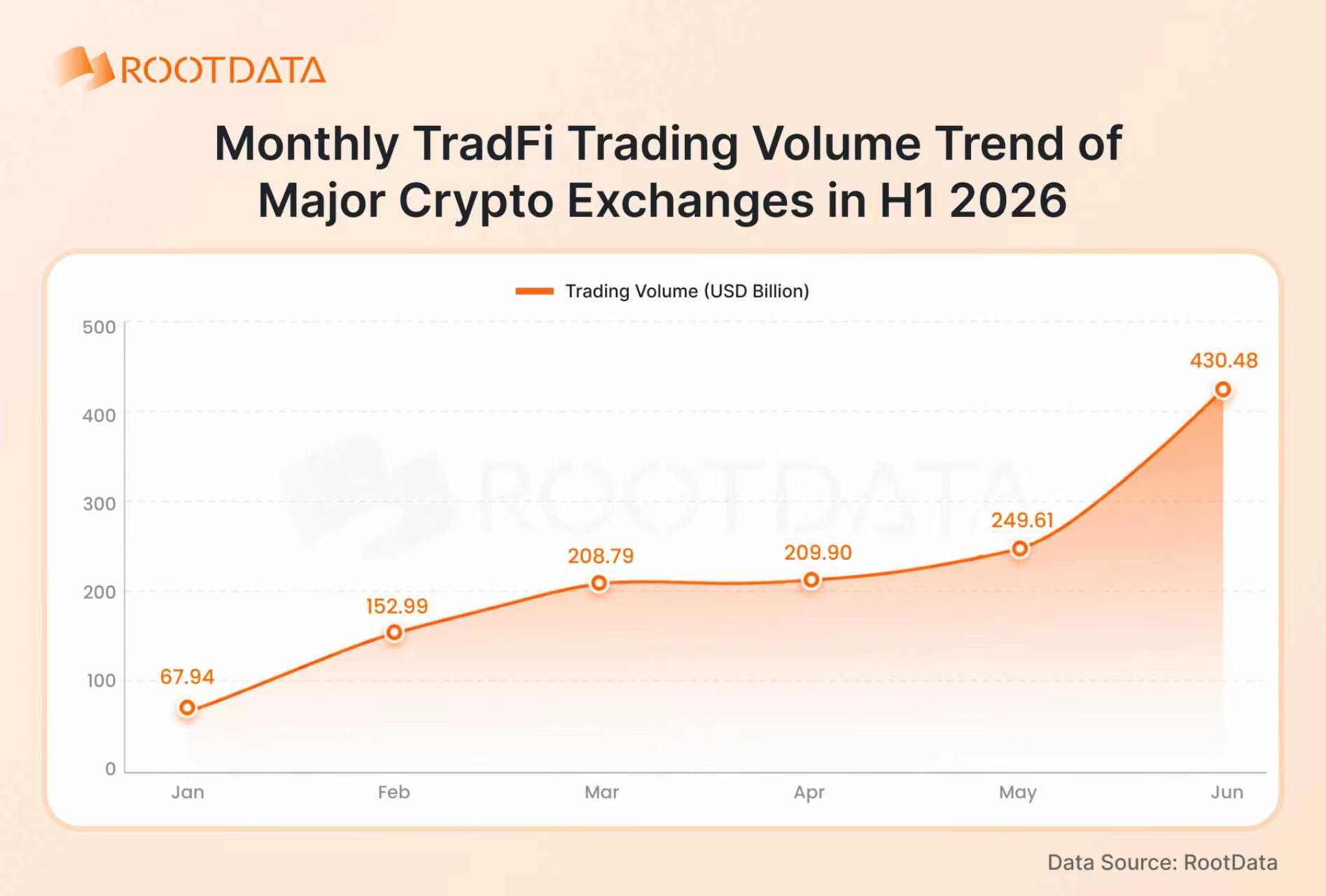
Behind this growth was the convergence of crypto exchanges’ early expansion into TradFi and market conditions in traditional finance.
Since 2025, mainstream platforms represented by Binance, OKX, and Gate have continued to expand their TradFi product lines, putting the necessary infrastructure in place ahead of time. As precious metals and global stock markets, including U.S. and South Korean equities, performed strongly this year, exchanges that had entered crypto TradFi early captured significant spillover demand and the benefits of strong traditional financial markets by actively listing popular TradFi assets and continuously iterating on product functionality.
On a monthly basis, trading volume reached $67.94 billion in January, when market attention remained focused on precious-metal tokens such as gold. Spot trading accounted for 7.48%, reflecting the brief popularity of precious-metals RWAs at the beginning of the year.
Starting in February, monthly TradFi trading volume surged 125.2% month-over-month to $152.99 billion, breaking above the $100 billion mark. In June, driven again by market conditions, volume rose another 72.5% month-over-month to $430.48 billion, setting a new high for the first half of the year.
June’s monthly trading volume was already 6.3 times its January level, while the prevailing level of monthly trading volume shifted from below $70 billion at the start of the year to more than $400 billion. Should second-half activity hold at first-half levels, full-year TradFi trading volume could approach the $3 trillion mark.
2. Derivatives Dominate the TradFi Sector
In the first half of 2026, derivatives dominated the TradFi sector, with cumulative trading volume exceeding $1.3 trillion and accounting for 98.59% of the total—making them the sector’s clear mainstay. Spot trading amounted to just $18.558 billion, or less than 1.5%. Spot’s share peaked at 7.48% in January, the highest reading of the first half, before quickly falling below 2% and remaining subdued. From February onward, the derivatives-led structure gradually took shape from February onward.
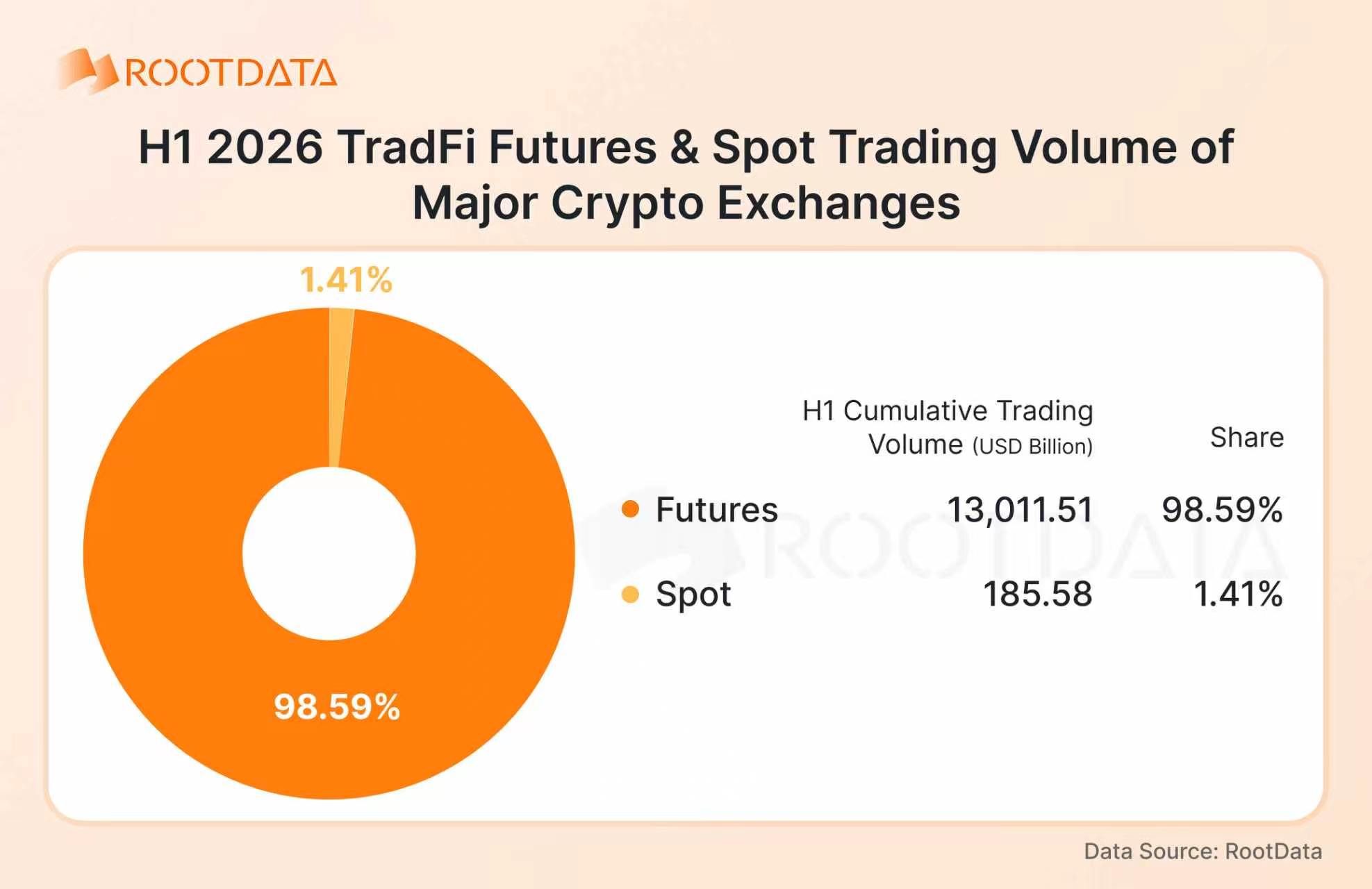
Equity derivatives account for the dominant share. In terms of asset coverage, more than 90% of the TradFi contract underlyings listed by the five exchanges are stocks and equity ETFs.
Open-interest data from the first half of 2026 also shows substantial growth in positions for popular TradFi assets including SNDK, SPCX, SK Hynix, and XAU. Open interest in XAU gold contracts at one point exceeded $700 million, while SPCX open interest peaked above $500 million.
Sign in to unlock the full article
Sign in to unlock the complete research report and PDF download
This report analyzes the business data, product structure, compliance status, security incidents, and market performance of relevant exchanges, based solely on publicly available and verifiable information. It does not constitute a recommendation, endorsement, or adverse assessment of any exchange mentioned. An exchange’s operations, licensing, fund security, and regulatory environment may change materially; readers should rely on official disclosures and regulatory filings for the latest status. This report does not constitute advice on account opening, trading, or asset custody, and makes no warranty as to the security, liquidity, or going-concern status of any platform. Readers who act on this report do so at their own risk. The institution may have commercial relationships with certain exchanges, which do not affect the independence of this analysis. Unauthorized reproduction is prohibited.