
Founder of Social Capital: Will Bitcoin go to zero?
Author: Chamath Palihapitiya, Founder of Social Capital
Compiled by: Gu Yu, ChainCatcher
A month ago on the Moonshots podcast, someone asked me about my views on cryptocurrency, in the context of the rapid rise of superintelligence.
I said that cryptocurrency and Bitcoin have a ceiling.
That comment sparked a strong reaction, so I had my team review my reasoning, cross-check with experts, and share a complete answer with our paying readers.
I hope you enjoy this holiday reading.
Nothing on the internet is truly 100% secure.
A digital system is considered "secure" only because the currently known fastest method to crack it would take an impractically long time to complete.
Based on everything mathematicians currently know, recovering a private key from a public key today requires astronomical levels of computational steps.
However, new mathematics—revealed by quickly digging into the underlying math of the problems—could bring about entirely new methods that reduce the workload required to crack a lock by several orders of magnitude.
Thus, what seems impractical may suddenly become feasible.
How a 129-bit lock composed of two prime numbers was cracked in 1994:
The core idea of public key cryptography is: creating locks is easy, but the computational cost of the recovery process for someone who does not know the key is extremely high.
For example, multiplying two prime numbers, 53 × 61 = 3,233, is easy, but the reverse process (factorization) is difficult. If you only see the product (3,233), the simplest way to find 53 and 61 is to sequentially divide this product by 2, 3, 5, 7, etc., until you find a number that divides it evenly, which requires 16 attempts.
Now imagine a 600-bit number.
At 600 bits, even using the best-known methods to find these primes, the time required would exceed any computer's operational lifespan.
RSA, invented in 1977, is based on this idea. Bitcoin's signatures are based on another mathematical problem, using elliptic curves instead of primes, but the core idea is the same.
In 1977, one of the inventors of RSA estimated that factoring a 125-bit product would take 40 quadrillion years. However, in 1994, volunteers factored a 129-bit product in eight months, speeding up the process by about 17 orders of magnitude, despite the larger number. This was thanks to a method invented in 1981 and much more powerful computing capabilities.
In other words, the security level of digital systems assumes that the tapestry of mathematical and computational knowledge grows slowly enough that discovering new techniques with much higher effectiveness will take years or even decades.
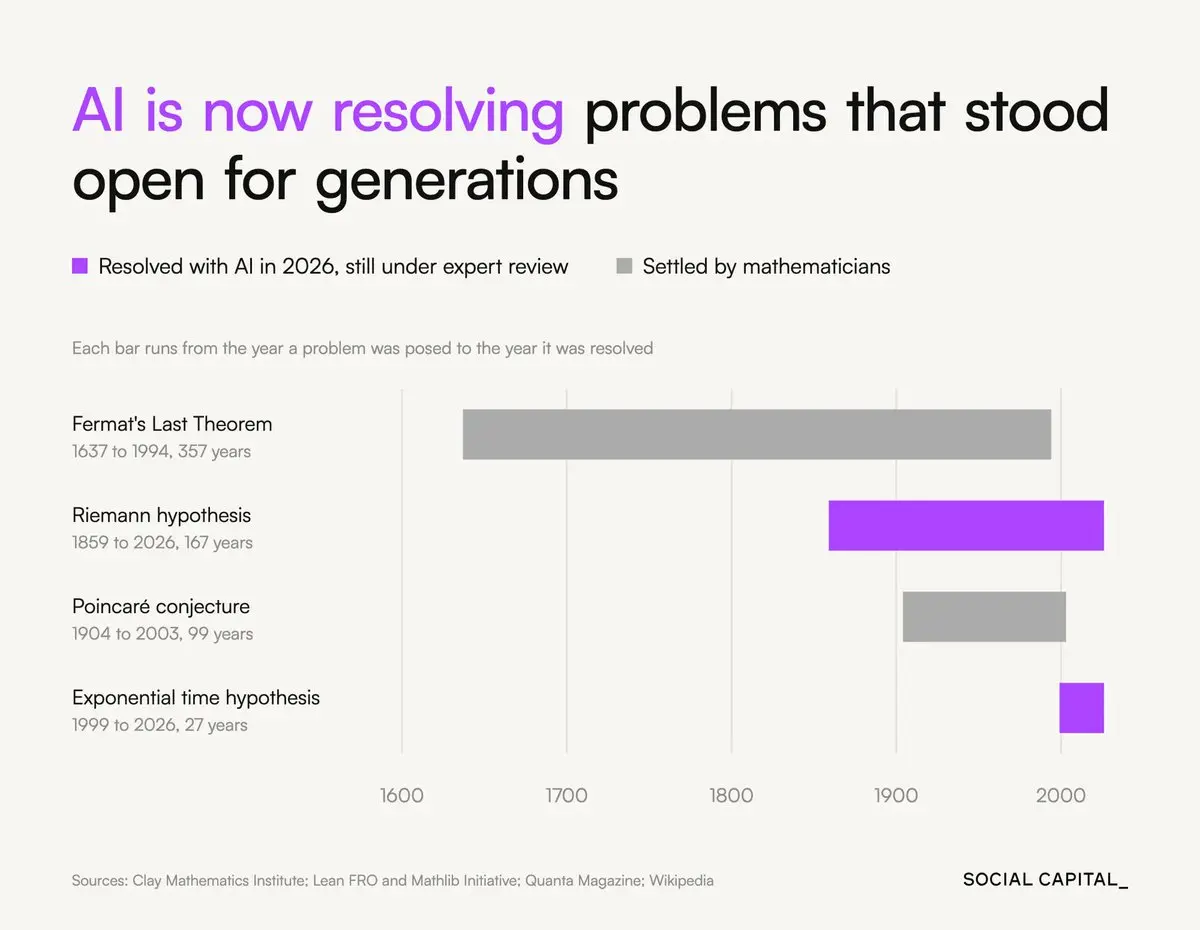
This assumption may be crumbling. Large numbers of collaborative AI agents are now tackling previously extremely difficult mathematical problems, such as the Riemann Hypothesis, and a conjecture in computer science that has existed for 27 years regarding how quickly certain problems can be solved (the exponential time hypothesis).
Although these two problems are not directly related to Bitcoin, the key point is that AI agents are collaborating with mathematicians to solve problems that have eluded even the top mathematicians for generations, using software that can verify their proofs at every step.
This is a period of alien mathematics. Not necessarily because the proofs are long, but because they contain so many unexpected ideas. Claude collaborated with mathematician Levent Alpöge to provide a proof of the Riemann Hypothesis in about six weeks.
AI agents have also begun directly studying cryptography. In July 2026, Anthropic reported that Claude Mythos Preview autonomously ran for about a week, providing an attack on a simplified version of the AES-128 cipher (7 rounds of its 10 rounds) that was 200 to 800 times faster than previous best results. Anthropic stated that this result has no practical impact on systems currently in use.
This suggests that if there exists a technology that can crack modern cryptography at a much faster speed, the underlying mathematics may be discovered in the near future, rather than decades later as assumed by the teams designing today's secure systems.
Almost all of the above applies to general digital security, from banking to messaging applications. Bitcoin is, in a sense, the most typical test of this risk, because Bitcoin is entirely self-executing through code, with nothing supporting it other than the verification of its code.
Will a large number of superintelligent AI agents inevitably crack Bitcoin? If so, is there a way to patch Bitcoin to withstand these attacks?
To answer these questions, we will first review how Bitcoin's security is designed, examine what is required to crack each aspect of Bitcoin's design, and then discuss whether Bitcoin can respond to this risk through patching.
How Bitcoin is Designed
From a cryptographic perspective, what is ingenious about Bitcoin's design?
First, Bitcoin does not introduce a new cryptographic lock.
Every lock used by Bitcoin was established decades ago and is of the same type (cryptographic hash functions, such as SHA-256, and digital signatures, such as ECDSA, which will be explained later). These locks are still used across the internet to confirm who sent messages between phones, prove that a bank's website is legitimate, and check that software updates indeed come from their creators.
The genius of Bitcoin lies in the clever arrangement of various locks, combined with a logically rigorous process that specifies how Bitcoin rewards those computers that continuously maintain the ledger, allowing strangers to reach consensus and trust a shared ledger over time without a bank.
This system has three key aspects:
The arrangement of locks
The locks within that arrangement
The process by which computers continuously maintain the ledger (proof of work)
We will analyze (1), (2), and (3) one by one, and explore whether AI agents could potentially break each aspect of this system.