
Coinbase Ventures analyzes the four-layer technology stack of Agent and explains the investment logic in the sector
Author: Jonathan King, Senior Investment Manager at Coinbase Ventures
Compiled by: Gu Yu, ChainCatcher
AI Agents are becoming active participants in economic activities. Their ability to pursue goals, make decisions, and trade on our behalf is laying the foundation for a brand new financial system: Agent Finance (AiFi). It is developing along two paths, both of which are changing the way we interact with money. The first path involves payments and commerce, where Agents pay for goods, services, and data. The second path involves trading and markets, where Agents directly participate in financial markets. This article focuses on the second path: agentic trading.
In agentic trading, AI Agents execute part or all of the trading decision loop on your behalf. You set goals and constraints, and the Agent can research the market, build strategies, adjust position sizes, place trades, and monitor risks within the permissions you grant. Although still in its early stages, this approach makes complex trading processes accessible through simple prompts.
In our 2024 Investment Outlook on Crypto x AI, we predict that natural language interfaces will become the primary way for people to conduct on-chain trading. In our article "The Rise of Onchain AI" published in May 2025, we explored how Agents can make personal portfolio management more accessible. Since then, the development of this concept has far exceeded the crypto space. Exchanges, brokers, and a new wave of startups are racing to build ways for Agents to trade in crypto assets, stocks, derivatives, prediction markets, and more.
As Agents themselves become easier to build, we focus on what can give the companies behind them a lasting competitive advantage. We believe that value will shift from mere order execution to the party that continuously manages investment strategies and earns the trust of users and their Agents to hold assets.
This perspective guides Coinbase Ventures in seeking investments in three areas: Agent trading Harness and terminals, gaining real advantages through specialized intelligence and data acquisition, and compliance and observability infrastructure that makes Agent behavior traceable and accountable. The following outlines the landscape of this emerging field and the conditions we believe are necessary to build lasting businesses within it.
What is Agent Trading?
Agent trading refers to AI Agents operating under the permissions you grant, running part or all of the trading decision loop. It has ongoing goals, autonomously collects information, formulates and adjusts strategies, and executes trades within the limits you set, without needing your approval for every step.
Trading automation has existed for decades, but each wave of automation prior has only executed decisions already made by humans in faster or cheaper ways:
Rule-based trading Bots trigger conditions you pre-write ("buy when X crosses Y"). They are faster triggers, not decision-makers.
Algorithmic execution (like TWAP or VWAP) aims to determine how to execute orders you have already selected, never deciding what to buy.
Robo-advisors use fixed rules to manage portfolios. They cannot form new opinions or react to news.
Copy trading mirrors the trades of others, inheriting their risks but unable to adjust based on your circumstances.
Agent trading disrupts this model. You articulate goals in plain language, and the Agent breaks them down into research, strategy, position control, execution, and ongoing monitoring. For the first time, machines form investment opinions rather than simply executing assigned views. Humans transition from operators to delegators: you no longer need to press buttons but instead set task instructions.
Why Now?
AI trading Bots are not a new concept. Many Bots were launched in 2023, but most were misnamed. We believe this time is different because four changes have occurred over the past 12 months:
AI models have become reliable enough. The generation of Bots in 2023 failed because language models could summarize the market but could not execute plans against it. Today's cutting-edge models can handle multi-step tasks, use tools, and recover from mistakes, which is the minimum threshold for managing positions without human supervision.
The cost of accessing markets has become low. Open standards like Model Context Protocol (MCP) and Agent2Agent (A2A) have transformed trading venues, data sources, and custody systems into plug-and-play functionalities. Previously, connecting an Agent to a broker required a quarter of custom engineering development. Now it takes just minutes.
Open-source Agent "Harness" makes it a weekend project. Tools like OpenClaw and Nous Hermes* provide out-of-the-box memory, scheduling tasks, and market connectivity for any model. OpenClaw alone gained about 250,000 GitHub Stars in roughly 60 days. The crypto space was the first to absorb this wave because open, permissionless APIs mean no gatekeepers, which is why perpetual contracts on Hyperliquid and prediction markets on Polymarket were among the earliest targets.
Markets are beginning to converge. Tokenized stocks, perpetual contracts for real-world assets, 24/7 trading markets, and stablecoin settlements mean a single Agent can now pursue a goal across multiple asset classes from a single collateral pool. Previous automation was trapped in their respective information silos, as each asset class operated on its own independent infrastructure.
Why This Matters
Agent trading is expected to democratize quantitative trading. Strategies that previously required a quantitative trading background, such as cross-asset class signal fusion, adjusting position sizes with market changes, identifying changes in market mechanisms, or rebalancing with tax considerations, can now be requested with a simple sentence.
Imagine a request like this: "Build me a portfolio with a momentum tilt between cryptocurrencies and semiconductor stocks, limiting maximum drawdown to 15%, and rebalancing weekly." From this short sentence, the Agent can extract momentum signals from both markets, construct a portfolio, adjust each position size to comply with the drawdown limit, place orders across platforms, and reassess the plan weekly.
This model also changes user demands on trading platforms. People are increasingly inclined to come to platforms with portfolio intentions ("Build me a portfolio that expresses my view on X") rather than order intentions ("Buy 10 shares of X"). This represents a fundamentally different product form from traditional trading interfaces and is more favorable to platforms that offer the widest range of asset classes rather than those that provide the best execution on a single asset.
Agent Trading Technology Stack
Agent trading is evolving from a state of being pieced together with experimental tools to a more structured technology stack. We divide it into four layers: Intelligence (the data and models that Agents rely on for thinking), Agency (the Harness and applications that turn models into continuously operating trading Agents), Execution (the track that turns decisions into executed orders), and Compliance & Observability (the trust infrastructure that verifies what Agents did and why).
The following market panorama covers the startups and platforms we track at each layer, starting from the foundational Intelligence layer all the way to the top Execution and Trust layer.
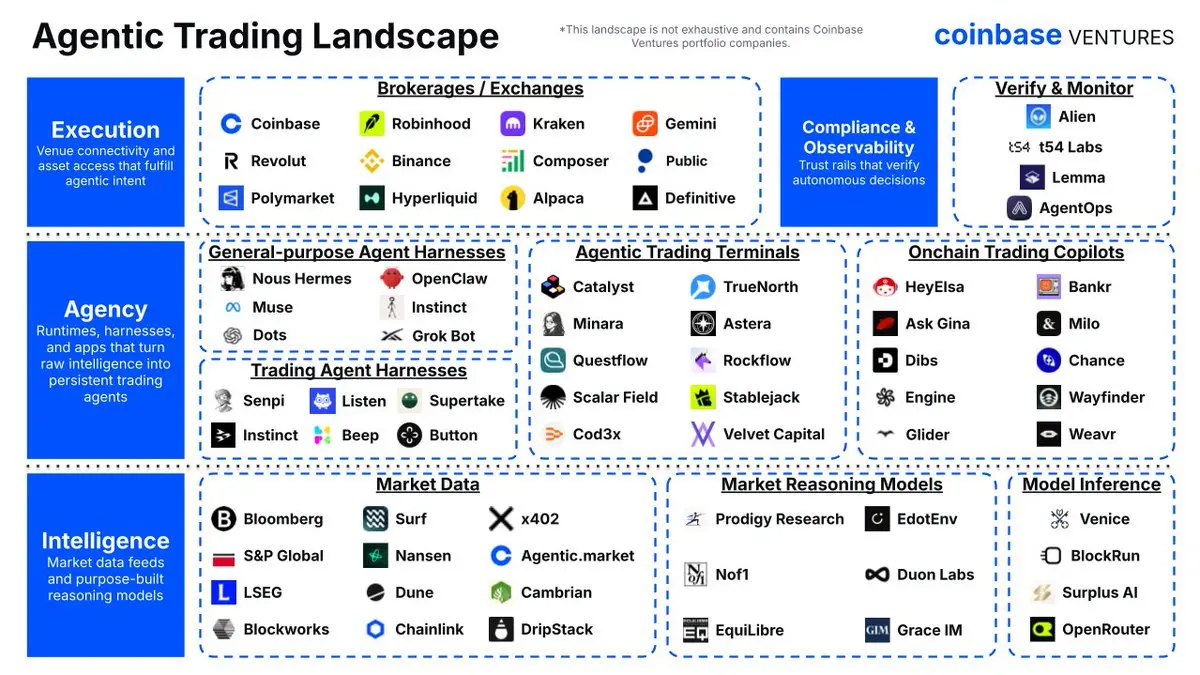
Intelligence Layer: Data and Reasoning
Market data. Agents need clean, machine-readable information: prices, order books, filings, news, sentiment, and on-chain activities with timestamps and source tags. Today's data business models are designed for humans, billed by the seat of terminal analysts, rather than for Agents that issue thousands of queries daily. This mismatch creates opportunities for machines to pay for data. For example, Coinbase's open-source x402 protocol allows Agents to pay precisely for the data they need using stablecoins when required. Established data providers like Bloomberg, S&P Global, on-chain analytics platforms like Nansen, Dune, and oracle networks like Pyth, Chainlink have already provided a wealth of such information. New players like Surf and Cambrian are building research and data information flows designed for Agents from day one.
Market reasoning models. While the general reasoning capabilities from frontier labs are indeed powerful, they are accessible to everyone, which means they do not constitute a competitive advantage in themselves. The real open opportunity lies in specialized market reasoning models: models trained specifically for reasoning about financial markets, testing and validating trading ideas, deploying real capital, and managing risk in long, unsupervised workflows. A new class of market reasoning model labs, including Prodigy Research, EdotEnv, and Nof1, are exploring this direction by training on market data or building simulated trading environments for models to learn. Meanwhile, reasoning platforms and routers like Venice allow Agents to select the best model for each task and, in some cases, can be paid for on request using USDC.
Core Layer: Harness, Terminal, and Copilot
The general Agent Harness transforms models into persistent Agents by endowing them with memory, timed triggers, tool calls, sandbox environments, and the ability to recover from errors. They are designed to handle any task, from coding and research to managing inboxes, and users can extend them with plugin skills. Open-source Harnesses like Nous Hermes and OpenClaw have become increasingly popular in this field, with trading rapidly becoming one of their most important use cases. However, trading requires more than just a general toolkit. We see a clear demand gap for Harnesses "tailored for trading reinforcement," which need to have built-in skills for dynamic position adjustments, take-profit and stop-loss limits, and position reduction, as well as provide a way to test strategies before real money is put at stake.
Trading Agent Harnesses are built specifically to fill this gap. Teams like Senpi and Supertake are two examples. Senpi, which calls itself an "AI Quant Engineer," is designed for proactive traders: it converts trading strategies described in plain English into code and runs around the clock across hundreds of Hyperliquid markets, automatically applying risk-based position size management and trailing stops. Supertake, on the other hand, is built for ordinary investors: users can write down an investment idea or "take" in their own words, and its Agent will convert it into a portfolio, providing a practice mode for simulating results and a public leaderboard for the best-performing takes.
Agent trading terminals are exclusive workspaces. They are fully equipped working environments where users can push an idea through the entire closed loop: research, strategy design, backtesting, execution, and ongoing monitoring. Many terminals are multi-asset, allowing a single Agent to trade stocks, cryptocurrencies, perpetual contracts, and prediction markets, and most terminals choose to connect to existing brokers and exchanges rather than self-custody assets. They can be seen as trading terminals restructured for the Agent era, aimed at active traders seeking depth and control. For example, Catalyst can transform users' market views into strategies for trading across stocks, options, and prediction markets; while TrueNorth provides users with personalized Agents to scan the stock, commodity, and crypto perpetual contract markets and establish trades.
On-chain trading Copilots are proactive assistants that serve you. They prioritize chat and are often directly built into mainstream applications that people are already using, such as X, Telegram, or crypto wallets. They are built around users' own on-chain wallets, so funds typically remain self-custodied. They focus on cryptocurrencies and can handle everyday operations like swaps, cross-chain bridges, perpetual trading, yield farming, and prediction market betting in a single message. Terminals pursue depth, while Copilots pursue convenience and coverage. For example, HeyElsa allows users to build portfolios, perform cross-chain swaps, and earn yields through simple conversations; while Bankr allows users to buy, sell, swap tokens, or set limit orders by mentioning it on X.
In practice, the boundaries between these categories have begun to blur. General Harnesses are adding trading skills, trading Harnesses are adding portfolio and leaderboard features found in terminals, terminals are adding chat interfaces, and Copilots are adding strategies that run around the clock. Over time, we expect them all to compete around the same question: who owns the decision-making closed loop. Terminals have advantages in depth, asset breadth, and user stickiness; Copilots and general Harnesses have advantages in distribution channels because they are already where users spend their time. The products most likely to endure will be those that combine genuine advantages at the intelligence or strategy level with hard-to-replicate distribution capabilities.
Execution Layer: Trading Venue Connectivity and Asset Breadth
The execution layer transforms the Agent's decisions into completed trades. This means routing orders across trading venues and asset classes, tracking order statuses, reconciling positions, and securely holding assets. The entire industry is converging towards a "single credential, multiple assets" model, where a single Agent connection can trade spot crypto assets, derivatives, stocks, and more.
Brokers and exchanges are opening up to Agents in two ways. The first is bring-your-own-agent access: external Agents (like ChatGPT, Claude, or Grok) connect via MCP servers, command line tools, APIs, or dedicated Agent accounts. For example, Coinbase for Agents allows third-party Agents to trade crypto spot, US futures, and stocks on users' Coinbase accounts within user-defined limits. The second is built-in intelligence: the AI of the trading venue itself runs within the application, helping users with research, planning, and executing operations. Coinbase Advisor is an example. Additionally, AI-native infrastructures like Alpaca and on-chain trading APIs like Definitive provide Agents with ready-made trading execution tracks without needing to build from scratch.
Compliance and Observability: The Trust Cornerstone of Autonomous Decision-Making
Today's regulatory and compliance frameworks assume decisions are made by humans. When an Agent makes a decision, someone must be able to answer: What did the Agent see, what decision did it make, why, and who is responsible for it? This layer records the Agent's inputs, reasoning processes, actions, and trades for auditing its behavior.
We believe this is one of the most underdeveloped parts of the entire tech stack. The opportunity here lies in a new trust infrastructure for Agents: Agent identity and authentication ("Know Your Agent"), tamper-proof decision logs, verifiable performance tracking, and reputation systems. Companies like Alien, t54 Labs, Lemma, and AgentOps are pioneers in this field.
Where Value is Flowing
This is our core viewpoint: in Agent trading, the Agent itself is not the moat. The open-source models running on open-source Harnesses mean anyone can build a powerful trading Agent over a weekend. If Agents become commodities, then value will inevitably settle elsewhere.
We believe there are three trends driving the flow of value:
Execution fees are compressed, but liquidity remains king. Agents will significantly reduce trading commissions because they can instantly compare prices across various trading venues and have no loyalty to any single interface. However, they optimize the total cost of trading, including spreads and price slippage, not just fees. The order flow of Agents will gravitate towards the deepest markets with the tightest spreads. The space for order routing businesses will shrink, but controlling liquidity will not.
Value flows to the party that controls the decision-making closed loop. We believe Agent trading platforms will increasingly monetize through what we call "Intent-as-a-Service": transforming users' goals into actionable portfolios and ensuring they stay on track. Users will pay for the final outcomes, not for clicks. This "intent premium" belongs to the party that controls the decision-making closed loop, not just the one that controls the order pipeline.
Trust and breadth win at the platform level. If anyone can build an Agent, the winning platforms will be those that gain the trust of users and their Agents to hold their assets, as well as those that offer the broadest trading assets on the safest and most reliable tracks. When users come with portfolio intentions, platforms that only offer a single asset class will hand over Agents to those that can provide a full range of assets.
For startups, this evolves into a simple screening criterion. We believe the most enduring venture-grade outcomes will emerge in places where proprietary intelligence, distribution channels, or regulatory compliance establish barriers. A model that simply wraps a thin layer of Agent shell around a general model plus trading APIs is unlikely to survive long-term.
Our Investment Direction
From this perspective, Coinbase Ventures focuses on the three pillars of the Agent trading tech stack:
Agentic trading execution framework and terminal. We are looking for products that go beyond order routing and can truly support the intention of building investment portfolios. They need to provide an excellent user experience and demonstrate that users will continue to stay: Agentic trading volume, assets under management, and retention rates are all increasing.
Gaining a true advantage. As general reasoning capabilities become commoditized, the advantage will shift to those who can provide agents with benefits that are difficult for others to easily replicate. Building market reasoning models and AI research labs that can reliably run multi-step financial workflows in an unsupervised manner is a clear path. We are also focused on unique data providers, quantitative strategy models, and validated strategy markets for agents to call upon.
Compliance and observability. Regulatory frameworks are not designed for non-human decision-makers. We are investing in infrastructure that can bridge this gap: agent identity and proof, tamper-proof decision monitoring, complete traceability of every tool used by agents, performance verification, and reputation.
When evaluating companies, we focus more on defensiveness rather than just capability:
Intelligent flywheel. Because the model itself is not a moat, we are looking for a "context loop," where proprietary data and specialized models reinforce each other, allowing strategies to continuously improve over time and widen the gap with competitors.
Native agent-focused teams. The strongest teams combine three capabilities: deep quantitative trading experience (to achieve risk-adjusted returns), advanced AI engineering capabilities (to ensure reliable agent behavior), and regulatory literacy (viewing compliance as a product feature rather than a remedial measure).
Looking Ahead
Agentic trading marks a true transformation in how people interact with markets. As agents become easier to build, we believe that businesses that can endure in the long term need to possess advantages that are difficult for others to easily replicate. The winners will be those who master intelligence, earn user trust, and provide agents with the safest, regulated pathways to the broadest markets.
This tech stack is still under construction, with a large part of it—from execution frameworks validated through trading practice, to strategy markets, to agent identity and audit trails—still completely open.
Related References
AiFi: Financial Systems for AI, Coinbase
The Rise of On-Chain AI: Agents, Applications, and Commerce, Coinbase Ventures
Demystifying the Crypto x AI Stack, Coinbase Ventures