
Berkshire's Q3 net profit plummeted by 28%, investment income shrank by nearly half, buybacks reached a new quarterly high for the year, and cash rose to 377.4 billion USD
Berkshire Hathaway's net profit in the third quarter saw a significant decline, with pressure from the insurance business and reduced investment income being the main burdens. However, the company significantly increased its stock buyback efforts this quarter, achieving a record high for the year in a single quarter, and cash reserves further climbed to $377.4 billion.
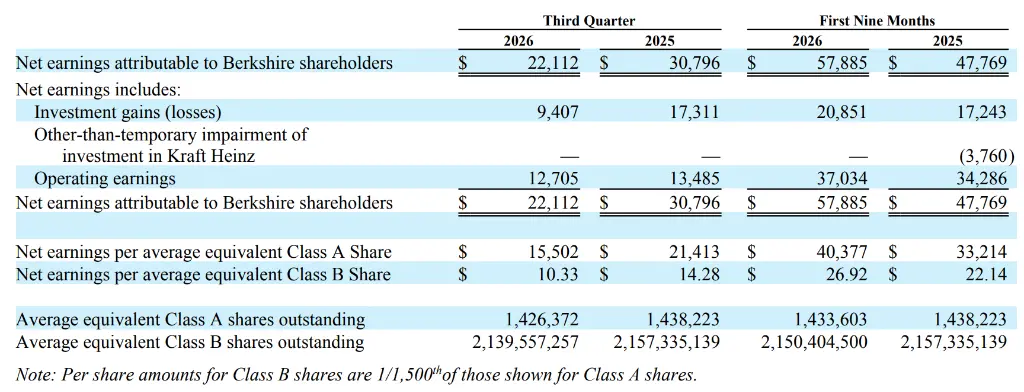
On November 7 local time, Berkshire announced its third-quarter performance. The company's operating profit was $12.705 billion, a year-on-year decrease of 5.8%; net profit was $22.112 billion, a year-on-year decrease of 28.2%. Among them, total investment income was approximately $9.407 billion, down about 45.7% from $17.311 billion in the same period last year, nearly halving.
The insurance business performed poorly. Insurance underwriting profit decreased by 43% year-on-year. The claims losses and underwriting expenses of the auto insurance subsidiary Geico increased by 8.5% and 17%, respectively. Net investment income from insurance also fell by 14% year-on-year to $2.7 billion, mainly affected by the decline in short-term interest rates.
In terms of capital allocation, Berkshire spent approximately $9.6 billion repurchasing its own stock in the third quarter, the highest level for a single quarter this year. Meanwhile, as of the end of September, the company's cash reserves rose to $377.4 billion, continuing to increase from the previous quarter. In the third quarter, Berkshire also net sold about $426 million in stock holdings.
Insurance Business Under Pressure, Operating Profit Down 5.8% Year-on-Year
Berkshire's operating profit in the third quarter was $12.705 billion, a year-on-year decrease of 5.8%, with the poor performance of the insurance business being one of the important reasons.
In the third quarter, insurance underwriting profit decreased by 43% year-on-year. Among them, Geico's claims losses increased by 8.5% year-on-year, while underwriting expenses grew by 17%, indicating rising cost pressure in the insurance business.
At the same time, Berkshire's net investment income from insurance fell by 14% year-on-year to $2.7 billion. Bloomberg pointed out that this was mainly due to the decline in short-term interest rates. The simultaneous decline in underwriting profit and investment income has put pressure on the overall profitability of the insurance business.
Investment Income Shrinks Nearly Half, Net Profit Drops 28% Year-on-Year
Compared to the 5.8% decline in operating profit, Berkshire's net profit decline in the third quarter was more pronounced.
The net profit for the third quarter was $22.112 billion, a year-on-year decrease of 28.2%. Total investment income was approximately $9.407 billion, a decrease of about $7.9 billion from $17.311 billion in the same period last year, a decline of about 45.7%.
It is important to note that investment income includes both unrealized and realized gains and losses from equity investments and does not equate to cash income generated from stock trading. The reduction in investment income is an important factor contributing to the year-on-year decline in Berkshire's net profit.
From the perspective of portfolio structure, Berkshire's stock investment portfolio remains highly concentrated.
As of September 30, Alphabet, American Express, Apple, Bank of America, and Coca-Cola collectively accounted for 65% of the total fair value of its equity investments.
At the same time, since Abel took office, he has also begun to increase investments in AI-related assets, including over $10 billion invested in Alphabet and $930 million in the Italian tech group Bending Spoons.
However, Alphabet's stock price has fallen more than 24% since June and is currently below Berkshire's cost basis; Bending Spoons' stock price briefly surged after Berkshire increased its holdings but has since continued to decline over the past three weeks. The timing of this series of investments in the AI field is being questioned by the market.
Buybacks Reach a New High for the Year, Cash Reserves Rise to $377.4 Billion
Despite the pressure on profits, Berkshire significantly increased its stock buybacks in the third quarter.
The company repurchased approximately $9.6 billion of its own stock during the quarter, setting a record high for a single quarter this year. Bloomberg reported that Berkshire restarted stock buybacks in the first quarter of this year, marking the company's first stock repurchase in over a year.
Abel believes that Berkshire's stock price is below its intrinsic value, prompting the company to start repurchasing its own shares.
Meanwhile, as of the end of September, Berkshire's cash (cash and short-term U.S. Treasury bills) reserves reached $377.4 billion, further increasing from the previous quarter. In the third quarter, the company also net sold about $426 million in stock holdings.
This means that while Berkshire is increasing its stock buybacks, it still maintains a large cash reserve. For Abel, how to allocate capital between external investments, stock buybacks, and cash management will be a focal point of ongoing market attention.