
The biggest suspense of the U.S. midterm elections next week: the Republican Party unexpectedly holds the Senate vs. the Democratic Party secures more than 53 seats
Author: Zhang Yaqi, Wall Street Journal
With less than a week until voting day, the control of the Senate has become the most critical variable affecting the U.S. stock market. Citi believes that the expectation of a blue wave has largely been priced in by the market, and the real market risk lies in two tail scenarios: the Republican Party unexpectedly retaining the Senate, or the Democratic Party exceeding expectations by winning more than 53 seats.
Citi Research pointed out in its U.S. stock strategy report released on October 30 that the probability of the Democratic Party sweeping both houses is currently the highest scenario and has been steadily rising recently, with this expectation largely incorporated into the current valuation of U.S. stocks. However, the polling results for several key Senate seats are still within the margin of error, making it possible for the Republican Party to retain the Senate.
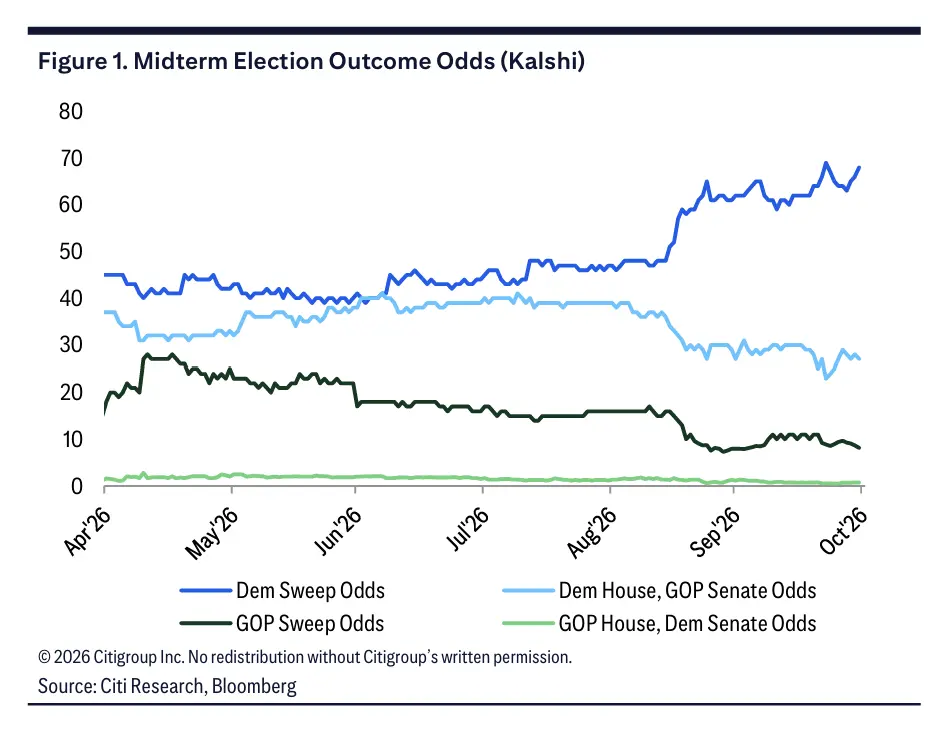
Citi strategists Scott T Chronert and Patrick Galvin believe that if the Republican Party retains the Senate, the U.S. stock market is likely to receive an additional boost by the end of the year; conversely, if the Democratic Party wins more than 53 seats, the market will begin to price in the risk of corporate tax rate increases in the 2028 election, putting pressure on stock valuations.
The two scenarios point to completely opposite market directions, making the Senate election results the core driving variable for the U.S. stock market next week. The relative performance of the financial and healthcare sectors, the progress of AI data center construction, and the prospects for the 2027 budget and debt ceiling negotiations will all face repricing due to the election results.
Senate Suspense: A Tug-of-War Within the Margin of Error
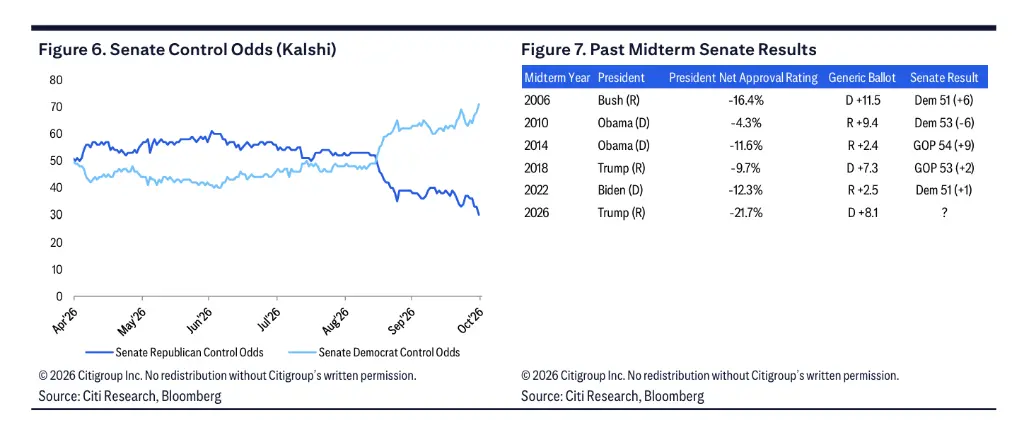
The probability of the Democratic Party flipping the Senate has been steadily rising over the past few months, and this week, as early voting data is released, the momentum in the predictive market has further tilted toward the Democratic Party. However, Citi emphasizes that this outcome is far from certain.
In terms of seat distribution, without counting swing states, the Democratic Party is currently expected to secure 53 seats, while the Republican Party is expected to have 47 seats. However, as many as 16 key Senate seats are listed as competitive by RealClearPolitics, with 9 being "true swing" seats. The latest data from the prediction platform Kalshi shows that key seats such as Texas (D +72%), Michigan (D +74%), and Ohio (D +70%) currently have the Democratic Party in the lead, but the advantages are not overwhelming. Iowa, Nebraska, and other seats are still slightly led by the Republican Party.
Citi points out that if multiple swing state polls show systematic bias simultaneously, the results could completely skew toward one side, causing a significant shift in the Senate's final map from "Republicans retaining" to "Democrats significantly exceeding expectations."
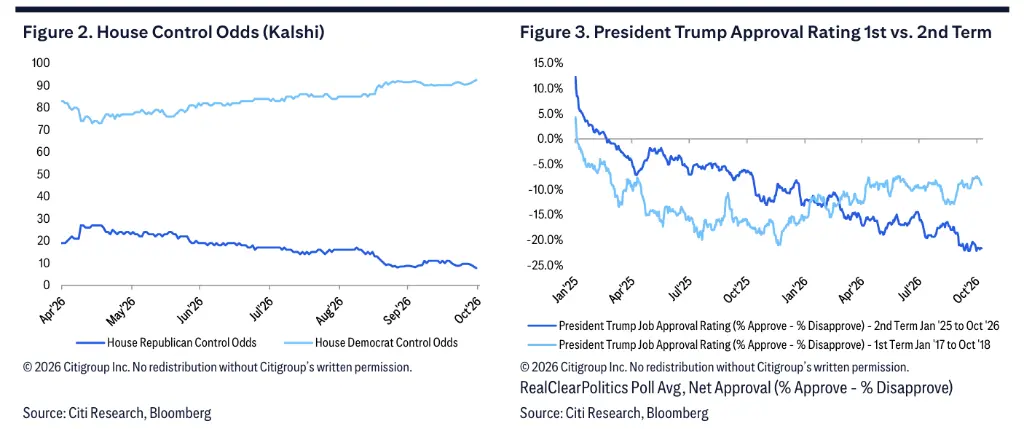
Trump's approval ratings are a key reference for understanding this context. Citi's data shows that Trump's current net approval rating for this term is about -21.7%, one of the lowest levels for a ruling party candidate entering midterm elections in nearly 20 years. The general ballot polling currently shows the Democratic Party leading by about D+8.1, which is close to the D+7.3 in 2018. Citi believes that the current landscape is most similar to the 2006 midterm elections during George W. Bush's presidency, when the Democratic Party gained a net of 31 seats in the House and 6 seats in the Senate, flipping both houses.
House is a Done Deal, Senate is Key
Regarding the House, Citi basically believes it will flip to Democratic control, and this outcome has been fully anticipated by the market. Currently, the Republican Party holds only a slim majority, and it is historically common for the ruling party to lose House seats in midterm elections.
Citi believes that the result of the House itself has limited marginal impact on the market; the key is the extent to which the Democratic Party wins seats. If the Democratic Party controls the House by a narrow majority, members will be forced to strictly adhere to party-line voting; if the Democratic Party wins by a larger margin, some members will have more flexibility to express their positions based on district interests on key issues, which will marginally increase the Democratic Party's chances of retaining these seats in the 2028 election.
In other words, the larger the margin of victory for the Democratic Party in the House midterm elections, all else being equal, the higher the probability of achieving a "blue wave" in 2028.
The Senate situation is much more complex. Citi specifically points out that Senate seats have a six-year term, and the seat advantages in this midterm election will directly affect the control of the Senate in 2028. In 2028, most of the seats facing reelection for the Democratic Party are in safe districts, so if the Democratic Party can win more than 53 seats in this election, it will significantly increase its chances of maintaining a Senate majority in 2028, thereby enhancing the possibility of a comprehensive blue wave.
Market Impact: Two Scenarios, Two Logics
- Scenario One: Republicans Retain the Senate
Citi believes that since the market has currently priced in a high likelihood of a blue wave, an unexpected retention of the Senate by the Republican Party would constitute a positive surprise, triggering a year-end rally in the U.S. stock market.
At the sector level, Citi's previously recommended "long healthcare/short financials" relative value strategy has largely been realized. If the Senate election results favor the Republican Party, it will become an increasingly important trading driver for the financial sector; because the leadership of Senate committees can influence the direction of financial regulatory policies, and the Senate also has the power to confirm nominees for the Federal Reserve Board. The appointment of Powell's successor after his term ends will also be affected by this mechanism. 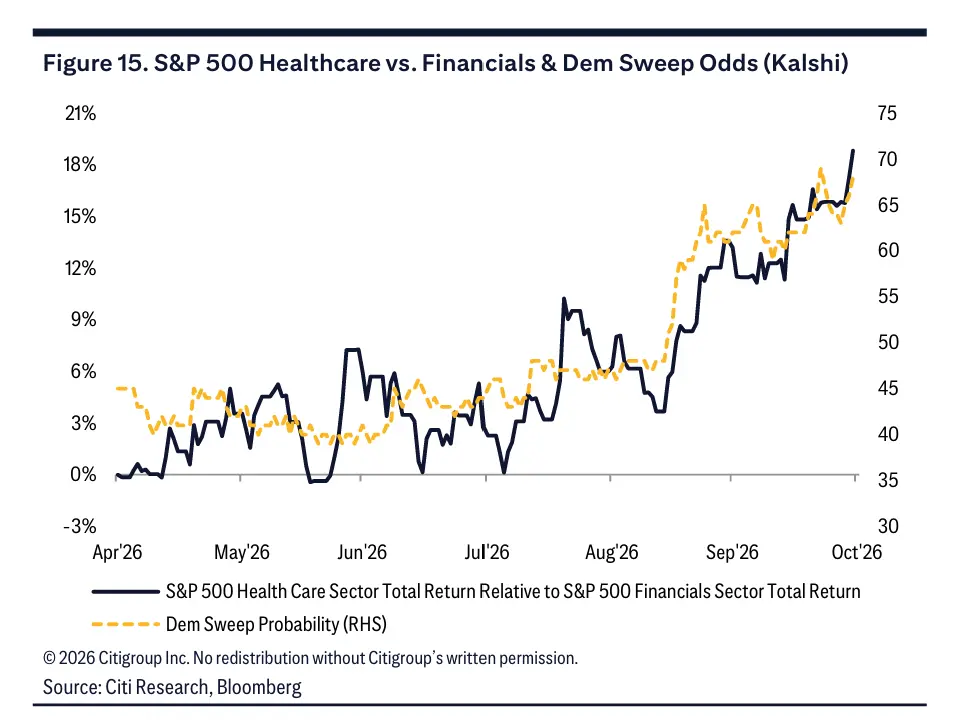
- Scenario Two: Democrats Win More Than 53 Seats
In this scenario, Citi expects the U.S. stock market to face incremental pressure, with the time dimension spanning both the short and medium to long term.
In the short term, market sentiment will be under pressure; in the medium to long term, investors will begin to price in the risk of corporate tax rate increases in the 2028 election—this aligns closely with the Democratic Party's policy proposals in the 2024 election. Citi also points out that the 2027 budget and debt ceiling negotiations will return to focus: the Democratic Party may push to restore healthcare spending, while the Republican Party tends to increase defense spending, leading to rising pressure on the deficit, although the positive effects of fiscal stimulus can be partially offset.
AI Data Center Construction May Become an Additional Variable
Citi specifically points out that the results of gubernatorial and local elections may have spillover effects on the progress of AI data center construction, which investors need to pay attention to.
Prediction markets indicate that the Democratic Party may achieve gains in several gubernatorial elections, including Wisconsin, Ohio, Michigan, and Nevada. Democratic governors typically take a more cautious stance on data center construction permits and zoning planning, which will marginally increase administrative barriers to advancing data center projects.
Citi highlights Texas as an example: although the current governor Abbott (Republican) maintains a certain lead in polls, the declining support for federal Senate candidate Paxton (Republican) raises the possibility of split votes, placing Texas in a competitive state. If Texas ultimately swings toward the Democratic Party, its impact on the investment logic of AI construction will be the most representative case in a single state dynamic.
Citi also emphasizes that the aforementioned pressures are more reflected as an extension of the supply timeline rather than a cancellation of existing data center construction plans, so the impact on the industry's long-term fundamentals is relatively limited. Additionally, concerns of the Democratic Party government regarding infrastructure financing pressures may instead be alleviated, providing some positive offset to the funding side of construction.
Election Results Do Not Change Fundamentals but Will Reshape Sentiment and Expectations
Citi ultimately concludes that the midterm election results are unlikely to have an immediate impact on the fundamentals of the U.S. stock market; the fluctuations in sentiment and policy expectations are the more significant market transmission mechanisms.
If the Republican Party retains the Senate, Citi expects it to trigger a phase of rebound, and this scenario cannot be ruled out; if the Democratic Party sweeps both houses, it will be marginally negative in the short term, but the extent is closely related to the direction of Texas. If the Democratic Party ultimately secures more than 235 seats in the House and more than 53 seats in the Senate, the market will have to take the scenarios of corporate tax rate increases in 2028 and comprehensive Democratic governance more seriously.