
Bloomberg: Has the Bitcoin white paper matured after being accepted by Wall Street for 18 years?
Author: Teresa Xie, Bloomberg Reporter
Compiled by: Jiahua, ChainCatcher
Bitcoin is stepping into "adulthood." At least in terms of age, it certainly is.
Eighteen years ago, a person using the pseudonym Satoshi Nakamoto published a white paper envisioning the establishment of a decentralized electronic payment system. This earliest cryptocurrency aimed to allow people to transfer money directly to each other without relying on banks or any central authority.
Now, Bitcoin will celebrate its 18th birthday this Saturday, and it is time to reflect on how far it has come compared to the rebellious experiment originally envisioned by Satoshi Nakamoto. This journey is well-known to many: some have made fortunes from it, while others have seen their relationships crumble; an ecosystem has emerged around it, with some ecosystems ultimately collapsing. Governments have bought it, celebrities have called it "rat poison," and a large number of people have debated for years about what it really is.
Along the way, Bitcoin has been declared dead and revived time and again; it was initially rejected by the public but later gained a diverse array of supporters, including Wall Street.
This raises a key question: nearly 20 years after its inception, has Bitcoin truly matured, or is it just pretending to be mature?
Wall Street Becomes a Supporter of Bitcoin
"It has indeed come a long way," said Anastasia Melachrinos, Head of Growth at Kaiko. "Think about where Bitcoin first appeared, in the dark web and forums. Over the past 18 years, we have moved from there to a whole new asset class."
Bitcoin has made some unexpected friends and gained social recognition, especially in recent years. Today, investors can invest in Bitcoin through various means, including products offered by Wall Street giants like BlackRock. BlackRock manages a Bitcoin ETF (Exchange-Traded Fund) with a scale of $66 billion. Dozens of publicly traded companies have accumulated Bitcoin on their balance sheets, and some of the world's wealthiest investors continue to praise it.
The irony is not hard to see. Bitcoin was originally born to challenge centralized finance, yet today, those institutions it sought to disrupt have become some of the strongest supporters of blockchain. Wall Street is accelerating its layout of stablecoins, asset tokenization, and blockchain-based financial infrastructure, increasingly incorporating this technology into the financial system that Bitcoin originally tried to bypass. There are many such examples, but few evoke thoughts of resisting the traditional financial order.
"The fundamental significance of Bitcoin lies in its proof that value transfer can be accomplished without intermediaries," said Linda Jeng, Chief Legal and Policy Officer at Aave Labs. "Since then, Bitcoin has driven several rounds of development in digital finance. Once marginal technologies are becoming part of the new financial system."
Decreased Volatility, Still Following U.S. Stocks
Now, let's look at stability. In this regard, Bitcoin has indeed made some progress. The increasing popularity of ETFs has made investing in Bitcoin more convenient, which has, to some extent, led to a significant reduction in its once-volatile price fluctuations. Earlier this month, its 30-day volatility dropped to its lowest level in three years.
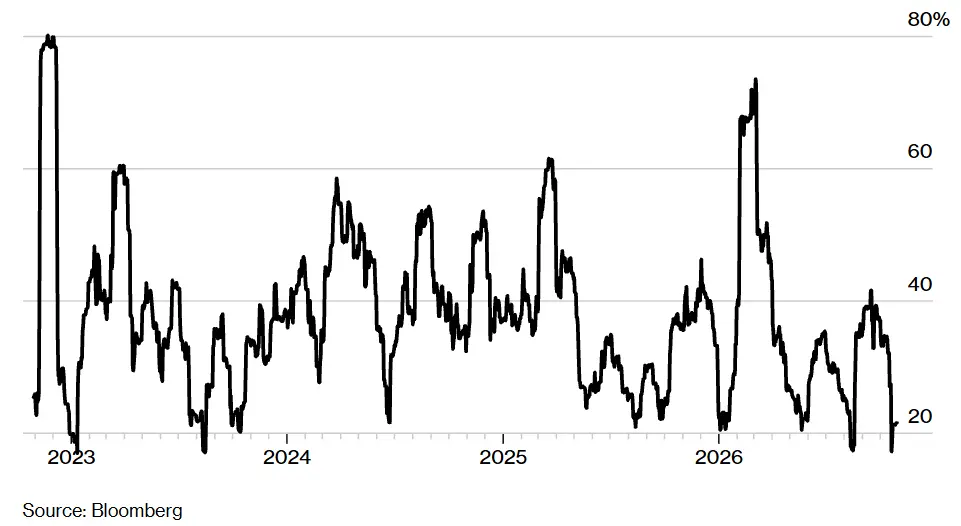
Caption: Bitcoin's volatility has decreased, with its 30-day volatility dropping to its lowest level in three years earlier this month. Source: Bloomberg.
This does not mean that Bitcoin has completely bid farewell to its immature side; it still experiences significant ups and downs. In October last year, a sudden sell-off led to a record $19 billion in leveraged positions being liquidated in a single day, which was far from the first time the crypto industry experienced such volatility. There was also the crypto winter of 2022, when the crypto exchange FTX, founded by Sam Bankman-Fried, collapsed in November, leading to the evaporation of over $2 trillion in crypto asset market value.
Moreover, Bitcoin's price movements still correlate with U.S. stocks. For example, it is highly correlated with the Nasdaq 100 index, indicating a lack of independence in its price movements.
18th Birthday, Market Lacks Celebration Atmosphere
As Bitcoin matures, it has also lost some of its edge. It is no longer the rebellious challenger in the financial market, nor is it a bold bet in the eyes of risk-takers; it has become an asset that ordinary investors include in balanced portfolios. Just last week, venture capital giant Andreessen Horowitz officially changed the name of its crypto fund from a16z Crypto to a16z Frontier.
On the eve of Bitcoin's birthday, there is not much of a celebratory atmosphere in the market.
Based on current trends, this month could become Bitcoin's worst-performing month since June. The upward momentum accumulated over the summer has failed to continue, and the price now hovers around $80,000. Supporters believe Bitcoin will soon return to $100,000, or even eventually reach $1 million; critics argue that it is worthless.
Anthony Scaramucci, founder of SkyBridge Capital, first bought Bitcoin years ago at $6,000 and later bought more at $16,000. He stated that he always views this investment as a bet for the next five years. He predicts that Bitcoin will double in the next five years, which he calculates to be about a 15% compound annual return.
"Bitcoin is the benchmark for this industry," he said in an interview. "It will still exist long after you and I are gone."