
Intel evaporated 140 billion dollars overnight
Author: Zhou Xiaoyan, Tencent Technology
Editor: Xu Qingyang, Tencent Technology
The semiconductor sector in the U.S. stock market has faced a new wave of collective sell-offs, with Intel being hit particularly hard.
On October 30, local time in the U.S., Intel's stock price plummeted by 28.58%, marking its worst single-day performance since 1974, with a market value evaporating by over $140 billion overnight. In after-hours trading, the stock continued to hover around $65.
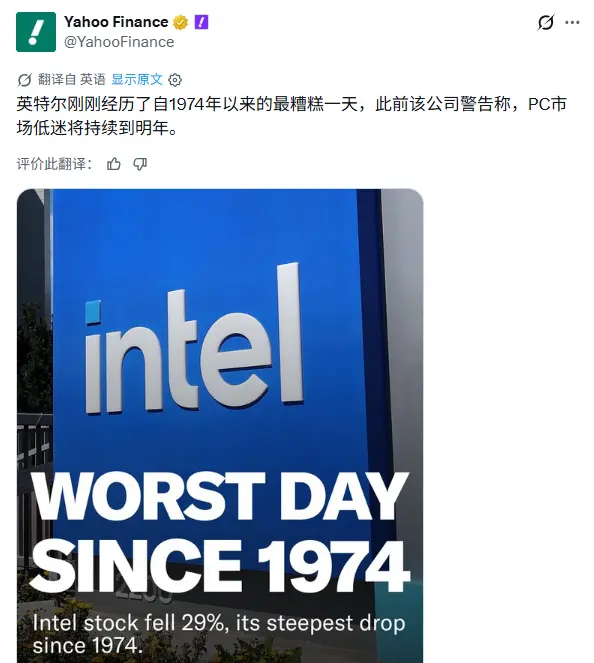
Other chip stocks were not spared either. SanDisk fell by 13.47%, Qualcomm by 11.12%, and both AMD and ARM dropped over 10%. Broadcom, TSMC, and Micron Technology saw declines of around 5%, while Nvidia closed down 4.22%.
From chip design to storage and wafer manufacturing, the semiconductor industry chain generally declined, but Intel's drop was particularly pronounced.
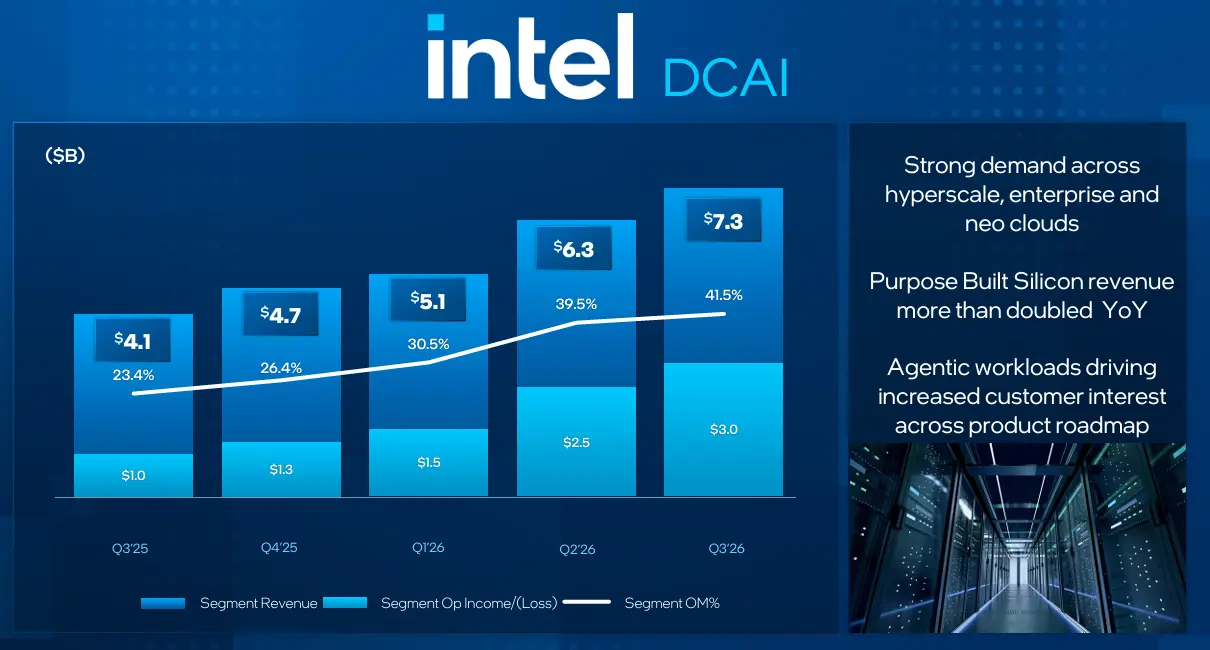
Notably, this crash occurred amid a continued surge in AI investments. Intel's recently released third-quarter financial report showed that revenue from data centers and AI business grew by 78% year-over-year, but the fourth-quarter performance guidance was significantly below Wall Street expectations.
With strong demand for AI, why is Intel facing such a severe setback?
There are limitations in manufacturing capacity and supply chains, as well as the pressure from the AI investment boom on traditional PC businesses. Meanwhile, the transition to advanced processes and wafer foundry still requires massive investments. Under multiple pressures, the market has begun to reassess Intel's growth prospects.
01 AI Orders Extend to Next Year, Intel Can't Deliver
Demand for AI servers continues to grow, but Intel faces an awkward situation: customer orders are increasing, but production capacity cannot keep up.
From the financial report, Intel's third-quarter revenue was $16.5 billion, a year-over-year increase of 21%. Among this, revenue from data centers and AI business (DCAI) was $7.3 billion, up 78% year-over-year.
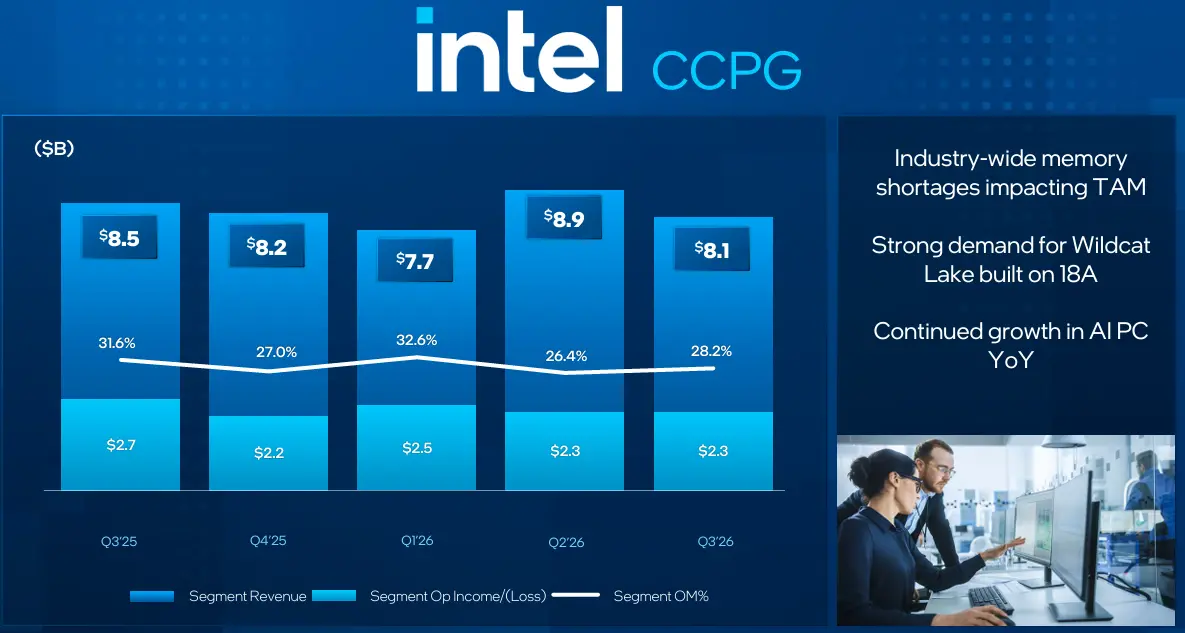
Client computing and physical AI business (CCPG) revenue was $8.1 billion, a year-over-year decrease of 5%. Total revenue from Intel's product business was $15.4 billion, a year-over-year increase of 22%.
In comparison, the data center business has become Intel's main source of growth.
Intel's CEO Pat Gelsinger stated during the earnings call that as AI applications evolve from model training to inference and intelligent agents, the role of CPUs in task orchestration, multi-step reasoning, and continuous execution is becoming increasingly important.
Intel expects that global server CPU shipments will grow by over 30% in both 2026 and 2027. If supply conditions allow, market growth could be even faster.
However, Intel's production capacity has not kept pace with this surge in demand.
The company acknowledged during the earnings call that customer demand for data center products continues to significantly exceed existing supply capabilities, primarily due to dual constraints from wafer manufacturing capacity and advanced packaging material supply.
On one hand, Intel is increasing wafer output for the Intel 3 process, but capacity release still requires time; on the other hand, there is a shortage of high-end organic substrates required for advanced packaging. Even if wafers are completed, if the packaging process cannot keep up, processors cannot be delivered on time.
Currently, Intel is working to increase wafer output, improve yield rates, and production cycles, while coordinating with suppliers to increase substrate supply. However, management expects that supply constraints may continue until 2027, making it difficult to fully meet customer demand in the coming quarters.
For Intel, while the demand for servers driven by AI is growing, insufficient capacity means that some demand cannot be timely converted into revenue. In the context of fierce competition in the server chip market, delivery capability will also affect its chances of competing for customers and market share.
To make matters worse, in mid-October, an accident occurred at Intel's wafer factory in Kiryat Gat, Israel, halting production for about two weeks, further impacting server processor supply.
Intel's CFO David Zinsner expects the accident to result in a revenue reduction of about $300 million in the fourth quarter, with a gross margin decline of about 200 basis points, and the first quarter of 2027 may also be similarly affected. The factory is expected to gradually resume production by the end of October, but the impact may continue into the first half of 2027.
02 AI Takes Memory, PC Market Can't Hold Up
While the server business faces capacity shortages, Intel's traditional PC business is under another layer of pressure: large-scale purchases of memory chips by AI data centers have driven up PC manufacturing costs, further suppressing market demand.
Large AI data centers require a significant amount of high-bandwidth memory (HBM) and server DRAM. Due to the higher profit margins of AI-related products, memory manufacturers are shifting more capacity and resources to the data center market, thus squeezing the supply of memory needed for traditional PCs.
The rise in memory prices first impacts computer manufacturers. The overall material costs of complete machines increase, leading to upward pressure on computer prices, while the replacement budgets for businesses and consumers have not increased correspondingly.
Intel's CEO Pat Gelsinger stated during the earnings call that customers have begun to adjust their PC procurement plans based on memory prices and supply conditions. Faced with rising end-user prices, OEM manufacturers are accelerating inventory adjustments and reducing processor purchases.
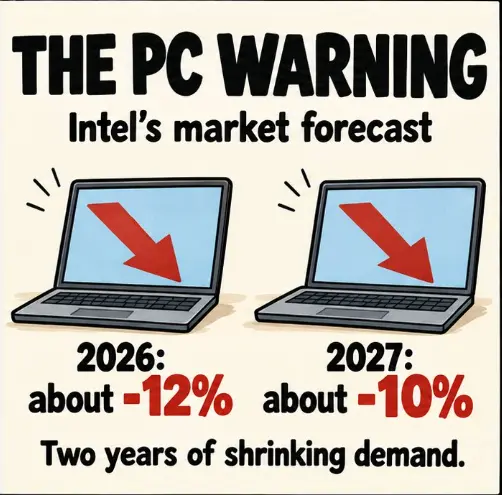
Intel expects global PC market shipments to decline by about 12% in 2026, with a drop of over 20% in the second half; a further decline of about 10% is expected in 2027. If memory supply and prices remain under pressure, the recovery of the PC market will also be affected.
This pressure has already been reflected in Intel's financial report.
In the third quarter, revenue from client computing and physical AI business (CCPG) was $8.1 billion, a year-over-year decrease of 5% and a quarter-over-quarter decrease of about 9%. Intel expects that revenue from this business will also decline by over 20% quarter-over-quarter in the fourth quarter.
Intel's CFO David Zinsner explained that in addition to weak demand in the PC market, OEM customers are also actively reducing inventory to adapt to procurement needs for 2027. Inventory adjustments will continue to exert pressure on the business from the fourth quarter to the first quarter of 2027.
This puts Intel in a dilemma: on one hand, there is strong demand for AI servers, but constrained by capacity, it cannot deliver fully; on the other hand, the traditional PC market is affected by rising memory prices, leading customers to be more cautious in their purchases.
Despite the rapid growth of the data center business, the PC business remains an important source of revenue for Intel. More troubling is that memory prices and supply are not issues Intel can solve alone. Even if its own processor capacity improves, high overall costs may still suppress PC demand.
AI has driven demand for data center chips, but it has also transmitted new pressures to Intel's traditional business through supply chain costs.
03 18A Has Entered Mass Production, Foundry Business Lacks a Major Client
Another challenge for Intel is that while advanced processes have entered the mass production stage, external foundry customers have not yet formed a scale.
In recent years, Intel has been continuously promoting its IDM 2.0 strategy, hoping to rebuild manufacturing competitiveness through advanced processes and wafer foundry business. Among these, Intel 18A is an important step.
At the beginning of 2026, Intel began mass production of 18A process products, utilizing RibbonFET fully wrapped gate transistors and PowerVia back power supply technology.
From the perspective of internal products, the progress of 18A is smooth. Intel's management stated that the revenue share of client CPUs using the 18A process has risen from less than 5% in the first quarter to nearly one-third, and related server products have also begun to ship.
However, mass production of its own products does not mean that the external foundry business has opened up the market.
Currently, 18A mainly serves Intel's internal products, and no large-scale mass production external customers have been announced. Pat Gelsinger stated that the company is advancing the improved version of 18A, 18A-P, in collaboration with potential customers, and announcements related to customers may come in the next two quarters.
The next generation, Intel 14A, is also being promoted for customer onboarding. In October of this year, Intel released the 0.9 version of the process design kit (PDK) for 14A, with a 1.0 version expected to launch in the first quarter of 2027, but there is still some distance before customer products enter mass production.
The financial performance of the foundry business illustrates the issue more clearly.
In the third quarter, Intel's wafer foundry business revenue was $6.7 billion, a year-over-year increase of 58%, but most of it came from internal transactions. After deducting internal transactions, external foundry revenue was only $411 million, while the operating loss during the same period still reached $1.9 billion.
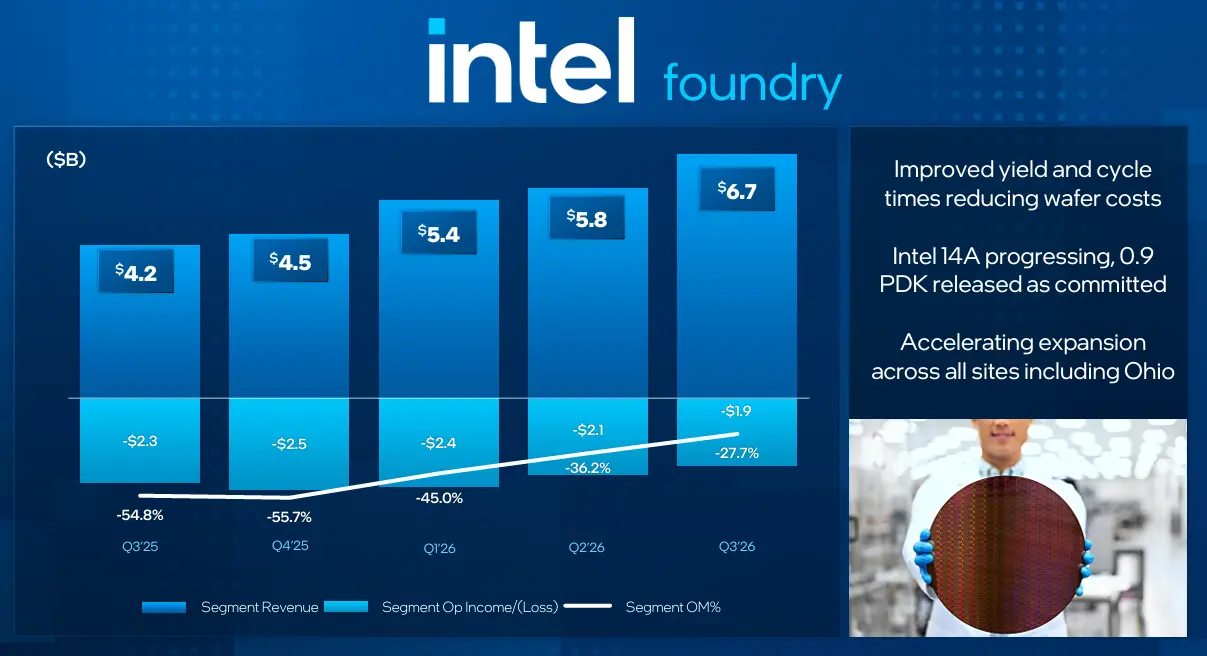
Intel's foundry business revenue reached $6.7 billion in the third quarter, but it remains in a loss state. Data from Intel's financial report.
For Intel, there is now a phased answer to whether advanced processes can be mass-produced, but whether it can attract enough external customers to make the foundry business profitable remains to be seen.
04 Continue to Invest, How Much Longer Will Intel Have to Endure?
Advanced processes and foundry businesses have not yet brought sufficient returns, but Intel still needs to invest more funds.
Wafer plant expansions, equipment procurement, and enhancements in advanced packaging capacity all require continuous investment. Intel expects capital expenditures for the full year of 2026 to be about $20 billion, with a significant increase expected in 2027. Pat Gelsinger stated during the earnings call that the company is accelerating equipment procurement, with formal purchase orders issued to suppliers increasing by nearly 40% quarter-over-quarter.
However, in the short term, revenue and profit growth are still difficult to keep pace with investments.
Intel expects fourth-quarter revenue to be between $15 billion and $16 billion, below Wall Street's previous expectation of about $17 billion; the Non-GAAP gross margin is expected to be 38%, a decrease of 5 percentage points from the third quarter; Non-GAAP earnings per share are expected to be $0.25, lower than analysts' expectation of $0.43.
Cash flow is also under pressure. Intel expects that the full-year free cash flow for 2026 will still be negative. As of the end of the third quarter, the company held about $21.84 billion in cash and cash equivalents, with long-term debt of about $46.32 billion. Although it previously supplemented funds through equity financing, future capital expenditures will still require continuous funding support.
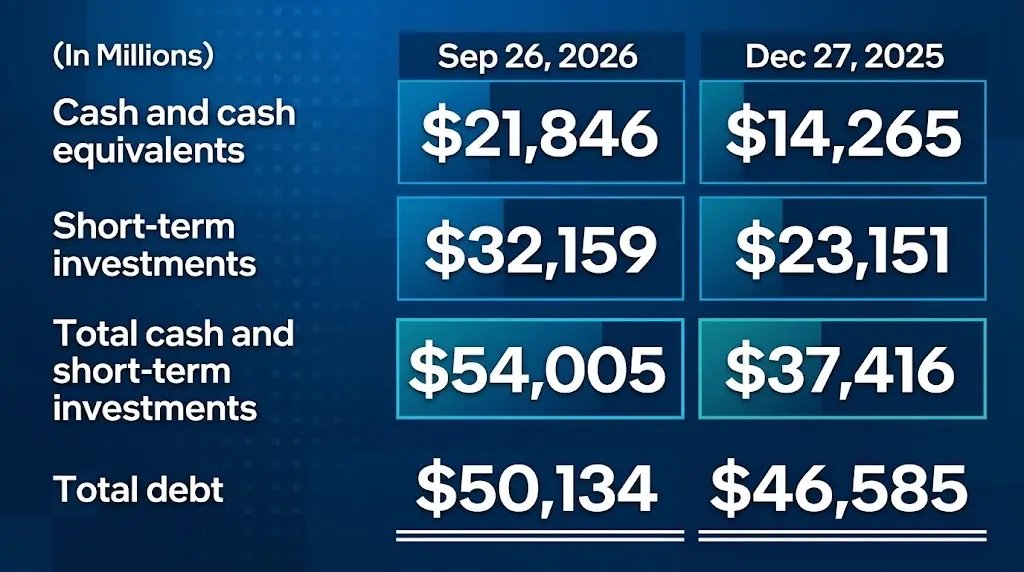
Intel's cash flow and debt situation, data from Intel's 10-Q filing.
This is also the most challenging aspect for Intel right now: to meet server demand, it needs to expand capacity; to attract external foundry customers, it needs to continue investing in advanced processes; but the traditional PC business is under pressure, and the foundry business has yet to achieve profitability, making it difficult to rely on operational income to cover all investments in the short term.
Over the past year, the market had re-bet on Intel's manufacturing transformation. However, as capital expenditures continue to rise, investors are beginning to pay more attention to when these investments can be converted into revenue, profit, and cash flow.
AI has brought new growth opportunities, but for Intel to truly benefit from it, time is still needed. The market's patience for this transformation is being tested.