
From "Maximum Cashback" to Real Cost: PayGlass Makes Crypto Card Choices More Transparent
Author: Payglass
According to a report by CoinDesk in August this year, the monthly payment scale of crypto cards has surpassed $1 billion, more than tripling year-on-year. In October 2023, this figure was still less than $1 million.
Today, the crypto card sector has become one of the fastest-growing areas in the crypto market. As a result, issuing crypto cards has turned into a competition, with various wallets, exchanges, and even public chain projects joining in.
In June this year, the self-custody stablecoin wallet MiniPay announced a partnership with Visa to launch the MiniPay Card, supported by Gnosis Pay, with Monavate acting as the regulated issuer, allowing users in Europe, Africa, Latin America, and Southeast Asia to spend stablecoins directly from their wallets; in July, BingX announced the launch of the BingX Visa debit card; in September, Telegram Wallet was renamed Walt and announced plans to launch a crypto card; in October, Gate announced a partnership with Visa to launch a cryptocurrency card in over 40 markets.
Visa's update in March this year showed that there are already over 130 stablecoin card projects operating on its network, covering more than 50 countries, and this number is expected to double by 2026.
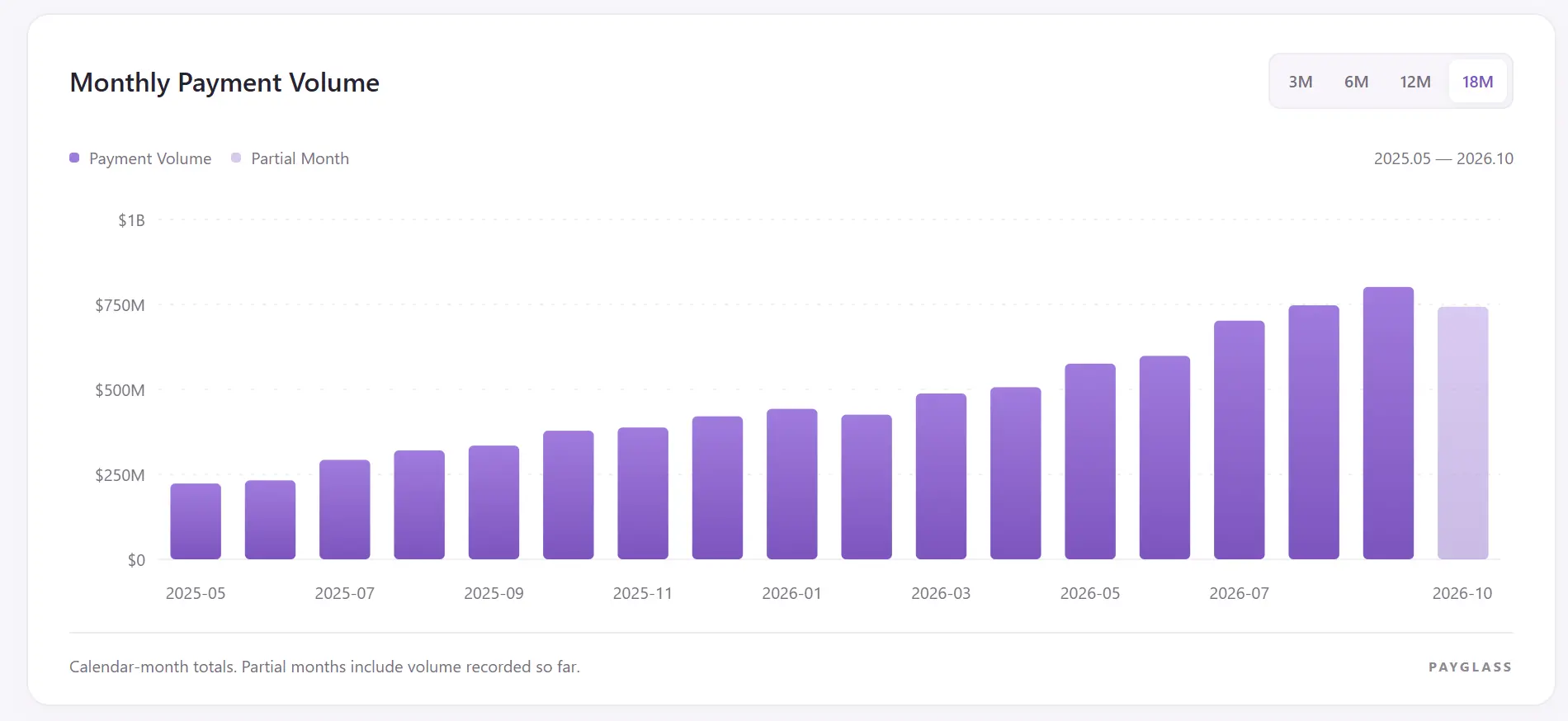
The explosive growth of crypto card product offerings far exceeds users' awareness of them.
I. Dazzling Rate Data
The fee structure of crypto cards is much more complex than that of credit cards, as it consists of three layers: the card organization layer, the issuer layer, and the blockchain layer. Users need to look at at least four numbers—application fee, foreign exchange fee (FX), cashback rate, and further down, annual fee, recharge rate, refund rate, and so on.
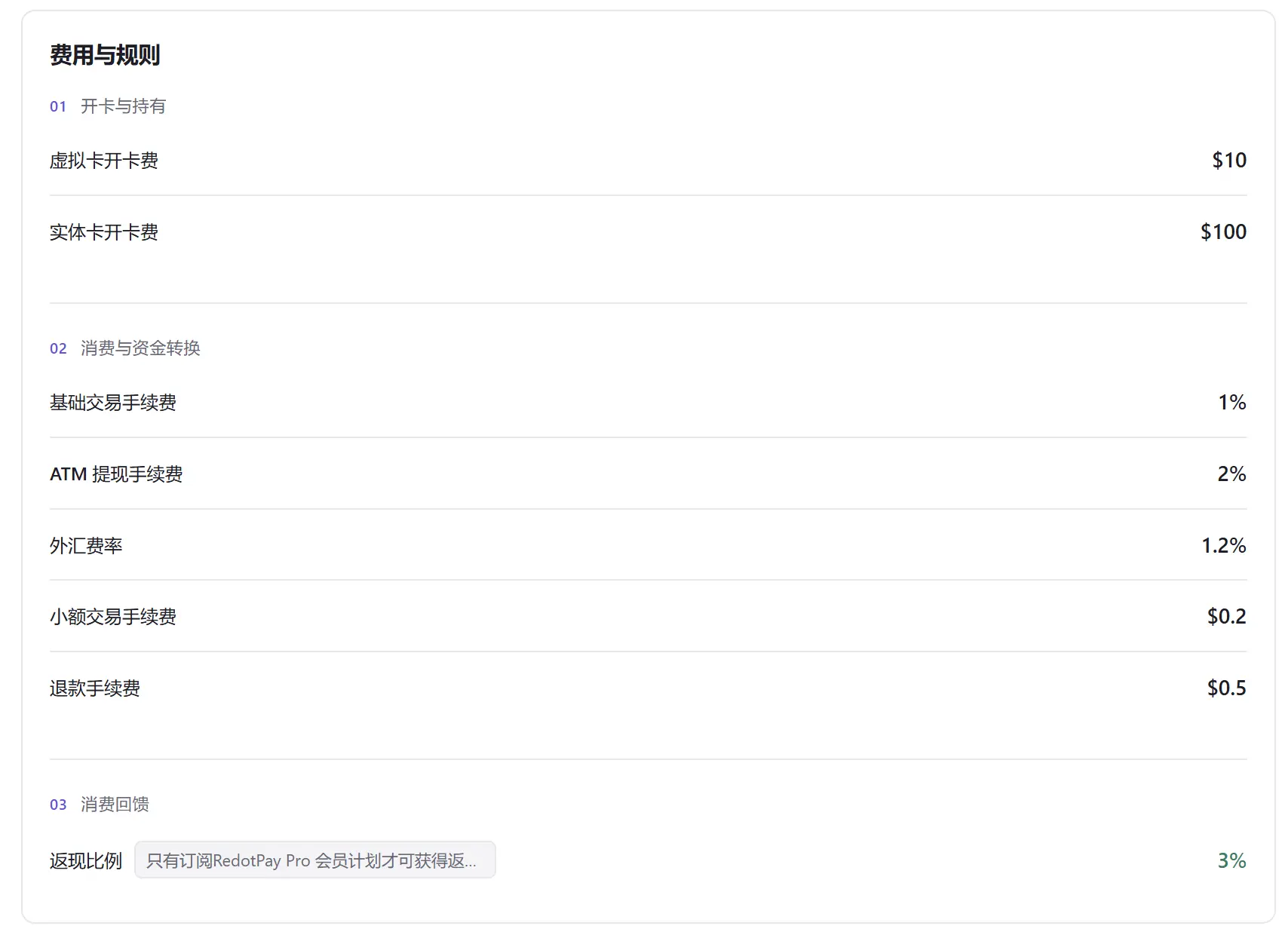
Looking at each item individually is not complicated. Application fees range from $0 to $100: RedotPay's virtual card is $10, while the physical card is $100, a tenfold difference for two cards from the same provider; Tria charges $25, Solayer Pay $20, Bitwala $1.1, and there are more than a dozen cards that charge no fee at all. Foreign exchange fees range from 0% to 1.75%, with Solayer Pay being the highest, while Moto, imToken Card, and KAST charge 0%. Some fees are listed separately: RedotPay's small transaction fee is $0.2, refund fee $0.5, and ATM withdrawal 2%; imToken Card deducts 1% for each crypto asset recharge—before you swipe the card, the money has already decreased once.
In an average consumption scenario of $86, these fragmented fees are not trivial: for an $86 purchase, a 1% foreign exchange fee is $0.86, while a $0.2 small transaction fee adds another layer.
Cashback is the easiest to misinterpret. RedotPay advertises 3%, but notes "only Pro members can enjoy this, with a monthly cap of $18"—calculated at 3%, cashback stops after monthly spending exceeds $600. Tria's 1.5% is only valid for the first $1,000 spent each month, dropping to 0.5% thereafter. Gate Card and COCA both state "up to 8%", while OKX Card is priced between 2% and 10%, but in reality, it’s all a tiered game based on VIP levels.
A card with a foreign exchange fee of 0% might charge 1% upon recharge, while a card stating "up to 8% cashback" might only allow users who spend over $10,000 a month to reach that 8%.
The annual fee is another extreme. Moto has the highest annual fee among the cards listed by Payglass: $2,500 per year, or $250 per month. However, it reduces the base transaction fee, foreign exchange fee, and crypto-to-fiat exchange rate to 0, allowing cardholders unlimited access to airport lounges. Based on a $2,500 annual fee and 5% base cashback, you need to spend $50,000 a year—averaging $4,167 per month—to just break even on the annual fee. This is a card designed for a specific demographic, not a product to be compared side by side with no-annual-fee cards.
Additionally, KYC is another hurdle for applying for card products; different crypto cards have different available regions, with some products limited to the U.S. and others primarily usable in Asia, and users may only discover they do not meet the card's KYC policy upon application.
II. PayGlass: Unpacking Every Layer of Card Data
Faced with such a fragmented table, what PayGlass aims to do is quite simple: to compile all key data of crypto cards into a single table and present it using the same set of standards.
On PayGlass, a card is no longer just a piece of marketing copy, but a set of fields that can be compared item by item. It currently lists over 35 crypto card projects and establishes four main data lines for each card.
The first line is rates and rules. From application fees, monthly fees, annual fees, base transaction fees, foreign exchange fees, to crypto asset recharge fees, refund fees, ATM withdrawal fees, small transaction fees, and cashback rates along with all their attached conditions—every number hidden in the corners of official websites is brought into the same column. The note from RedotPay stating "only Pro members can enjoy this, with a monthly cap of $18" is placed right next to the 3% figure on PayGlass, ensuring it is not overlooked; the 1% recharge fee of imToken Card will not disappear just because it is "not a card swipe fee."
The second line is the specifications of the card itself. Card type (debit or credit), custody model (self-custody or third-party custody), card organization, supported currencies, supported countries and regions, whether it supports Apple Pay and Google Pay, and whether it issues physical cards. These fields determine "whether I can use this card," for example, Moto is a non-custodial Solana credit card, while imToken Card is a multi-currency debit card provided by Fiat24 with a Swiss IBAN—there is almost no overlap in their applicable demographics.
The third line is transaction data. PayGlass tracks the on-chain transaction flow of each card project, 30-day month-on-month comparisons, and trend curves, allowing users to see two things at once: how much this card is currently receiving and whether it is being used by more people or being abandoned. As of October 24, 2026, the total transaction flow of cards with complete 30-day transaction data amounts to $825 million, with the top three, RedotPay, ether.fi, and KAST, accounting for 80.4%.
The fourth line is project and reputation. Team members, investment institutions, recent news, and user ratings reflect the overall strength and background of the project behind the card, providing important references for assessing the project's development prospects and backing capabilities.
IV. The Information Infrastructure of Crypto Cards
However, PayGlass's goal is not just to create a comparison table.
In a market where the number of products continues to double and fee standards vary from one issuer to another, what it truly aims to build is the information layer of this industry.
First, establish a set of recognized comparison standards. Today, each issuer talks about its own fee system on its official website, using different terms to describe the same thing, placing the least favorable item in the least conspicuous place. PayGlass hopes to be the place that translates and unifies these standards—just like DeFiLlama for DeFi and CoinMarketCap for exchanges. A sign of a mature market is not just an increase in products but the comparability of those products.
Second, make the crypto card market verifiable. Fees are stated by the issuer, while transaction flows are derived from on-chain data; only when both are presented together do they make sense. PayGlass places the real on-chain flow alongside the issuer's stated fees, allowing users for the first time to verify marketing claims with behavioral data—if a card advertises 4% cashback but has only a few million dollars in 30-day transaction flow, that cashback seems more like a subsidy budget rather than a stable business model.
Third, reduce the cost of choice. As the number of card products continues to increase, the time cost for users to compare each official website will rise linearly, and the likelihood of giving up on comparisons and casually applying for one will also increase. PayGlass provides filters (by country and region, currency, whether physical cards are issued), sorting (by application fee, foreign exchange fee, cashback, rating), and a customizable watchlist, essentially compressing the information cost of this process—allowing a user to make a judgment in a few minutes that previously required visiting dozens of official websites.
Fourth, bring competition back to the product itself. When all rates, benefits, transaction flows, and project backgrounds are laid out on the same table, what issuers can compete on is only the real product strength: whether the rates are genuinely lower, whether the cashback is truly attainable, and whether the service is genuinely stable. A transparent market ultimately benefits those products that perform well, rather than those that merely sound good.
PayGlass's vision is to enable every stablecoin holder to find the card that best suits them with the lowest information cost; it also aims to shift the crypto card industry from "whose cashback number is larger" back to "whose product is truly better."
Conclusion
From less than $1 million in October 2023 to now $1 billion per month, crypto cards have taken less than three years. They have proven their ability to deliver stablecoins to any Visa terminal worldwide.
What remains to be proven is another matter: when there are 100 cards or even more in the market, how can users quickly find the card they want with the lowest decision cost and threshold?
The maturity of an industry is not just about an increase in products but also about making its information searchable, comparable, and verifiable. The way to spend with crypto cards is already mature enough; what is lacking now is a system that makes them understandable.