
a16z Co-founder: In the era of Agent, everyone will become a manager
Author: Ben Horowitz, Michael McGuiness
Compiled by: Jiahua, ChainCatcher
If AI can directly query business conditions, execute tasks, and track results, how many layers of reporting does a company still need? What changes will occur in employees' daily work?
a16z co-founder Ben Horowitz points out, using Databricks as an example, that a shared enterprise data system will allow frontline employees to take direct action, and management work will no longer be monopolized by a few professional managers; whether a company can embed decision-making experience in its own system will determine its long-term competitiveness.
Note: Databricks is a portfolio company of a16z, and Ben Horowitz also serves as its director. The content related to this company carries an investor's perspective and does not constitute investment advice. The following is the main text.
In the next 20 years, many aspects of our lives will change. Among them, one of the top five questions is certainly: "What do you do every day at work?"
Two major breakthroughs are about to happen around this question. The first is automation through Agents: "Describe a task we are currently doing, and then let it be done automatically." The second is empowering employees to take proactive actions. The people closest to the problem will increasingly be able to investigate situations and seize opportunities directly, without waiting for information and decision-making authority to pass through layers of management.
Both breakthroughs will fundamentally improve everyone's daily work. But there is a significant premise: organizations must indeed be able to shift to this new way of working.
"What a person does every day" is largely constrained by the enterprise data and decision systems used by employers. And this system itself is constrained by the database technologies employed and what those technologies can achieve. Few people think about this latter layer.
This story is divided into four parts:
What exactly does Databricks do? What are the "Lakehouse" and "Lakebase" you may have seen on billboards? Why are they considered timely architectural breakthroughs?
What is an "enterprise data system" (system of record, SoR)? If Agents are to work in real companies, make real decisions, and contribute to the company's knowledge base, why is a new enterprise data system needed?
What exactly is an enterprise? If the ratio of Agents to humans reaches 1000:1, what changes will occur in enterprises? How should enterprises differentiate themselves and create value?
In this new world, what do people do every day at work? AI in work scenarios is often promoted as "giving ordinary people the capabilities of software engineers." But in the long run, the changes it brings may not be "everyone becoming an engineer," but rather "everyone becoming a manager."
This may be the most far-reaching part. We are witnessing the gradual dismantling of the management methods that shaped the 20th century. James Burnham documented this management style in his classic work "The Managerial Revolution."
Eighty-five years ago, he described how information technology and organizational complexity gave rise to a corporate operating model: a small group of professional managers concentrated decision-making authority within the company. Today, a new wave of technological change is allowing frontline professionals to take back responsibility, and we will all benefit from this.
From Spark to Agent
Recently, some have described Databricks as "a data company riding the AI wave." But the company was founded a decade before this wave arrived.
The initial problem Databricks aimed to solve was straightforward: enterprises have more and more data, but processing it is too slow. In 2009, Ali Ghodsi, while researching at Berkeley, saw internet companies using massive data to predict user behavior. However, the mainstream tools at the time were not suitable for the repeated calculations required for machine learning.
Berkeley researchers subsequently developed Spark, which increased the processing speed of such tasks by up to 10 times. In 2013, Ali, Matei Zaharia, and six other researchers founded Databricks to create a platform that enterprises could use directly, eliminating the hassle of building and maintaining complex systems themselves.
Spark accelerated data processing speeds, but enterprise data remained scattered across different systems. Data warehouses stored organized, trustworthy data primarily for business analysis and reporting; data lakes, on the other hand, stored various raw data such as documents, images, recordings, and logs at a lower cost, but this data often lacked organization and quality assurance.
Both systems have their uses, but they also create silos between different teams. Engineers and data scientists primarily use data lakes, while analysts mainly use data warehouses. When one side needs data from the other, someone must be responsible for transporting and maintaining it, leading to the accumulation of numerous data copies and conflicting business definitions.
In 2020, Databricks combined the two and launched the "Lakehouse" architecture. It allows enterprises to conduct business analysis and machine learning on the same set of data: retaining the data lake's ability to store various data at low cost while providing the reliable management and fast querying capabilities required by data warehouses.
As a result, engineers, data scientists, and analysts can share the same set of data, reducing the repetitive work of copying and transporting data between different systems.
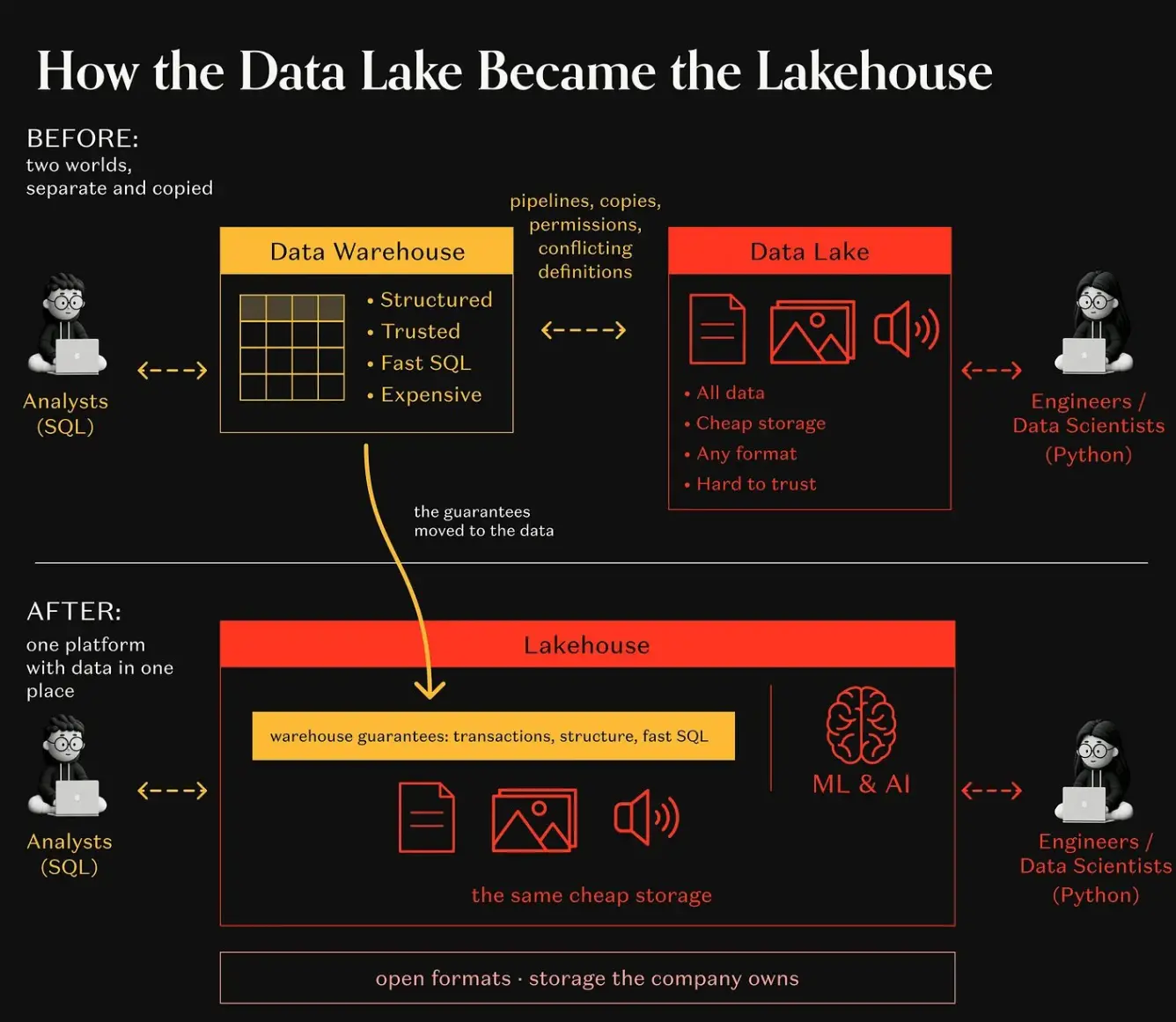
Image: The Lakehouse combines data lakes and data warehouses, allowing the same set of data to serve business analysis, machine learning, and AI simultaneously.
However, there is still a portion of data that has not been integrated. Enterprises rely on another type of database for daily operations such as payments and user logins. These databases still need to be connected and maintained separately to send data to the systems used for analysis. As business continues to change, the work of connecting these systems persists.
In 2025, Databricks acquired Neon and, based on this, launched Lakebase, further extending integration to daily business databases. When data in business systems changes, it can automatically sync to be used by analysts, engineers, and Agents, reducing the work of transporting data between different systems.
For Agents, Lakebase also provides an important capability: quickly creating isolated data copies from formal business operations. Even if the database is large, such copies can be prepared in seconds. Agents can experiment within them and discard them afterward, without needing to copy the entire database from scratch each time.
This lays the foundation for a change in how software is used. For decades, enterprise software has primarily been developed by a few engineers, with other employees responsible for using it. Now, people are moving toward a new way of working: first stating the desired outcome, then letting the software figure out how to achieve it.
Enterprises are no longer just having thousands of employees read and write from a few databases managed by a central team, but may have thousands of databases being read and written by millions of Agents. Making data jointly usable, timely updated, and facilitating Agents' work within it is becoming increasingly important.
Agent-Focused Enterprise Data Systems
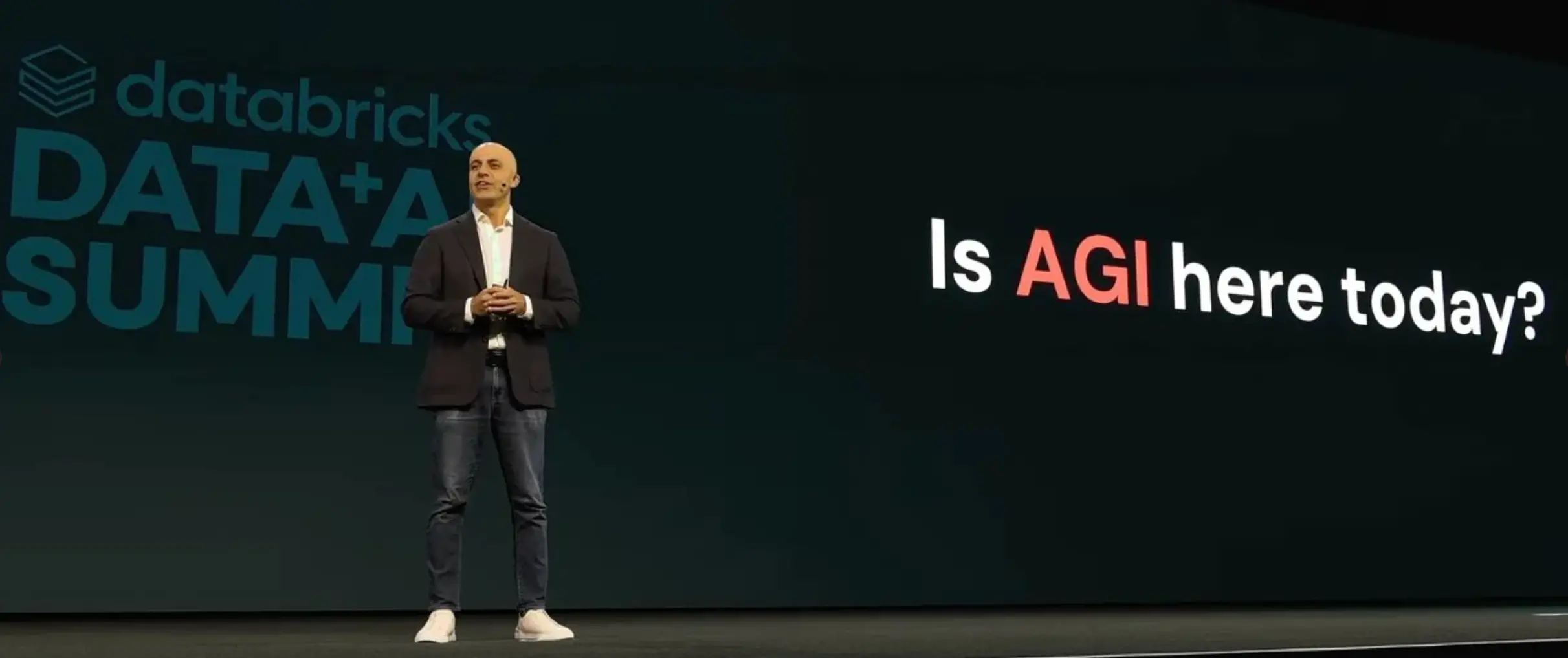
Image: Databricks CEO Ali Ghodsi on stage at the company's 2026 Data + AI Summit.
In June, Ali stood before about 30,000 attendees at the company's Data + AI Summit and asked those who believe general artificial intelligence has arrived to raise their hands. He estimated that about 10% of the audience raised their hands.
"We believe AGI has arrived," he told the audience, noting that today's leading models can answer more than half of the questions in "the final exam for humanity." This test includes 2,500 questions written by experts from over 100 fields, which were originally thought to be too difficult for any AI to answer.
When ChatGPT was first released in 2022, the programming tasks it could handle were roughly equivalent to what a human could complete in 30 seconds. Now, leading Agents can complete programming tasks that would take a skilled engineer an entire workday.
Independent evaluation agency METR has tracked the time different models have been able to independently complete tasks since 2019, finding that this time roughly doubles every seven months. Recently, progress has been even faster, and similar trends have appeared in fields beyond programming. If this trend continues into the early 2030s, Agents will be able to accomplish tasks that would take humans years to complete.
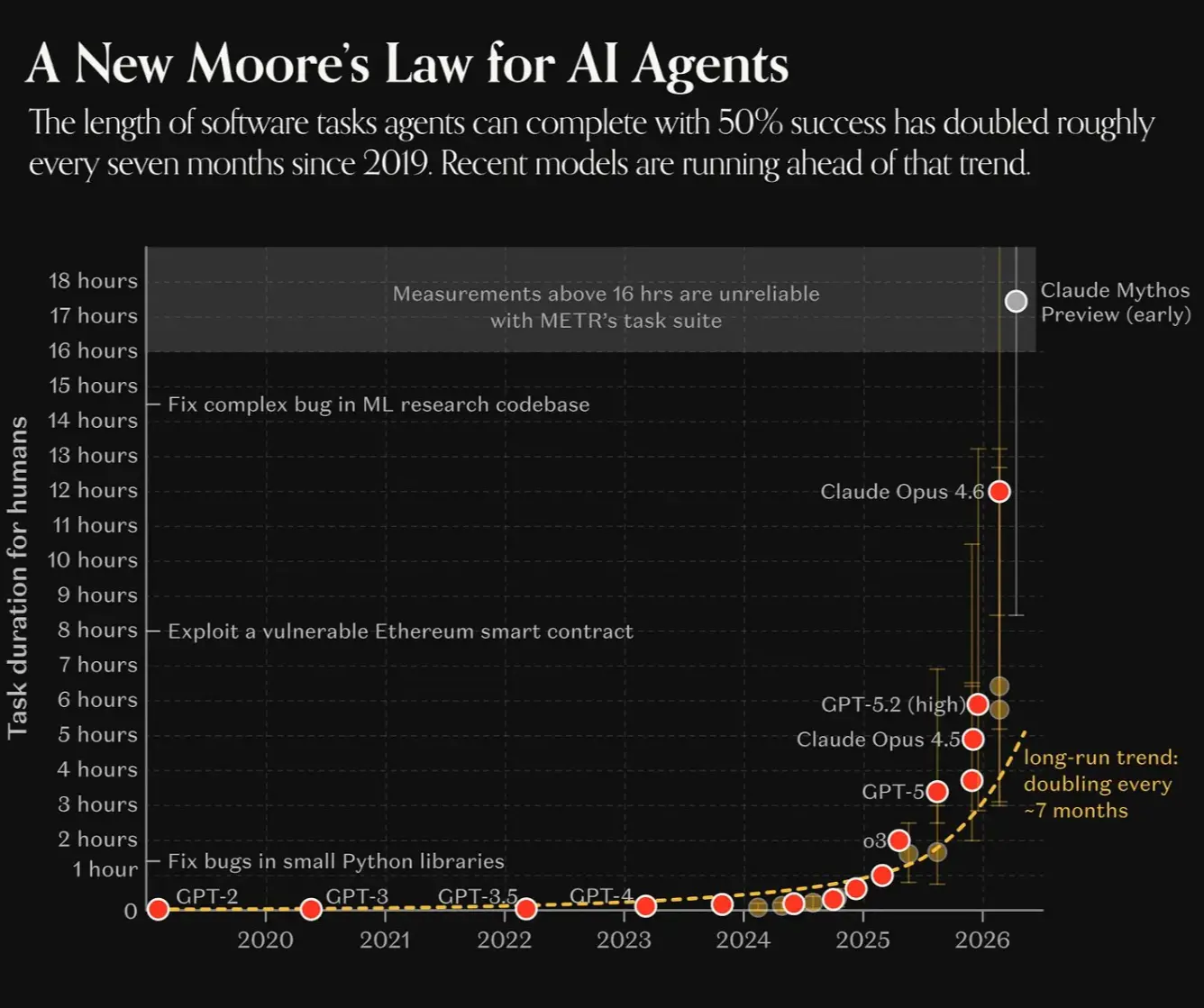
Image: The "new Moore's Law" for AI Agents.
However, in most companies today, people still do not believe that AI can reliably update records in Salesforce (a customer management software).
"The problem with AI is not intelligence, but context," Ali explains. Even the smartest person is nearly as powerless if they cannot access company data, have no authority to act, receive no feedback, and do not understand the knowledge in other employees' minds. Ali's answer is what he calls "Agent-focused enterprise data systems."
You may have seen a video clip of Palantir CEO Alex Karp discussing business ontology. He believes, "All the value in the market will flow to chips and what we call business ontology. Business ontology allows you to take a large language model, use it, improve it, and then apply it to the enterprise." As for what this actually means in practice, it is usually left for the audience to ponder.
Every company has its own business ontology, which is a set of models describing what entities exist within the company, how they relate, what various terms mean, and which information source should be prioritized when two sources conflict. Some of this exists in databases, dashboards, policies, and documents, but a significant portion exists only in the minds of senior employees.
Moreover, this model will never be fixed. Contracts change, temporary workarounds become processes, exceptions become rules, and formal records gradually diverge from actual working methods. Who decides what, which decisions later prove correct, is similarly fluid: decision-making authority and evaluation criteria, like business ontology, are often not documented.
People will quietly fill these gaps in their daily work. A vice president of sales needs to know that the reason the largest deal, once thought to be closing, is stalled is that the key person driving the deal on the client's side is quietly interviewing for other jobs; they also need to know that the "90%" closing probability mentioned by a salesperson is actually only 50%, and adjust it down before reporting forecasts to the CEO.
To enable Agents to act autonomously, the vast amount of business ontology knowledge, decision-making authority, and evaluation criteria currently residing in the human brain must be integrated into the company's data systems. Databricks' bet on the lakehouse system is a natural choice for hosting this content, as the company's other data is already stored and managed there.
"Today, the lakehouse system has become the enterprise data system," Ali said. "I call it SORA, which stands for System of Record for Agents."
Employees can interact with this enterprise data system through Genie. Genie is a natural language interface launched by Databricks in 2024, allowing anyone in the company to ask questions about enterprise data and increasingly build Agents on top of that data.
At its core, this record system must cover the entire enterprise and continuously answer four questions. Databricks is addressing these questions one by one:
What is real? The Lakehouse and Lakebase have preserved the current business state of the enterprise.
What does this information mean? To avoid AI having to repeatedly search for answers in company data every time a question is asked, Databricks' Genie Ontology continuously builds an organizational knowledge graph, such as how revenue is calculated and what was discussed in last week's meeting minutes.
The engineers named one of the algorithms OntoRank, paying homage to Google's PageRank. It assesses which knowledge is more authoritative based on attributes like who created it, how widely it is used, and when it was last modified. In Databricks' tests, using the enterprise business ontology as a basis for the Agent improved the accuracy of responses from about 50% to 84.5%.
What is allowed? In the past, each employee had a login account access model that worked when all employees were human. But when employees can launch hundreds of Agents daily, this model becomes unworkable. "You can't grant each Agent access to every proprietary, isolated database one by one," Ali explained.
Databricks' Unity Gateway assigns identities, budgets, and operational limits to every model, Agent, and AI tool in the company, and tracks logs of every operation, allowing the company to see what the AI system is doing, what data it accessed, and how much it spent.
Has it worked? Databricks provides two ways for enterprises to build Agents. Business teams build in Genie, turning a prompt into a shareable Agent that reasons based on enterprise data and increasingly takes action in applications like Slack or Salesforce. Engineers can use Agent Bricks to build more customized Agents for actual production environments.
Regardless of the approach taken, Databricks allows teams to design their own "exams," clarifying which results are acceptable, which errors must never occur, and then providing tools to optimize each Agent according to the enterprise's specific task requirements. This is how AI forms a feedback loop.
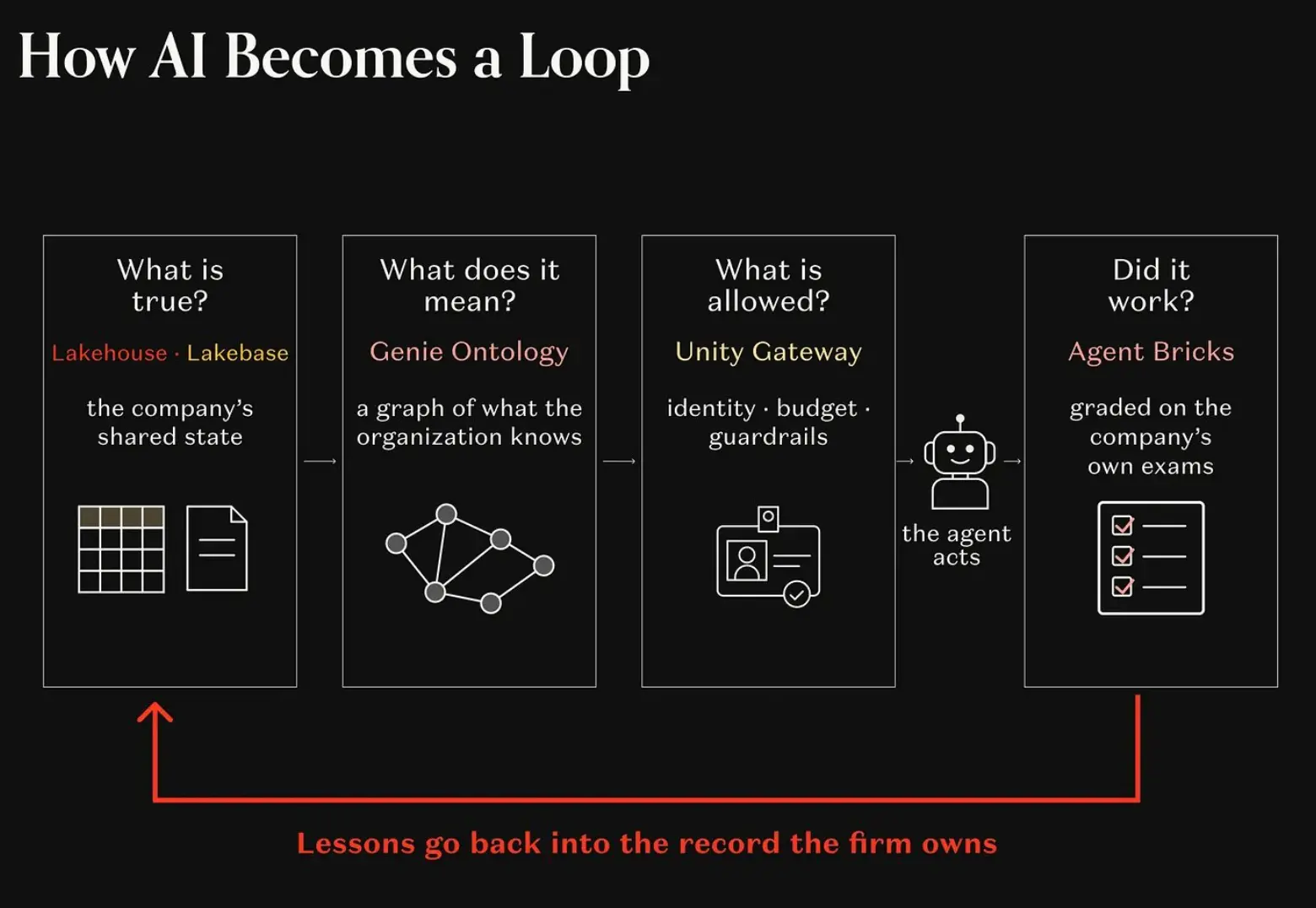
Figure: How AI forms a feedback loop: confirm facts, understand meanings, clarify permissions, execute and evaluate, and then write experiences back to the record system controlled by the enterprise.
Every platform change in the field of enterprise computing triggers a new round of competition around enterprise data systems. IBM dominated the mainframe era; Oracle and SAP became the foundations of client-server architecture; Salesforce, Workday, and ServiceNow built SaaS enterprise data systems in sales, human resources, and IT, respectively. Agents will bring about the next round of transformation.
But how Agents will change the enterprises themselves is a bigger question than which vendor will prevail.
Nature of the Enterprise
In his 1937 paper "The Nature of the Firm," economist Ronald Coase posed the question: Why do firms exist? If markets can coordinate economic activities through prices and contracts, why gather people into companies and have their work directed by managers?
His answer boiled down to transaction costs. Finding the right people, agreeing on what to do and at what price, and supervising the entire process all require time and money. Firms replace some of the repetitive market transactions with arrangements that do not pre-specify each specific task, allowing managers to allocate resources within agreed-upon limits.
However, organizing work internally within a firm is not without costs. As companies grow, more information needs to be passed through more people. Ultimately, the cost of organizing a transaction internally will equal the cost of purchasing from the market. According to Coase's explanation, firms will continue to expand until these two costs converge.
Forty years later, one of the few individuals to receive both the Nobel Prize and the Turing Award, Herbert Simon, discovered that centralizing a firm's memory could enable decentralized decision-making. He wrote that shared computer records "allow various decentralized decision points to act independently," as the system automatically checks and coordinates these actions with shared records.
For example, a ticket agent in Boston does not need to call all other agents before selling the last seat on a flight to Chicago. She only needs to check the records; when she sells that seat, the records visible to everyone will update accordingly. Centralized management of business status makes decentralized actions safer, as people can coordinate through shared records without needing to communicate individually with others.
Relational databases extended this principle across the entire enterprise. Tasks that previously required reports, meetings, and management handovers could now be completed with a single query to shared records. This allowed companies to coordinate more products, locations, personnel, and transactions without proportionally increasing the number of managers.
By the 1990s, the internet allowed the external world to write information into a firm's records, enabling online markets to coordinate transactions, inventory, and payments among millions of strangers.
As transaction costs both internally and externally have decreased, the database era has not led all firms to uniformly grow or shrink but has allowed for the existence of more diverse types of firms. Large enterprises can manage much more complex operations, while small firms can rent or purchase capabilities that previously required entire departments.
AI is likely to follow a similar path. Internally, Agents can reduce coordination costs by automating report generation, searches, and routine tasks. Externally, they can assist in finding and evaluating suppliers, negotiating standard terms, and monitoring outcomes.
Like previous databases, AI will enable enterprises and markets to support more complex activities. But its more profound impact may be on changing the organizational forms of enterprises.
Typical enterprises of the 20th century were pyramid-shaped because the hierarchical system was their information processing system. Facts were transmitted upward through reports and meetings, and decisions were communicated downward in stages, with the flow of information corresponding to the organizational chart. Management decided which data was worth collecting and sharing, meaning the company's self-awareness depended on what information managers chose to collect.
Databases changed this structure, but only partially. Shared records allowed people to access information directly and act more independently, but they were often still confined within processes designed by others.
For most of the computer age, a relatively small number of managers, operations teams, and engineers defined the company's data structures, metrics, applications, and workflows. The number of employees using these systems far exceeded those involved in designing them.
This not only limited what people could do but also restricted what the organization could know. For instance, a customer service representative might hear the same complaint several times a week, but if her manager does not write a report to document it, the company remains unaware of what she knows. Addressing this issue is another matter.
Today, the technical barriers to obtaining information and taking action are simultaneously decreasing.
As Andrej Karpathy said in 2023, "The hottest new programming language is English." Natural language interfaces enable more domain experts to directly query enterprise data without waiting for someone who knows SQL or Python to think of these questions or answer them on their behalf.
At Novo Nordisk, a global healthcare company with a century-long history, scientists previously had to wait for data engineers to write queries. Now, they simply ask Genie to "show us all data related to obesity," and it immediately finds relevant trials, research findings, and visualized results.
Within defined permission boundaries, employees can also build solutions on their own, saving hours or even days of work. At electric vehicle manufacturer Rivian, a financial analyst without SQL experience used Genie to create a revenue dashboard for the CFO; a supply chain analyst developed an application to track incoming goods transportation.
This does not mean that everyone can access all company data or resources without approval. As work becomes more decentralized, a shared business ontology, permission system, and accountability mechanism become even more important. The enterprise data system centrally manages business status and operational boundaries while allowing more people to ask questions, design workflows, and take action.
In March, Jack Dorsey wrote a manifesto titled "From Hierarchy to Intelligence," introducing how his company Block began to experiment with a more radical version of this concept. He wrote, "For the first time, a system can continuously maintain an up-to-date model of the entire enterprise and coordinate work accordingly. In the past, this work required humans to pass information through layers of management."
Ali's concept of an "Agent-oriented enterprise data system" is similar to what Jack refers to as the enterprise "world model," both being continuously updated models that present the organization's operations, decisions, capabilities, and priorities. Frontline employees keep the model connected to reality, while the model provides the shared contextual information needed to take action.
"Humans can enter areas that the model cannot reach," Dorsey explained. "They can perceive things that the model cannot: intuition, explicit directional judgments, cultural backgrounds, changes in trust relationships, and the atmosphere on the ground. They will make judgments that the model should not make on its own, especially in ethical decisions, new contexts, and critical moments where mistakes could jeopardize the enterprise's survival."
As a result, enterprises can coordinate with fewer management levels while work becomes more decentralized, allowing leaders to have a clearer understanding of the work situation.
In Dorsey's view, the competitive advantage of this new structure lies in speed. "Whether a company operates quickly or slowly depends on how information flows," he said. "Hierarchical systems and middle management hinder the flow of information."
Ali generally agrees with Dorsey but has one difference. "Philosophically, I agree with Jack Dorsey," he said. "The question is whether this also applies to the organizational chart of human employees." He believes people have conflated two things: the company's organizational structure and the way information flows within the company.
"Ten or twenty years ago, they were indeed the same thing." Back then, to understand what was happening in the company, one had to inquire step by step along the organizational structure: you ask your subordinate, and then they ask their subordinate. But now, it is different.
Companies still need managers, but they no longer require as many people responsible for conveying information. Training employees, helping teams determine what is more important, and noticing when someone is feeling down still require human attention.
Therefore, although the two individuals have different views on how much the management hierarchy will be reduced, they both believe that AI will take over the information transmission work. In the 20th century, it was precisely because companies became too complex and relied on these coordination tasks that managers gained immense power.
The Second Managerial Revolution
Eighty-five years ago, just after the Great Depression, James Burnham wrote "The Managerial Revolution." This book foresaw the significant changes that would occur in the way businesses operate, and even in capitalism itself.
After the Great Depression, a popular view held that entrepreneurial capitalism had come to an end and that some new system would inevitably replace it. The popular proposals at the time included socialist collective organizations and nationalization.
Burnham understood what was happening. He proposed a third possibility. This was not just a corporate structure but a brand new social order, which he called the "managerial society." In this system, the decisive ruling class was neither the traditional capital owners nor the workers, but the professional managers, planners, bureaucrats, and executives who run large enterprises and state institutions.
He believed that modern institutions had become technically complex to the point where they could not be directed by individual capitalists. No CEO could know everything happening in a company with 100,000 employees; therefore, control would gradually shift from owners and domain experts to administrative managers.
By the second half of the 20th century, the managerial model dominated by professional managers had almost achieved total victory. "Most executives in the Fortune 500 companies are not experts in their respective fields, and certainly not the founders of those companies," said Marc Andreessen.
"They are professional managers. In fact, throughout their careers, they are likely to manage many different types of businesses: first spending some time in healthcare, then moving to financial services, and later transitioning to other industries."
But this victory is exhausting its own advantages. The managerial class that Burnham spoke of brought scalable management capabilities and stable, reliable professional operations but sacrificed speed and adaptability, especially in times of rapid technological change.
Marc suggested that a well-developed data infrastructure combined with Agents might allow companies to retain the vitality of founders while also maintaining the coordination capabilities required by large organizations.
In the past, some information transmission and coordination tasks made management necessary. Agents will automate some of these tasks, allowing more founders to adopt this operational model; the company's data systems will provide frontline employees with the contextual information and permissions needed for action.
Elon Musk pushed Marc's ideas a step further. Earlier this year, he predicted that companies that still "retain human involvement" would lose. He believes that in the age of AI, keeping humans in the process is akin to using a spreadsheet while requiring manual calculations for some cells.
On the ultimate direction, Elon may be right. But no one knows how far we are from fully automated companies: some predict just a few years, while others believe it will never be possible.
Before that, an ironically significant outcome is that the decline of the professional managerial model may manifest as everyone starting to take on management tasks. Not everyone will have direct reports, but more people will be responsible for clarifying work content, assigning execution tasks, checking results, and updating processes. The second managerial revolution, rather than the demise of management, is more about the end of the professional managerial class's monopoly on management work.
Software engineers are already feeling this strongly: their work is shifting from writing code by hand to managing a group of programming Agents. An engineer's day is increasingly resembling that of a manager: defining problems, breaking them down into tasks, assigning them to parallel-working Agents, and reviewing their submitted code merge requests, some of which are approved while others are returned with comments.
As Agents gain capabilities in more areas, more knowledge workers will experience similar transformations: shifting from personally completing every step to clearly specifying requirements, assigning tasks, and judging outcomes.
Scientists at Novo Nordisk and supply chain analysts at Rivian are already directing Agents through Genie to accomplish tasks that previously required a team of engineers or data scientists, allowing these teams to focus on the most strategically valuable tasks.
This is good news for both human productivity and salaries, as execution and judgment economically complement each other: when AI lowers the cost of routine execution work, the demand for judgment capabilities to guide these tasks will rise.
A century ago, mathematician Alfred North Whitehead pointed out: "The progress of civilization is measured by the extent to which important operations can be carried out without our thinking about them." The same goes for businesses; every time a work loop is perfected, it enhances autonomous operational capability.
Whenever someone corrects an Agent's work loop, that correction should improve the next execution. Once a loop proves it can reliably complete a clearly defined task, humans can exit that loop, move on to the next unresolved issue, while leaving the accumulated experience in the company's shared records.
However, as Burnham would likely also notice, to maintain autonomy, companies must master their own models and all the knowledge that frontline employees impart to them.
Autonomous and Controllable Enterprises
In companies operated with the involvement of Agents, talented individuals will be more valuable than ever. But talented individuals will also come and go. Meanwhile, models continue to improve, and every competitor can rent the same models. So, how should companies establish sustainable competitive advantages in this new world?
Imagine two banks renting the same cutting-edge model to assist in credit decisions. The first bank sends prompts to the model, receives answers, and then records the final decision. The second bank records which facts contributed to the answers, what modifications humans made, which decisions were effective, which failed, and continuously adjusts policies throughout the process.
A year later, when a better model emerges, only one of the banks will have truly improved. If you change a company's AI model, and the new model can inherit the company's business definitions, permission settings, evaluated cases, customer histories, and hard-earned special case handling experiences, then this forms the foundation of a sustainable competitive advantage. If the new model starts from the same prompts as all competitors, then there is no such foundation.
The second bank is what people are starting to call "autonomous and controllable" enterprises. If suppliers raise prices, modify terms, or discontinue a model, the enterprise can switch suppliers without losing accumulated experience. As models become smarter and companies become more reliant on them, this independence will only become more important.
In a recent article, Microsoft CEO Satya Nadella reached a similar conclusion from another perspective. He believes that AI models continuously absorb the expertise of individuals and organizations and turn it into universally accessible capabilities, thus "every company must build what I call human capital and Token capital."
Human capital consists of employees' knowledge, judgment, interpersonal relationships, and creativity; Token capital is the AI capabilities that the enterprise builds and masters. Both accumulate and grow together in a continuous learning loop, and "this loop will become the new intellectual property of the enterprise."
Data is the foundation of Token capital. "The business data of every company is its own gold mine," said Jensen Huang, CEO of NVIDIA, to the audience at the Databricks 2024 Data + AI Summit. He explained that from chip design to supply chain, almost every process at NVIDIA starts with a data flywheel.
"It allows us to become one of the largest 'small companies' in the world," he said. At that time, NVIDIA's valuation exceeded $3 trillion, yet it had only 30,000 employees. "The reason, of course, is that there is a lot of AI within the company helping us accomplish remarkable work." Huang believes that every company will be like this. "This is an extraordinary time," he said, "and everything starts with data."
The Future of Enterprises
To ensure that Agents work reliably within enterprises, data systems need to continuously answer four questions: What happened, what does this information mean, what actions are allowed, and whether the actions were effective.
With this foundation, both humans and Agents can act autonomously without requiring every decision to pass through layers of management; the results of actions will also return to the records controlled by the enterprise itself.
Coordination costs will decrease, allowing companies to accomplish more work with existing employees. New companies that were previously unviable in business will also emerge, as ten people will be able to accomplish what used to require thousands. And before AI can do everything that talented individuals can do, talented individuals will become more valuable rather than devalued. That day is still far off.
Fewer people will operate according to processes designed by others, as Agents will handle tasks that we have already figured out how to do. More people will turn to unresolved issues: judging what is good, noticing what changes are occurring, and deciding what should be created next.
What will people do every day at work in the coming decades? The honest answer is: doing those things we have yet to figure out how to do. As Agents and enterprises automate more tasks that we already know how to perform, people will create outstanding new things and solve problems that were previously beyond our capabilities, alongside this new intelligence.