
A new generation PayPal gang? HRT interns have produced the head of Meta AI and Hyperliquid
Author: Zhou, ChainCatcher
On October 19, Meta's Chief AI Officer Alexandr Wang posted a selfie in the mountains on X, captioned: got the HRT gang back together!
The other two people in the photo are Jeff Yan, founder of Hyperliquid, and Scott Wu, co-founder and CEO of Cognition. The three interned together at the quantitative trading firm Hudson River Trading ten years ago and now stand at the forefront of AI foundational models, on-chain trading, and AI programming.
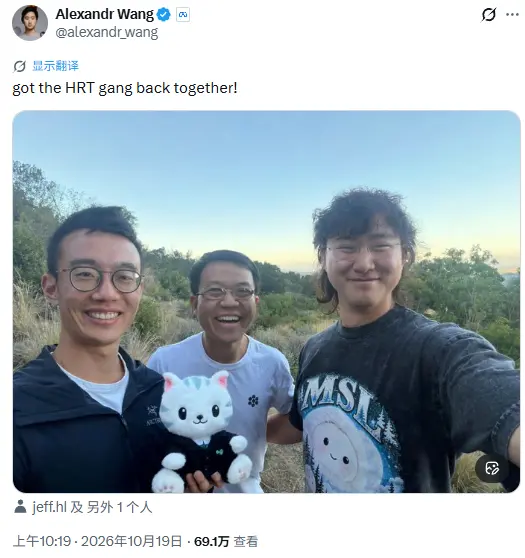
The group photo quickly went viral in both Chinese and English communities. Crypto KOL AB Kuai.Dong called it a century-defining group photo. Others believe that top quantitative firms are becoming the training ground for a new generation of founders in Silicon Valley, effectively screening talent for the region for free.
The Winter of Ten Interns, Seen as the Starting Point of the New PayPal Mafia
This experience is well-known, starting with an interview of Jeff Yan by the American business magazine Colossus in April.
According to Jeff Yan's recollection, he was selected for the first HRT internship program during his junior year at Harvard, which had only 10 participants. The program lasted three weeks and was conducted in a competitive format, with the top two spots in almost every round being occupied by him and Scott Wu.
Among the interns were Alexandr Wang, who was studying at MIT at the time, and Jesse Zhang, who later founded the AI customer service company Decagon.
HRT, headquartered in New York, is a well-known high-frequency trading firm on Wall Street. Jeff Yan later stated that he chose quantitative trading because trading is the purest form of real-world competition between people.
According to Colossus, it was during this time that 19-year-old Alexandr Wang, at a friend's gathering, questioned everyone about the PayPal Mafia, asking why it couldn't be us.
Ten years later, this phrase has been repeatedly quoted. Looking at the three's resumes, their paths are strikingly different.
Jeff Yan Brings Trader Intuition to the Blockchain
Of the three, Jeff Yan is the only one who is truly a trader.
He grew up in California, won a gold medal in the International Physics Olympiad in high school, and later completed his undergraduate studies in mathematics and a master's in computer science at Harvard. After graduation, he joined HRT full-time to develop algorithms for U.S. stocks but left after eight months.
In 2020, Jeff Yan founded the crypto market maker Chameleon Trading. After the collapse of FTX in 2022, he decided to halt the existing business and pivot the team towards building trading infrastructure, which became Hyperliquid.
Hyperliquid operates on its own Layer 1, with the order book and matching all on-chain, starting with perpetual contracts and gradually expanding to more asset classes. The project was launched with its own funds and did not accept venture capital.
According to Colossus, the Hyperliquid team consists of only 11 people, and profits generated in 2025 are expected to exceed $900 million, making it one of the highest profit-per-capita organizations globally.
The market capitalization of HYPE is often used to measure Hyperliquid's scale. Based on the price of about $80 on October 19, HYPE's maximum supply of approximately 1 billion tokens corresponds to a fully diluted valuation close to $80 billion, while the actual circulating market value is only a portion of that.
Scott Wu Approaches AI Programming with a Competitive Mindset
Scott Wu is the most accomplished competitor among the three.
Born in 1997 in a Chinese immigrant family in Louisiana, he won gold medals in the International Olympiad in Informatics for three consecutive years from 2012 to 2014.
He left Harvard after about two years to co-found the professional networking platform Lunchclub. In 2023, he co-founded Cognition with fellow IOI gold medalists Steven Hao and Walden Yan, launching the AI software engineer Devin in March of the following year.
Cognition then entered a rapid expansion phase. In 2025, the company acquired the AI programming tool Windsurf and raised over $1 billion at a valuation of $26 billion in May of this year.
On September 8, Cognition announced the completion of over $2 billion in Series E funding, raising its valuation to $48 billion, led by Andreessen Horowitz and Accel. The company stated that its annualized revenue has increased from $492 million in May to nearly $900 million.
Wealth followed suit. According to Forbes' 2026 list of America's 400 wealthiest individuals, Cognition co-founder and CTO Steven Hao made the list with a net worth of $5.8 billion, making him the youngest member at 30 years old.
The Olympiad Circle is the True Starting Point of This Network
After the saying "HRT helped" spread, many felt this case demonstrated the strength of the Chinese community. However, a more accurate statement is that the pipeline of American Olympiad + top universities + quantitative firms is highly efficient in selecting individuals from Chinese second-generation/immigrant families, and this group is currently coinciding with the explosive window of AI and on-chain finance.
Scott Wu himself stated that the HRT internship was not the starting point of friendship for this group; many had known each other since high school through Olympiad competitions.
The names extending from this circle are equally prominent. Johnny Ho, co-founder of Perplexity, Demi Guo, co-founder of Pika, and Steven Hao, co-founder of Cognition, all come from the same group of competitors.
From this perspective, HRT resembles a crossroads. Top quantitative firms have long preferred to recruit from Olympiad winners, and these young people were already in the same small circle; that internship merely allowed them to spend three weeks in the same office.
Afterward, they ventured into AI, crypto, and software engineering, yet their work shares similarities. Scale AI redefined the data supply chain for AI, Hyperliquid redefined on-chain exchanges, and Cognition attempted to redefine the act of coding itself.
Of course, having four well-known founders emerge from ten interns seems impressive only in hindsight. The paths of the other interns are rarely reported, and many in the competition circle did not pursue entrepreneurship.
But at least on this day, the three in the group photo belong to Meta, Hyperliquid, and Cognition, and the question "why can't it be us" from when they were 19 now has an answer.
