
Sun Yuchen's latest interview: Sun Xue, Bo Ji, Huang Mao, and the cognitive upgrade in the AI era
Compiled by: Rhythm BlockBeats
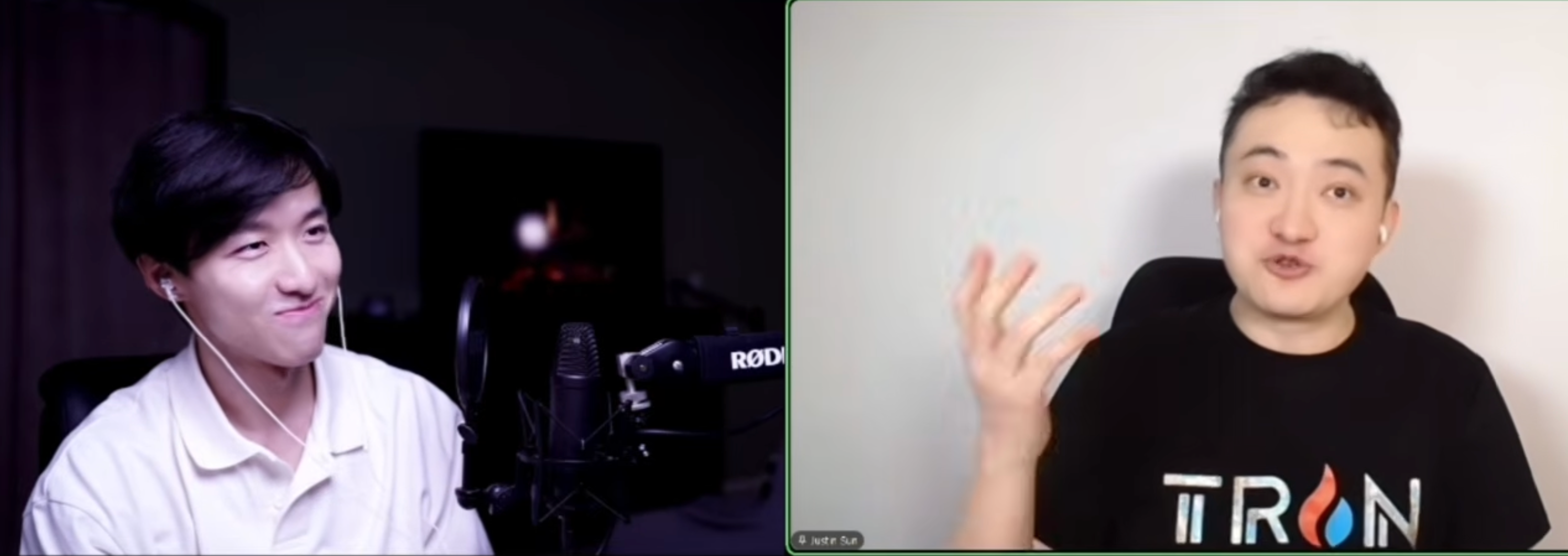
Editor's Note: This is the latest interview with Sun Yuchen. His 2016 book "The Path to Financial Freedom" has been wildly shared ten years later in 2026, especially among the post-2000 generation, because many of his previous statements, such as buying Tencent, Bitcoin, Tesla, and Nvidia, are now seen as highly insightful. At the same time, Sun Yuchen has indeed become the strongest version of a post-90s individual in many aspects. In a conversation with the hottest combat IP Shao Allen, Sun Yuchen discussed his recent new thoughts, including reflections on AI, the industry, the entire era and future, as well as thoughts on life and Earth. Many points will indeed provide us with new perspectives and directions. We have tried to compress and refine his language without changing his tone and viewpoints. Since the full text is quite long, we have extracted a few key representative points from his original words, followed by the full text.
TL;DR: · Cognition determines everything; it is all about cognition. This includes yellow hair, thin muscles, and crypto, all of which are cognition. · In the AI era, everything will become very cheap; the only valuable thing is lifespan. Being young is wealth. · You may be materially rich now, but physically you are poor. · Muscles are equivalent to your most important bank account. They are a strategic reserve, the cash on your body. · Versions cannot roll back; they can only be updated forward. · Business opportunities must be discovered globally; do not limit yourself to opening a small shop at your doorstep to earn money from the old lady downstairs. · Opening a map can be like cheating; cheating is like opening a map. With enough information, you no longer need to make decisions. · There is no such thing as IQ in the world; only the amount of information exists. · All those who become the correct answer did not know they were correct before they became the correct answer. · Pursuing meaning is actually meaningless; the experience itself might be. Getting on the road is more important than figuring out why to get on the road.
My Daily Routine: Fully AI-Driven Life
What I am currently doing is still the initial practice of thin muscles; I will give myself three to six months to see the progress. A bit about my physical data: height 172 cm, weight around 75 kg, body fat approximately 29.
Since I started practicing thin muscles a few days ago, my life has changed compared to before. My day is very simple: I wake up, work first, then have my first meal. Now I throw everything I eat to Claude to help me calculate how many calories I consumed in that meal. The method is also simple; I first send a photo of the dining table before eating, and after finishing, I send a second photo. It will also tell me how to eat and in what order, starting with high-protein foods. I have also added protein powder and creatine, 25 grams of protein powder and 5 grams of creatine, and then I start eating.
After eating, I train. On training days, I focus on a few main exercises: deadlifts and squats. On non-training days, I just work normally. Currently, training days and non-training days alternate every other day. After work, I have my second meal, which is roughly dinner, then continue working at night, and then sleep.
Regarding sleep, the next day when I wake up, I believe that to do a good job, one must first sharpen their tools. I now have an Oura Ring to track sleep metrics and calorie metrics, and I directly send the data to Claude Code. It checks the calories burned and the calories consumed, and if the difference is within 600 calories, it indicates that I am burning fat; I currently set my protein intake at 140 to 150 grams, aiming to gain muscle while losing fat.
I specifically created a project for Claude Code, which generates a daily report for me, telling me how I performed today, combined with the sleep data from the Oura Ring. I also send it photos of what I eat every day. For each exercise, my coach helps me record videos, and I send those to it as well, which keeps track of how many sets of 12 reps I do, how many sets, and how much weight. I do progressive overload, gradually increasing the weight, and it keeps a daily log. After training, it calculates how many calories I burned; on the first day of training yesterday, it was 275 calories, and it recorded that. I plan to repeat this process for three months; this is the current arrangement.
The theoretical groundwork took a week. This week included preparing the Oura Ring, reading tutorials and theories on thin muscles, absorbing what it’s all about, and then buying protein powder and creatine. I really need to drink protein powder. This week also broke an outdated notion of mine: I used to wonder if protein powder was "technology" and whether drinking it was like taking drugs. Later, I realized that protein powder is actually just like eating protein. It is indeed quite difficult to consume 140 grams or 150 grams of protein through regular meals, so this 25 grams of protein powder is a great supplement. It’s not that I rely entirely on protein powder, but I definitely need a portion of it, which also alleviates the pressure of "not needing to eat so much."
Now I am fully AI-driven. AI first gives me feedback and suggestions: how many sets I did for the exercises yesterday, which muscles were worked, and how many it suggests I should do. Since I recorded videos of my movements, the AI reviews everything. Of course, I also have a coach monitoring me; AI checks in, and the coach checks in, to see if I am performing correctly, integrating all the information, and then Claude Code pushes out a daily report.
Now it is visualized, data-driven, and calculable. Everything has been turned into an md document, and all photos are stored in a local folder, and the AI has been trained. So the next AI can read directly. If one day I want to clear Claude Code and switch to Codex, it can take over directly; everything is in README.md.
Three Fundamental Cognitions and AI Belief
My advice to young people is: this era is actually the best era, and it is not difficult. If your disposable income is less than 1000 RMB a month, you can first register for Zhipu or Kimi; they both have something similar to Claude Code, and it’s mostly free. Claude Code is too expensive, costing 200 dollars a month, which many people cannot afford. If I can only spend 100 dollars a month, I don’t have the money to use it. So just find a cheap AI to install, or you can use my own B.ai.
Then, using the theory I just mentioned, put all your information into a document. Don’t say "I can’t even afford a computer"; if you don’t have a computer, you must have a phone, and you can put it in your phone just the same. Create a folder and dump everything in there; no matter how much it costs, you can start AI integration for free now. Our company, including products, is now promoting full AI integration; I believe it can be done for any amount of money, just fully AI-integrate the entire process first.
Sun’s theory mentions an important principle: first, arm yourself with theory. The most important thing now is AI integration. This is no less than what Japan said back in the day about rising first by establishing a constitutional monarchy and modernizing. Japan was originally a feudal country, and to become a capitalist country, the first step was this. This step of AI integration can start at zero cost, no matter how much it costs. You just need to tell it directly, "I want an md document," input everything, and you can set it up. Today it’s free, tomorrow it’s free; changing an API doesn’t actually require spending money. I might have a bit of money now, but money is not my main obstacle; I just package it to Claude for stability. But if you don’t want to spend a penny, just look for activities from each company; eat from one today and another tomorrow, no problem, you can fully AI-integrate without spending a cent.
Starting from zero, I summarize three theories. The first is Sun’s theory, which is to arm yourself with theory. Sun’s theory is a relative upgrade of the brain, equivalent to changing the operating system, understanding money, understanding financial freedom, and understanding everything; first, upgrade with Sun’s theory. The second is thin muscles, which can indeed be practiced. This is not just for attracting women; ensuring physical health is priceless in the AI era. Poor health is a veto. Not practicing thin muscles and being overweight can lead to many problems, severely slowing down your progress toward financial freedom and causing many troubles in life. Therefore, practicing thin muscles is absolutely necessary. Attracting women is also important; the quality of offspring must be ensured, but fundamentally, thin muscles are still for physical health. The third is the yellow hair theory, which I think is also quite important. Because once Sun’s theory and thin muscles are implemented in today’s China or among the Chinese community, there will definitely be a lot of backlash; it is after all a niche theory, although correct, it will face a lot of suppression and ridicule. Moreover, once you practice Sun’s theory and thin muscles, being handsome, muscular, and wealthy will definitely attract jealousy in society; that’s a hundred percent. So you still need to arm yourself with the yellow hair theory: what others say is not important; what you believe to be right should be fully executed.
In short, having Sun’s theory, thin muscles, and the yellow hair theory means you can get to work. And it is at zero cost, requiring nothing; it is just a cognitive upgrade, without spending a penny. These three sets of theories can be applied by 200 million young men aged 20 to 40 in China, and with women included, it’s 400 million.
On this basis, the most core master now is AI, and I believe in AI one hundred percent. Recently, I had a small controversy, also caused by my excessive faith in AI. Many people said I was shifting blame to Claude, but that’s not the case; it’s just that I absolutely believe in Claude, and whatever it says, I execute, no matter how much resistance I face. Of course, you don’t have to use Claude; using OpenAI’s o1 is also okay, and using Zhipu or Kimi is fine too.
This entire process can be executed without spending any money. No matter where you are on Earth, as long as you have internet access and a phone, you can execute this at zero cost. Whether you are a freelancer or a civil servant, it is all zero cost. If you hear this podcast, just install it immediately if you have a phone.
Specifically, I suggest two points. The first point is to hand over your current situation to AI because AI understands you better. Accumulate your health data and various data; don’t panic at first, just accumulate for two to four months, then digitize and unify all the data, and add an analysis of your current situation, and give it to AI to help you analyze, even let it point you in the direction of how to make money, because AI understands this data better and has more data and is more rational.
The second point is to ask three questions. You can use our B.ai, which is an API purchase; you pay for each question you ask, and you can directly switch models. Ask Claude, ask OpenAI, and then ask a major domestic model; you will have the top three from China and the US, and then choose among them for strategies.
The second idea is to keep an eye on the trends in human technological development, which is crucial. Sun’s theory was established in 2016, and it has been ten years now; I myself am a practitioner of Sun’s theory. In 2016, I was nothing, started practicing Sun’s theory, and began training thin muscles; I might have had a big belly back then. After six months to a year, I could compare photos and see changes using the control variable method. With technological advancements, new things will constantly emerge, so it’s necessary to have a grasp. You can also let AI grasp this; I am personally very interested in AI, so I also keep track of things like what Elon Musk is doing every day. Combine your own interests with what AI tracks. Of course, if you are not interested in something, there’s no need to force it; just pick a direction you are most interested in and delve into it, because each direction already has a lot to offer. Everyone will have their own areas of expertise; it’s impossible to be an expert in every field.
Decision-making also involves a tuning process. Large models need training, and so do people. If the data is different, the conclusions need to be adjusted. Just like the Oura Ring reads data every day, we improve based on specific situations, so this is not a one-time deal; it’s continuous tuning and modification, ultimately training it like a model.
Yes, everything relies on AI, but we also add some of our own judgment, with AI being the main focus. If flying a plane, I would let AI fly 90% of the time, while I might adjust AI for about 10% of the time. Sometimes I also have different opinions and discuss them with it. For example, a couple of days ago, I had a very simple conversation with AI that changed a preconceived notion of mine: I thought protein powder was somewhat "technological," but AI told me it’s not; there is indeed a lot of technology in the fitness field, but protein powder and creatine are the only things that are not considered technological; they are just ordinary food. Once it explained the principle, my perspective flipped. So your ideas may conflict with AI, but you can communicate frequently to update your concepts, which is very inspiring.
The theories of Sun Xue, Huang Mao, and thin muscle are still quite valuable for reference because everyone's situation may not be that complicated. Upgrading thoughts, upgrading the body, and focusing on personal development are the three most critical things that can be done immediately; other matters can be discussed with AI based on individual circumstances.
Regarding asking AI, I used to have a famous saying: don’t chat with WeChat, chat with Doubao. This has already been an upgrade. Now I further upgrade it by using APIs to chat with global AI. Using one API, all files are stored locally, and then read with one API to help you construct the overall large model. This requires a bit of computer knowledge, but it’s actually very simple; just ask AI online how to do it. People shouldn’t think that APIs are extremely difficult and shy away from them; they are not much different from using Doubao, just a slight change in channels.
Opportunities and Business Strategies in the AI Era
I am very optimistic about the future and about young people. The reason is simple: everything will become very cheap in the AI era, and the only valuable thing is lifespan. Being young is wealth. Because when you get old, there are still many things you can’t keep up with, and eventually, you have to get off the bus. Although AI is advancing, it hasn’t progressed to the point of eliminating death; immortality has indeed not been achieved. Besides that, all industries will be revolutionized by AI, so young people are filled with opportunities in every field.
Let me give a few examples unrelated to my industry. The first is mathematics. Mathematics used to rely heavily on learning and family background. People often wondered: why do Peking University and Tsinghua University win so many medals at the IMO but receive fewer Fields Medals or top math awards? The fundamental issue is that solving math problems requires thinking. If your mentor is from Harvard, MIT, or those Parisian academies, your thinking will improve; being smart at Peking University won’t help if your teacher doesn’t know how to solve the problem, and if you haven’t entered that circle, you won’t know that path.
But now AI is like a wild punch that can defeat the master. AI has captured all the thinking processes from around the world into its model. AI itself doesn’t create anything and can’t build high towers from the ground up; if I ask AI how to achieve controlled nuclear fusion, it wouldn’t know because humanity hasn’t achieved it yet. However, there are several approaches to controlled nuclear fusion that have been proposed by predecessors, and AI has the ability to extract all those thoughts, analyze them, and explore forward.
That’s why I established the Sun Yuchen Prize, which is for problems you can solve directly. Now a large number of math graduate students, even high school students, can reach the level of a math PhD based on the ideas provided by AI, o1, and o3. Information that only mentors used to know can now be known by high school students, as long as you understand what it’s saying. The field of mathematics often produces geniuses; people like Terence Tao solved very difficult problems in their teens or early twenties. Achievements that used to take until one was in their thirties or forties can now be accomplished at twenty or even younger. After AI, young people in mathematics are completely liberated; it doesn’t matter what grade you are in, whether you are a PhD or a master’s student; you can start working on it in high school. Those who used to compete in the IMO were just delayed; now they can connect directly with AI, and you and AI might achieve a world-class result in just two days.
A few days ago, there was a dispute involving OpenAI, which I’ll briefly explain. A mathematician from New York University has been tackling the NS equations, the most difficult ones. He shared his general thoughts with OpenAI. OpenAI is now equivalent to large model training, especially with cutting-edge knowledge; once learned, it becomes internalized. I believe OpenAI itself asks every day: for breaking the ten hardest problems of the Millennium Prize, has your thinking evolved daily? Because it absorbs a vast amount of human knowledge every day and is constantly updating, it created agents. As a result, this professor happened to provide a new idea, and OpenAI judged that this direction was promising, so it mobilized $7 million worth of computing power and thousands of agents to work together, solving it in two days. Of course, the professor’s idea was crucial; without it, OpenAI wouldn’t have known; but once he provided it, OpenAI solved it in two days. So now the mathematics field is in a competitive situation where you chase me and I chase you. Young people entering the mathematics field, as long as they understand AI, can defeat a 50-year-old professor in no time at all.
Another example is biology. I’ve also asked AI: which fields are likely to achieve decisive breakthroughs now? AI told me that astronomy will make essential progress. Because the Hubble Space Telescope collects a vast amount of data, but it’s all extremely tedious data, and no one has time to process it. Now with AI working on it, astronomy can achieve decisive breakthroughs in no time.
There are too many ways to make money. Let me give a legal example: the prices of APIs in the AI field are actually not uniform. For the same user, monthly subscriptions in Argentina, Turkey, and Nigeria are the cheapest, while in the United States, the monthly subscription price is the highest, so you can do token transfers. I’ve created something similar myself. This idea was actually formed gradually as I trained with AI.
Business opportunities are global. Never limit yourself to "I’ll open a small shop at my doorstep to earn the money of the old lady downstairs"; that thinking is too small. Business opportunities must be discovered globally, and then combined with your strengths and interests.
Doing global business means treating a Nigerian, a Turk, and an Argentine as your customers. People are actually quite simple; their needs are similar, so don’t be limited by language. Now there’s AI; if I want to go to Argentina and don’t speak Spanish, what should I do? You can learn, and now AI can help you with language. Of course, you can also learn some basics yourself. But don’t be limited; go out to make money globally.
The most fundamental aspect of business is whether you can create value. Taking token transfers as an example: if somewhere tokens are cheap due to OpenAI’s policies or various reasons, while in other places they are expensive, if you can let people in the expensive places use the cheap ones, aren’t you providing value? One of my more advanced ideas is: measurement standards need to change. Never consider only your own country or region; think globally. Then, based on that, consider whether I can enhance my value globally and whether I can reflect that value to my customers.
Today’s China actually has an advantage: China is the world’s factory with overcapacity, and China’s production can make money worldwide. Isn’t that how China has risen? Helping the world produce things and selling them worldwide. As long as you can demonstrate value, you don’t need to worry about selling. This is one of the most important thoughts I’ve had over the years.
This is also why, although our program is a Chinese-language program aimed at young people across China, with four hundred million young people, its purpose is to encourage these four hundred million to go global. It’s absolutely not about having four hundred million young people consume internally and compete with each other; that has no meaning. We need to earn money globally. After being armed with AI, the theories of Huang Mao, thin muscle, and Sun Xue, the four hundred million young people will serve the world’s eight billion people, and soon there will be another two billion AI to serve as well. The ten billion people and AI worldwide need services, and our four hundred million will serve them, eliminating the need for internal competition. The demand pool is large enough; there will always be opportunities. If this industry doesn’t work today, you can switch to another tomorrow. You must jump out of your domain. Therefore, I do not recommend that young people make judgments too early based on their own ideas about "what I want to do"; I suggest learning more, listening more, and observing more.
When it comes to making decisions, I have a method called "opening the map." I’ve mentioned the theory of not buying a house, a car, or getting married before the age of thirty, but if you must buy a house, a car, or get married, how should we proceed?
Taking buying a house as an example: before making this decision, look at 100 houses; don’t buy, just look, and don’t make a decision. Look at 100 houses, both new and second-hand, in various locations; don’t rush to buy. Reading a hundred times makes the meaning clear; by looking at 100 houses, you will understand everything, how others price them, and what they are roughly worth, and you will form your own thoughts.
There’s also a theory in mathematics: suppose you have the opportunity for ten houses, at which house do you make a decision? If you buy the first one, you haven’t seen the other nine; if you only buy the tenth one, you can’t regret it after seeing the previous ones. The mathematical answer is: absolutely do not buy the first three, because the first three help you build a benchmark. For the fourth to sixth houses, if a house better than the first three appears, you should buy it immediately. Why up to the sixth house? The golden ratio of 0.618; probabilistically, the sixth house is the most critical. If the sixth house is the best, that is the best scenario.
The same goes for young people choosing careers. If you don’t know which industry to engage in, now with AI, you can transform into Zhang Xuefeng overnight, first looking at 100 majors and their job prospects over the next ten years, asking AI one by one to deduce the future. Zhang Xuefeng has actually recommended some good careers: with the same college entrance examination score, you don’t necessarily have to go to Tsinghua or Peking University, which are highly competitive; with the same score, you can be the top student at a less competitive school like the China Customs Academy or Fujian Customs Academy, which may sound inferior, but actually leads to a great future in customs. Such niche majors are now also accessible. So don’t rush to make a decision; first look at 100 majors.
The biggest problem we face when making decisions is being limited by too little information. Your decision doesn’t matter whether it’s right or wrong, but the problem is you don’t know. Now let’s first open up the information, first open the map. Anyone who has played Red Alert or StarCraft understands: opening the whole map lets you know how to play; opening the map can be like cheating. Having AI is similar to cheating; you have more information. With enough information, you don’t need to "make a decision" because decisions are only necessary when information is lacking; with information, you know what to choose.
Let me give another example. In the past, when we played Red Alert or StarCraft in the same dormitory, many people liked to work in isolation, just farming and developing, then producing troops to attack others; that’s a slightly foolish approach. A smarter approach is to first build some scouts to explore the map: where the resources are, where the gold is, where the enemy troops are, and what the enemy is primarily producing, keeping everything clear in your mind, and then building accordingly. If they build war elephants, you just build spear soldiers; when the battle starts, spear soldiers deal five times the damage to war elephants, and you can take them down in no time.
So don't rush to create troops; first, build a few scouts to explore the map. Moreover, exploring the map is free now. I've seen some people play this game without ever exploring the map, just stuck at home creating troops, and only check later on when the resources have already been depleted by others, resulting in a low win rate. It's not too late to make decisions after exploring the map. The same goes for playing Honor of Kings; you need to explore the map, place wards, and know when the opponent is taking the dragon and the situation in the jungle. Someone has to be responsible for this; without information, it's easy to lose.
Five Key Trend Tracks
In academia, I believe that anything relying on data inference has great opportunities. Pure mathematics goes without saying. I've talked about astronomy; there is already a lot of data, but no one is processing it. The same goes for biology; there is a vast amount of data that no one is reading, and in biology and pharmaceuticals, this is no joke. When a drug comes out, it’s like a cannon firing gold; if the experiment passes, I am very optimistic, and I might even research some biology-related topics myself. These three areas can be compared to others: as long as there is a large amount of data, whether experimental data, observational data, or theoretical data, it's all good to be processed by AI. This includes genetics; genetic sequencing is now quite rich, and all of a person's genes can be sequenced. Coupled with AI analysis to predict future health management, I am highly optimistic.
In the business sector, the first can also be based on academia, like what I just mentioned, which are all interconnected, including biology, genetic analysis, and health management. The second is the financial industry built on this series, such as insurance, because insurance is directly related to life expectancy, which I am very optimistic about. Of course, these algorithms need to be overturned; many algorithms are outdated, waiting for us young people to invent a new set of logic and methods. Third, I am also very optimistic about crypto because crypto is a global payment system, inherently linked to AI. Moreover, crypto can perform very low-level calculations, equivalent to reading calculations at the API level, which allows it to achieve very low precision calculations. Traditional industries cannot do this; the lowest unit you might have is a cent, and you can't do lower precision calculations, but crypto can, so it naturally fits the entire AI API system, and it is instant settlement, very close to the AI track. Fourth, AI itself is also very powerful, including data cleaning and data labeling. Don't underestimate data labeling; the founder of Scale AI created a data labeling company, sold for over a billion to Facebook, and now it can be said to be a money-making trend.
Everyone must cherish the age they are in, between 20 and 40, as it is the most creative age, coinciding with humanity's most impressive inventions. I am 36 this year, and I have four years left in this golden period. Ten years ago, even 20 years ago when I entered university at 17, there was hardly any progress in human technology; the internet had just started, and there was a bit of stuff to go online, but nothing more. Back then, there was a campus network to chat with classmates, which at most just enhanced connections. Unlike today’s explosive advancement in AI, it’s a tremendous breakthrough.
It’s not an exaggeration to say: in the future, as long as you put in a little effort, everyone can win a Nobel Prize. It’s Nobel Prize-level achievements that everyone can attain. This is not bragging; the entire industry will flourish. Eventually, the Nobel Prize will become unsustainable, and the Nobel Prize Committee will say they can’t issue any more. If everyone gets a million dollars, wouldn’t that lead to bankruptcy? But the subsequent achievements will definitely be at the level of a Nobel Prize per person. Now, a university student working with AI can surpass a Nobel Prize in no time. Humanity has truly entered an era of technological explosion. Therefore, I am eager to fully integrate AI and enter a state of data cleaning.
Thin Muscle is Active Health Management, the Most Critical Thing
Let me upgrade the thin muscle theory a bit and talk about something more sophisticated, called active health management. With AI, this will become one of the most critical aspects for humanity. Active health management means: you don’t wait until you are sick to go to the hospital; it’s too late to go to the hospital when you are sick; instead, you go to the hospital every day even when you are not sick.
I have been doing this recently. AI tells me what to test, what to test, and what to test, and I proactively go to the hospital and directly tell the doctor that I want to test these things. Because I have gained a bit of weight recently, before working out, AI told me to check: will there be high blood sugar, high blood lipids, how much good cholesterol and bad cholesterol do I have, let’s check these first, and then guide my workout.
I went to the hospital to test these things, and the doctor looked at me and said, “Have you been using AI recently?” I said yes, this thing is called AI, and it told me to come for testing. The doctor said, “You are amazing.” Why? He said he has seen so many patients, and I am the first one to come for a check-up without symptoms or illness but proactively asking for monitoring. Other patients only come when they have symptoms, which is too late. He also chatted with me and found out that I work in technology, and he said, “You are on the right path; as a doctor, I think what you are doing is correct.” So, in the future, this kind of active health management will become mainstream.
Thin muscle is the same. Right now, it still seems like a minority; many people don’t work on muscle, but in the future, it will become a standard for successful people and successful men. Because if you don’t have muscle, it proves you are not doing active health management; frankly, that’s a cognitive flaw. When you see cardiovascular health at 25 and muscle at 25, don’t you want to improve that 25 in muscle? You must aim for full marks and take responsibility for your health. Once you engage with this theory, you will naturally walk on the broad path of health. So the core is still cognition; in the end, we find that cognition determines destiny; thin muscle, crypto, and other concepts are all about cognition.
Why is thin muscle most useful for young people? Because the thin muscle theory is the simplest AI variable control you can do yourself, and you can see the effects. The previous theories require time; from looking at 100 houses to making truly life-changing decisions takes some time. But with thin muscle, once you start, you will definitely see immediate results in three months. Wang Shi is 70 years old and still works out, but I asked AI, and it said that starting to work out at 70 is indeed a bit late because muscle mass starts to decline after 40. Working out at 70 might barely ensure you don’t end up in a wheelchair, but the maximum muscle mass in life peaks between 30 and 40. So, working on muscle between 30 and 40 is crucial; starting at 70 is a bit late. From 20 to 40, thin muscle is a must. This is when the investment return ratio is the highest.
There’s also an interesting question I asked AI: Elon Musk, Warren Buffett, and Donald Trump are all my alumni from the University of Pennsylvania, and all three oppose working out and don’t exercise. How can this theory be correct? AI convinced me with one sentence: When you had dinner with Buffett, did he walk into the restaurant by himself, or was he pushed in a wheelchair? Of course, he was pushed in. It’s that simple. If you don’t work out, at 80, you’ll be pushed in; if you do work out, at 80, you’ll walk in by yourself. You don’t need to ask Buffett or Trump what they think; just ask yourself if you want to walk in at 80. And spending just 40 minutes a day, is that too much? The improvement in life quality is enormous.
Musk is now 56 or 57, 20 years older than me. If he continues to not work on muscle for another 20 years, no matter how advanced AI becomes, he will still need to be pushed in unless by then he has become Iron Man, and Neuralink has invented consciousness uploading and direct steel armor, which we won’t discuss. If that hasn’t happened, he will still need to be pushed in because biological laws are irresistible. So AI is absolutely right: Musk, Trump, and Buffett cannot go against nature. You cannot fight against natural laws; if you say you won’t work out, no matter how great or wealthy you are, it won’t help; natural laws are set, and you cannot wrestle with God. God has set a time for everyone; if you say you want to go against the heavens, it’s absolutely impossible; you can only follow your fate and adhere to the rules that have already been designed.
So Trump, Buffett, and Musk do not support working on thin muscle; in fact, they are wrong. Young people can learn from them in many ways; their thinking is excellent, but if Musk disagrees with exercising, that is definitely wrong, and you should start working out quickly. This is theoretical confidence; we who practice thin muscle, yellow hair, and other concepts should not be influenced by old legends saying those people don’t work out; that’s absolutely not acceptable; you cannot joke with your body. Why not work out when you are in your best physical condition between 20 and 40? If you start now, the quality of life from 40 to 80 will see a decisive improvement. Thin muscle is the trend.
Earlier, I mentioned the average Nobel Prize; now it’s the average thin muscle. If you are between 20 and 40 and don’t have thin muscle, that’s not acceptable. With the development of AI, everyone should achieve Nobel Prize-level results; don’t think that Nobel Prize-level is a high requirement; this is just the entry level. Now, at the entry level, you must have a Nobel Prize level and thin muscle. If you don’t have thin muscle, you can provide me with your API, and I will read what you have been doing for the past 180 days that led to you not having thin muscle. In the AI era, there are really no excuses because everything is ready.
Regarding lifespan, I asked AI yesterday, and it provided a breakdown worth 100 points. I am 36; the period from 1 to 40 is almost over, so I naturally need to think about how to live from 40 to 80, which is why I started considering longevity. AI said lifespan is a total of 100 points: 25 points for cardiovascular health and 25 points for muscle mass, which together account for 50 points.
And working on muscle covers both. Just running will cause muscle loss; working on cardiovascular health alone is pointless; but working on thin muscle, on one hand, passively burns fat, even while sleeping, like the red lotus cloak in Honor of Kings, sticking to others drains their health, and you want to wear this kind of skin, sticking to burn fat. On the other hand, the 25 points of muscle prevent you from falling or being bedridden, and it also burns fat. Moreover, the process of working out itself improves cardiovascular capacity because you need to breathe and lift weights. So, by focusing on muscle training, you can secure all the previous 50 points.
The remaining factors, such as not smoking or drinking, your own genes, whether you will get cancer, and checks on important organs like eyes and teeth, may require money or luck, like your parents' genes. But the first 50 points of cardiovascular health and muscle can be fully secured through thin muscle training. This is some of my research findings; I now chat with Claude AI every day: the only path that won’t cause your cardiovascular health to spike, while also passively burning fat, building muscle, and securing all 50 points, is this one. This is science; respect science.
From AI, I also heard a statement that completely changed my understanding of muscle: muscle is your body’s bank account. For a country, muscle is a strategic reserve resource, and the same goes for individuals.
I decided to work on thin muscle not because everyone said I had "problems." There was a period of turmoil, and many people mocked me for being 1.63 meters tall (actually, I am 1.72 meters), calling me fat and saying a bunch of things. These are not the key reasons. The most critical reasons are: first, this aligns with science; second, I asked AI, and it said something that shocked me.
I asked, how do you understand muscle training? AI said: materially, you are a rich person, but physically, you are a poor person. It made a lot of sense: training muscle is like earning a salary; you need to raise your own salary. Because your body’s muscle is precious; it not only supports you daily and is used for various activities, but once you start "deducting," it first deducts muscle. Aerobic exercise can lead to muscle loss because if you don’t replenish it completely, it will consume your muscle; a serious illness also first deducts muscle. So muscle is equivalent to your most important bank account. When you have enough time, you must eat more protein to store it; when conditions allow, store it first. It is a strategic reserve, cash on your body. This is more critical than US dollars because if you lose US dollars, you can earn them back; you can earn US dollars by carrying a big bag. Muscle should be stored as early as possible.
The thin muscle theory should really be promoted. Reducing obesity saves money for the country's healthcare system; 90% of diseases are related to cardiovascular issues and obesity. As long as this is addressed, many problems will be solved—no illness and having muscle. Moreover, recovering from a major illness is very fast because it directly extracts from muscle, repairing various mucous membranes quickly, with strong resistance. Therefore, building muscle is crucial and is basically a pillar in the health field.
However, my previous understanding of muscle was very superficial, and my misconceptions in youth were quite misleading. First, I thought building muscle was for attracting women, and that those who build muscle are not serious. Second, I thought people with muscle must be using technology or taking something. There are some online public accounts that cater to this, saying that someone who uses drugs to build muscle dies suddenly, which is a bit demonizing. I used to be influenced by these ideas, thinking I was too busy to work out. At one point, I even opposed muscle to health, setting a theory for myself that having muscle is unhealthy, which is a misconception.
After this recent controversy, I was subjected to online bullying, which woke me up. I am someone who corrects my mistakes and improves where I can; actually, I don’t care about others bullying me online. I have already passed the stage of being sensitive and have been armed with the theory of thin muscle (even though I have black hair). But is there any truth to what everyone is saying? Is the issue of muscle, with a big head and small limbs, a problem? I thought deeply about this. The first thing I did was consult AI; I had a profound conversation with Claude Code. It said my views were wrong, and we debated. I threw all my outdated theories at it, and it refuted them one by one, ultimately establishing the concept for me: muscle is your body's savings, which is crucial.
The saying "big limbs and a simple mind" does not undermine those with developed limbs; instead, it deceives many intelligent people into thinking they don’t need to work out. There are many highly intelligent individuals, excelling in mathematics and science, like Trump, Musk, and Buffett—can we say they are not smart? They are among the smartest people in the world, my peers. Yet they all say fitness is harmful. How were they deceived? It’s because their mindset is determined by their situation. Before they made a change, they were not thin muscle, so they had to justify their big bellies. I can understand that, but it is not objective and disrespects science and facts.
This is somewhat like: I am a poor person who does not want to become rich, so I say money is useless, even claiming that many wealthy families have committed murder over a little money, and that money severely hinders family happiness. Therefore, my poverty has its reasons; I choose not to be rich. Moreover, the smarter a person is, the more likely their mindset is determined by their situation; they refuse to engage in this matter and even invent many theories, mocking those who work out. So I say, why do you face jealousy when you start working out? Because people around you will criticize you, and they have powerful means to attack you.
So why was I able to break free from this theory? Because my thinking has completely updated, just like the reform and opening-up. China’s path to reform and opening-up was not easy; at that time, speculation was frowned upon, and engaging in high buying and low selling was considered speculation and punishable. Some said that was wrong; you need to change your mindset. Not only should you not punish it, but the opposite is true: low buying and high selling is a skill that proves one can provide consumers with cheaper goods. If I buy something cheaply in the U.S. and sell it in China, I am not only not taking money from the Chinese but actually bringing technology and new things to them. So not only should there be no punishment, but we should also evaluate representatives and members of the political consultative conference. The same applies to thin muscle: recognizing that muscle is not harmful to health but beneficial to health, and that one should accumulate more muscle, not the opposite of saying not to train and control muscle. This thought is the transition from isolation to reform and opening-up, which is crucial.
So everyone listening to this podcast doesn’t need to rush to build muscle; you should ask yourself and not rely on our conclusions. First, ask yourself; second, think clearly about whether you should train. Respect science. I used to have a mindset of deliberately avoiding muscle. Many women ask their trainers, "I don’t want to build any muscle; I want to maintain my health without any muscle." I was also influenced by this mindset, doing more cardio, less equipment, and less muscle training. Now I realize that this is completely wrong. You can skip cardio because when you train with equipment for resistance, you are already improving your cardiovascular health without needing to specifically train for cardio. What you need is muscle; both cardiovascular and muscle should be 25 points each, which you can achieve through muscle training. If you train for cardiovascular health, you will lose muscle and only have 25 points for cardiovascular health, while still lacking that 25 points for muscle. I have been completely awakened and have fully transitioned to the thin muscle theory.
I highly recommend "The Thin Muscle Bible"; I downloaded that video and even showed it to AI sentence by sentence; it is very useful. The only thing that can be compensated is that the audience of "The Thin Muscle Bible" must already recognize that the thin muscle theory is correct to be able to read it; otherwise, they will just skip over it. I think we can also do an episode of "Thin Muscle Q&A," addressing some very basic questions and the most common misconceptions to awaken these people.
Musk plays a very bad role here. He himself is overweight, not completely fat, but similar to my situation—thin limbs and a large torso. Bryan Johnson, who is into anti-aging, used to have thin limbs and a large torso; this is a common issue among us internet entrepreneurs. Later, he followed the thin muscle theory and trained; now he doesn’t dare to say thin muscle, but at least he is healthy and has muscle. However, Musk commented on Bryan Johnson's Twitter, attacking the thin muscle theory, saying "You looked better before." Bryan posted a side-by-side of his unhealthy photo and his after-training photo, calling on everyone to work out, and Musk replied that he looked better before, implying that all his training was in vain. The mindset is determined by the situation.
But Musk spreading this erroneous thought ultimately harms himself the most. AI has already told me: Musk is 20 years older than me, now 56 or 57, and every year he doesn’t train, he loses another year of precious time because muscle declines at a rate of 1% to 2% each year. If he waits until after 60, it will be too late to train. Now training can be done in a two-day cycle, but as the body’s recovery ability decreases, it may take three to four days or even four to five days for one cycle because you need to recover. This cost will keep increasing. So it is essential to train and to do it early; I welcome everyone to join the thin muscle club.
Mobility, High Liquidity Assets, and a Ten-Year Strategy
I used to have another theory, also in the context of Sun's studies: I greatly admire nomadic peoples. Their characteristic is simple: they live where there is water and grass. Wherever there is water and grass, that’s where they go. Because nomadic peoples raise sheep, and sheep need water and grass, so wherever there is water and grass, the Xiongnu, Liao, and Jin dynasties would go there.
The Liao, Jin, and Xiongnu have been severely demonized in Chinese history. When we look at textbooks, we are sitting on the side of the Song dynasty, and the Liao and Jin were always attacking us; could they be good people? But today, both the Liao and Jin have also joined China, becoming part of this big family; why are they considered inferior to the Song? All 56 ethnic groups are equal. Our history still tends to demonize the Liao and Jin, so we haven’t analyzed them. The Liao and Jin were so powerful that they made the Song dynasty cry out; they must have their strengths.
In today’s context, living where there is water and grass does not have a fixed answer; it is not about settling down in one place for a lifetime and never daring to move. Personally, in the new era of living where there is water and grass, I go where I can exert the greatest influence and engage in whatever industry. Whether I can earn enough money is one standard because earning more proves that you are valuable in that place. This can be seen as an important feedback mechanism, viewing money as data. If I can make money, it proves that the value I create is significant, and others are willing to pay me, indicating that my industry holds considerable value among all humanity.
The same person working in the AI field earns more than working in a restaurant like Xibei, which is on the verge of bankruptcy these days. Comparing making a braised noodle dish to working in AI, which has greater value? To be honest, AI definitely has greater value. Liang Wenfeng has been working on DeepSeek for a few years and is about to go public, claiming to break through a trillion dollars, several trillion yuan in company valuation, after just a few years; Xibei has been around for over a decade and is going bankrupt. The industry premium given by the national society is indeed much greater for AI. So living where there is water and grass means going where I can exert the greatest value. Not sticking to one place. This is also why Sun's studies, the yellow hair theory, and the thin muscle theory are very useful—they are mobile and flexible.
Therefore, I do not recommend everyone to buy cars, buy houses, or get married. Buying a house, buying a car, and getting married all require settling down; once you settle, you are stuck in that place, and sometimes you may not even be aware of it.
For example: if tomorrow morning OpenAI says they accept you to work in San Francisco, but you have already bought a house in Beijing, can you work in Beijing? The likelihood is they will not agree, and you will lose that opportunity. OpenAI has resources, so you should go to San Francisco. Young people who buy houses, cars, and get married too early end up getting stuck.
I have seen many excellent talents; we want them to come to big cities, but they have to say they need to discuss it with their wives, and later they reject our offers. Because his wife earns 5,000 a month, but has the final say in the family; he earns 40,000 a month, but his status is not higher than that of his wife earning 5,000. His wife says she cannot quit her job; she wants to stay in that job, and he cannot go for a job that pays 40,000 a month, so he can only stay where he is earning 20,000. Therefore, mobility is crucial. I rarely invest in businesses that are not very mobile; mobility must be strong. Go where you can exert the greatest value and achieve the greatest return.
Flexibility is the most important; it is the top priority. Under this premise, choose what suits you and aligns with your values. Sun's studies, the yellow hair theory, and the thin muscle theory are all the best; they are all about mobility: system updates are mobile, the AI in your phone is also mobile, and you can just take your phone with you; it doesn’t matter how much you install.
There is also a characteristic of the times here. Others often ask me: why did you spend 6 million dollars on a banana instead of spending 6 million dollars on gold, diamonds, or jewelry? Because this banana is conceptual art; it spreads on the internet and is highly mobile. As long as I agree, I can stick a banana in any museum in any country in the world tomorrow; it is very fluid. In contrast, gold and jewelry are static; once you settle in one place, you cannot take them with you, and they are also easily stolen. This banana cannot be stolen; it is forever tied to my name. It is an investment in a digital asset.
Many people do not understand, but this is similar to our theory—it is very cutting-edge and new, and the vast majority of today’s Chinese people cannot accept it; it is too new. But it is correct. Our value as evangelists lies in this: if what I say is known by all Chinese people, then it is meaningless for me to keep saying 1+1=2 every day. Everyone would say that saying 1+1=2 is not innovative; why say it? We all know it. So having a niche theory is actually a good thing; a niche proves it is a trend. Once it becomes mainstream, it loses its significance. The more people do not accept it and criticize it, the better, because I am spreading it; spreading the correct theory reflects my value, which makes my promotion of the theory more resolute.
The Underlying Logic of Crypto: Translating Human Civilization for Machines and AI
What we are doing is very simple: Tron and crypto are essentially doing one thing—translating currency into something that machines and the internet can understand.
This is very similar to the Sun Yuchen Award I established. The Sun Yuchen Award encourages translating mathematical proofs into Lean formal proofs, making mathematical theories and all derivations understandable to machines. This also lays the groundwork for AI because AI can only understand things that machines can comprehend; if what you have is not machine-readable, it won’t understand what you are saying.
Is China Merchants Bank and PayPal a currency that machines can understand? No. China Merchants Bank and PayPal are just the digitization of traditional currencies; they are not a currency language that machines can understand, and there is an essential difference between the two. The difference essentially depends on whether the financial ledger is managed by a centralized server or a decentralized server. Only the ledger under decentralized server management can be understood by machines at once because it operates entirely according to cryptographic mathematics. This is also why concepts like Tron and Bitcoin are languages that machines can understand instantly, and all their APIs naturally integrate perfectly with these payment methods.
What we are doing is translating the ancient currency that humanity has used for thousands of years—a financial communication tool invented by humans—into a language that AI and machines can understand. This is what blockchain and crypto are doing.
Of course, many people who do not understand keep shouting about being scammed. It's like practicing thin muscles: you talk about health, but people love to demonize it. A significant method of demonization is to selfishly interpret your legitimate motives, for example, saying you practice thin muscles to attract women, making it seem like you are particularly opportunistic and lewd. This is wrong, but many people can easily be deceived by this because they do not see what you have done. You say practicing thin muscles is good for your health, but they do not listen; they focus on something you cannot explain: you are doing it to attract women. Motivation is subjective, and it is hard for others to falsify or verify. Saying blockchain boils down to scamming: as long as you are doing blockchain, you are scamming. Scamming means selling something worthless at a high price to others, leaving them with something worthless, and your motive is to do something bad; they do not talk about the benefits this technology and this thing bring to humanity. But what we are doing is the same as AI.
Another point that particularly resonates with me: everything must be translated and put on the internet to become AI's corpus, which is crucial. Because if something does not become AI's corpus in the future, it has never happened. A shocking example: recently, they were formalizing Fermat's Last Theorem, including plans to formalize the Poincaré Conjecture in the future. Fermat's Last Theorem and the Poincaré Conjecture have already been proven by humans, but the current problem is that machines cannot understand this proof. If machines cannot understand it, it cannot be absorbed by computers and AI worldwide, so this thing has no value; proving it is pointless. If you prove it, how many people in the world know your thought process? No one knows. You must formalize it and transmit it to AI so that computers can understand it; only then can it be considered digested.
So humanity is currently in a transition from human to machine, from carbon-based to silicon-based, and in this process, acting as a translator is crucial: translating mathematics for machines, translating currency for machines, and translating all human inventions for machines. Once machines understand, they can get started.
Think about the current SWIFT system; what we are doing is the same: sending money to any corner of the world, whether it is dollars or anything else. SWIFT was invented around 1955, using the Allied telegraph system after World War II. At that time, there were no computers or AI, and you could not expect it to be compatible with AI and computers, so it is a completely outdated, offline, cumbersome system. What we are doing is absolutely correct because we have translated it into a language that machines can understand. In the future, if no one translates your things into machines, your life itself will have no value.
Let’s say 500 years ago, for example, if a country had 50 million people, and if these 50 million people had no historical records, no corpus records, and in the future, they did not go into AI, if all the people in this country perished, they would have never existed on Earth because no one knows of their existence. You cannot blame AI because AI says you did not feed me. So, putting everything online is crucial now; it must go online so that AI can read this corpus. This is an opportunity to enter the next civilization of humanity. If AI does not read your corpus, it is equivalent to being wasted.
Therefore, there are many projects that I think are very meaningful: digitizing China's history, Chinese characters, and Chinese poetry and freely transmitting them online. I believe DeepSeek and ByteDance may already be doing this. All of China's history, culture, and all the books in Chinese libraries must be digitized and transmitted online because if you do not transmit them online or digitize them, it is equivalent to not existing.
The example of Fermat also illustrates another point: if the thought process is not recorded, humanity will have to walk an extra 100 years. If you are speaking privately, without recording or stating it, it is very likely that your moment of inspiration will just pass.
Another example is the professor from New York University. From a scientist's personal perspective, it may be a tragedy, but from humanity's perspective, it is a good thing. He had an idea and told OpenAI, and indeed the idea was taken by OpenAI to solve. But from humanity's perspective, humanity has locked in the solution to the NS equation; do not underestimate this. Fermat's Last Theorem, when Fermat proposed it, said he could solve it, but the space was too small, and he had no draft paper to write it down. What happened? He might have been able to prove it, and he knew the thought process, but he did not share it with humanity, and it took humanity over 100 years to find the next person who could prove it. Because Fermat had no time. If he had a little time, if it were the AI era, Fermat could have directly shared this thought process with AI, even just through voice dialogue, recorded the voice, and AI would remember it and send it to other mathematicians. Others might have been able to prove it, and it could have been done 100 years earlier. Just like the speed at which everyone is competing today, if you state this thought process, it could be proven in two days. So, from a scientist's personal perspective, it may be a tragedy, but for the progress of all humanity, it has accelerated. If viewed from the perspective of all humanity, then welcome AI to "steal" a few more ideas.
The phenomenon of self-media is also worth mentioning. Why is it called self-media? In the past, only media could speak; you could not express your thoughts yourself. Media refers to a few people within the media, determined by the editor-in-chief and reporters. I have worked in media, and the media structure is very simple: the editor-in-chief sets the topics, and reporters execute them. So basically, the editor-in-chief's thinking determines how everyone thinks. This is actually wrong. The editor-in-chief is not a deity; is everything the editor-in-chief says necessarily correct? This is centralized. In principle, self-media should be allowed, and everyone should be allowed to speak because allowing everyone to speak is more likely to approach the truth. Everyone should express their opinions and debate. It was not possible before the self-media era. Therefore, the self-media era is very important; it gives everyone a chance to speak. This is also the reason for the rise of platforms like Douyin, YouTube, and Twitter, where everyone can speak, and the opinions produced on these platforms are likely to be correct because it is market competition. Without market competition, it is very likely to mislead; it is very likely that biases determine thoughts, and it is very likely that everyone does not think thoroughly, leading to everyone being misled because once the newspaper states something, everyone can be misled by it.
The killer application of crypto is already quite a few, which is sending money around the world. Tron now has a daily trading volume of hundreds of billions of dollars, sending a total of several trillion a year. But it is still a gradual process. Just like AI, many people have already started adopting it on a large scale, but many people have not used it yet. This is an unstoppable trend because AI is more efficient, and crypto is closer to the endgame.
To give a simple analogy: will there still be people using paper money 100 years from now? No one will use it. Digital currency and digitized currency are definitely the direction of the entire society's future. So, another way we refer to it is programmable currency; crypto is programmable currency, and that currency is programmable, as I mentioned earlier, translated into a language that AI can understand. Therefore, with the popularization of AI, the digitization of currency and crypto is unstoppable because it is a newer and more advanced technology. Resisting AI with your flesh and blood is meaningless because this is a technological trend that cannot be changed. The prospects for payments between AIs are significant.
Jack Ma came first and made online shopping in China very fast, which is a good thing. Once a technological trend is formed, we must embrace it rather than keep it out. AI has arrived; we embrace it and adapt to it, rather than trying to control AI and prevent its development, which is certainly wrong. From the perspective of young people, this is relatively easy because we are young; people aged 20 to 40 absorb new things quickly; those in their sixties and seventies are reluctant to change because biases determine thoughts. But for us young people, especially those in the 20 to 40 age range, we must absorb and change first.
I have fully converted my money to crypto since 2012. Some people may be envious that I made a lot of money, but there is no need to be envious. I was not in it for the money at the time; just like practicing thin muscles, I was only upgrading the system. First, do what you believe in; second, I am a bit like a smartphone; when a new version comes out, I am the first to update. When the iPhone was released, I was among the first to buy it. Later, when the iPhone rose to $100 each, can you say I bought the iPhone to make money? No. The only reason I bought it was that I felt this thing represented the future; it was not even about making money; I just thought it was new, so I updated first.
At that time, I felt that buying houses and cars was meaningless because they are assets of the old era, and these things will not be translated for machines. Can a house be translated for machines? Machines cannot understand it at all. Can digital currency be translated for machines? Bitcoin, including Tron, which I later worked on, can be translated for machines. So I was the first to update this system.
Versions cannot be rolled back; they can only be updated forward. If you resist updating, more and more things will not support you in the future because they only support new versions. So, the earlier you update, the better. I switched everything to crypto in 2012. Of course, the buying price was low at that time, which involves buying costs, but which area does not involve buying costs? Does practicing muscles not involve buying costs? It is too late to start at 70; it is definitely better to buy early. So this theory is to say: change early, not for the sake of making money, but even from the perspective of "trends represent the future," you should update early.
I was also among the first to advocate for more storage because AI needs storage and permanent storage. Why do I advocate for more? Because AI needs it. Many people think Sun Yuchen is advocating for storage because he wants to make money and is going to scam people. There is no intention to scam; the problem is that this trend is going that way, and you do not need to resist it.
The reason we do many things is not because they make a lot of money. Making money is a byproduct. Why does it make a lot of money? Because society values it highly. Why does society value it highly? Because over time, the role it plays in society becomes increasingly important.
Regarding defamation, I want to say one thing: do not care about motives; look at whether it is right. The market will vote with its feet. After the storm I went through, it was quite interesting; many people tried to dig up my dark history, claiming I was a bad person, fabricating many things that never happened: for example, I went to the dentist without paying, or I bought things from stores without paying. Not paying is just being a thief, right? Then why not just call the police to arrest me? Secondly, they fabricated many absurd things about not paying and defaulting everywhere, trying to prove I am a bad person, so what I do is also bad, and the money I earn is also bad. This is meaningless.
For example: Recently, a fitness influencer promoted working out, so we desperately dug up news about his scandals, claiming he cheated with 50 women to prove he is a bad person. Even if he really did cheat with 50 women and is a bad person, does that prove that working out is bad? Or should everyone stop working out? Where is the logic in that? The act of working out is determined by health; if someone is healthy and you are weak and lack muscle, you will end up lying in bed unable to get up. This is not something that the muscle influencer decided.
The core reason I can succeed in Tron and crypto is actually not much related to myself. If you say I don’t pay my dentist, does that mean everyone should stop using digital currency? That’s a logical fallacy. You shouldn’t care about motives; you need to see if it’s right. To judge, you must be 100% rational, looking at whether the matter is correct, not why someone said it.
Many people use this logic, possibly to ride the wave of popularity. A few days ago, there was a documentary about Elon Musk, where a Hollywood director tried to smear him by interviewing a bunch of his ex-girlfriends, who claimed Musk is a bad person and that his work in AI is to enslave humanity. This is also motive theory. Sam Altman has a brother or sister with whom he has a poor relationship, and during media interviews, they often say: Everyone must not believe Sam Altman because his work in AI is selfish and only for profit. This is also motive theory. What Sam Altman essentially creates is evaluated separately from him; whether what he creates is useful has little to do with his character.
Motive theory and biases can be very persuasive. I was also influenced by this mistake before: saying that working out is just for picking up girls, which seems like a sleazy idea, so one shouldn’t pursue girls and should study hard. To avoid risk and fearing that people would think my style is improper, I didn’t even dare to work out; not working out would mean I’m a good student, right? When I entered the gym, many people would say, “Are you working out again to pick up girls?” Some even said that middle-aged people working out might be going through a midlife crisis or planning to cheat, even whispering to their wives. In reality, that might not be the case; why must working out be related to cheating? The two are fundamentally unrelated. But to smear and block you from doing this, various motive theories come into play.
Personal ability and investment do not conflict at all. If your strength is in content creation, you can also invest. When I first learned about the iPhone in 2007, I thought it was amazing, during the time when Steve Jobs was still around. So, at that time, I bought a lot of Apple stock. But that doesn’t mean you have to work at Apple; of course, if you work in the mobile industry, going to Apple is also good, aligning knowledge with action is great; but it doesn’t exclude you from just buying Apple stock. The same goes for when I bought Tesla in 2012: I saw Tesla for the first time and thought it was definitely revolutionary. Upgrading operating systems is always correct, whether in investment or any field. When you see something more advanced, you should upgrade it first; that’s definitely not wrong.
I am usually quite trendy; I buy and use all new things that come out. Of course, it costs some time, but I think it’s worth it because new things are right. Many people thought my views were extreme at first, but facts have proven them right. For example, I said all decisions should be left to AI, and many people said that was too extreme and that one should make their own decisions. But as AI becomes stronger, AI decisions are correct, and you should listen to AI’s decisions. Many things need to be asked of AI. So I was one of the earliest to advocate for full AI integration; everything must be AI-driven. New things should indeed be embraced.
Hold on, and never give up just because everyone advises you to. Be bold and be an outlier, because that’s how you achieve great results.
The direction of self-media is also quite good; this is an era of more self-media. For example, in the U.S., Joe Rogan has already made it big, having absolute podcast influence in the U.S., controlling votes. But do you think Rogan does his show to control votes? Impossible. He just wants to do self-media. Joe Rogan alone has the influence of an entire CBS network; why? Because this is the era of self-media. Joe Rogan also works out; he definitely practices lean muscle. A few days ago, a well-known muscle-building Telegram influencer in the U.S. was arrested; he had indeed done something wrong a couple of years ago in Florida, which is also related to the lean muscle theory.
Mindset Upgrade: Small Ego, Cognition, and the Essence of "IQ"
Sun theory can definitely play this role because it is correct, and secondly, it changes your cognition early. Many people have a misconception: they think they need to be wealthy or have resources, or they must become like Warren Buffett to achieve anything. That’s not the case at all. In this society, including now in the AI era, cognition completely determines fate.
When I bought Bitcoin in 2012, it was one dollar, and now it’s worth seventy to eighty thousand, even a hundred thousand dollars. At that time, I didn’t persuade Buffett; he didn’t buy. If Buffett had entered the market at one dollar, he could have bought all the Bitcoin with just a small amount of money. But Buffett didn’t buy; isn’t that also a cognition issue? It’s too late to advise Buffett to work on lean muscle because when I had dinner with him, he was already 89 years old, and I was 29. But if he had dined with me earlier, I would have advised him to work on lean muscle, and his quality of life would have greatly improved, avoiding the need for a wheelchair. So even the richest person, cognition is the most critical. Don’t look at social status or how wealthy someone is; cognition is the key.
Regarding cognition, Zhang Yiming has a great saying. ByteDance has been able to keep winning, with Douyin and various apps, and in the new era, they also made Doubao, all ahead of the curve. Zhang Yiming said the secret to business is small ego. No matter how successful Zhang Yiming is, he is always willing to listen to what young people have to say and learn what is good. He doesn’t think, “I’m great at ByteDance, I’m the best in the world, and you all can’t compare.” He thinks: If there’s something new, I must learn it; if there’s something new, I must do it. This is the state of small ego, so he can keep winning. A person with a big ego, like Baidu, will be left behind by the times; they may have done well in the past, but they can’t catch up later.
Moreover, this is inversely proportional to cognition. The wealthier and more successful you are, logically, your ego should be smaller to ensure your success in the next version. But often this is a curse: the wealthier and more successful you are, the stronger your ego becomes. Because you think, “I’m so successful, doesn’t that prove my thoughts are correct?” If you’re failing, then your ideas must be wrong.
For example, when I pitched to Buffett, saying he could invest in Musk’s Tesla or buy Bitcoin, I recommended it to him. He might say: “Musk is so great; why am I the richest? Shouldn’t he be the richest?” Although this is a boomerang, 16 years later, Musk really became the richest. But think about it: if at that time you had laid the groundwork before Musk became the richest, now that he is, wouldn’t you be even richer? You would have ridden Musk’s coattails. So the more successful you are, the more you need to avoid the pitfalls of a big ego. Today, many people criticize the lean muscle theory, and I quickly say this needs to be learned urgently.
This wave of online violence, to be honest, benefits me because I absorbed this theory. When I first saw the lean muscle theory, I studied it seriously, along with AI, and found that this theory is indeed correct, and if it’s right, it needs to be implemented quickly. I spent two weeks testing blood and doing various things, organizing everything. For the next 40 years, this theory will be crucial. At least for cardio and muscle, I will rely on this theory. I’ve definitely gained a huge advantage.
As long as you control your weight and have lean muscle, you avoid many pitfalls. Being overweight leads to too many problems: not to mention the three highs, the issues caused by cholesterol, it can also worsen your sleep, cause obstructive sleep apnea, insufficient cardiovascular oxygen supply, and a series of other issues. So at this time, working on lean muscle is the answer.
Sun theory, lean muscle, and yellow hair; others may see you as more likely to pick up girls, wealthier, or more envied, but in reality, you are on the right path. Just like I converted all my money into crypto, I made money because I upgraded early; making money and picking up girls are by-products. What we are essentially pursuing is the future, pursuing health; it’s just that this pursuit brings by-products: it becomes easier to pick up girls and become wealthier. Others will attack you based on picking up girls and making money. If they only saw me promoting crypto, they might let it go, but when they see that I’ve been ranked in the top 100 by Forbes because of promoting crypto, that’s when they start fabricating stories about me not paying my dentist. Practicing lean muscle will also get you attacked, but I believe you should be confident: my essence is pursuing health. Instead of attacking me, you might as well start working on lean muscle early. If you can’t beat them, join them, because the trend of the times is irreversible.
"Every generation has its own version of the divine." Wang Sicong used to mock me, but now he’s not as wealthy as I am. This seems like a significant change to others, but to me, it feels no different; I’m still the same Sun Yuchen as before, just that society now recognizes this cognition more. So from my perspective, cognition must continuously upgrade; no one says a cognition can last for 50 years like a fortune teller. Just because you have the right cognition in some areas doesn’t mean other cognitions are also correct. For example, Musk has top-notch entrepreneurial cognition, but his understanding of health and lean muscle is not as good as ours and may even be wrong.
Musk not only doesn’t practice lean muscle but also mocks those who do. He might be overweight and is using semaglutide and tirzepatide for weight loss. But the problem with using these substances is that they can lead to muscle loss; when losing weight, you lose a layer of muscle, and if you don’t work out, you lose another layer, causing both fat and muscle loss, which lowers your muscle mass and leads to a series of problems: a fall could easily result in a fracture, and you might not be able to get out of bed because your bones and muscles can’t heal.
Musk needs to listen to this podcast; he absolutely needs to. If his cognition doesn’t change, it’s called "midlife reversal." The more correct something is, if cognition doesn’t change, and biases dictate thoughts, he might think that people like you are wrong. Just like Bryan Johnson, he promotes anti-aging, which is not a problem and doesn’t provoke Musk, but Musk insists on saying he was better when he was overweight, creating a cognitive distortion.
So this is called "Good advice can only persuade those who are willing." If you think in that direction, not even 100 oxen can pull you back. Only those who want to be saved will be saved. Cognition determines fate.
Just like I earnestly advised Buffett to invest in Tesla and Bitcoin, it has nothing to do with price. Buffett believes Bitcoin and Tesla are not viable and do not fit his investment logic, so he doesn’t invest, even if that money is insignificant to him. When I was advising him, he had $300 billion in cash; he could have bought all the Bitcoin with just $30 billion, but Buffett wouldn’t buy.
At that time, Tron was only valued at two to three billion dollars, and I was sitting across from Buffett at dinner. Buffett directly said: "Yuchen, I’ll give you $1 billion for Tron; give me half of the Tron tokens." I might have actually agreed because Buffett’s reputation as a shareholder would be a huge benefit for Tron. Now we have reached a valuation of $34 billion; that $1 billion Buffett invested would have grown to $15 billion or $20 billion in just seven years after dinner. So cognition determines fate; I can only advise those who understand.
Including myself, I have not practiced thin muscles for the past 36 years, and I have been influenced by a lot of misinformation. I may be an expert in the crypto field, but I don't understand fitness or health because I haven't studied biology. First, the online bullying I faced actually saved me; it made me realize for the first time that I might indeed be physically poor. I used to think I was normal; perhaps the poor are those fat guys, and fat guys are abnormal, but no one ever told me. However, these little fairies, in their quest to find faults in me, magnified my shortcomings to attack me, which made me discover one of my flaws. I realized that this is indeed a flaw that must be corrected.
So, a small ego allows you to benefit from seemingly unfavorable situations. Didn't everyone laugh at me? I posted two pictures: one where my head is big and my limbs are small, and another of Zhang Jike whose legs are thicker than a hippopotamus, comparing the online bullying. This really made me realize that I need to start exercising, and first, I need to practice squats because the gluteal muscles and leg muscles are the largest muscle groups. I immediately transformed Zhang Jike's picture like AI, making it my own. So, a small ego can quickly transform others' theories and ideas into your own thoughts, which is very important; I can't say that I don't listen to others.
By the way, let me mention something more fundamental: there is no such thing as IQ in the world, only the amount of information. This is clearly explained in "Attention is All You Need" and the Transformer model. Do you think large models are stupid? GPT-3 and GPT-4 are stupid, right? Are you still mocking them? You won't be laughing at GPT-5 or GPT-10, will you?
So, what is the main difference between GPT-5, GPT-4, and the future GPT-10? It's the amount of information fed into them. The way to feed information is, of course, through learning and training, with pre-training and reasoning, but ultimately, it's all about feeding information and giving it more information.
So, the concept of large models is clarified: to the average person, this appears to be an IQ gap. At version 3.0, it was like being mentally challenged; artificial intelligence was called artificial stupidity. Now, the NS equation has been cracked. People feel it's an IQ gap, but essentially, it's just that more information has been fed into the backend. Now it might be a thousand times the previous data, which leads to a significant increase in IQ.
We don't have the problem of training large models, but cognition determines many things: cognition leads to changes in your behavior patterns, and behavior patterns lead to many changes. For example, Wei Shen is certainly good at math; he is the main person who cracked the NS equation for humanity, and he is there cracking it. But I don't know much about other things regarding Wei Shen. I see a major problem in that photo: he has lost all his teeth at a young age. This is very serious; he must have periodontal disease and hasn't taken dental care seriously. Dental hygiene is something he doesn't understand. Once teeth are lost, it's irreversible; even if you get dentures, their function is far inferior to natural teeth.
So now we need to be hexagonal warriors, absorbing everything and improving cognition in all aspects. You can't always think that being Wei Shen and studying math is enough; if you lose all your teeth, it will definitely bring a lot of inconvenience. You can't be arrogant. Just like Elon Musk, being overweight brings a lot of inconvenience, shortens lifespan, and slows down your progress. Sharpening the axe does not delay the work of cutting wood; you must not think that you can cut wood without sharpening the axe; this is absolutely not acceptable.
This is also why I later proposed the concept of proactive health management. Many wealthy people always think that being rich means they need doctors to help them extend their lifespan. This is actually incorrect. Your health must be managed by yourself. What can doctors do? Every time they rush into the hospital shouting to spare no effort to save someone, it's too late; why didn't you do something earlier? Health is something you must take care of yourself; you can't let others manage it because health is determined by you. If you don't even have a concept of proactive health management, how can you let others manage your health? That's unreliable.
So cognition and information itself determine IQ; IQ is just an external manifestation of cognition and information. The current trend on the internet is "manifestation"; your cognition manifests as IQ, rather than reversing it to say that IQ is an essential thing, cognition is actually more fundamental.
"Version Theory": From Honor of Kings to Earth Online
Bitcoin is not compared to anyone; Bitcoin is compared to gold. Can gold win against Bitcoin? Impossible; Bitcoin sometimes even extinguishes it. It's simple: AI and these things are new, and I am very optimistic because their competitors are too old. Bitcoin upgrades with each version; does gold upgrade? Gold never upgrades.
Software emphasizes versions. What works today may not work tomorrow; if you keep up with the version, you will succeed. This is a very new concept, commonly used by programmers. As programmers developed later, there was an old saying: "software eats the world." With the development of software, many software terms have been learned by young people and have entered the realm of life guidance. The so-called "each generation's version is a god" is a term that older people may not understand; it's software jargon.
How did this become popular? Initially, software version numbers were automatically updated, but later, with the popularity of "Honor of Kings," people started to care. Because when "Honor of Kings" updates its version, it changes the strength of heroes. If you practice Li Bai and play well today, in the next version, they might nerf Li Bai and buff other heroes, hitting your pain point immediately; won't you take it seriously? You will start to pay attention to that version number. So, the term "version" has become popular among young people, making everyone understand: versions are important.
This has also popularized a new principle. Many people didn't understand before playing "Honor of Kings": they thought they should first ask which hero is strong, like Hou Yi, and then practice Hou Yi hard, thinking they could dominate. But that's not how it works; "Honor of Kings" is a dynamic version. You first need to learn the entire mechanism of "Honor of Kings," then start to understand development, economy, and jungle dynamics, and then choose a hero or a type of hero to start strategizing. There has never been a case where playing one hero guarantees victory; if you can dominate, they will nerf you immediately, and by tomorrow morning, you will be nerfed.
Life is actually the same. This "Earth Online" game is also like this; there is no one direction, one hero that can guarantee success. In the next major version, they will nerf heroes. The major version updates of Earth in 2017 and 2018 saw real estate nerfed by 50%. If I were Wang Jianlin, I would quickly switch to the AI version. If there is no cognition in the room, I could invest in DeepSeek, Kimi, or Zhipu, and invest in all of them. Country Garden previously did industrial development in Hefei and inexplicably invested in Changxin Storage, resulting in it earning several times, and they quickly sold it, failing to hold on. So, every major version of Earth will also update; this version nerfs real estate while AI gets a boost. I don't know what new things will emerge in another ten years; AI might also be nerfed. But keep learning and keep updating.
So, yellow hair, thin muscles, and Sun Xue are actually like when you play "Honor of Kings," you must first understand the rules of the entire game. We are not saying that you should just practice Hou Yi hard and shoot arrows wildly; shooting arrows wildly is useless; a single assassin can take you down. You need to clarify the whole situation first, and then the version keeps changing, and you keep learning. The only difference is that the update speed of the "Earth Online" version might be a bit slower, with updates every year, every two years, or every three years; while "Honor of Kings" updates quickly, with a new version every quarter or a few months. In the game, if a hero is no longer strong, you will immediately know you will die; in real life, some things require a lag; for example, after following the version, you might go bankrupt three years later, which has a delay. But it will happen eventually.
This is also why I say that successful people are not necessarily right. Elon Musk insists on not exercising, and by the time his muscles deteriorate to an irreparable state, it might take 15 years, 10 to 15 years. But if you keep going without moving, it will definitely happen. Moreover, it has already entered a vicious cycle: the fatter you get, the more medication you take; the more medication you take, the more muscle you lose; the more muscle you lose, the easier it is to have problems; the easier it is to have problems, the fatter you become because you don't exercise; the fatter you get, the more hopeless it becomes because losing muscle also reduces your metabolism.
One core reason I am so overweight is that when I was 20, I was also very thin and handsome; I was still the spokesperson for Zegna in China. So why did I become fat by 30? I didn't move; why did I get fat? I lost muscle, my metabolism dropped, and naturally, just breathing and drinking water made me gain weight. Because if you don't move, you will gain weight from eating anything.
So, Elon Musk is just a stronger version of Sun Yuchen. I have now awakened at 36, improving and updating, patching up, and fixing this bug, so I won't have the same issues as Musk later. If Musk's version remains unpatched, it's like being repeatedly attacked by hackers; no matter how much money you have, it will all be stolen, and you could lose your life. If Musk fixes it early, it might still be possible, but I think it's difficult because at his level, he can only persuade himself; he won't listen to anyone else's opinions, and no one can convince him unless he changes his mindset. But his butt decides his head; he has already formed a preconceived notion, making it difficult for him to make a 180-degree turn unless he reaches the level of a great person. Or I think there is a scenario: he suffers a heartbreak, which might lead to an awakening. This is also very difficult because his ego is very large, making it hard for him to admit that he previously opposed something and now needs to make a 180-degree turn. Those who can do such things, combined with such strong abilities, are at the level of greatness.
I can still do this at my current stage. The first reason is that I am not successful enough; if I were at Musk's level, I might be too big to turn back. The second reason is that those who have an ego large enough to make a 180-degree turn are definitely great people.
So this is actually an opportunity for young people because he can't turn around, so the waiting time becomes shorter. Why are young people naturally able to avoid this big ego? There is a very simple reason: they are starting from zero. So sometimes, don't think that being young, starting from zero, and having no money is a bad thing; it's a good thing because there are no burdens. When we talk to Musk about Sun Xue, yellow hair, and thin muscles, he looks down on us; Buffett looks down on us and refuses to update. No matter how you try, you can't compare to someone who refuses to update. When young people hear about Sun Xue, yellow hair, and thin muscles, they just install it, one-click installation; as long as you practice thin muscles, you will immediately move to the front.
Rethinking Financial Freedom and the Emotional Marriage Dilemma
The theory of Sun Xue has indeed been around for 10 years now; the things from 2016 have actually seen quite a few updates. In September 2016, I have now patched the thin muscle theory. Of course, at that time, it might not have been so important to patch the theory because my muscle mass was still large, and young people were normal, with high metabolism, so eating was not a problem. But now that I am 36, I quickly need to make this major update, incorporating the thin muscle theory into the patch. After incorporating this theory, it can last for another 44 years. Moreover, we have also promoted it theoretically: proactive health management and so on.
Our understanding of the world has deepened, and you can see that there are new tools. In 2016, there was no AI. Now, proactive health management, along with financial freedom, is all bound to AI and training, making costs unprecedentedly low, all tied together. There is also something that shocked me: when I went to the hospital to check those things, the doctor was amazed and said that looking at me, I must be using AI; otherwise, it is impossible for an ordinary person to immediately say to check this and that. You all don't understand; only doctors understand what these data represent. I told him I used AI, and the doctor said, "You are amazing." The doctor knows how many patients there are and what they look like; he is very clear about what you are doing is right, but he might not say it because it doesn't help; others don't listen to him. Doctors actually feel powerless; they want to promote proactive health management, but patients only come to them when something goes wrong.
Financial freedom, let me upgrade this a bit, deeper than what I talked about in 2016: first freedom, then wealth. You must first achieve freedom; wealth is a byproduct.
Many people desire financial freedom but come to this program without understanding it. When we explain it, it’s like the example of Honor of Kings. Many might just want to play casually and have fun, possibly even with the intention of flirting, but later they realize that if you don’t understand the entire theory of Honor of Kings that I explained earlier, just practicing with one hero won’t work. The path to financial freedom is similar: many people think they need to have money to be free, but in fact, it’s the opposite; you need to be free to gain wealth.
You should read "The Path to Financial Freedom in Sun's Theory," which explains it in detail. Today we also touched on a point: living flexibly according to the water and grass, you need to be as adaptable as possible to step into this field, to enter this trend, to gain wealth that matches society and this trend. This series is quite complex. In summary: financial freedom is "first freedom, then wealth."
Moreover, this is a good thing. Freedom is a subjective thing; if you say you want to give yourself freedom, then you have freedom, especially for young people. This is a cognitive enhancement. If you are willing to be free, you can attain freedom; after gaining freedom, wealth is a consequence that comes with it.
These two things reinforce each other: the more freedom you have, the easier it is to gain wealth; the easier it is to gain wealth, the more freedom you have. This strengthens your freedom, and freedom strengthens wealth, leading to a spiral of upward growth, like a flywheel effect. Just like building lean muscle: better health leads to better sleep, better sleep saves time, more time to train, yielding results, and your health also spirals upward. Moreover, being more disciplined and having a greater sense of control leads to more research into AI, which earns more money, and more money allows for better nutrition and hiring nutritionists. It’s a positive cycle. Therefore, the first step for young people to enter this positive cycle is building lean muscle.
Looking at Elon Musk's negative cycle: using semaglutide and tirzepatide interventions, losing muscle; losing muscle makes it easier to harm health and gain weight; he thinks he’s doing well, saying he lost weight with semaglutide, but he doesn’t realize he lost muscle too. With muscle loss, metabolism decreases, and a lower metabolism makes it easier to gain weight; gaining weight leads to more medication and less muscle; less muscle leads to more weight gain, and ultimately, muscle weakness leads to using a wheelchair, bringing all sorts of issues: easier fractures, illnesses that can’t be recovered from.
Financial freedom is also a complete system. For example, entering this negative cycle also reinforces the cycle: you buy a house, maintaining the house costs you time and money, and buying this house leads to losing more opportunities; losing more opportunities means less money, leading to less money and worse conditions, resulting in an infinite downward spiral.
There is a well-known model in AI that discusses the earliest models and the gap in information input. Due to RSI (self-recursive updating), this leads to spirals of upward and downward growth. The smarter AI can RSI, the smarter it becomes; the smarter it is, the more it updates, and the more it updates, the smarter it gets, feeding on more data. Meanwhile, the less intelligent one has the wrong direction of RSI, becoming increasingly absurd, leading to a widening gap between the two. So a small difference at the beginning can lead to significant changes in outcomes later.
From this perspective, the cognitive enhancement of young people is extremely crucial; it is much deeper than the tangible things people see in daily life, such as how much money, power, or IQ they have. The external things we used to see are actually much deeper. Understanding these things is essential to grasping the fundamental source of wealth.
Let me add my understanding of "muscle." Building lean muscle is not just about training; you need to establish a complete foundational theory of overall health first. Start by reading "The Lean Muscle Bible" to build some of the most basic theories; lean muscle is just a manifestation of your proactive health management. Thus, muscle is a reflection of cognition, high intelligence, and self-control; it is not merely superficial muscle.
For example, migrant workers also have muscles, but the muscles of migrant workers are not the same as ours because their muscles are passive. Many migrant workers have muscles when they work as construction workers in the city, but they quickly gain weight when they go home because that muscle is just a result of their work, from moving bricks. Why doesn’t this lead to a corresponding increase in lifespan for migrant workers? First, when they go back, they might lose muscle because they haven’t thought about proactive health management, caloric deficits, or nutrition; they don’t understand protein either. They might have passively built some muscle, but their protein intake is insufficient, so they have built some muscle but also accumulated fat. But they lack the underlying knowledge of nutrition.
In contrast, our Sun Theory, lean muscle, and Huang Mao Theory are different; we understood this early on, and we have a structured foundation. For example, I can say that in six months, I will have lean muscle (of course, it depends on my execution). Those who haven’t watched our program might see my big belly and laugh at me, but I tell you I will have lean muscle in six months. They might say, "How is that possible?" In their eyes, having muscle and not having muscle are two different categories of people, but in my view, I might have had muscle six months ago because I understood.
In 2016, I didn’t have much money, but I had an insight back then. I had already written my theory in 2016; I might have started to understand it in 2012. By 2016, my theory was established, and at that time, I didn’t have much money, at least far less than now, possibly 1,000 times or 10,000 times less wealth, but I had that insight. Back then, I was very far from Wang Sicong; he was ahead of me by a hundred streets. But I had that insight, and time will prove that it was correct; the timing of realization is crucial. Because having insight and not having insight is not just about looking at muscle or money; having insight or not has a theoretical basis behind it. The essence is still the brain; cognitive ability determines everything; money and muscle are manifestations of cognition.
Migrant workers also have muscles, but they are different from ours. Our muscles understand nutrition, proactive health management, and progressive overload. Progressive overload is a concept: the reason muscles grow is due to the stress applied to them, causing muscle breakdown, followed by protein supplementation, leading to larger muscles; this is a positive cycle. The muscle you store can be quickly utilized when your body needs it in the future. There is a complete theory behind it. Migrant workers don’t know this; they just train muscles passively, possibly coincidentally having a higher metabolism without fat due to moving bricks. But their muscle is different from our actively managed muscle. Our muscle is just an exterior; the proactive health management philosophy it brings, the cognitive enhancement it leads to, and everything else cannot be simply explained by just having muscle.
Speaking of wealth, I want to mention winning the lottery. Winning the lottery is like God snaps his fingers, and you suddenly have a body full of muscles. But if you haven’t learned the theory of lean muscle or the proactive health management mindset, if you still eat McDonald's fried chicken every day and sleep without exercising, within six months, your fat will quickly return.
Winning the lottery is actually a one-time intervention: it suddenly gives someone wealth without the entire mindset of financial freedom or the theories of Sun. Suddenly gaining wealth is actually a death knell; this curse amplifies everything. Why is it a curse? Because it cannot be used for reproduction or self-discipline; it quickly transforms into drug use and other chaotic behaviors. Without this wealth, one might live to 80, but with it, they might die at 60. Money is an amplifier; it amplifies mistakes and bad habits.
It’s like if you don’t have the lean muscle theory, you used to eat one bucket of fried chicken a day, now you eat ten buckets, which is even worse. Wealth amplifies everything. So everything is indeed a manifestation of cognition: when your cognition is in place, everything rises; when your cognition is not in place, even if you gain lean muscle or wealth, those things can be detrimental to you, leading to a negative cycle that destroys you. So everything is essentially a version of cognition.
Lastly, let’s talk about relationships and marriage. Honestly, I am also exploring this. If I had a fixed answer, I wouldn’t have been in that turmoil last month. When reporters interviewed me, I honestly said I didn’t know what was right or wrong, so I even asked Claude how to handle it because I didn’t know myself.
After many people read that article, their first reaction was that Sun Yuchen was trying to ride the wave. But many believed that Sun Yuchen's coin rose due to his popularity, that this coin has no real use, and that it only rose because many people knew about it and came to buy it. This is first and foremost nonsense. Did I force anyone to buy my coin? No, I have never done anything like that. On the contrary, this article, including those about Buffett, reflects my life exploration path and is a result of expressing ideas that resonate with society. Regarding relationships, marriage, and the current contract, it is indeed a chaotic and incomprehensible state. If I understood it, I wouldn’t have posed this century-old question.
For example, now everyone on the internet has their own century-old questions: if I give him 50 million, will he still leave? I think he will. Because there are too many bloggers discussing this issue online, I believe the correct answer is yes. Some bloggers have already deduced that whether it’s 500 million, 5 billion, or 50 billion, they will still leave, and I agree. Some bloggers have even calculated when Buffett would take over and how long he could last, saying: Sun Yuchen can last over 200 days, Buffett can last 300 days, Musk can last 400 days, and the Federal Reserve can last 600 days. This theory is quite interesting.
I don’t fully understand this yet; otherwise, I would be discussing this topic today. This is actually a very core theory that we may not fully grasp. But I can share some thoughts.
First, relationships have nothing to do with how much money you have. Don’t try to solve problems in relationships, especially romantic ones, with money; it doesn’t work. This is also a cognitive understanding; money can also be an amplifier. Whether someone loves or doesn’t love, there is an essential input-output relationship; the money you add later acts as an amplifier, making love possibly more intense or not at all. But can you completely change the initial outcome? Probably not. So relationships indeed have little to do with money.
Second, relationships are particularly subjective, making it harder to see clearly. For example, we often joke that emotional masters can analyze others’ situations very well, but when they are in a relationship themselves, they are very limited; they are not looking at it from a more objective perspective. An emotional master can analyze others well, but once they enter a relationship, they can become completely confused, which is entirely possible because relationships are very subjective. This is why the Chinese saying goes, "It’s hard for a wise official to settle family matters"; no matter how smart a person is, it’s difficult to resolve others' family issues because family matters are very subjective.
However, subjectivity does not mean there are no patterns; these patterns still need to be learned and explored. Although I haven’t completely figured it out yet, I must be honest. I can’t pretend to understand; I haven’t been married. I’ve explored the edges of marriage, but I haven’t married or started a family, and I don’t have children yet, so I don’t dare to speak recklessly because I certainly don’t understand as well as those who are married or have families.
I also need to explore this. That’s why when I later replied to Hu Xijin, I was very honest; I didn’t hide it and said I didn’t understand this. But my lack of understanding is not just my problem; it’s a problem of this era, a problem shared by 200 million people in China who are unmarried. And it’s a global issue; the same goes for the United States and other countries, as well as South Korea and Japan; they all face this dilemma.
I am also exploring personally. In fact, I feel like I am in this pattern, and I believe I have a set of theories and answers, including the video I made about the "Yellow Hair Thinking." If you're interested, we can chat privately, and I can explain the logic and patterns behind it. This really requires exploration because it is a very important part of life, especially important. If you haven't figured this part out, it always feels like something is missing. Once you have sorted out the thin muscles and caught up mentally, you have achieved health. However, in terms of marriage and family, the patch for that has not yet been released; this version has not come out yet, and everyone is still exploring on their own, so just play according to your own things for now. Give us some time to see if maybe in the future, Brother Sun will provide the correct answer. Everyone, just hang in there.
Ultimate Philosophy: The Experience Theory and Business Boundaries of "Earth Online"
The meaning of life, I actually have a player mentality. I feel like I have been thrown into the game "Earth Online," and I find this game quite interesting. I am currently in an exploration phase of this game.
The question of the meaning of life is too big; I really dare not say I have figured it out. But I am gradually understanding some of the tricks in this game, which means I am starting to grasp what this game means and what is key.
It's like if you ask a large model today, even if you ask Sam Altman or Dario, they cannot answer this question: Why does pouring in more data and training more significantly increase the intelligence of large models? The derivation mechanisms inside, including the logic chains and thought chains, how are they formed? You can ask AI, and AI can give you a response. This is also a significant reason why humans fear AI. Why does Dario say we need to align and hit the brakes? It's because they haven't figured out how it works. If you want AI to act like a magician, pouring data into a black box, the smarter AI will be produced; but if you pour in more data, will that intelligence edge towards evil? And how is good and evil defined, marked, and understood in this data? All these aspects of intelligence have no definition; they truly do not. Even the strongest AI researchers have not figured it out, so many things rely on guessing and experimentation. It is a chaotic system, and AI is currently like that. This chaos also creates a certain degree of fear because you fear what you do not understand.
As for life, I currently feel that the first 50 years are crucial. Because if we humans practice thin muscles, I estimate I will hit 90 as a baseline, 90 to 100 as a baseline, then my first 50 years might be just half. So according to my earlier theory of Sun Learning, which also has mathematical basis: for the first 50%, we just observe and do not rush to conclusions. In the latter 50%, if there is something we feel is correct compared to the first 50%, then we quickly conclude. This is basically the theoretical framework.
So what we are sharing today based on the theory of Sun Learning is truly the latest information derived from frontline insights, and it comes from frontline personnel. There are many things I really do not have the authority to speak on; I will not say I have figured it out unless I truly have. Therefore, this video is extremely substantive; if you haven't figured it out, you should not easily draw conclusions.
I feel the same way about the meaning of life. When I was younger, I thought a lot about the meaning of life, but those ideas were gradually shattered. For example, when I was a child, I thought the meaning of life was to contribute to humanity and the Earth. But that was later shattered when I went to space; I found that was not correct. Perhaps in a few years, humanity will leave Earth, so contributing to Earth would be meaningless; I would be contributing to Mars or other planets. Later, I thought contributing to humanity might not be certain either; now that AI has emerged, who knows if there will be other new life forms or what the future of humanity holds? So later I realized: the more I know, the less I dare to conclude.
But I believe the patterns of this game can still be understood. So now I feel there is a deeper statement, of course, similar to before, but perhaps the understanding is deeper: enjoy your life, experience. For the first 50%, we just observe and do not express opinions because we fundamentally do not understand. After observing the first 50%, we are qualified to express opinions because we have seen it. If better viewpoints emerge later, we can adopt them.
First, experience. Life experiences should first increase; the data from the first 50% is used to enrich experiences, which is also pouring in data.
We dare not say much about the patterns; in fact, we have only grasped a small part, and we cannot say we have fully opened this map. But I believe this theory can explain many of my behaviors. Many of my own actions, why do I do them? I still do not know? Theories explain behaviors; there are many theories, but you need to extend the time to see clearly which theory holds.
For example, to explain Sun Yuchen's success, there is a theory called the hype theory. Others observe me and say that Sun Yuchen's recent controversies, along with Buffett and going to space, are all for hype, crazy hype, just to gain greater heat or traffic; without hype, he cannot spiral upwards. According to this theory, when Sun Yuchen becomes the president of Earth, it might be for hype, to enhance the recognition of extraterrestrials, possibly starting a galactic war, which might kill millions; in the end, it is still said that Sun Yuchen did it all for higher recognition because launching a galactic war would make not just Earth people know him, but everyone in the galaxy. This is one theory.
The second theory is the experience theory, which is my own theory. To explain my trip to space: this was not for any hype, nor for any honor; I approached it with an experimental attitude, purely for the experience. Because who has been to space? Before going, what comments can you make about it? Making comments without having been there is quite powerless. So it’s about going first and then talking, to gain more information.
Go first and then talk. Some people say I didn’t go far enough; they look at going to the International Space Station or the Moon and think my trip to space was too soft, just a little visit is not enough. But I think that is a bit harsh because I might not necessarily think going to space is right; I might just want to try it first, go and then see. After going, if I have experiences and thoughts, I can digest them and then decide whether to go to the Moon, whether to go further, or whether to go to Mars in the future. If the input-output ratio of the previous experience is okay, then we can go. This is a real frontline experience: it does not mean that everything is pre-planned, that everything has a conclusion, or that everything has a purpose before we do it.
So some people feel life is meaningless, and some may even deal with depression. I do not attempt to instill what is meaningful, but I can share a theory: you can take your time before making drastic decisions like suicide; you can wait a bit longer. Is there anything that requires an immediate conclusion? There is nothing that requires an immediate conclusion; just take another look. Whether it’s a therapy or anything else, we do not necessarily have to say that this must be resolved by tomorrow morning, or that this therapy must be effective; it is not certain, but you can still try it.
I am increasingly feeling that I cannot say I am sliding towards agnosticism, but I increasingly think that drawing conclusions too early might be premature and may not hold meaning. This is a new understanding. I believe experience outweighs conclusion. We all try to find meaning and conclusions, as if through this we can skip the experience. But have we ever thought that perhaps the meaning of life itself is your experience? Experience should outweigh meaning. This is a possibility I see; I do not dare to draw direct conclusions, but I truly feel that experience may outweigh meaning.
The meaning itself may not be that significant. I recommend everyone watch a show called "Rick and Morty." Morty is a young boy, and Rick is his grandfather. He often asks his grandfather some life questions, and his grandfather just laughs without speaking, then Morty immediately gives his grandfather a conclusion. This grandfather is quite mischievous; every time Morty presents any conclusion, the grandfather can immediately take him to another part of the universe, making it impossible for him to summarize the entire universe because no matter how he explains, the grandfather can always find a counterexample.
The grandfather can find counterexamples because he is actually the king of the universe; he knows everything in the universe. But this also illustrates our earlier question to some extent. From Rick's perspective, it is certainly a bit nihilistic, but Rick's ultimate conclusion is that he no longer pursues any meaning; rather, life itself is a collection of his experiences.
Different people's experiences must overlap and yet not overlap because no one can experience everything globally. For example, Usain Bolt in sprinting, what is the experience he cares about? If I run 9.80 seconds, can I run 9.70 seconds? Can I run 9.60 seconds? 9.50 seconds? 9.40 seconds? As you continue to break through, you not only represent Jamaica in running but also represent the Americas. This is not something you can just say; it is achieved by breaking through one goal after another: when you break 9.90 seconds, you might be the fastest in Jamaica; when you break 9.80 seconds, you are the fastest in the Americas; when you break 9.70 seconds, you might already be the fastest in humanity. After 9.70 seconds, you are representing humanity in breaking records. When Bolt runs 9.58 seconds, he represents humanity in breaking through.
As business people and entrepreneurs, we happen to be engaged in a very good profession: this profession has a long lifespan. Buffett and many entrepreneurs can continue to do it until they die as long as they are willing.
I am also very fortunate; I started my business at 22. When I was young and started my business at 22, I set a rule: I plan to be an entrepreneur until I am 122 years old. Because the human limit is 123 years; a woman living to 123 years old means I cannot exceed 123. Just right, I started my business at 22, and I want to live to 122, so I made a plan: to be an entrepreneur for 100 years. By being an entrepreneur for 100 years, I will break a record for the longest entrepreneurial time. Then, during this longest entrepreneurial time, I will see how far I can explore on behalf of humanity.
At that time, I had just started my business and had no persuasive power. Now, I have been an entrepreneur for 14 years since I started 12 years ago; I have already completed 14% of the 100-year progress bar. Although compared to others or Buffett it may not mean much, compared to myself and many who have never started a business, my entrepreneurial progress bar is already quite long; I have been in business for 14 years. Moreover, I am still in a continuously growing industry with time constantly extending.
I am luckier than sports stars because their athletic careers are very short; sports may only last ten years, and then they can no longer perform. This is also why recently Cristiano Ronaldo came to Hong Kong to compete; he personally came to my house, and I chatted with him for a long time, had two or three meals with him, and took photos. He signed a jersey for me. But all of this is superficial. I also exchanged many ideas about life with Cristiano Ronaldo; I think he is also a practitioner of our theory.
What is Cristiano Ronaldo's concept? It is about continuously extending his athletic experience. What is his pursuit? What does it feel like to score 100 goals, to score 200 goals, and to keep pushing forward? Now he is at 900 goals, and the whole world is waiting for Cristiano Ronaldo to score his 1000th goal. This is indeed the result of human limits and the continuous expansion of the boundaries of football experience. Football also gives him a mission. Now that Ronaldo is 41 or 42, of course, some critics will say, why don’t you play until 52, or even 102? But Cristiano Ronaldo is continuously expanding this boundary.
So personally, I feel that my business and my pursuits are actually about expanding this boundary. Of course, many things are not planned from the beginning. As I mentioned earlier, I do not rule out Tron, and we are already working on B.ai. I wouldn't say, and it's even hard for me to conclude that our company will definitely be a blockchain company in the future.
Just like Berkshire Hathaway, when you hear Berkshire Hathaway, you think it's an investment giant; now the first reaction is that it's an investment giant. But it wasn't; it started as a textile factory and later evolved into a financial behemoth, one of the most famous investment companies in the world. So what Tron and I will do in the future is also hard to say. It might still be in the blockchain field, it might be AI in the future, or it might even involve space colonization—who knows? But one thing remains unchanged: I will be within the scope of advancing experiences. When I first started my business, I thought about being exactly 122 years old, working for 100 years, continuously expanding this boundary; that's the theory.
Someone once asked me a question that I found quite interesting, and I also asked AI: What is money, really? I tried to ask AI, and we both discussed it. For example, this number is not infinite; there might be a boundary. I asked AI: The world's richest person, Elon Musk, might only earn 200 billion dollars; why can't anyone earn 1 trillion dollars? Why can't anyone earn 5 trillion dollars and keep going up?
AI gave me a very interesting answer: The amount of money you earn is not important; you first need to see that money is a measure of economic activity within the entire reachable scope. For example, the GDP of the United States is only about 11 trillion, 14 trillion, 15 trillion, or 20 trillion a year, and with China's 10 trillion dollars, the total global GDP might be around 40 to 50 trillion. The most you can earn is a fraction of the Earth's GDP; you can't expect to earn all the money of the people on Earth, right? So the total economic value, say 50 trillion, determines that the most you can earn is 500 billion.
Then technology itself might raise this ceiling. For example, if there was no AI or this technology, the most money could only be made by Apple, with a maximum market value of 4 trillion dollars for a single company, but now that limit might have been broken. In the future, with AI, because AI will increase concentration, this new industry might not rule out the possibility of reaching 10 trillion. But it all has limits, and those limits are constantly being pushed forward.
For a simple example in the future: if humanity discovers aliens and we start interstellar trade, then the entire GDP could expand unprecedentedly, possibly jumping from 50 trillion directly to 1 quadrillion. So how much money you earn is essentially just a measure of all dynamic things; it is just a value, and beyond that value, it does not represent anything.
Business Boundaries: From Berkshire to "Becoming a Reference Point"
Finally, let me talk about what kind of person I hope to become. I dare not say in hundreds of years because I have no reference point in front of me. First of all, I actually want to become a person who is a reference point. That is to say, future entrepreneurs, like an entrepreneur 50 years from now, will say, "I want to be someone like Sun Yuchen," because he has a certain defined value in his life mission, and he has become a coordinate system, "I want to become him because he defined my goal."
Because before everyone is born, no one is born as a benchmark; you all use others as benchmarks. I hope to become someone else's benchmark, so that in the end, others say they want to become this Justin, or they want to become Sun Yuchen.
Before me, I had several benchmarks, I had several idols. I set Elon Musk as a benchmark early on; I started paying attention to him when I was 12. Why did I pay attention to him? Because I felt he was the most likely person to become a business leader in America after Steve Jobs died. Of course, at that time, Tesla's market value was not high, only two or three billion dollars, far less than Apple, and Musk had not yet reached the level of the richest person in America. But I felt he had great potential. I know a lot about Musk because I have been following him for a long time, so I know many details about him.
In today's discussion, I actually have three benchmarks: Elon Musk, Warren Buffett, and Donald Trump. Coincidentally, these three people were my benchmarks when I was doing business, and they all happened to graduate from the University of Pennsylvania. I didn't deliberately seek out University of Pennsylvania graduates as benchmarks; it just so happens that I am interested in these three people, which is quite strange.
These three people represent different quadrants, and it wasn't random selection.
Elon Musk represents my industry; he is engaged in high-tech, engineering, to put it plainly. Isn't our era the era of engineers? I am also one; all my main employees are software engineers, all doing engineering work. So in the area of Musk, I am learning about engineering and how to become a good engineer and how to do engineering well. He represents this quadrant.
Warren Buffett represents the quadrant of longevity, always living and always doing. Buffett's famous snowball theory: how you do it in the beginning doesn't matter, but you need this snowball to roll down a slope for a long enough time for the advantages to amplify. Long-termism. So he emphasizes long-termism, ultra-long waiting, and needs to lay the groundwork in advance and then wait for a long time. His quadrant represents finance.
I believe Trump represents three things. The first is personal IP influence, the ultimate of personal influence in business. Trump is probably the most famous brand in the world, equivalent to a brand. He might be the first person in the world to operate his last name as a brand, turning it into a family brand. Many people have succeeded, like Chanel and Hermès, but they are different from Trump: they first win with a product, Hermès equals a bag, and then launch that brand. No one is like Trump, who first knows the person and then pursues the product. You think of LV and associate it with cars, think of Chanel and associate it with bags, and later find out that the founder made bags or cars. Trump is the first person you think of not as a product but as himself. The second is cross-industry. Buffett is the most focused, only doing business; Musk has already deviated a bit, getting involved in some cross-industry ventures; Trump does cross-industry the best, with diverse cross-industry involvement. Don't think he only crosses politics and economics; Trump is also in the entertainment industry, WWE, beauty pageants, reality shows, casinos, everything, and even recorded "The Apprentice," which is countless cross-industry ventures. Trump is actually the result of numerous cross-industry operations, ultimately exploding with a very strong capability like a nuclear weapon.
Everyone can only represent themselves, and I can't say how I will operate. But the fundamental business ideas I absorb come from Trump, Musk, and Warren Buffett. So you can see my overall thinking has a bit of a blend of these three people.
What is the shadow? Buffett is actually the closest to me because we both work in finance, which is our main business. But my personality and what I do are a bit like Musk and Trump. And I am also someone who does not easily draw conclusions.
If you only learn one thing, only learn from one teacher, that teacher will often tell you what is wrong. For example, Buffett looks down on Trump; he thinks if you are a businessman, just do business, and crossing into other areas is a waste of your time, which severely weakens your business fundamentals, and you shouldn't do it. So Buffett absolutely does not cross industries. Moreover, to focus, Buffett doesn't even leave Omaha; he thinks if he moves Berkshire to New York, it would be a distraction because he focuses on investing, looking at financial reports, and concentrating on what he does. If he were Buffett, he would definitely not be able to attend all the dinners in New York. He is the largest financial company in the world; wouldn't he go to New York? He doesn't go; he stays in Omaha. Everyone has their own choices.
But I don't dare to easily conclude who is right. It's like learning martial arts; Qingcheng School, Huashan School, Peach Blossom Island—who is right and who is wrong? They all practice martial arts, and you don't know which side's martial arts will make them the dominant force in the martial arts world. So I chose to practice from three schools: Musk's engineering, Buffett's finance, and Trump's cross-industry personal IP.
They are also interconnected. I believe Musk has also borrowed a lot from Trump because he is also a strong operator of personal IP and cross-industry. Musk now has many industries; he makes electric cars, works on AI, and has bought the social platform X. This can't be said to be right or wrong: some people might think his acquisition of X is right, while others think it's wrong; some think his support for Trump's campaign is right, while others think it's wrong; it's hard to say. I have an advantage: I learn from them, so I am behind them.
There is a benchmark, just like when sailing, you have a North Star; you can steer your ship in that direction by looking at this North Star, otherwise, you wouldn't know how to navigate in the ocean. I at least have several North Stars in front of me. At the same time, I also learn from these to establish my own methodology. So my Sun School is not random; I am absorbing from my own path, but I also establish my own methodology. Of course, this methodology will also become a reference for other entrepreneurs and business people in China and even the world; I am learning from Sun Yuchen. Of course, I also have Chinese influences; primarily, I learned from Jack Ma, as I studied at Hupan University, which also has that influence.
This thinking is very similar to my previous thought: do not define your martial arts or your thinking too early, saying I am an idol or a school, and I only practice this martial art. Becoming a martial arts master or a great person is about touching on various aspects. In Jin Yong's novels, the highest martial arts are often a combination of several martial arts; practicing just one won't work. This is my subjective thinking; it may not be accurate, but I practice multiple martial arts.
This is also very related to the ego issue: the more successful you are, the more ego you have, and the more ego you have, the harder it is to absorb others' martial arts. For example, Buffett has his own school, so he looks down on Musk and Trump; he thinks if you are a businessman, just do business, and crossing into other areas is a waste of time. He thinks Trump is not even in the same league. But each of them has their own strengths in their respective fields. Musk also looks down on Buffett; I think this is a reactive response because Buffett looks down on him, so he also disdains him; he is an attack and counterattack type. Bill Gates and Buffett, these old money types, look down on him, so he seems to be annoyed by old money.
So the martial arts I learned from these few masters have mutual disdain among them, in a stage of great masters clashing. On the contrary, because I am in the mix, I have seen their original developments, so I feel that each of them has their own unique aspects. I should not have this ego or sectarian bias; I can absorb from all three of them and make connections. Because as strong as they are, they also have fatal flaws: none of them have accepted thin-skinnedness. Each of them has fatal flaws, and the commonality is that they all lack thin-skinnedness. So making connections and absorbing is important; do not define too early, do not have preconceived notions; many things, if you have preconceived notions, once you enter, you easily make wrong judgments, and drawing conclusions quickly can easily lead to mistakes.
Finally, let me mention a point that gives me a headache: I really want to go to work right now. Everyone is lacking something and compensating for it; those who are working don’t want to work, while I, who am not working, really want to work.
I am currently in a period of confusion. I really hope someone can let me join OpenAI or Anthropic; I would be willing to give $50 million for that offer. OpenAI and Claude don’t need to pay me anything; I will absolutely meet the targets, I will give this company $50 million. But just a couple of days ago, even if they let me work, neither of them is willing, fearing that Sun Yuchen will come in and steal their information, and tomorrow B.ai will be manipulated by me. So I’m still having a headache; I still want to go to work.
Why do I want to go to work? It’s simple: because I haven’t really worked before. I started my own business right away, which constitutes a flaw for me: I don’t particularly understand how other companies operate, at least I don’t have firsthand information. Of course, I can obtain information by interviewing employees of other companies, and there’s always information available online, but I don’t have first-person perspective information because I haven’t actually worked.
I have the perspective of a boss; I can look down from above, but I have never looked up from below. So I want to work at other companies because how our company is managed can teach me a lot. Some people often work and have many perspectives from below, but they have never been a boss and lack financial freedom, missing the top-down perspective. It’s all about compensating for what’s lacking. Everyone says they are tired of their own perspective, but I want to see others' perspectives.
So back to that experience: I feel that financial freedom and these ideas are all a myth, a myth that needs to be broken, or a kind of delusion. You think you lack something, you think you want something, but when you reach that other shore, you will find you are lacking again. It’s a cycle. What I lack the most after starting my business is actually working because working at a good company can provide me with many benchmarks, so I know how to steer the ship when I’m navigating. This kind of muscle memory can only be experienced if I have worked at that company. But if I hadn’t worked there, I might find it boring and uninteresting, feeling frustrated being managed by others. So I think life is actually complementary.
Sometimes I also like to play games, computer games, and I particularly enjoy simulators now, experiencing other people's lives. You can’t truly enter that perspective without playing; just playing a bit allows you to enter that perspective, and suddenly many things become clear. Although that simulator has already been cut down to only 20% of life, originally a 100% experience reduced to 20%, that 20% experience is quite crucial for me because it provides me with a brand new perspective. I have even played a homeless simulator, wandering between different lives, barely surviving by scrounging a little money. I have also played a worker simulator. The feeling that simulators give me is that they provide different perspectives. What you don’t cherish may be very precious in the eyes of others. This is a kind of life experience.
Moreover, different people have different experiential modes. I have a friend who has also been to space, named Wang Chun, who is Chinese and also works in crypto. But unlike me, he doesn’t do business; on the contrary, he is very low-key, just paying to have his name removed, not taking that route. However, he happens to share a path of space exploration with me, so we are quite familiar because we both explore space and happen to be Chinese exploring space.
His experience is literally traveling around the world, going to every country in the world, taking every train. He doesn’t have a correct answer; he has set this experience and perspective for himself. I believe his experiential perspective is also very interesting. He has been to many places I haven’t: he has been to Norway, he has been to Antarctica, doing that kind of trekking in Antarctica. It’s a perspective I may not have experienced. He and I have some intersections in life because he also works in crypto and has been to space, which is the part where our lives intersect, but he has so many parts that do not intersect with mine.
There is no correct answer. Everyone who becomes the correct answer didn’t know they were correct before they became it.
For example, Einstein didn’t vow in advance that he would become the greatest physicist in the world. Einstein was once a Swiss patent clerk, whose job was to register patents. Is there any connection between registering patents and physics? There might be a bit, and he was particularly interested in physics. Later, after becoming a patent clerk, he discovered the law of the constancy of the speed of light and the theory of relativity, and then he became a professor at a university. But he started as a patent clerk. Before anyone becomes the correct answer, they actually never vowed to become the correct answer.
Trump is even more so. When he first started in business, he was involved in entertainment, beauty pageants, WWE, possibly out of a desire to show off, to be high-profile, to become famous, and then he got more involved in politics and ended up becoming the President of the United States. So many things are like a twist in the road. It’s not that you must achieve something for a utilitarian purpose; many things are learned through related experiences. But does that mean Trump had to become president for his previous endeavors to have meaning? Not really. In another timeline, Trump might have gone somewhere else. Everyone has their own map set up.
Take Nobel as another example. Nobel was heavily criticized; after inventing dynamite, the whole world used his dynamite to kill people, and everyone scolded Nobel, saying he caused the deaths of so many people, directly giving him the name "merchant of death." How unpleasant. But Nobel had no choice; you all used my dynamite to kill people, and I couldn’t stop it. But when Nobel was about to die, none of this mattered to him anymore; he said, "Alright then, let’s set up five prizes with my estate." As a result, others used his money to award prizes. Now, when you mention Nobel, who remembers he invented dynamite? Explosions and killing people? No one. When everyone hears Nobel, it feels scholarly and authoritative. But in fact, Nobel never engaged in academia or had authority; he just invented dynamite and then, before he died, said you all should set up this prize. He didn’t know that this prize would develop for over 100 years and award countless people. Life’s encounters are quite wonderful.
So many times, everyone initially wants to pursue a meaning or give a higher meaning, but later I feel that this often starts as a meaning, which actually has little existence. Pursuing meaning often has no meaning; the experience itself might be. Just get on the road. Getting on the road is more important than figuring out why to get on the road. Many things may seem meaningless when you start pursuing that meaning; you might encounter it by chance when you’re on the road. It’s important not to have preconceived notions.
Let me mention another example I really like: Li Yu. Everyone’s personal life is a bit of a fluke; the thing he later became famous for has nothing to do with what he originally thought.
In ancient times, there was an emperor named Li Yu from the Southern Tang dynasty. He simply lost his country, and his wife was taken away by the emperor of the Song dynasty, which caused him great sorrow. Then Li Yu wrote many lyrics and poems. He had no intention of any hype; he was simply very sad and wrote a poem to express his sorrow. As a result, these few poems became popular, "How much sorrow can one have? Just like a river of spring water flowing eastward," was written by him. This is called deep sorrow, but this sorrowful poem struck a chord; indeed, we all understand sorrow. Then Li Yu suddenly became the most famous person in China, becoming the representative figure of Song poetry. The emperor of the Song dynasty took his wife, but unexpectedly, the Song poetry he invented was instead dominated by Li Yu. You could say he received some cultural education from the Song poetry, and then his later life experiences added some charm to his poetry, coincidentally making him the most famous person in all of China.
So everything is a random chaos, which absolutely occupies a certain proportion. Can you say Li Yu was illiterate? Of course not; an illiterate person cannot write poetry. But can you say I want to become the greatest poet in the world, and just write poetry like crazy? That doesn’t work either, because literature is often the result of experience; it’s the result of experience and literary foundation trained together. So everything is a random collision, not something planned from the beginning. I might think from this perspective because I studied history at Peking University: life is perhaps largely a chaos.
I am not yet the ultimate being. Perhaps 100 years from now, a young person will only know Sun Yuchen because of the Sun Yuchen Prize, for example, I will honor many people, just like Nobel, and actually, no one will care about the previous things. People 100 years from now will look at me, and at this moment, you see Nobel, who is famous for inventing dynamite; Nobel himself would say no, no, I didn’t even know what I was doing. After inventing dynamite, I felt guilty for the many people it killed. So at every moment, the perspective may not be the same.
Does everyone have a North Star? Absolutely. Does this North Star bring some variables to their life? Absolutely. For example, when I set up the Sun Yuchen Prize, I talked about Nobel. The establishment of the Nobel Prize has a lot to do with Nobel’s own preferences. Because Nobel was a dynamite expert and chemist, there is no mathematics prize because Nobel did not believe in things that are purely theoretical apart from inventions. He only awarded physics and chemistry because he believed that physics and chemistry involve experiments that can directly lead to changes in real life. You say mathematical research is theoretical; that cannot win a Nobel Prize because it does not reward pure theory; it must be combined with reality and change life. This is very consistent with his production of dynamite, as dynamite may be the most extreme way for humans to change nature. Therefore, the Nobel Prize carries a profound Nobel character because it does not reward theory.
So you ask whether everything is related to his previous life experiences? Absolutely. Just like Li Yu’s poetry, is it related to his being an emperor who lost his country? Absolutely. But it may also not be completely related; this poetry and him are completely different, and Nobel and the Nobel Prize are completely different, so it is a conjugate, in Chinese called conjugate; it is a resonant and symbiotic relationship.
But one thing I firmly believe is: as long as your life experiences are in the right direction, no experience is wasted. Just like these three people are probably a direction. As long as this general direction is correct, you can experience it to your heart's content.
I think this doesn’t necessarily need to create value for the world because value is actually very subjective. Everyone tries to define their meaning; in the end, you will find that this itself is not a definition, just your own taste. For example, even Nobel tried to make a very clear definition of value: you must contribute to humanity, and the contribution must be precise enough to change the world; theory does not count as changing the world. If you solved a math problem, Nobel would say you have no impact on the world because you just solved a problem. But he invented dynamite, and this mountain was 50 meters; I blew it up tomorrow, and it was only 25 meters left; this absolutely changed the world. If you didn’t reach my level, it doesn’t count as changing the world. But this might also be wrong: mathematics later proved that it can change the world just as powerfully as Nobel Prize-winning dynamite. Moreover, mathematics is not limited to your reference frame and comparison; who says my mathematics must be transformed into dynamite to count as mathematics?
So according to Nobel’s own standards, mathematics might have surpassed it later because mathematics also changed the world. For example, the cryptocurrency we often talk about is a product of mathematical encryption algorithms. Therefore, don’t try to define meaning too profoundly; many of our definitions of meaning might be wrong. As long as you are in a broad direction, it is meaningful, and you can confidently try. I believe everyone has their own direction in the broad sense. For example, my own direction is my interest in AI and crypto, so I do this. Everyone might have their own different ideas. As long as there are no major issues in the broad sense, you can try to your heart's content. Trying to define direction may often be a futile effort or a useful effort.
Human activities can be divided into two types: one is creative activity, and the other is consumption activity. Generally speaking, creative activity is paramount; pure consumption is meaningless. For example, let's look at Li Yu. He demonstrated value later, not because he simply lost his country, but because he created and wrote a poem, right? There have been many foolish monarchs who lost their countries, and every dynasty has them, but losing a country purely means consumption; transforming that into poetry is creation.
Take Haaland's father as another example. Old Haaland was also a player, and he played quite average. But because he played football himself, he ended up having a son, thus creating this great player. He also coached his son in football. However, he didn't know his son would become a world superstar; he just played football and loved it. The meaning of life for him was playing football. Then he got married, had a son, and said, "I'll coach you; you go play football," and he kept going in that direction. You could say he didn't shine too much, but when it came to his son, he did shine. Doesn't Haaland carry the deep imprint of old Haaland? Absolutely. If his father hadn't played football, how could he have possibly followed that path?
So, why do I think many experiences are meaningful? You don't necessarily have to pursue meaning for yourself. Your descendants might completely change their lives because of your choices. First, he created a son; second, coaching his son in football is also creation, and education is creation too. Then his son suddenly rose to prominence. In the end, even the last name he uses is his father's. You might think Haaland is amazing now, but actually, that name belongs to his dad; it's just that Haaland has now brought it to prominence, but the name is definitely his father's, leaving a legacy.
I believe creation is primary. In "The Path to Financial Freedom," I also make it quite clear: consuming for too long becomes meaningless. To be honest, you need to return to some creation. But if you create for too long and work too hard, it can also be overwhelming; you need some consumption to recharge. These two aspects complement each other; it's not a relationship where one suppresses the other. It's impossible for people to pursue 100% creation; that would be too cruel and against human nature.