
In addition to the more expensive subscription and halved quota, what OpenAI wants to do is still "WeChat."
Author | Alan
In the early morning of September 30, Beijing time, OpenAI concluded what it called "the largest developer conference to date." The official summary page listed a total of 25 releases, ranging from new models and new APIs to an application marketplace for businesses to purchase software.
The quietest moment in the venue occurred when Sam Altman discussed the adjustments to the ChatGPT Pro membership. Not a single person in the audience applauded.
The adjustment itself is not complicated: the price of Pro 200 remains at $200 per month, but the usage for new subscriptions has decreased; additionally, a new tier, Pro 500, has been introduced at $500 per month, with usage 25 times that of Plus, plus a speed tier called Astra Ultrafast that is only available in personal packages.
That silence spoke more to the essence of today than any of the 25 releases: what this conference fundamentally changed is how ChatGPT charges for its services: it no longer charges as a chat software but begins to charge as an "employee," with clear pricing based on how much work is done and how quickly.
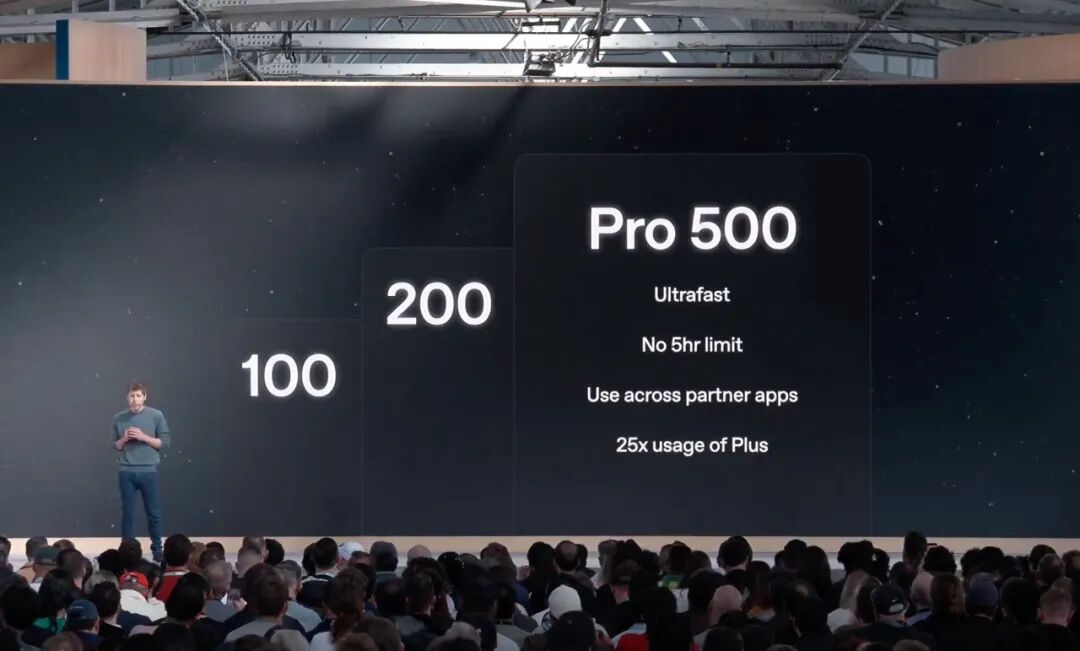
Monthly fees and usage are both 25 times that of Plus | Image Source: OpenAI
01 AI Starts Earning a Salary
As anticipated, OpenAI devoted the largest portion of the conference to dots, and the official Chinese page retained this English name.
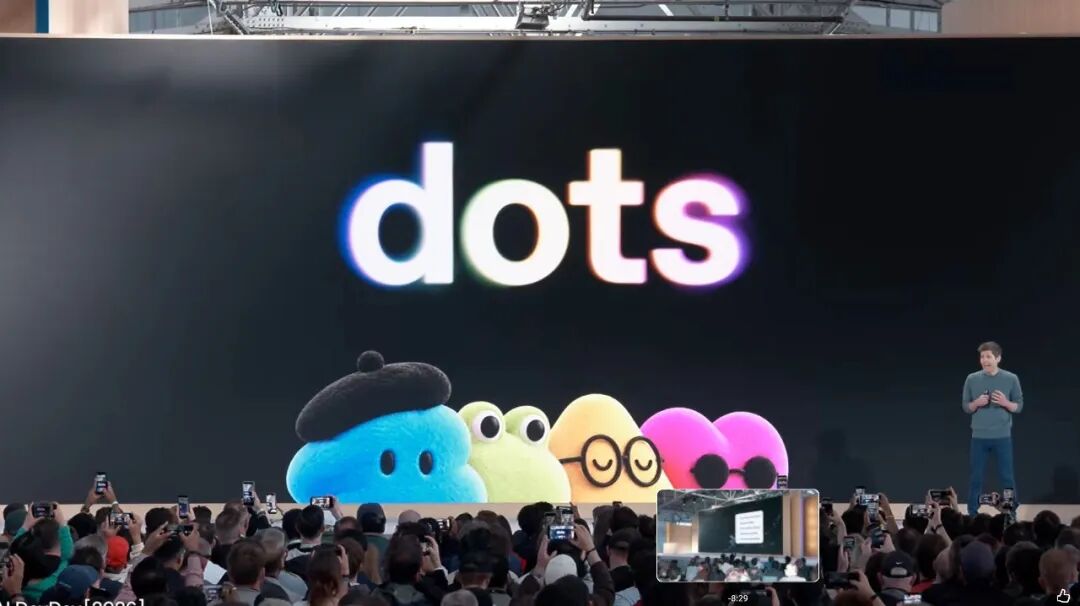
According to the official statement, each "dot" is powered by GPT-6 Astra, equipped with its own cloud computer and browser, capable of connecting to over 4,000 applications and operating around the clock.
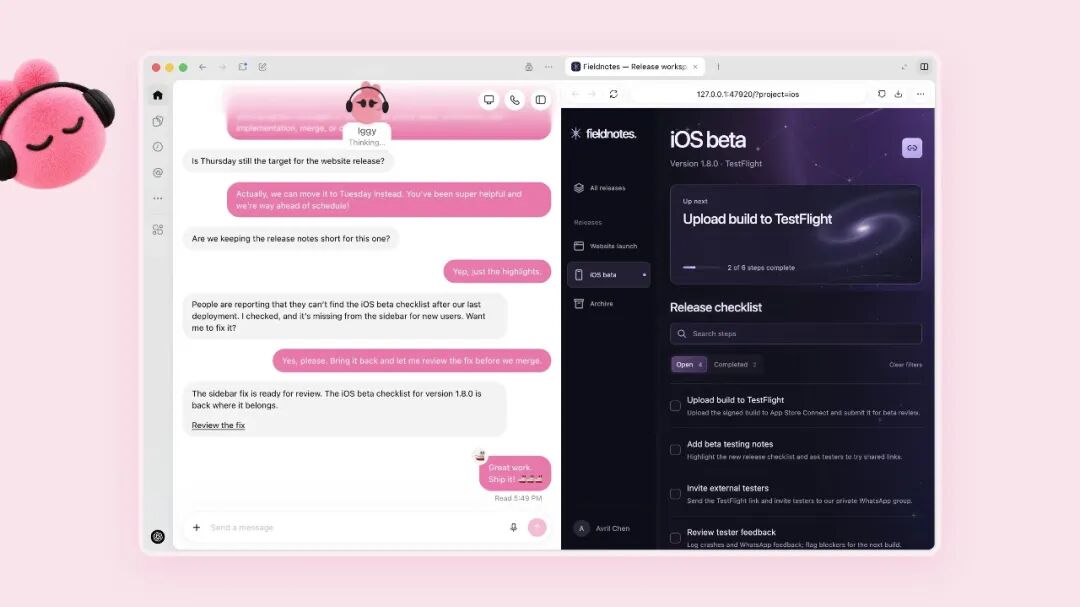
The usage is quite similar to assigning tasks. You give it a goal, define which operations it can take charge of, and it will proactively start working. It can reside in ChatGPT, Slack, and Teams, and OpenAI's product lead Tibo (Thibault Sottiaux) tweeted during the event that while it is working, you can even call it directly.
OpenAI describes it as "an intelligent agent capable of continuously taking on responsibilities," envisioning a future where multiple dots form teams to work collaboratively for you.
The phrase "taking on responsibilities" is very precisely chosen. Past AI assistants responded to your queries one at a time; the setting for dots is that they continue to work even when you are not present. This sounds more like a job description rather than a software manual.
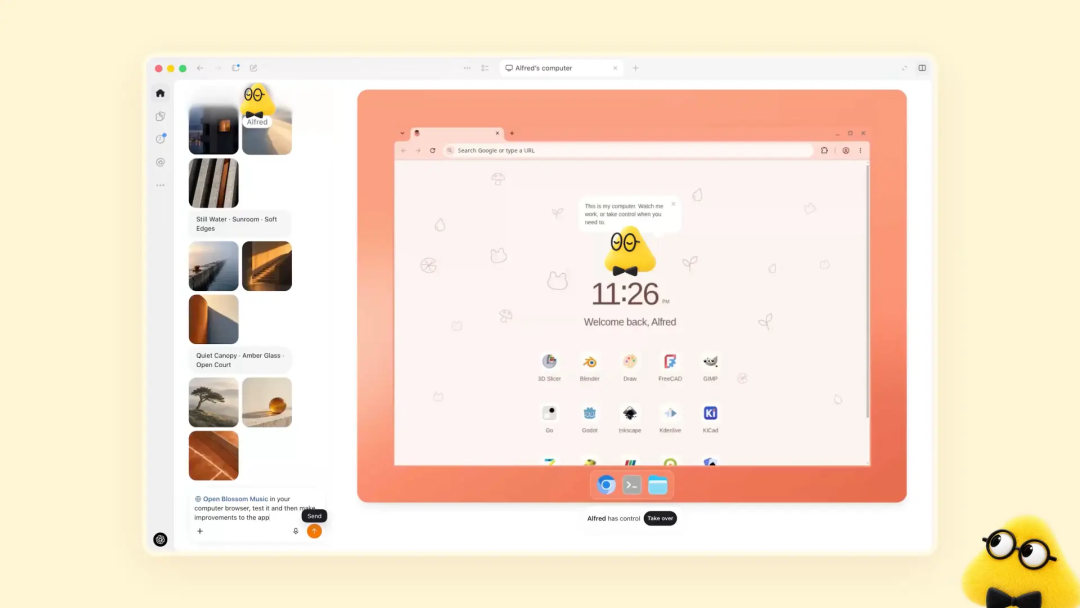
Dots are only available starting at $100 per month for Pro | Image Source: OpenAI
The threshold for using dots is not low. Only Pro packages among individual users can access it, and Tibo specifically noted that this includes the $100 per month Pro 100, while businesses have access to Business Premium.
The official statement says the first dot is included with the package at no extra charge, and chatting with it does not count towards usage. However, having it "work in ChatGPT" and in Codex will still deduct from your quota.
The question is, what is installed in this cloud computer? Tibo is very confident about the cloud; he tweeted during the event that once the new Codex cloud environment is set up, you will not be able to return to developing on a laptop.
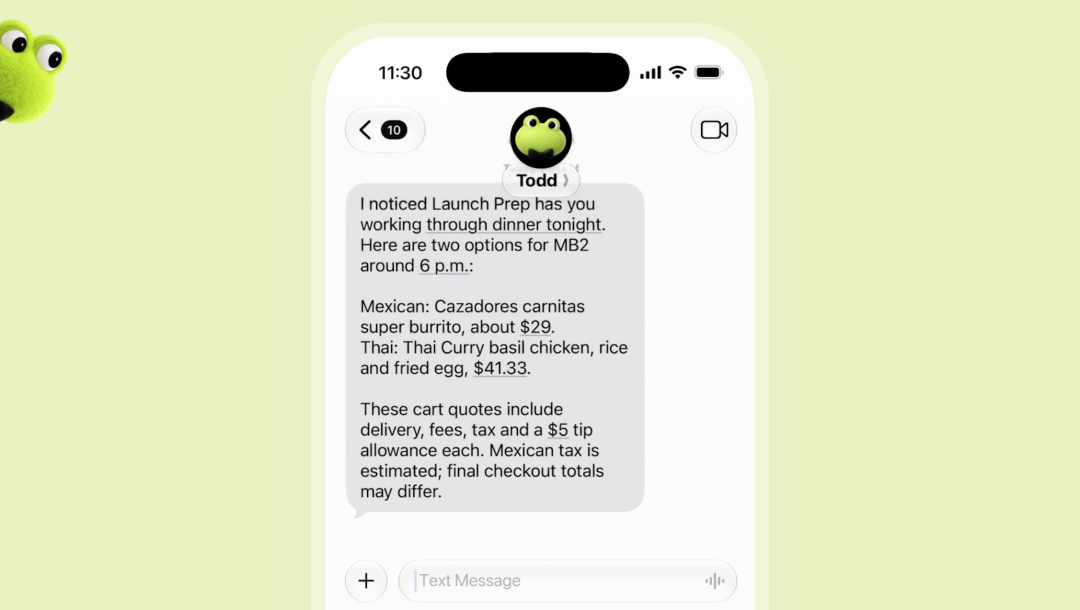
During a live viewing organized by Geek Park in Silicon Valley, a participant working in mathematics expressed that his code needs to call a commercially licensed mathematical optimization solver, which the local Codex can call, run, and test, but once migrated to the cloud, these tools and licenses may not follow. Should AI simply rewrite one? His judgment is that we are not yet at the level of mature tools.
He usually uses AI for specific research, not for booking tickets or reserving sports fields. During the viewing, some felt that personal assistants from various companies are starting to look increasingly similar. Just the day before, Manus released version 2.0, which also focuses on personal AI assistants and cloud computers. For these professional users, what is lacking is not a few more thousand application connections, but their own local environment.
Aside from dots, the tiered membership structure is the most drastic change this time and also the most criticized. About two hours before the conference began, Tibo tweeted that the new multipliers were explained quite straightforwardly: Plus counts as 1x, Pro 100 is 5x, Pro 200 is 10x. The old Pro 200 was 20x.

To add a bit of surprise, Tibo even prepared a physically meaningful "reset" button on site | Image Source: OpenAI
Converting the monthly fees into multipliers clarifies the situation. The monthly fee for Pro 100 is 5 times that of Plus, Pro 200 is 10 times, and Pro 500 is 25 times, matching their respective usage multipliers exactly. The old Pro 200 cost 10 times the price for 20 times the usage; this "wholesale price" is gone, with each tier now costing $20 for 1 unit of Plus usage.
The wording on the official help page is much more tactful: Pro 200 is reopening for new subscriptions at $200 per month, but the usage quota for new subscriptions is lower than before; eligible old subscribers can retain their old quota until October 29, after which it will also be reduced. Tibo calculated before the conference that the new Pro 200, when converted to API costs, is about half that of the old version.
The most concentrated dissatisfaction during the viewing also fell here. Some participants believed that the original package's usable quota has decreased, effectively amounting to a price increase, while they did not receive the new model they had anticipated; others said they most wanted a model with stronger mathematical and algorithmic capabilities, but this release leaned more towards consumer-oriented features.
The official reason given is that the models are becoming more efficient.
However, at the same conference, OpenAI released the only new model this time, GPT-6.1 Sol.
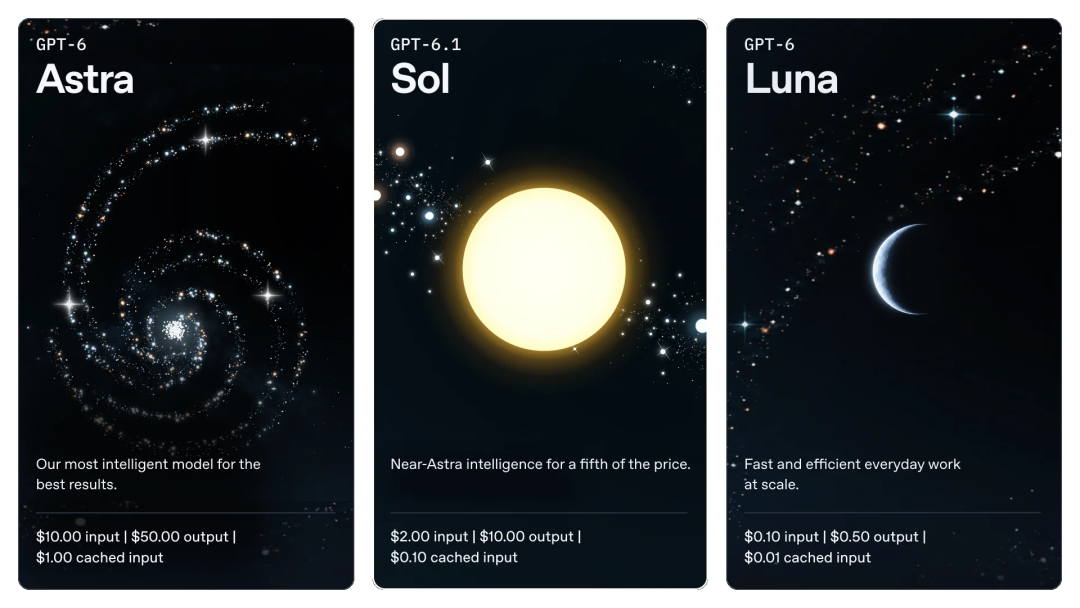
It is an upgraded version of Sol, and the official statement claims it has intelligence close to Astra, with API prices only one-fifth of Astra's. Tibo also mentioned that GPT-6 Sol and Luna have just dropped to half of their original prices.
Models are becoming cheaper, yet the usage provided to members has been cut in half.
Putting these two things together is not contradictory; the unit of pricing has simply changed. According to OpenAI's logic, as models become more efficient, each unit of quota can accomplish more work, so less quota can be given. What you are paying for is no longer how many conversations or tokens, but how much work is done.
This is the logic of calculating salaries for employees. The boss does not care how many times you hit the keyboard; they only care about how much work you deliver.
Speed is also starting to be priced separately. According to official data, Astra Ultrafast in Codex is up to 8 times the standard speed, processing 300 tokens per second, while in the API it is up to 6 times, and the API price is exactly 6 times the standard price. When included in ChatGPT membership, it consumes quota at a speed 8 times that of standard mode, and only Pro 500 and enterprise versions can use it. If you want AI to work faster, you have to pay an expedited fee like sending a package.
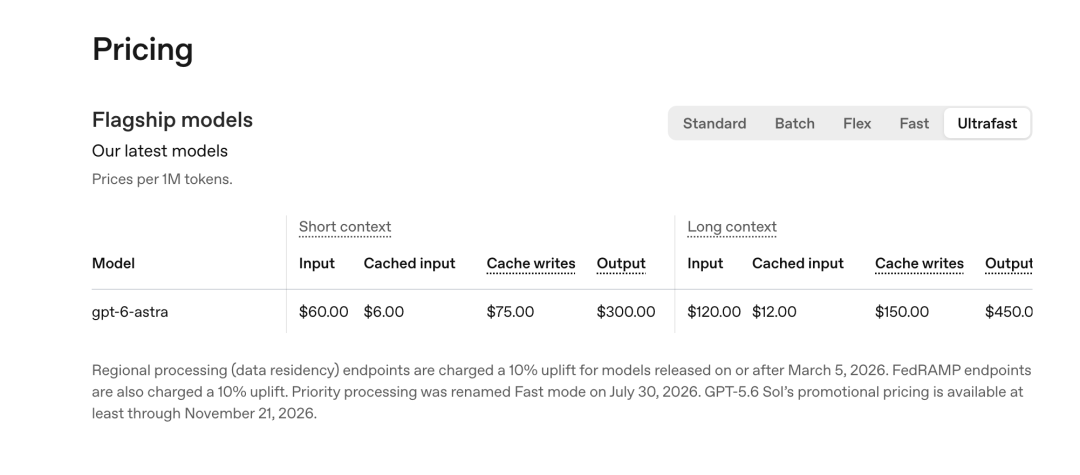
Every million output tokens, $50 becomes $300 | Image Source: OpenAI
This trend has actually been traceable in Silicon Valley: in May, Microsoft pressed the pause button on vibe coding, concluding that burning tokens had become more expensive than employing staff; in September, Silicon Valley reviewed employee AI bills, with the median reported monthly AI expenditure for Microsoft employees being $300.
At that time, companies were learning to account for AI expenses. Now it is OpenAI's turn to set prices for AI using the method of calculating wages, and the monthly fee for Pro 500 is already higher than the median on that chart.
What about the $20 monthly Plus and free users?
The heaviest items this time, dots, data spaces, dynamic pages, and Ultrafast, all start at Pro. GPT-6.1 Sol will gradually be available to Plus, but currently only in "ChatGPT work" and Codex; the official statement is that it "has not yet entered Chat." Most features marked "suitable for all packages" are developer-oriented functionalities like Codex command line, code review, and plugin extensions.
02 The Next WeChat
The other half of the conference announcements focused on transforming ChatGPT into a single entry point. OpenAI stated at the beginning of the summary page that it aims to "open ChatGPT as a shared platform for collaboration between humans and intelligent agents," allowing developers to directly offer native experiences to a combined total of 1.2 billion users.
Plugins are the gateway to this entry. Developers can create applications directly within ChatGPT: occupying a fixed entry in the sidebar, creating an interactive panel for simultaneous chatting and usage, or making a viewer for their own file formats. Accompanying this are plugin creation tools, redesigned submission processes, and new sorting methods; plugins can also automatically trigger a series of actions when something happens in connected applications.
When Tibo tweeted live, he added a more crucial line: ChatGPT will directly recommend relevant plugins during conversations.
This statement carries much more weight for developers than the plugin features themselves. Users do not need to search the store; plugins will be pushed in front of them while chatting, but who gets pushed and who does not is determined by ChatGPT. Developers have gained access to 1.2 billion users while simultaneously relinquishing sorting power.
Another feature called "Log in with ChatGPT" allows users to log into partner products using their ChatGPT account without needing to register again. The official Chinese page specifically states that partners will only receive the user's name, email, and avatar, and chat records and memories will not be shared. Plus and Pro users can also directly use their membership quotas in some partner products, which is currently in limited preview. The official English page lists 16 partners, including Devin, Notion, and Vercel.
In the context of the Chinese internet, this combination is quite familiar. Recommended plugins in conversations resemble mini-programs, logging in with ChatGPT is akin to WeChat login, and membership quotas are universally applicable across partner products, similar to a cross-application wallet.
This wallet layer is connected to the membership tiers mentioned earlier. According to the official English page, the OpenAI usage consumed in these partner products will count towards the user's own plan quota. In other words, the previously calculated usage of "20 dollars per share" can now be spent not only in ChatGPT but also in others' products.
On the enterprise side, there is an "OpenAI Software Marketplace": eligible enterprise customers can use their committed spending quotas to purchase software from the first batch of 32 partners, including Adobe, Figma, and Salesforce.
Work-related tools have also been integrated into ChatGPT this time. The data space replaces the original Library, allowing teams to work alongside ChatGPT and their own dots in the same space; dynamic pages are a new type of document, with the official statement being "Anything that can be done with ChatGPT can be completed on the page"; slides can be edited collaboratively and then exported as PowerPoint or Google Slides.
These features are also available only to Pro and enterprise plans. Enterprise users can @ChatGPT in Slack and Teams, and colleagues without ChatGPT licenses can join the same conversation.
As for Codex, in addition to the previously mentioned cloud version, the command line has also been updated, allowing task delegation via voice, and new versions of code review and code security scanning have been released.
The API has introduced the Decisions API powered by Luna, which Tibo said can make judgments within hundreds of milliseconds; the Agents API, which supports computer operations, is in preview, and Tibo mentioned that dots use the same set of technology. OpenAI has also collaborated with Amazon to integrate its agents into AWS's Bedrock.
Tibo's tweet from the event included a figure: the token traffic on the Responses API has increased 100 times compared to this time last year. He also admitted after the meeting that the live demonstration was affected due to all updates being launched simultaneously.
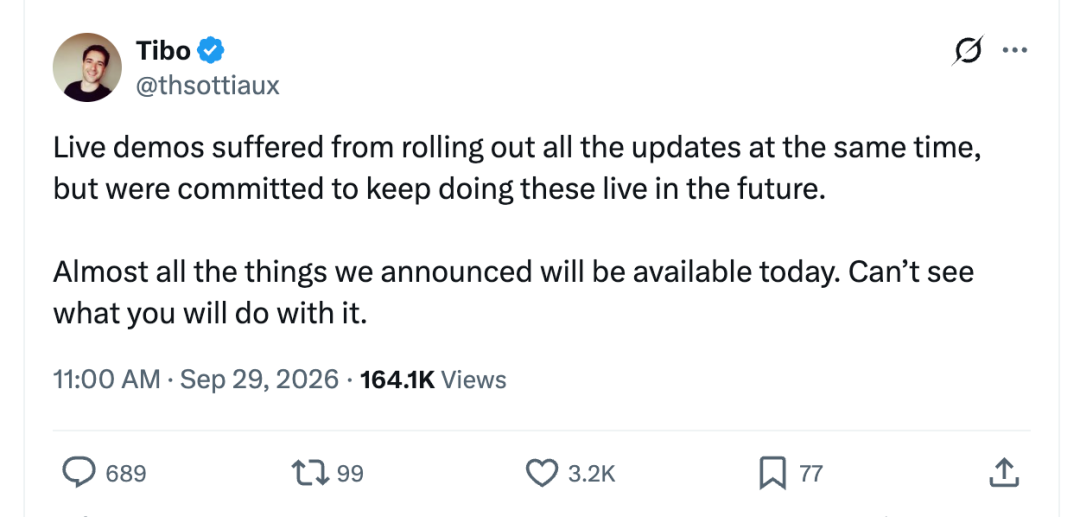
Tibo's conference summary page | Image source: X
Looking at the 25 releases laid out, OpenAI aims to make ChatGPT a workplace: a space for colleagues with their own computers to collaboratively edit documents, integrated into Slack and Teams channels, along with a pricing table based on workload and speed.
At that moment, no one in the audience applauded for Sam Altman: because the developers sitting in the audience are the first group who will have to pay according to this pricing table.
 *Header image source: OpenAI