2026 Q4 Popular Token Unlocks and Supply Changes
This review draws on a RootData sample of 1,537 project entries. Tokenomics changes are also moving in different directions
As Q4 2026 approaches, ALLO and HUMA are set for their first major unlocks of team and investor allocations in November. DBR and ZRO continue their quarterly and monthly releases, while ENA is bringing forward the remaining investor allocation into a single release on Oct 5, 2026. Story, now renamed DATA, and 0G have extended lockups on insider holdings. JUP has reduced net supply through burns, suspended emissions and buybacks. Drawing on RootData data and project announcements, this report reviews upcoming unlocks and changes to tokenomics over the past two years.
1. Upcoming Unlocks: Major Tokens
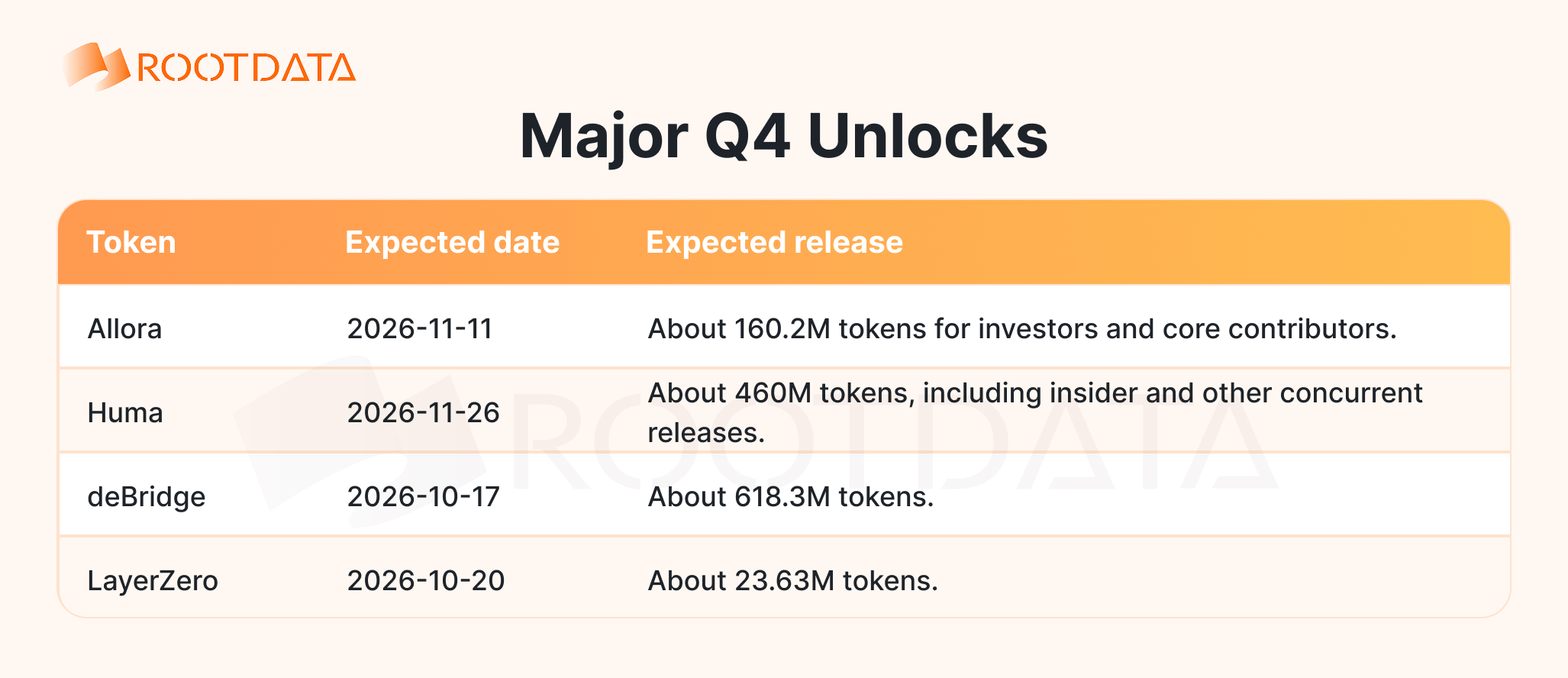
ALLO and HUMA face cliff unlocks: the first concentrated releases after a lockup period ends. DBR and ZRO release tokens on recurring schedules. The table below uses maximum supply as a consistent denominator; the project analyses also show each unlock as a share of circulating supply at the time of verification. As circulation changes, these ratios may differ on the unlock date.
Major Q4 Unlocks
Allora (ALLO): Around 160M Tokens in the First Insider Unlock
Allora is a decentralized AI network. Investors and core contributors were allocated 31.05% and 17.5% of total supply, respectively. After a one-year cliff, each group unlocks 33% of its allocation, or about 160.2 million tokens combined. Against the roughly 250 million circulating tokens reported by the unlock calendar, this is about 64% of the existing float. Including concurrent ecosystem and other releases, the calendar lists a total of about 163.9 million tokens.
These newly transferable tokens are mainly held by investors and core contributors, and their scale is large relative to the existing float. Allora has a mainnet and a funding track record, but the available material lacks a continuous record of paid demand and revenue. It is therefore difficult to quantify how much additional supply its business can absorb. Actual sales will also depend on holders’ decisions. Source: ALLO official tokenomics.
Huma (HUMA): Insider Unlocks Delayed by Six Months
Huma focuses on PayFi, providing financing and liquidity for real-world payments. The first unlocks for the team, advisers and major investors were postponed from 2026-05-26 to 2026-11-26. Together, these allocations represent 39.9% of total supply. Assuming equal releases over the following 12 quarters, the first insider tranche would be about 332.5 million tokens. Including other concurrent allocations, the calendar lists about 459 million–479 million tokens, or 4.59%–4.79% of the 10 billion maximum supply.
Huma’s business is built around real-world payments, and the six-month delay pushes back the circulation of insider holdings. Payment volume, however, cannot yet be directly translated into demand for HUMA. The value the token captures from business growth depends on its utility and value-distribution mechanisms. The change only covers certain insider allocations; ecosystem, treasury and other tokens continue to follow their own schedules. Source: HUMA tokenomics.
deBridge (DBR) and LayerZero (ZRO): Quarterly and Monthly Releases
DBR’s quarterly unlock is about 618.3 million tokens, equivalent to roughly 10.44% of the circulating supply reported by the calendar at the time. Similar quarterly tranches follow. deBridge facilitates cross-chain trades and asset transfers without requiring funds to remain in the protocol for long, so TVL, or total value locked, does not fully capture its business scale. The protocol already generates fees and conducts buybacks. Ongoing unlocks and buyback demand will both affect market supply and demand. Source: DBR official tokenomics.
ZRO’s monthly unlock is about 23.63 million tokens, or roughly 6.69% of the circulating supply reported at the time. LayerZero provides cross-chain messaging infrastructure. It has disclosed buybacks and renewed lockups for some investor allocations, as well as buybacks linked to Stargate revenue. The former delays when certain holdings can be sold; the latter adds buying demand. The available material does not establish how much of the monthly release is offset by buybacks. Source: ZRO official disclosure.
RootData’s front-end export contains 90 unique token samples. Of these, 87 have a valid “next unlock value ratio”; 16 are at or above 10%, representing about 18.4% of those valid observations. This field broadly corresponds to unlock value as a share of circulating market capitalization. It measures the scale of supply, not an expected price decline. The snapshot’s “next tranche” may also fall on a different date from the major insider unlock discussed here.
Sign in to unlock the full article
Sign in to unlock the complete research report and PDF download
This brief is a short-form research note intended to provide timely and concise observations on a specific issue, event, or subject. Coverage is limited and does not constitute comprehensive due diligence or a full investment research report. Views are based on publicly available information as of the publication date and may be revised as new information emerges; the authors are under no obligation to update this note. It does not constitute advice to buy, sell, hold, or dispose of any asset, and no warranty is given as to the ultimate correctness of the judgments expressed. Readers should weigh the inherent limitations of brief research, seek additional sources, make independent decisions, and bear their own risks. Full reproduction or selective quotation without permission is not allowed.