
The current stock price is $28, but it has been speculated on-chain to $132: How should the RWA pricing loophole be fixed?
Author: Krix, blocmates Contributor
Compiled by: Gu Yu, ChainCatcher
In late August, a group of traders attempted to short the low-priced stock HIMS.
The idea was simple. Pair a memecoin with tokenized stocks and buy as much as possible to "monopolize" the supply, driving up the price of HIMS.
Since this happened over the weekend, the price of HIMS in the pool briefly surged to $132.64, while the stock's closing price on Friday was $28.84.
What this group did not consider was that the on-chain supply of HIMS stock only accounted for a small fraction of the total circulating shares in the real world.
On Monday morning, the issuer of the stock minted new tokens and arbitraged the price difference between the real price and the on-chain price, bringing HIMS back to parity.
The moral of this story is not about trying to short a stock listed on NASDAQ.
Instead, it reveals that most tokenized stocks today are traded through the same type of AMM that has been used in DeFi for years, with asset prices derived from the ratio of two tokens in the pool.
This effectively decouples the prices of real-world assets, allowing their tokenized versions to exist in a parallel universe.
However, if HIMS stock were in an active pool on Metric, this situation would not have been possible from the start.
What is Metric?
Metric is a decentralized exchange that introduces the concept of active pools, separating pricing from liquidity into two components.
The design of active pools aims to address the discrepancies between the prices of real-world assets and their tokenized counterparts in DeFi pools, which are driven by trading activity.
But if oracle networks already exist, why is this still the case? Shouldn't they serve as a bridge connecting DeFi with the rest of the world? This only exists on paper.
In v2 pools, quotes come from their own inventory; while in v3 and v4, quotes come from stored ticks and the liquidity available within that tick range.
In any case, the issue is that unless someone acts on this and arbitrages the price difference, the quotes will not move.
In contrast, regardless of whether arbitrageurs enter the market, Metric's active pools can use oracle data sources or custom logic to accurately price tokenized stocks, foreign exchange, gold, and mainstream crypto assets.
How Active Pools Work
Unlike conventional AMMs, active pools separate price from pool inventory. Since price accuracy is a key breakthrough, let's address that first.
Price Provider
The asset prices within the pool come from an on-chain smart contract called Price Provider, which returns quotes containing buy price, sell price, and reference price.
The Price Provider contract can determine prices from various sources, most notably oracle networks like Chainlink or Pyth, to accurately track off-chain asset prices.
The contract can also use advanced logic, such as the midpoint from another DEX, TWAP, exchange rates from staking or treasury, custom models for options, prediction markets, or synthetic assets, as well as trading strategies like grid, limit, deep OTC, or volatility-adjusted orders.
Regardless of the logic, the pool does not form its own price opinion; instead, this responsibility is transferred to the Price Provider contract.
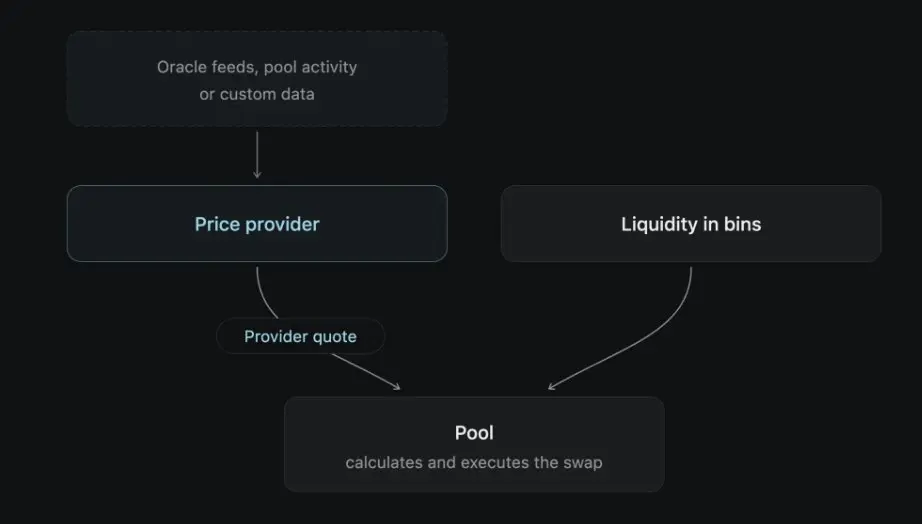
But without liquidity willing to be injected into the pool, accurate prices are of no use to us. This is where the liquidity bin comes into play.
Liquidity Bin
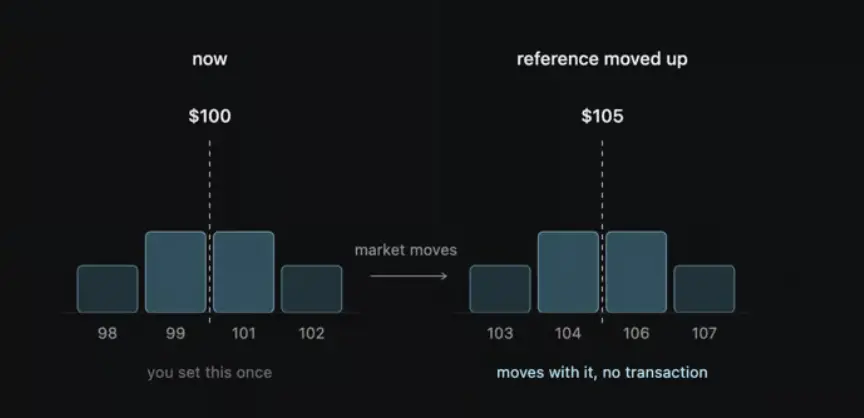
On Metric, liquidity tracks the reference price from the aforementioned Price Provider contract and is located within a liquidity bin around that price. Each bin represents a price range (deviation) relative to the pool's reference price, expressed as a percentage.
Assuming the trading price of ETH is $2,000, and you are willing to sell 2% above the real price and buy 2% below it, this effectively means you set the sell price at $2,040 and the buy price at $1,960.
Overnight, a once-in-a-century price fluctuation occurs, and ETH rises to $3,000. In a traditional concentrated liquidity pool, you would be caught off guard.
But on Metric, your liquidity moves with the price, and the same rules still apply: 2% on both sides means your sell price is now $3,060, and your buy price is $2,940.
In simple terms, whenever the price changes, the bin also moves, even if there is no trading activity in a particular pool.
Conclusion
Since I started with HIMS stock as an example, I would like to conclude with it as well.
Imagine a person reading the latest news column, seeing a mention of how finasteride and minoxidil are effective for hair loss, sponsored by the men's health company HIMS.
After briefly browsing their website and completing a quiz, this person is convinced by the idea and likes what the company is doing. He decides to buy the dip.
For reasons directly related to his hair loss, this person has a bit of knowledge about cryptocurrency and tokenized stocks, so he decides to open his Robinhood wallet to purchase the stock.
He clicks on the HIMS token, enters the amount, and clicks exchange; only to find that the returned quote is not the price he saw five minutes ago on the stock ticker. It is slightly lower. Not drastically, but enough to notice.
For traders without considerable scale (capital), this price difference is not something he would particularly pay attention to, but it is precisely this difference that makes life hell for LPs providing liquidity in DeFi pools, as they need to constantly rebalance while arbitrageurs are eating their lunch.
However, if the HIMS token were in an active pool, and the Price Feed was set to follow the actual price of the stock in the real world, all participants would be much more satisfied with the outcome:
As an LP, the main benefit of providing liquidity to an active pool is that your position remains within the range, while the earnings stay in the bins and compound into your position.
Since you do not need to withdraw or re-enter, you can also avoid the gas costs incurred from withdrawal and deposit transactions. It does not protect LPs from asset declines, nor does it prevent seasoned traders from entering and trading with you when the pool's reference price fails to update in a timely manner, as well as other risks listed here.
Meanwhile, traders can enjoy accurate pricing of assets without paying trading fees or front-end costs, only paying the spread between the reference price and buy/sell price, from which Metric takes a small portion.
Although Metric cannot completely eliminate risks, it provides a key building block for the future we are moving towards: tokenized RWA becoming legitimate tools that people can trade reliably, without worrying about a few degens gambling on liquidity-thin pools over the weekend.