
"Stop holding onto false hopes, technology stock investors," JPMorgan advised against technology stocks: "There are still many people who haven't sold."
Author: Gao Zhimou, Wall Street Journal
As the technology sector of the U.S. stock market recorded its largest weekly decline since March 2020, John Schlegel from JPMorgan's position intelligence team paraphrased a famous line from Dante's "Divine Comedy" in the latest weekly report: "Those who trade tech stocks, abandon all hope."
Recent data from JPMorgan and Goldman Sachs shows that despite significant reductions in positions by hedge funds, long-term asset management institutions and retail investors holding large stakes have not exited the market on a large scale.
In the past week, the S&P 500 index fell for seven consecutive days, closing at 6,910 points on Friday, below the 7,000-point mark; the Nasdaq 100 index plummeted by 10.4%, and the Philadelphia Semiconductor Index (SOX) dropped by 17%. The sell-off also affected commodities and cryptocurrencies, with gold falling 9.5% over the week, Bitcoin down 14.2%, and copper prices dropping over 9%.
Both investment banks warned that a reduction in positions by hedge funds alone is insufficient to confirm a market bottom; JPMorgan further pointed out that the current market is increasingly resembling the trends of the fourth quarter of 2018.
Hedge Funds Experience Worst Week Since Last April, Net Leverage Hits Bottom, Short Positions Surge
Fast money is under pressure first.
JPMorgan estimated that hedge funds fell another 1.5% on Friday alone, with a drop of over 3% in the last five trading days, and a cumulative decline of about 4% since November, marking the worst five-day performance since the "Liberation Day" crash on April 7, 2025. Their 5-day and 63-day returns are both more than 3 standard deviations below the mean. Unlike October, this round of losses primarily stems from an overall market decline (Beta), while stock selection (Alpha) has not significantly failed.
Kartik Singhal from Goldman Sachs' prime brokerage trading desk provided similar statistics in a report on Friday evening: fundamental long-short strategy funds fell 1.2% that day, with about three-quarters reporting losses. U.S. and European stock funds fell 1.6% and 1.3%, respectively, but stock selection Alpha was actually +0.3%. Including Friday's decline, stock selection funds have cumulatively dropped about 2.8% over the past six trading days, only bearing one-third of the S&P's approximately 9% decline during the same period.
Low exposure has become the only cushion at present. The S&P 500 index was still up about 12% year-to-date (including dividends) on November 12, but by this Friday, it was down to only 0.9%, while the Nasdaq 100 index had turned down 0.9%; meanwhile, Goldman Sachs' tracked global stock selection funds are still up 7.0% year-to-date, with quantitative funds recording a 17.7% increase.
While net leverage hits bottom, total leverage is climbing. As of Thursday's close, the global fundamental long-short net leverage on Goldman Sachs' prime brokerage book fell to 42.3%, a five-year low; adjusted for Beta, it is 48.2%, down 36 percentage points from the 12-month high of 84.6%; the overall long-short ratio of 1.57 is also at a five-year low. However, total leverage rose by 3.8 percentage points to 315.9%, reaching the 98th percentile of the past five years.
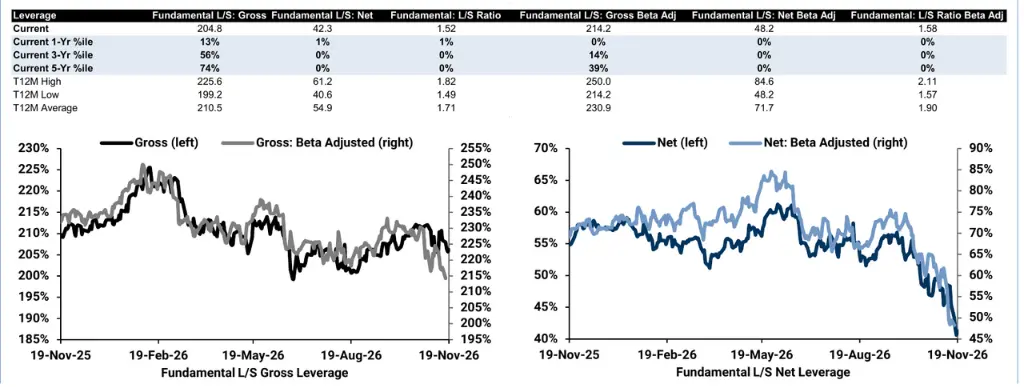
JPMorgan also monitored a rebound in total capital flows from low levels. With net exposure hitting bottom and total positions increasing, there is only one answer: hedge funds are aggressively increasing short positions. Goldman Sachs' derivatives team pointed out that hedge funds have sold tech stocks at the fastest recorded pace over the past six weeks, with selling intensity exceeding 4 standard deviations, and the global tech stock long-short ratio has dropped to its lowest level since at least 2017.
Why is the Rebound Missing? Long-term Capital and Retail Investors are Still in the Market
Based on past experience, when fast money sells to this extent, a rebound should have already occurred.
Morgan Stanley estimated that after net leverage drops to the current low level, the S&P 500 index typically rises by an average of 6.3% over the next three months; JPMorgan's equity strategists suggested bottom-fishing just 11 days ago, Goldman Sachs' macro traders bet on a year-end short squeeze, and Morgan Stanley's Mike Wilson originally only saw a pullback to 7,100 points. Instead, the S&P directly fell below 7,000 points.
Charlie McElligott from Nomura Securities analyzed on Thursday: when all quantitative machines are ready to buy, yet the stock market still fails to rise, it may indicate a misreading of position indicators.
The issue is that hedge funds are just one seat at the table.
As of Thursday, JPMorgan's U.S. Tactical Position Monitoring Indicator (US TPM) showed a four-week change of only -1 standard deviation, not yet reaching the -1.5 standard deviation threshold for a complete clearing. Although overall positions have dropped to the 13th percentile since 2015, CTAs (Commodity Trading Advisors) have not reduced risk to extremes, and asset management institutions are still maintaining futures exposure.
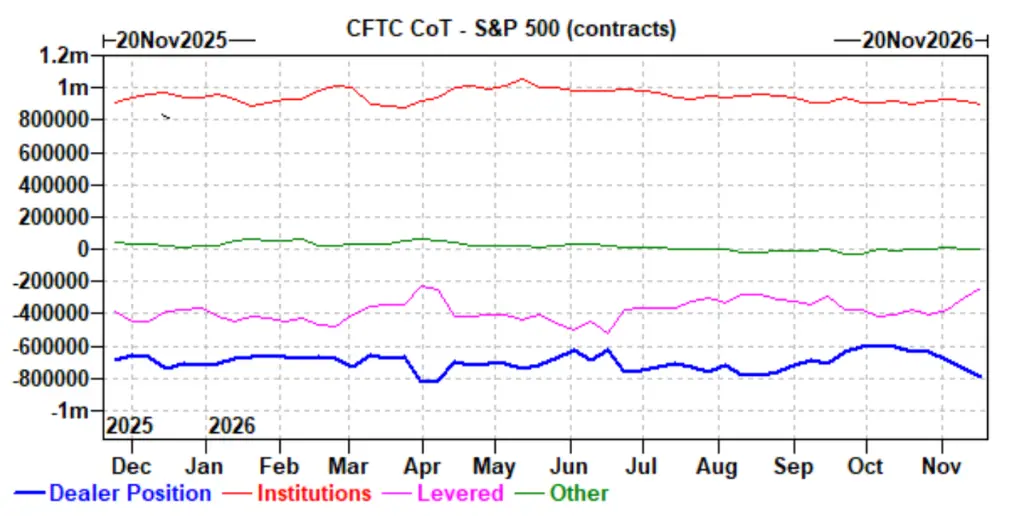
Goldman Sachs' derivatives and futures trading desk cited data from the CFTC (Commodity Futures Trading Commission), more plainly exposing this disconnect: on Nasdaq 100 futures, CTAs have turned into net short positions of $3.6 billion, nearing a decade low; however, non-dealer positions remain net long at $53 billion, far above the ten-year average of $6.5 billion, and close to the peak of $61 billion.

The same is true for S&P 500 futures. Institutions have maintained about 900,000 contracts of net long positions throughout the year, with little change in November; the only significant activity has been from leveraged funds, which covered 68,000 short positions (about $25 billion) between November 10 and 19.
The leading decline in chip stocks and the flow of equity funds further confirm that "slow money hasn't sold." The semiconductor sector has plummeted 33% since early October, and although it has seen the largest net selling in the U.S. stock market over the past two months, JPMorgan's data shows that its positions have only returned to the 63rd percentile since 2018 (near the long-term average), with a clear answer of "no" to the question of whether the sell-off has ended. Goldman Sachs' spot trading desk noted that pure long-only institutions have only recently begun to place sell orders on chip stocks, with buying frozen, and the Nasdaq VIX has risen to its highest level since the pandemic.
Retail investors off-market are still buying against the trend. Lipper data shows that last week, equity funds had a net inflow of $59 billion, the highest since June; data cited by Bank of America from EPFR shows a cumulative inflow of a record $310 billion over the past four weeks. Bank of America's latest survey also indicates that fund managers are selling tech stocks at the fastest pace since 2006.

Funds Concentrate in Defensive Sectors, Wall Street Closely Watches "2018 Script"
Funds exiting tech stocks are rapidly flowing into defensive sectors.
JPMorgan's data shows that last week, net buying in the U.S. stock market concentrated in utilities, telecommunications, pharmaceuticals, food and beverage, tobacco, and real estate, with positions in consumer staples distribution and retail reaching historical highs. However, when a safe haven becomes crowded, it can easily fail; Goldman Sachs' volatility trading desk has advised clients to hedge the consumer staples sector, as the options skew for this sector has dropped to the 3rd percentile of the past 20 years.
Globally, JPMorgan's monitored regional positions have all fallen below the 20th percentile, with the overall global position around the 10th percentile (-1.5 standard deviations, matching the low since 2022). Japan, China, Hong Kong, and Europe are all at low levels, but Schlegel reminds us that the current drawdown is still relatively shallow.
Goldman Sachs' fear index has surged to 9.8 (out of a maximum of 10), and with this week's shortened trading days due to holidays, a technical rebound could occur at any time. However, the marginal selling pressure determining the mid-term direction has changed hands—no longer from hedge funds that have already reduced positions, but from pure longs that have just placed sell orders in chip stocks, asset management institutions that are holding steady, and retail investors who were still throwing money at the bottom last week.
John Schlegel pointed out that the fourth-quarter sell-off has nearly erased this year's gains, and the "2018 analogy" is becoming a focus on Wall Street: in that year, the S&P 500 index briefly rebounded at the end of November before facing a more severe sell-off in December. The difference is that the 2018 bottom was ultimately reached through a combination of market capitulation and a shift from the Federal Reserve, while the Fed is still raising interest rates now. Goldman Sachs believes that only a continued decline in the stock market could force the Fed to halt its actions. As for whether Friday triggered a broader capitulation sell-off, it remains to be verified by subsequent position data.