
The script at the end of 2018: The Federal Reserve continued to raise interest rates, and the U.S. stock market plummeted 20% from the September high, forcing the Federal Reserve to "pivot" in January
U.S. stocks continue to decline, financial conditions are tightening sharply, and the market is showing dangerous signals similar to those at the end of 2018: the Federal Reserve still faces expectations of continued interest rate hikes amid accumulating market pressure, and investors are beginning to worry whether monetary policy will once again exacerbate market turmoil.
According to Goldman Sachs trading chief Rich Privorotsky's report on Friday, the current market bears a striking resemblance to the end of 2018. He characterized the recent sell-off as a "comprehensive liquidation" rather than a typical sector rotation and warned that the market may be shifting from a decline in risk appetite to a deeper liquidity contraction.
At that time, the Federal Reserve raised interest rates four times in 2018, and the S&P 500 index fell 19.8% from its September peak to its December 24 low, nearing a technical bear market. As market pressures continued to escalate, the Federal Reserve ultimately signaled a pause in rate hikes in January 2019, marking a shift in policy stance.
Now, Privorotsky is particularly focused on the movement of gold. Stocks and gold have been sold off in tandem, and traditional safe-haven assets have failed to provide protection. In his view, gold may be the best indicator for assessing the depth of the current liquidity crisis, and its movement may reveal whether market pressures are worsening further.
Lessons from the End of 2018: Continuous Rate Hikes Ultimately Forced the Fed to Pivot
In 2018, the Federal Reserve raised interest rates four times throughout the year. On September 20, the S&P 500 index reached a peak, but as global economic growth slowed, trade tensions intensified, and monetary policy continued to tighten, market pressures accumulated.
In December, the Federal Reserve raised interest rates again, increasing the target range for the federal funds rate to 2.25%—2.50%. However, concerns about the economic outlook and monetary policy continued to heat up, and the S&P 500 fell nearly 20% from its September peak to its December 24 low.
The market sell-off ultimately prompted the Federal Reserve to adjust its policy stance. On January 30, 2019, the Federal Reserve stated that it would be patient in adjusting interest rates in the future, sending a clear signal to pause rate hikes, after which the market rebounded.
Privorotsky believes that the current market is similarly facing dual pressures of tightening financial conditions and a constrained growth outlook, with the contradiction between policy and the market deepening.
Financial Conditions Tighten Abruptly, Market Shifts from Rotation to Comprehensive Sell-off
Privorotsky points out that the most noticeable change in the current market is that the sell-off has spread from specific sectors to the entire market. On Thursday, the S&P 500 briefly rose over 1% during the day but ultimately closed down 2%, marking six consecutive days of decline and falling below the 200-day moving average once again. All 11 sectors closed down that day, with traditional defensive sectors such as utilities and consumer staples also not spared.
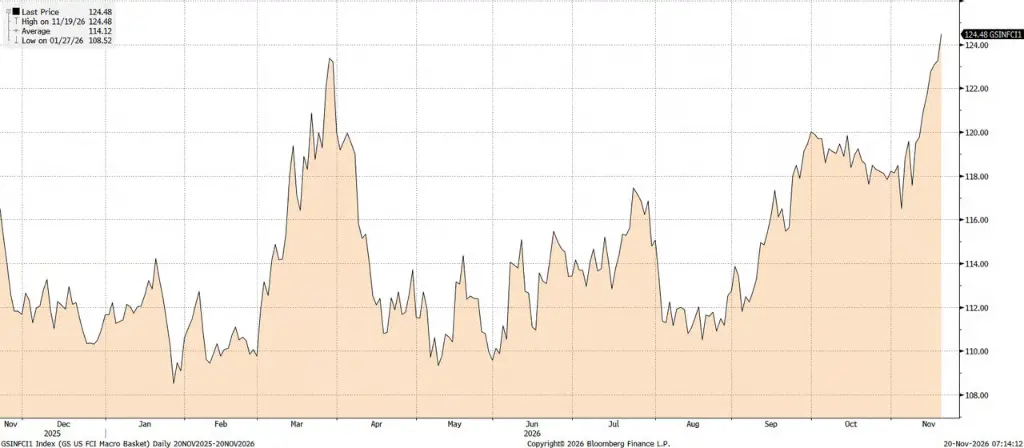
Meanwhile, Goldman Sachs' U.S. Financial Conditions Index (FCI) macro basket rose to 124.48 on Thursday, reaching its highest level in the past year. Since early November, the index has risen about 8 points in roughly two weeks, indicating that financial conditions are tightening rapidly.
Currently, Federal Reserve officials are continuously sending hawkish signals, with Governor Waller's comments about a 50 basis point rate hike and support for continued rate hikes in the meeting minutes further exacerbating market concerns. Rising capital costs are also putting pressure on the return expectations for AI infrastructure investments.
Privorotsky believes that the market's technical picture has been severely damaged, and the negative gamma effect in the options market is amplifying the downward trend. The previous sector rotation is evolving into a broader stock liquidation.
Gold Becomes the Best Indicator of the Liquidity Crisis
Among all assets, Privorotsky is particularly focused on gold. He believes that gold is the most valuable synchronous indicator for observing the current market liquidity situation.
Typically, gold is viewed as a safe-haven asset, but this time it has fallen in tandem with stocks. Gold prices have dropped below $3,600, and copper prices have also seen a significant decline of about 5% in a single day.
This cross-asset synchronous decline signals something different from a typical market adjustment: investors are no longer just shifting from stocks to safe-haven assets like gold, but are selling off different categories of assets to obtain cash. The market may be facing a broader liquidity contraction.
ANZ points out that speculative long positions in gold still have about 200 tons of potential liquidation space, indicating that deleveraging pressures may not have been fully released.
At the same time, long-term government bond yields are declining, and inflation breakeven rates are contracting, yet stocks and gold are being sold off in tandem. Privorotsky believes this combination indicates that the market's focus is shifting from inflation to growth and liquidity issues, and the bond market may have already begun to price in policy missteps.
Therefore, whether gold can stabilize and stop falling will be an important observation window for assessing whether market liquidity pressures are easing. 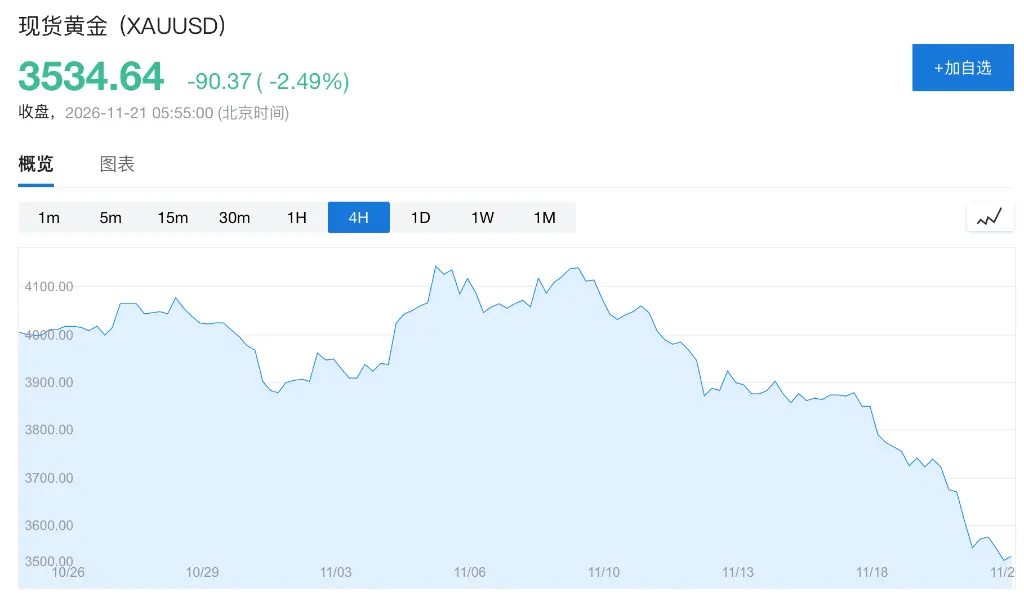
When Will the Market See a Policy Shift?
Privorotsky believes that the current pessimism and the scale of unilateral deleveraging suggest that the market may be approaching a tactical low point. Given that fund positions are already significantly underweight, once a rebound catalyst appears, the market's rebound could be quite substantial.
However, the real turning point still depends on whether policy expectations change. He continues to favor going long on short-term government bonds, believing that this trade is clearly misaligned with the risk signals reflected in the stock market.
In the near term, the market will focus on PCE data, the non-farm payroll report, and the December FOMC meeting. Privorotsky believes that the data that could truly force the Federal Reserve to reassess its policy path is the November CPI data, but that data is still some time away.
It is worth noting that Goldman Sachs economists currently still expect the Federal Reserve to raise rates by 25 basis points in December and to raise rates again in March 2027, while there is a significant divergence between bond market pricing and this forecast.