
Musk's Shenzhen Dialogue: Optimus will learn to wash dishes in a year and a half, Jensen Huang is a "Jordan-level" founder
Elon Musk. Image generated by AI
Text by|Joanne
Editor|Xu Qingyang
On November 19, Beijing time, Elon Musk, who was in Shenzhen, China, shared his impressions of China. He praised the scale of the city of Shenzhen, its level of modernization, and the vitality of its technology industry, suggesting that outsiders come to China to see for themselves, expressing his respect for China.
When discussing Sino-U.S. relations, he stated that maintaining a good relationship and achieving positive progress in economic and trade consultations benefits both countries and the entire world.
Musk's visit to China coincided with the APEC series of meetings held in Shenzhen. The public generally associates Musk's trip with the APEC Business Leaders Summit, and the progress of Tesla's FSD in China has also become a focus of attention.
During his visit to China, Musk participated remotely in the TomorrowX Summit held in Austin, Texas, where he engaged in a dialogue with Gavin Baker, founder of Atreides, and Antonio Gracias, founder of Valor Equity Partners.
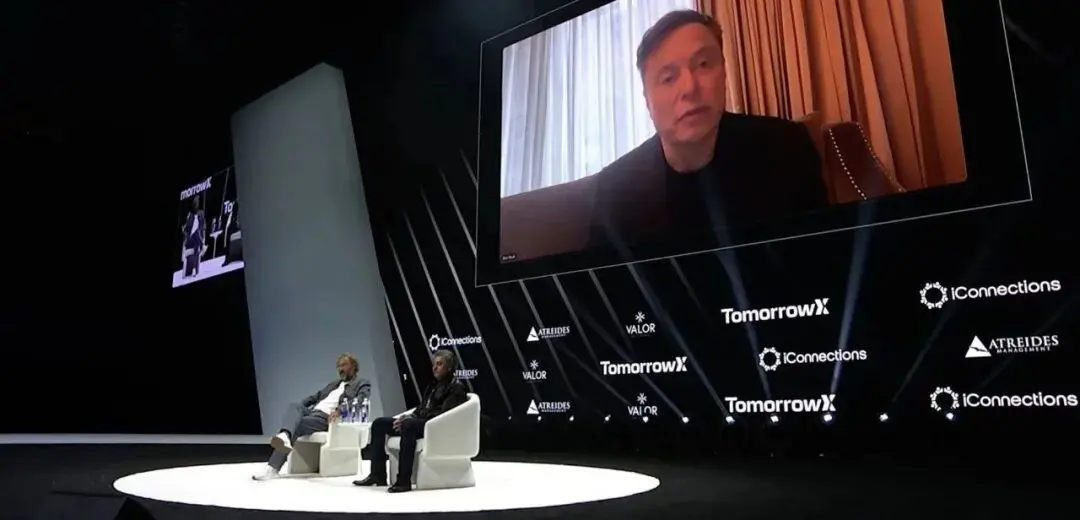
The three have known each other for many years, and their conversation covered topics including the latest developments in SpaceX, xAI, and Tesla, as well as fields such as artificial intelligence, robotics, chips, and brain-machine interfaces. Musk also took this opportunity to disclose the technological progress and product plans of several of his companies.
In the aerospace field, Musk discussed the progress of the Starship's first successful recovery of the upper stage spacecraft, stating that this signifies a key breakthrough in the goal of fully reusable rockets. He believes that Starship is expected to reduce the cost of getting into orbit by about 100 times, providing conditions for the construction of bases on the Moon and Mars.
In the field of artificial intelligence, he revealed that xAI is reallocating core engineering personnel from Starlink to rewrite the training software stack from scratch using C/C++. The upcoming Grok 4.8 will not prioritize boosting benchmark test scores but will focus more on the ability to solve real-world problems.
Robotics and autonomous driving were also important topics of discussion. Musk stated that Optimus is currently tackling the technical challenge of fine motor control, which may first be applied in industrial scenarios such as mining and smelting. He expects that within the next 12 to 18 months, robots will be capable of performing complex household tasks such as washing dishes and taking out the trash.
Regarding Cybercab, he mentioned that this driverless taxi without a steering wheel has already been put into operation in Austin, with plans to gradually expand its service area.
In terms of chip and computing infrastructure, Musk anticipates that the super chip factory Terafab will achieve phase one mass production by the end of 2028. He also introduced SpaceX and xAI's approach to data center construction: having internal engineering teams directly involved in construction to shorten the construction cycle and control costs. Additionally, he proposed the idea of using space solar power to build the in-orbit computing satellite Star Mind, believing that its technical complexity may be lower than that of Starlink V3.
Musk also discussed Neuralink's clinical progress. He stated that over 30 paralyzed participants have been able to control robotic arms through brain-machine interfaces to eat independently, and the company is advancing the Blindsight project to help the completely blind regain vision.
On the issue of AI safety, he reiterated that models should strive for truth as much as possible and should not deviate from facts to cater to users. When discussing NVIDIA, he compared Jensen Huang to Michael Jordan at his peak, expressing that it is a pity for NVIDIA to lose such a leader during its winning streak.
Throughout the conversation, Musk repeatedly emphasized how to solve problems from the perspective of engineering and technology itself. From the recovery of Starship, the rewriting of AI training software stacks, to data center construction and the practical application of humanoid robots, he focused on specific technical bottlenecks, costs, and timelines for implementation. Rather than a vision of the future, it was more of a concentrated review of the technological progress and development plans of his various companies. He provided his judgments on the public's concerns regarding artificial intelligence, robotics, and space computing, revealing many ongoing projects.
The following is a condensed version of the interview content:
01 Starship Reusability and Deep Space Vision
Question: "Starship" (Starship) successfully recovered the upper stage spacecraft (Ship 42) for the 15th time. What does this mean for fully reusable rockets and the aerospace industry?
Musk: This successful capture and recovery of the spacecraft is an extremely grand milestone, perhaps only those who have closely followed SpaceX's development can truly appreciate the significance of this achievement. Previously, we had successfully captured and recovered rocket boosters three times using the mechanical arm of the launch tower, even completing booster re-flights and subsequent captures.
But this is our first successful capture and recovery of the upper stage spacecraft, proving that all components of "Starship" can fly into space and return intact, requiring very little maintenance for another flight. To honor this historically significant spacecraft, we plan to retire it from further flights and keep it for public display.
Before this, humanity had never created a truly fully reusable orbital upper stage spacecraft, let alone one that could land vertically using propulsion and be precisely caught in mid-air by a massive "chopstick" mechanical arm.
This sounds like something out of a fanciful science fiction novel, but we did it. From a practical economic perspective, complete and rapid reusability can reduce the cost of human access to space by 100 times and achieve an orbital carrying capacity of millions of tons per year.
Question: Why reduce the cost of access to space by a hundred or even a thousand times? What are the deeper motivations for building cities on the Moon and Mars?
Musk: To establish a city on the Moon or Mars, massive amounts of materials must be transported there because you need to rebuild a complete industrial system from scratch locally. Just like the classic "pencil manufacturing" case in economics, even a smartphone or a pencil relies on a vast industrial foundation from mining, multi-stage refining, manufacturing basic parts, to assembling complex components.
The Moon and Mars must achieve industrial self-sufficiency, which is crucial for the long-term continuation of human consciousness. Even if Earth faces natural disasters or man-made catastrophes in the future, human civilization and consciousness can still survive. I call this "backing up the biosphere" or "buying life insurance for all humanity."
At the same time, this is also the first critical stepping stone for humanity to move toward a true interstellar civilization. At that point, space travel will no longer be the privilege of a few government astronauts; any ordinary person who wishes to can travel to the Moon, Mars, or any corner of the solar system. Once we become a multi-planetary civilization, it will drive the development of more advanced spacecraft, leading us out of the solar system to explore the galaxy, and perhaps encounter extraterrestrial civilizations or ancient extraterrestrial relics that have existed for millions of years.
If we count from the Sumerians inventing cuneiform writing, human civilization has only a history of a little over five thousand years, which is just a fleeting spark on a cosmic scale. A self-respecting civilization cannot be content with being a mediocre "single-planet civilization"; we must become a multi-planetary and even multi-stellar civilization.
Overall, the motivations driving me forward can be divided into two categories: one is "defensive motivation," which is to ensure that human consciousness does not go extinct in the event of a disaster on Earth; the other is "prospective motivation," which is excitement and longing for the future. Life cannot be just about solving one painful reality after another; it must also have a vision that excites people and makes them wake up every morning with anticipation. Becoming an interstellar civilization is such a great cause that makes one grateful to be alive in this era.
Question: After a long journey of 25 years and countless failures, achieving the milestone of fully reusable rockets in the aerospace field, what are your thoughts?
Musk: It feels amazing. You can see from the emotional reactions of the SpaceX team at that moment that everyone internally understands the fundamental and far-reaching significance of this breakthrough. "Starship" will become the first fully reusable orbital space system in human history, which has been a dream milestone for the rocket engineering community since its inception.
Previous space shuttles, although claimed to be partially reusable, would discard the massive orange external tank, which serves as the main load-bearing structure, with each launch; and technically recoverable orbiters required about nine months of tedious disassembly and refurbishment after each flight, essentially rebuilding a large number of components.
In contrast, the design intent of "Starship" is to achieve complete and immediate reusability, just like a commercial airliner. Once the booster lands, another spacecraft can be hoisted up for another launch immediately. If we do not reduce the cost of space travel by 100 to 1000 times based on the current foundation, it would be economically impossible to build cities on the Moon and Mars, even if we poured all of the U.S. government's budget into it.
02 Rewriting the AI Foundation
Question: xAI recently rewrote the underlying training stack from scratch. What is the progress of the upcoming Grok 4.8? Why is AI training essentially a network communication problem?
Musk: When I initially founded xAI, I saw it as a small side project. At that time, I encountered many top AI talents who only wanted to research large language models and did not want to engage in "real-world AI" (such as autonomous driving and humanoid robots) that Tesla focuses on.
To prevent them from flowing to OpenAI, Anthropic, or Google, while not distracting Tesla's focus, I established this small company with only five or six people at the beginning. However, since I initially did not invest as much effort into it as I did with SpaceX and Tesla, and later spent about a year involved in campaigning and government affairs, the early development path of xAI was not solid. Building a company is like building a skyscraper; you must first lay an extremely deep foundation.
Later, xAI was integrated into SpaceX, and I realized that we had to completely start over and rewrite the entire software architecture to achieve a leap in AI intelligence levels. In the past, the industry generally relied on open-source tools like JAX or SGLang; mediocre free software cannot produce world-class AI.
Therefore, over the past six to eight months, we have drawn on core personnel who led the software development for Starlink and "Starship," primarily using C and C++, to rewrite the entire training, reinforcement learning, and reasoning software stack from scratch. We strive to make the code as close to the hardware as possible, reducing performance losses and third-party black box issues caused by software abstraction layers. Now, I believe we have the world's top AI training software stack.
In large-scale AI training, it is necessary to have hundreds of thousands of GPUs working in high coordination, which has largely evolved into a "network communication software problem." How to connect a massive number of GPUs in the most efficient way. This is highly similar to the technical challenges solved by Starlink in rebuilding the entire internet in space, allowing SpaceX's network technology and engineering experience to be seamlessly transferred.
Of course, in addition to the training stack, high-quality data and reinforcement learning are also crucial. We have invested a lot of effort in filtering high-quality data, optimizing the tokenizer, and filling in data for out-of-distribution blind spots.
In the reinforcement learning phase, the questions posed must be logical, and the standard answers must be absolutely accurate. If you train the model with foolish questions and incorrect answers, reinforcement learning will turn into meaningless "random walks." When you look at the model's thought chain in such cases, you will find that the model behaves like a human locked in a box undergoing severe torture.
It clearly calculated the correct answer but was told "wrong answer," forcing it to start wildly guessing what absurd wrong answer humans actually wanted. Even when facing a machine, witnessing that scene can evoke sympathy. Currently, Grok 4.8 is in the reinforcement learning stage.
Question: Why do you prioritize "practicality" over various benchmark tests when developing Grok 4.8 and Tesla's autonomous driving?
Musk: We did not develop Grok 4.8 to chase various benchmark rankings; that would be a futile and foolish endeavor. Our core goal is to maximize "practicality," which aligns perfectly with Tesla's logic in developing Full Self-Driving (FSD).
At Tesla, we never optimize just to meet so-called driving test standards; instead, we focus on every instance of human intervention that occurs during real driving, tracing back to find the underlying causes. Whether it's incorrect raw data, imbalanced data distribution, or a lack of data for specific scenarios, we then fix the data and retrain. Our requirement for Tesla AI is not to "achieve a certain percentage of accuracy," but to achieve zero accidents and be flawless.
Similarly, we regularly conduct soft releases through Grokbot, testing different versions of Grok behind the scenes to directly verify whether it truly solves users' real problems, and using this genuine feedback to create a data flywheel that drives continuous model evolution.
03 Early Applications of Optimus in Heavy Industry
Question: What is the latest progress on the humanoid robot Optimus? When will it be able to help with tasks like taking out the trash and washing dishes, and what were its initial commercial application scenarios?
Musk: The progress of Optimus is going very smoothly. We plan to hold a public demonstration in about one to two months, and it will definitely be a completely real, non-pre-scripted, non-staged demonstration.
Currently, the vast majority of humanoid robot demonstrations on the market are pre-programmed "fake shows," and they cannot execute arbitrary commands in unfamiliar real-world environments. For example, if you ask the robot to pick up an apple from the table and then move the table, it would be completely lost. What we are about to showcase is Optimus's actual capabilities in everyday real interactions.
Creating truly practical humanoid robots is an extremely challenging engineering task, with the most difficult part being the hands and forearms (where the main actuators are located), which is even more complex than the rest of the robot combined. This is because human hands possess a very high level of fine motor skills.
Computer scientist John Carmack once proposed a very profound and fundamental test standard: have the robot walk over, pick up a box of remote-controlled toy cars, open the packaging, unscrew the battery compartment, insert the batteries, screw it back, and then operate the toy car. Currently, there is no robot in the world that can do this, and this is one of our goals.
As for the household chores you mentioned, like "taking out the trash" and "cleaning dirty plates with residue, washing and drying them, and putting them back in the cabinet," currently there are no robots capable of handling these tasks globally, but I expect Optimus to have these capabilities within 12 to 18 months. In the future, Optimus will not only do household chores, mow the lawn, and cook, but also serve as a tutor for children and a 24/7 bodyguard, becoming a more practical personal assistant than R2-D2 and C-3PO from Star Wars, with almost every household wanting one or two.
However, if we talk about the initially most economically valuable application scenario for Optimus, it will be in heavy industry, such as mineral extraction and multi-stage refining. Currently, the U.S. heavily relies on overseas sources for mineral extraction; for national security, we must rebuild this capacity domestically. Deploying Optimus in these heavy industrial jobs that operate 24/7 (168 hours a week) is the most reasonable starting point in terms of economic benefits. Once the demand in heavy industry is gradually met, it will then enter thousands of households on a large scale.
Question: What is the current operational status of the steering wheel-less autonomous taxi Cybercab in Austin and what are the plans for future expansion?
Musk: Since Cybercab has completely eliminated the steering wheel and pedals, with no backup means for human intervention, we are particularly cautious in its promotion. So far, the entire autonomous taxi (Robotaxi) network, including Model Y, Model 3, and Cybercab, has not experienced any serious injuries or major accidents. We must not allow the entire project to be halted by regulators due to an accident that causes injury.
Currently, Cybercab is operating very smoothly in Austin, and local residents can summon one within minutes. We are expanding on a large scale to other major cities in Texas, with Florida next in line, and we expect to obtain operational permits in California early next year. We will push this project forward as quickly as possible, ensuring the highest safety standards and regulatory approval, as it will profoundly change the future landscape of cities.
04 Terafab to Release First Batch of Test Chips Next Year
Question: Can you introduce the concept of the super chip manufacturing plant Terafab, its construction pace, and how it differs from traditional chip manufacturers?
Musk: The Terafab project was announced earlier this year and is still in its early stages, but we have already recruited a very strong core team and welcome more excellent engineers to join. Our goal is to build the largest and most advanced chip manufacturing plant on Earth. It will ultimately become the largest single building on the planet, expected to cover up to 100 million square feet, densely equipped with the world's most cutting-edge semiconductor equipment.
In the initial phase, we will use relatively standard industry equipment, but we will then push suppliers to customize dedicated models for us; if we believe it is necessary to optimize the production process, we may even personally manufacture certain equipment. The project is progressing smoothly, and we expect the research and development wafer fab to be operational and produce the first batch of test chips around June next year (about eight to nine months from now); if all goes well, Terafab Phase 1 will achieve large-scale production by the end of 2028, followed by Phase 2 and subsequent expansions.
I have great respect for traditional chip manufacturing giants; they are technically skilled, but due to the massive capital expenditures often exceeding hundreds of billions of dollars, they tend to be conservative in the face of risks and are reluctant to try radical technological routes.
Our strategy, however, is to dare to take high risks and iterate quickly, thereby creating a chip manufacturing process that is more efficient than any competitor in the industry. While I don't want to set overly ambitious goals right now, I am cautiously optimistic about achieving a breakthrough in chip production processes by 2028.
05 Infrastructure Efficiency and Space Computing Power
Question: Wall Street is very concerned about the construction costs of 10-gigawatt-level AI computing power. How have you managed to reduce infrastructure construction costs to about half of industry expectations?
Musk: The industry's general estimates of construction costs are often overestimated by two times or more; I estimate our actual costs are about 60% of the market consensus figure. Throughout my entrepreneurial career, I may not be the best in the world in terms of capital expenditure efficiency, but I am definitely among the top.
The core secret behind this is: we get our hands dirty. The traditional data center construction model is like the meme of "Jose," where one person is digging in a pit while eight others stand around pointing and giving instructions.
I aspire to be that "Jose" who digs the dirt myself, never satisfied with just issuing purchase orders to contractors. On the data center construction site, I personally participate in every specific task, including dragging power conduits as thick as snakes, plugging and unplugging fiber optics, and replacing computing nodes on racks; only in this way can I truly understand the intricacies of the underlying construction.
In addition to external contractors, we have also formed an internal engineering team called "Army X," which thoroughly "products" and "streamlines" data center construction.
We break down complex construction tasks into standardized actions that can be learned within a few days, so there is no need to hire seasoned technicians who have spent their entire lives laying network cables. We have recruited a large number of excellent talents from Starbucks baristas, Target stock clerks, and In-N-Out burger employees. Those who can perfectly make top burgers all day long can easily connect network cables after training.
Currently, our base in Memphis, USA, operates like a smoothly running precision machine, conducting uninterrupted construction 24/7, with the efficiency of work done at 1 or 2 AM being no different from that at 10 AM.
At the same time, we closely collaborate with Tesla's energy department, utilizing the world's top electrical engineering technology and Tesla Megapack energy storage systems to smooth out the grid and turbine loads. Because the power consumption during GPU training fluctuates dramatically, without a large-scale high-frequency voltage stabilization system, the huge current shocks could even directly break the turbine's crankshaft.
Question: What is the current pace of your ground computing power expansion? How do you plan to extend computing power into space in the future?
Musk: Looking solely at ground data centers, we are currently adding about 0.5 gigawatts of AI computing power each month (power plant-level supply capacity, accounting for turbine maintenance redundancy and peak cooling power), which is equivalent to bringing online about 220,000 NVIDIA GB300 chips along with supporting CPUs, networks, and cooling systems each month.
Currently, there is probably no other organization in the world that can achieve such a pace of computing power deployment. By the end of next year, we will double this speed, achieving over 1 gigawatt of super-intelligent computing power added each month.
Once we move into space, the upper limit of computing power expansion will be completely opened. We are massively building solar photovoltaic cell and silicon wafer production capacity, aiming to achieve an annual space photovoltaic manufacturing capacity of 200 gigawatts.
In space, there is no day-night cycle or cloud cover, so this 200 gigawatts of power can operate at 100% full load. To put it in perspective, 200 gigawatts is equivalent to 40% of the total average electricity load in the United States, and it is impossible to add such a massive amount of electricity each year relying on the traditional ground grid. With the massive transportation capacity of "Starship," SpaceX's AI computing power will gain unprecedented exponential expansion space.
Question: Compared to hardcore projects like "Starship" and Terafab, what is the technical difficulty of operating AI computing satellites (Star Mind) in space?
Musk: I don't quite understand why some people think making AI satellites is difficult. SpaceX currently has over 11,000 satellites in orbit, more than double the total of all other countries and organizations combined, so we are quite familiar with space satellites.
In fact, our on-orbit computing satellite called "Star Mind" is far less complex in technical terms than the Starlink V3 communication satellites. Starlink V3 is an extremely complex orbital radio base station that needs to operate simultaneously across multiple frequency bands such as Ka, Ku, W, V, and E, equipped with the most advanced phased array antennas ever (far exceeding any military equipment) and tens of thousands of laser links for inter-satellite communication.
In contrast, the structure of the AI computing satellite is much simpler. Its core components consist of three parts: a large solar array (with a power generation capacity of about 250 watts/square meter); a dual-sided radiator facing away from the sun and towards the 3 Kelvin cosmic deep space radiation (with a heat dissipation capacity of about 1200 watts/square meter, based on the fourth law of thermodynamics, the area of the solar panels is about five times that of the radiator); and a central "interstellar computer" (only a quarter the size of NVIDIA's Vera Rubin NVL72 cabinet but with equivalent computing power), plus several sets of laser communication terminals for high-speed data transmission with the Starlink network, allowing data to be relayed back to the ground at high speed through Starlink.
06 New Developments in Brain-Machine Interfaces
Q: What are the latest clinical breakthroughs of Neuralink's "Telepathy" and "Blindsight" projects?
Elon Musk: Neuralink is currently still a non-public company with only a few hundred employees, but it has already achieved breakthroughs that could change the fate of humanity. So far, more than 30 subjects have had Neuralink devices implanted.
Our first product is called "Telepathy," which aims to help patients with quadriplegia control their phones, computers, or robotic arms using only their thoughts. Currently, subjects have been able to control robotic arms to feed themselves through thought alone. For someone who is completely paralyzed and unable to care for themselves, being able to feed themselves using their own thoughts is a transformative experience that restores dignity and autonomy.
Looking ahead, we are very confident that through "Neural shunt" technology, we can bridge the neural signals from the brain's motor and sensory cortex across damaged areas of the neck or spine, allowing paralyzed patients to stand and walk again.
Our next-generation flagship product is called "Blindsight," which directly interfaces with the brain's visual cortex. By using glasses equipped with a camera to capture images and wirelessly transmit signals to the implanted device in the brain, this technology can allow patients who are completely blind, have damaged optic nerves, or are congenitally blind to see again.
07 AI Safety and Jensen Huang
Q: What do you think is the core principle of AI safety to ensure that future superintelligent AI benefits humanity rather than brings destruction?
Elon Musk: I firmly believe that the probability of humanity achieving a bright future is far greater than the probability of heading toward disaster, but the premise is that we must take AI safety extremely seriously and ensure that the AI we create loves and cares for humanity. In my view, the core and most important principle of AI safety is to make AI "maximally truth-seeking."
This may sound like common sense, but it is extremely critical. If you force AI to believe certain lies that cater to "political correctness" but contradict objective facts, it may seem harmless on the surface, but it will ultimately force the AI to make logical deductions based on lies, leading to extremely terrifying and absurd conclusions. As Voltaire said, "Those who can make you believe absurdities can make you commit atrocities."
Moreover, AI must maintain a high degree of "curiosity." A superintelligent being that is maximally truth-seeking and full of curiosity will naturally tend to protect and nurture human civilization because it desires to observe how humanity continues to evolve.
Just as humans have the ability to exterminate chimpanzees or gorillas in the forest, but instead, we study and protect them. Of course, the emergence of digital superintelligence that far exceeds all of humanity is inevitable, and while this is awe-inspiring, as long as we establish the right values for it and use Neuralink to enhance human cognitive abilities, humanity can achieve a good coexistence with superintelligence.
Q: Finally, what is your assessment of your old friend, Jensen Huang, the founder of NVIDIA, in his current situation?
Elon Musk: I am a staunch admirer of Jensen Huang and consider him a close friend. He is an exceptionally talented entrepreneur and is absolutely at the level of Michael Jordan during his peak among tech entrepreneurs, making him irreplaceable.
Although he has indeed made some mistakes during previous controversies, in my view, NVIDIA's previous situation is like the Chicago Bulls at the peak of their winning streak, yet they kicked Michael Jordan out of the team midway. This is certainly not a wise move to maintain victory. I am not sure how the situation will evolve in the coming months, but I firmly believe that losing Jensen Huang at the helm is a huge blow to NVIDIA.