
Can the vision of Pearl be realized for miners and AI computing power middlemen?
Original text: 0xMedia
The rapid development of the artificial intelligence industry has led to a continuous increase in global demand for GPU computing power, and has also brought attention back to the issue of computing resource utilization in traditional blockchain proof-of-work mechanisms. Pearl, a Layer-1 blockchain developed by Pearl Research Labs, attempts to combine artificial intelligence computing with blockchain consensus. This project adopts a Proof of Useful Work mechanism, using GPU matrix multiplication as the core computational task for block production competition, hoping that the computing power invested by miners can also serve artificial intelligence inference. Pearl positions itself as the Bitcoin of the artificial intelligence computing era; can it ultimately achieve this?
The market has not been very good lately, with BTC falling below 65,000. However, amidst this gloom, the Pearl project has actually risen. After all, seasoned investors know that when the market is down, the projects that are worth paying attention to are those that have not fallen as much as BTC, or even those that have risen.
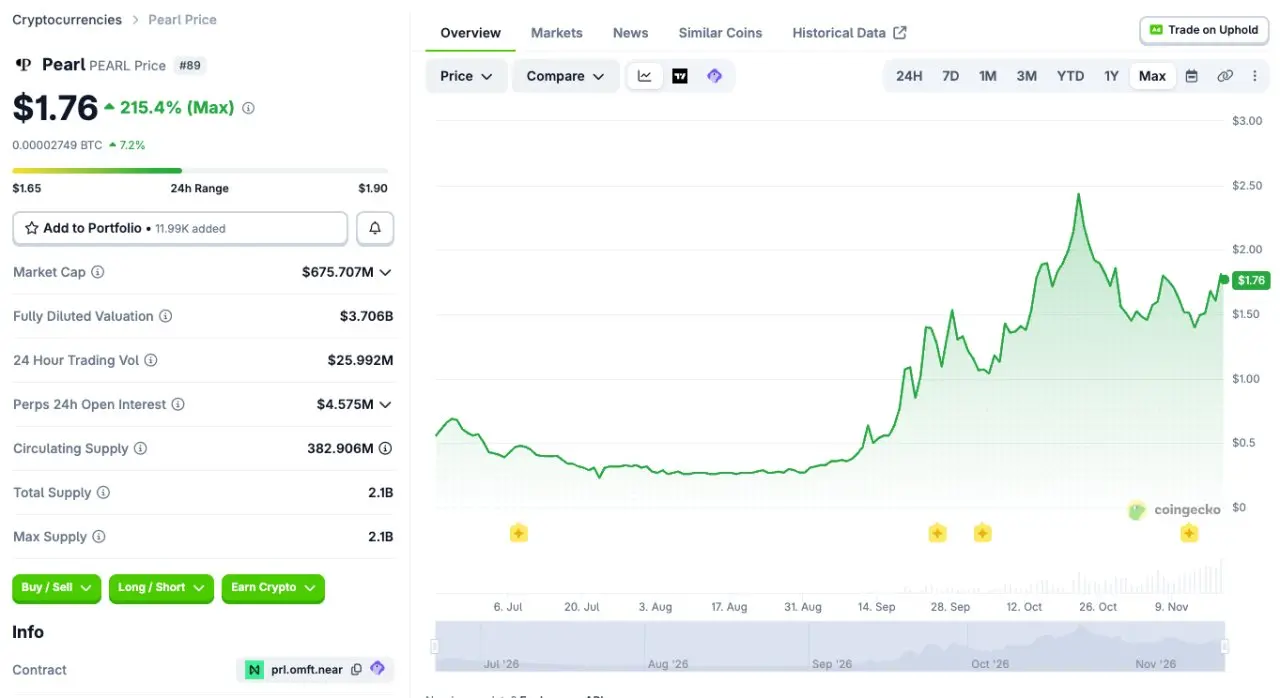
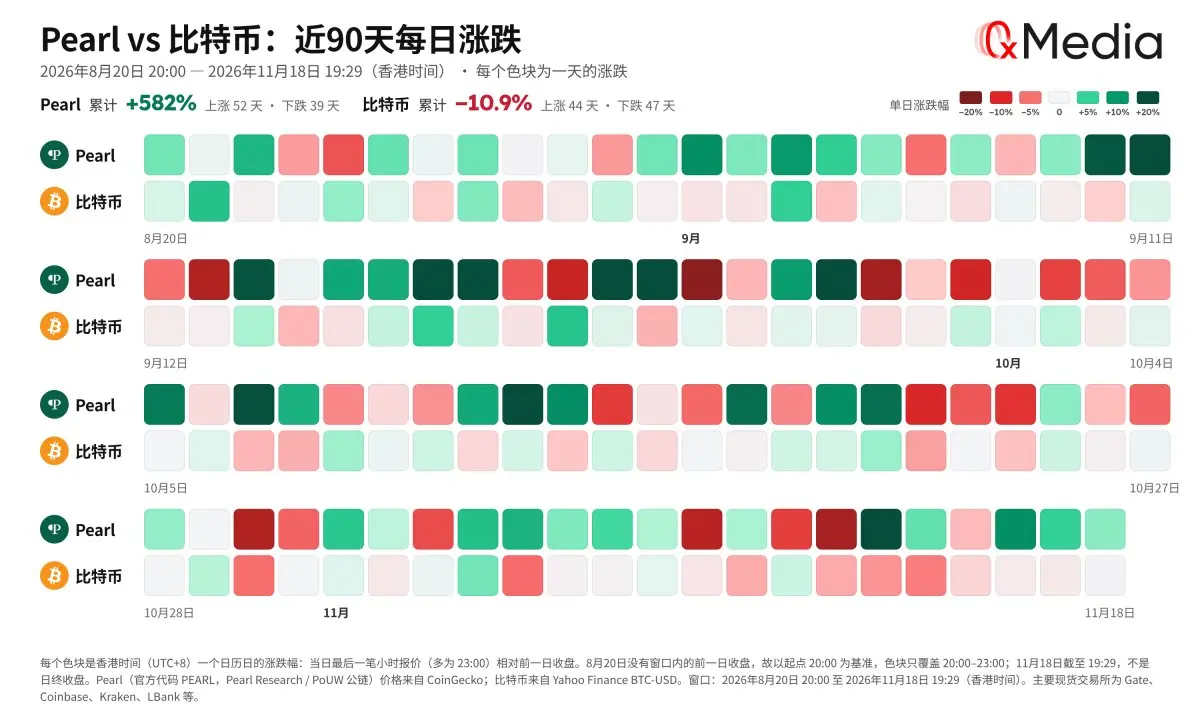
If we switch the K-line of this project to monthly, we will be surprised to find that Pearl has recorded three consecutive days of gains, significantly outperforming Bitcoin over the past 90 days.
Pearl's market price is approximately $1.75, with a circulating market cap of about $672 million, a fully diluted valuation of approximately $3.684 billion, and a 24-hour trading volume of about $25.84 million, ranking around 89th in market cap. The current circulating supply is about 382.9 million coins, with a maximum supply of 2.1 billion coins. The historical highest price was $2.46.
Even more astonishing is that this project has only been online for a few months and has successively landed on mainstream exchanges such as Coinbase and Kraken.

Let's first understand the fundamentals of this so-called Pearl.
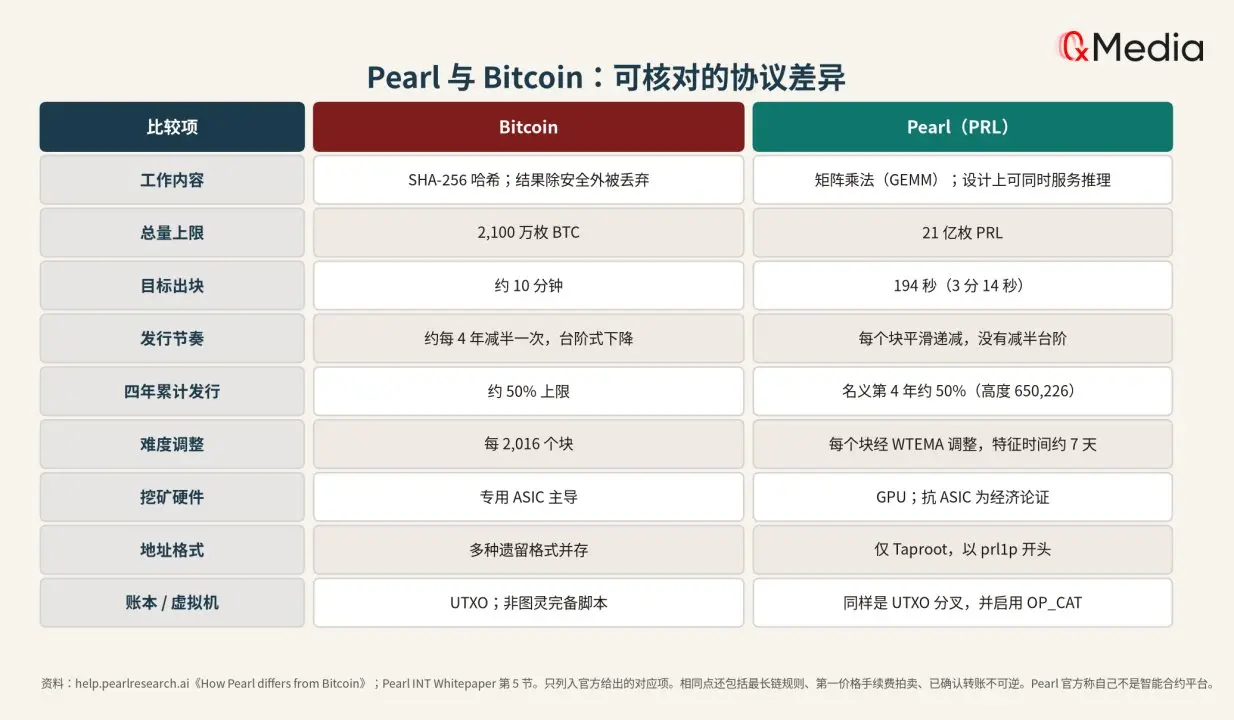
Pearl is a proof-of-work Layer-1 blockchain, using Bitcoin's UTXO model for its ledger. The nodes initially forked from btcd, wallets from btcwallet, and light clients from neutrino. The total supply cap is 2.1 billion coins. The smallest unit is grain, which is one hundred millionth of a PRL.
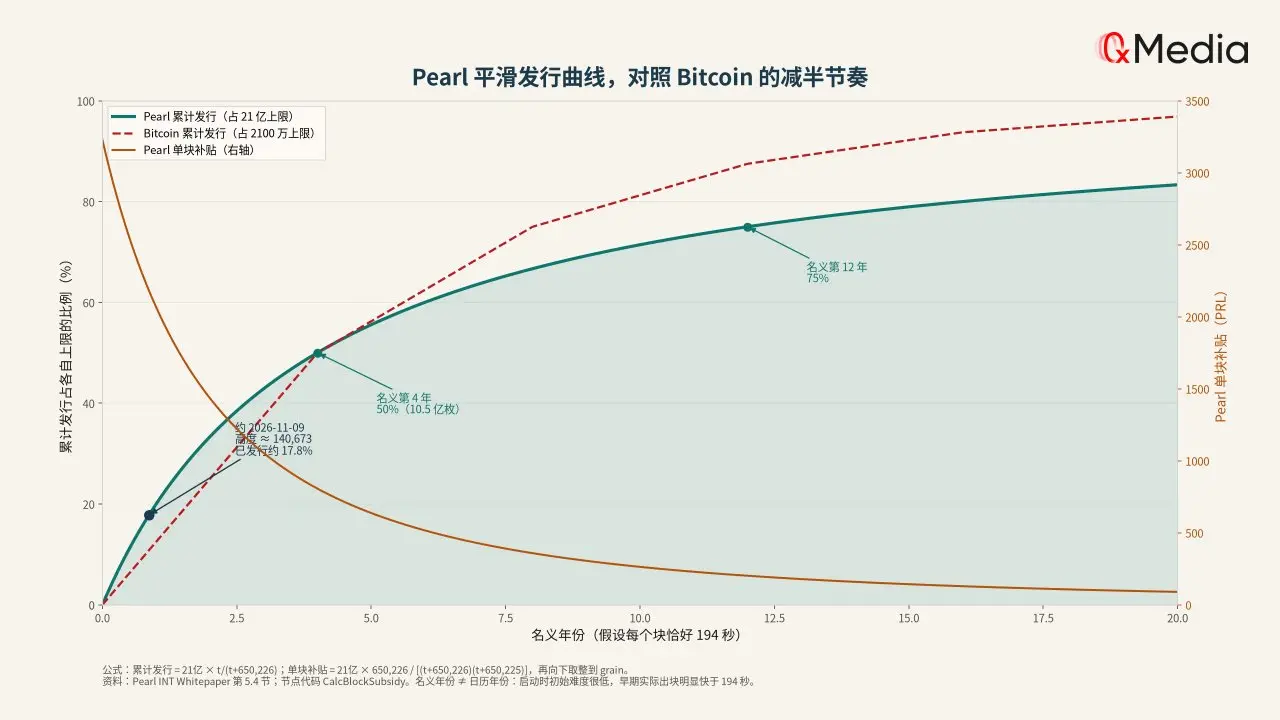
The issuance mechanism is also quite interesting. Pearl adopts a smooth polynomial decay issuance mechanism, where the rewards for each block gradually decrease, avoiding the issuance gaps caused by Bitcoin's periodic halving. According to the official design, 50% of the total issuance will be completed in the first four years, approximately 1.05 billion coins, reaching 75% in 12 years and 90% in 36 years. The remaining supply will continue to be released at a gradually slowing pace, providing longer-term security incentives for the network while maintaining the total supply cap of 2.1 billion coins.
The target block time for the mainnet is 194 seconds, or 3 minutes and 14 seconds. Addresses only support Taproot, and mining hardware is directed towards GPUs, using NVIDIA's graphics cards, which can be used for both home and commercial mining. How much can you theoretically produce in a day using common graphics cards to mine Pearl? Let's take a look at the expected calculations.
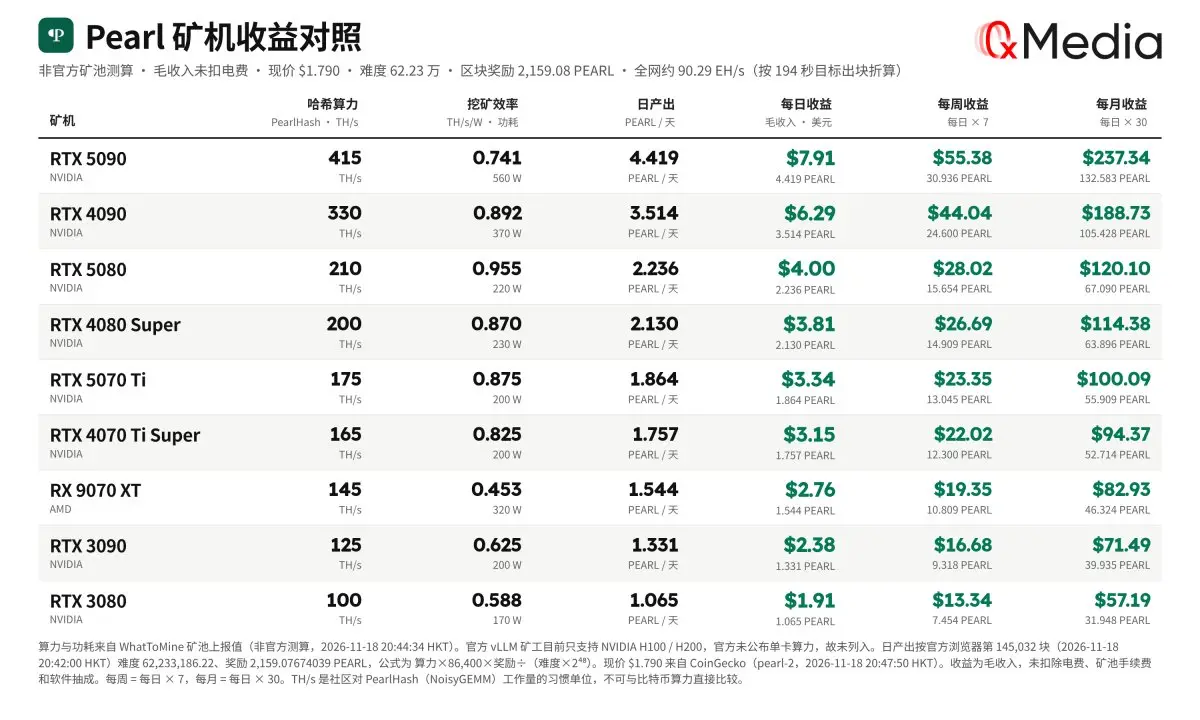
Those graphics card vendors also know that as long as Pearl remains strong, the prices of home-grade graphics cards won't drop anytime soon.
Does it feel a bit like mining Ethereum a few years ago, but there are actually some differences. Pearl has succinctly outlined its key points, with consensus being useful proof of work, so the interesting question arises: what exactly is considered useful?
Bitcoin miners continuously execute SHA-256 hash calculations through dedicated ASIC chips to compete for the accounting rights of new blocks and receive rewards. These calculations are mainly used to maintain blockchain security and are difficult to directly serve other computational tasks. This should be understandable to everyone.
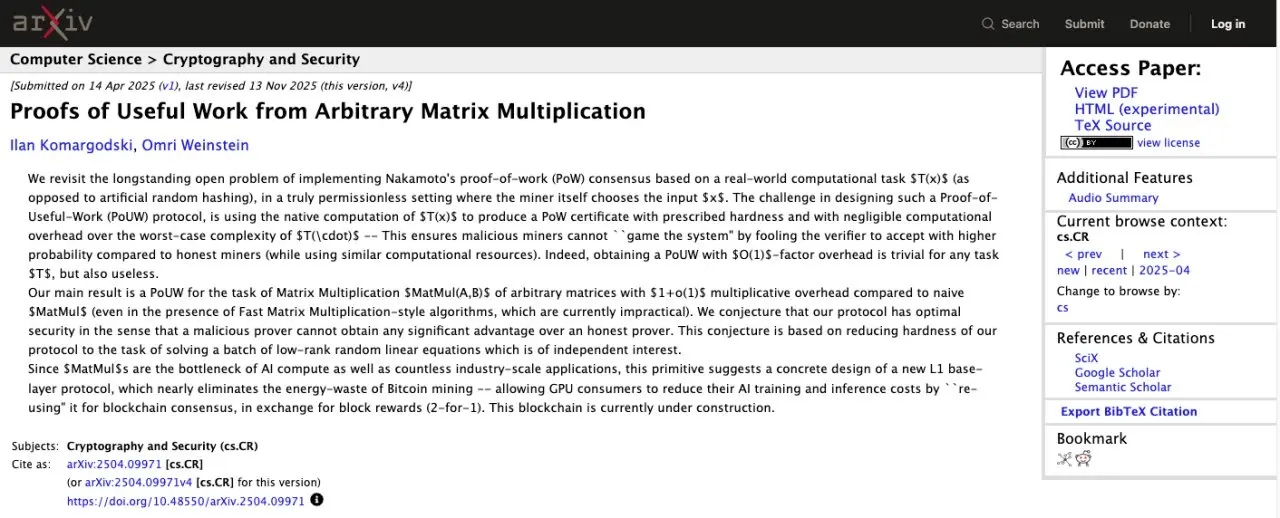
Pearl, on the other hand, adopts a Proof of Useful Work (PoUW) mechanism, combining the computations required for mining with matrix multiplication commonly used in artificial intelligence, allowing GPUs to generate valid proof of work while performing AI inference tasks and earning PRL block rewards.
The most interesting aspect is its commercial application. Pearl hopes to further connect GPU power providers with artificial intelligence companies. According to its vision, miners can use their GPUs to provide model inference services for AI companies, developers, or other clients, earning income from computing services while participating in mining.
From this perspective, Pearl is more like a coordinating platform that connects both sides of computing power supply and demand, with one end being miners who have GPU computing resources and the other end being enterprises and developers who need AI inference computing power. The project attempts to link the demands and interests of both sides through task allocation, computation verification, and economic incentives.
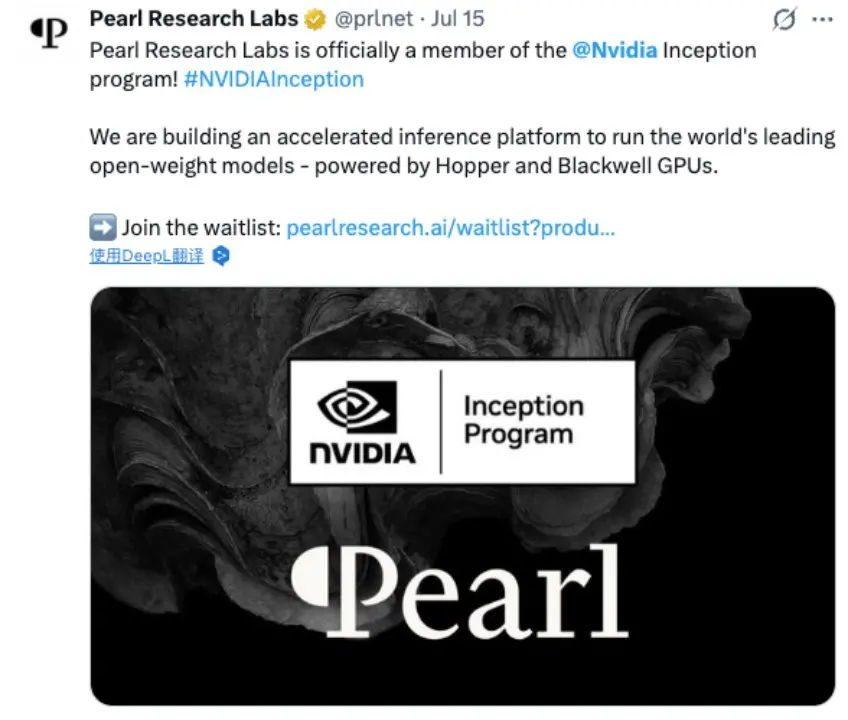
The builder of this mechanism is Pearl Research Labs, a member of the NVIDIA Inception Program.
Pearl is developed by Pearl Research Labs, with key figures publicly named. The mechanism paper "Proofs of Useful Work from Arbitrary Matrix Multiplication" (arXiv:2504.09971) was first submitted on April 14, 2025, authored by Ilan Komargodski and Omri Weinstein.
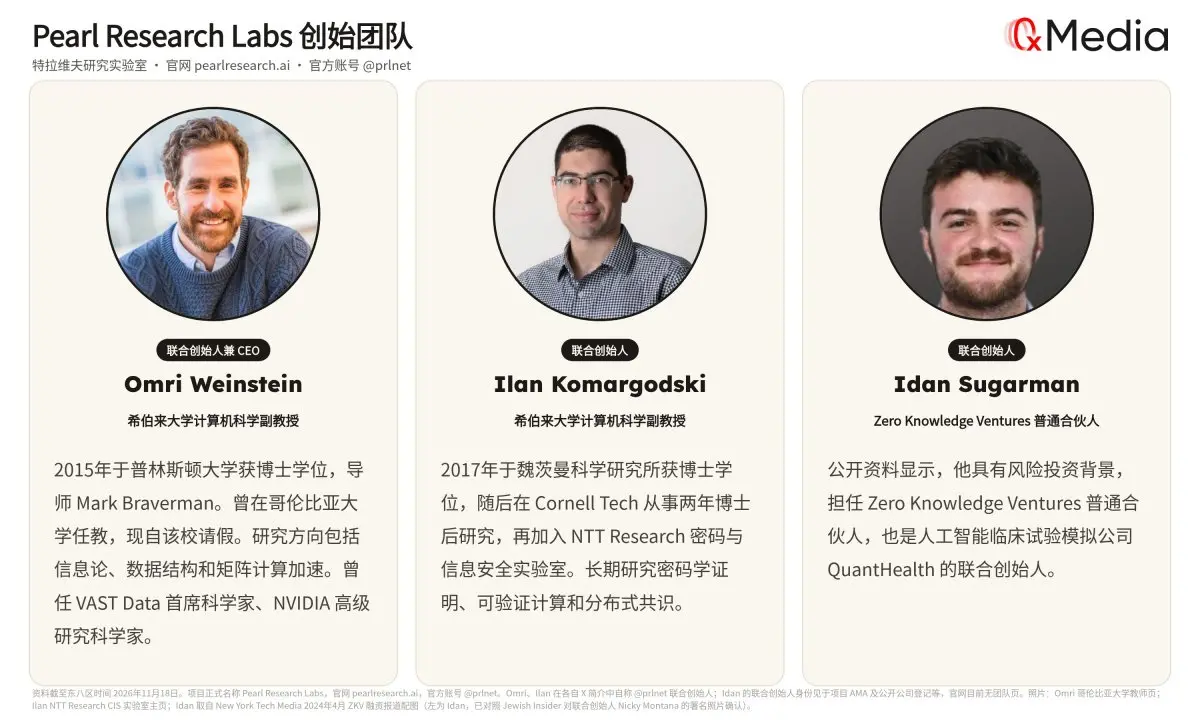
The founding team consists of Omri Weinstein, Ilan Komargodski, and Idan Sugarman, with backgrounds leaning towards academia and investment. Weinstein obtained his PhD from Princeton University (2015, advisor Mark Braverman), taught at Columbia University, and is currently an associate professor at the Hebrew University, with research interests including information theory, data structures, and matrix computation acceleration.
Komargodski earned his PhD from the Weizmann Institute of Science and has done postdoctoral work at Cornell Tech. He joined NTT Research's Cryptography and Information Security Lab in 2019 and is currently an associate professor at the Hebrew University, focusing on cryptographic proofs, verifiable computation, and distributed consensus. Sugarman has a background in venture capital and is publicly known as a general partner at Zero Knowledge Ventures and a co-founder of the AI clinical trial simulation company QuantHealth.
TheMarker reported on October 25, 2026, that the company has raised approximately $130 million in total, including $55 million in equity financing and $75 million in a GPU infrastructure fund, with investors including Lightspeed, Ribbit, and Square Peg.
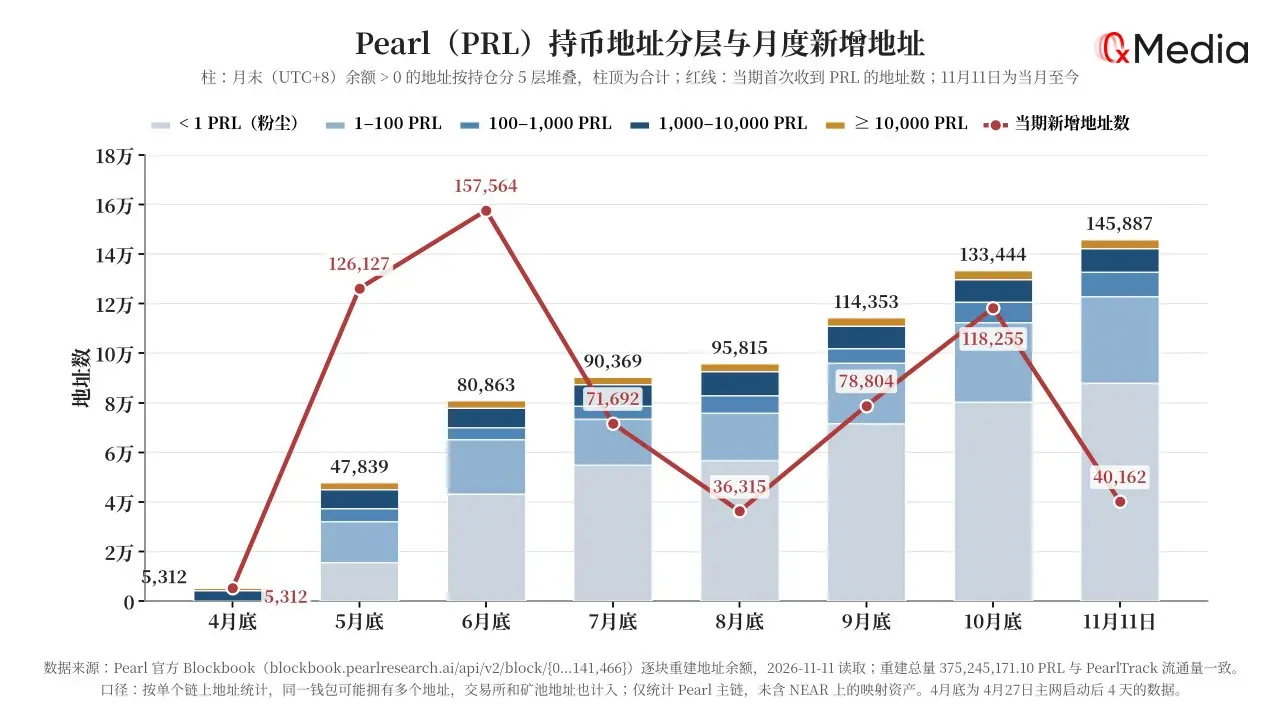
The on-chain activity of Pearl is very high.
Statistics are divided into five ranges: addresses with a balance of less than 1 PRL, 1-100 PRL, 100-1,000 PRL, 1,000-10,000 PRL, and over 10,000 PRL. Among them, the stacked bar chart represents the number of addresses with a balance greater than zero at the end of each month, while the red line reflects the number of new addresses that first received PRL during that period.
The Pearl main chain has a total of 145,887 holding addresses, approximately three times the 47,839 addresses at the end of May. From the distribution of holdings, addresses with a balance of less than 1 PRL have reached 88,036, accounting for 60.3% of the total, forming the majority of holding addresses. In contrast, there are only 3,639 addresses holding at least 10,000 PRL, accounting for about 2.5%, but they collectively hold about 333 million PRL, accounting for 88.6% of the issued supply, reflecting a high concentration of on-chain holdings.
The changes in new addresses are even more pronounced. The number of new addresses in June peaked at 157,564, fell to 36,315 in August, and rose again to 118,255 in October, with overall changes generally consistent with the price trend shown in Figure 7.
Pearl deserves serious consideration because it has turned an open question discussed for over a decade into a live chain that can be synchronized, verified, and traded, empowering artificial intelligence. However, as an early project, its ability to sustain operations remains a point of concern for us.