
Inflation stickiness has not yet dissipated: CICC maintains the judgment of a 25 basis point rate hike in December
CICC Research
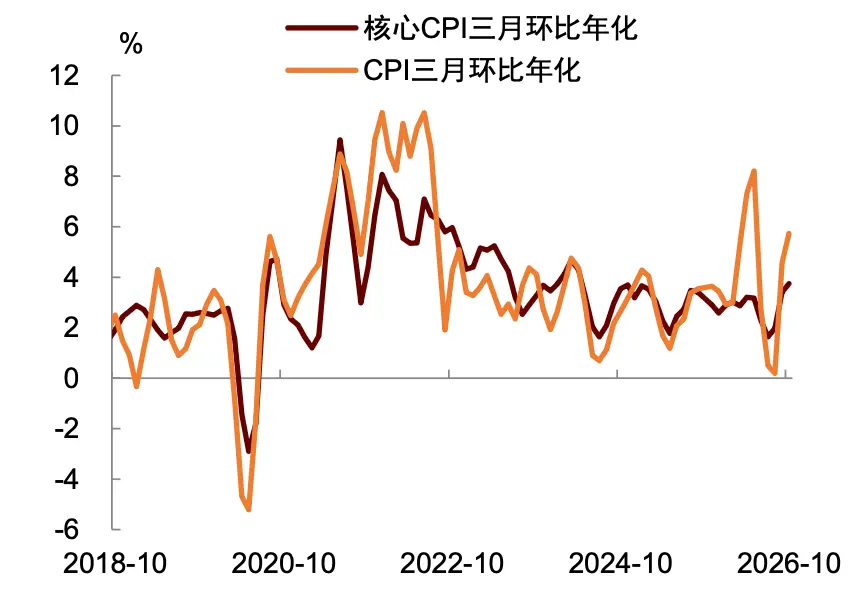
In October, the U.S. CPI adjusted for seasonal changes increased by 0.4% (compared to 0.6% last month), and the core CPI rose by 0.3% (the same as last month), both exceeding market expectations. Last October, the U.S. government shutdown prevented the release of economic data, resulting in a lack of year-on-year data. Overall, inflation remains sticky, with the core CPI rising by 0.3% for the third consecutive month, supporting the Federal Reserve's continued interest rate hikes. Recently, Federal Reserve Governor Waller suggested that a 50 basis point rate hike in December cannot be ruled out. However, we believe that the Federal Reserve's policy is not significantly "behind the curve," and with financial conditions having marginally tightened, the necessity for accelerated rate hikes is not strong. We maintain our baseline judgment of a 25 basis point rate hike in December, with the current tightening pace still leaning towards gradual and moderate.
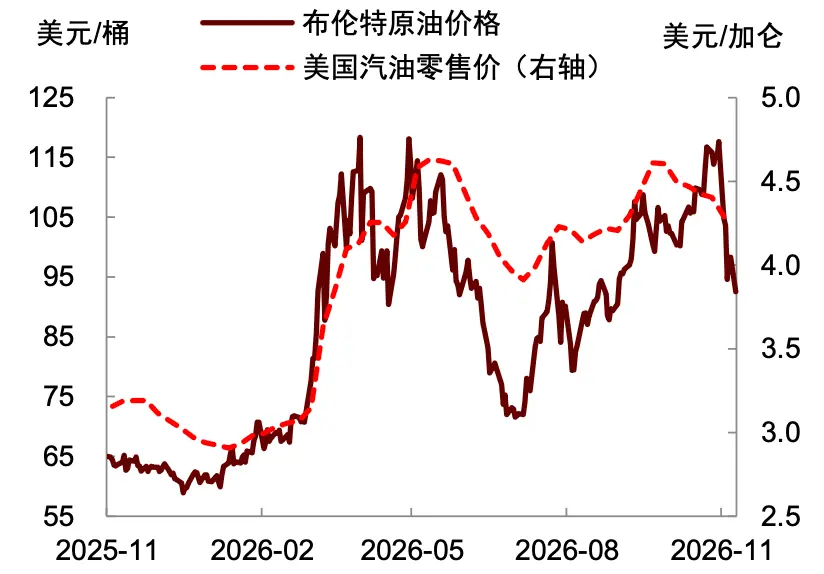
Energy inflation has marginally weakened, while food prices have accelerated. In October, the energy CPI rose by 0.7%, significantly down from September's 5.2% increase. Among these, gasoline prices rose by 1%, and fuel prices increased by 2%, both notably lower than September's increases, while natural gas pipeline services decreased by 0.8%. However, electricity prices rose by 0.9%, marking the highest point since May of this year. Against the backdrop of data center construction and growing electricity demand, electricity prices may face some upward pressure.
In October, the food CPI rose by 0.5%, the highest point since May of this year. Among these, household food prices increased by 0.4%, and dining out prices rose by 0.5%. The rise in food prices has a broad coverage, with prices for fruits and vegetables, dairy products, and meats all increasing, not driven by any single category. This may have been influenced by the earlier transmission of rising energy prices.
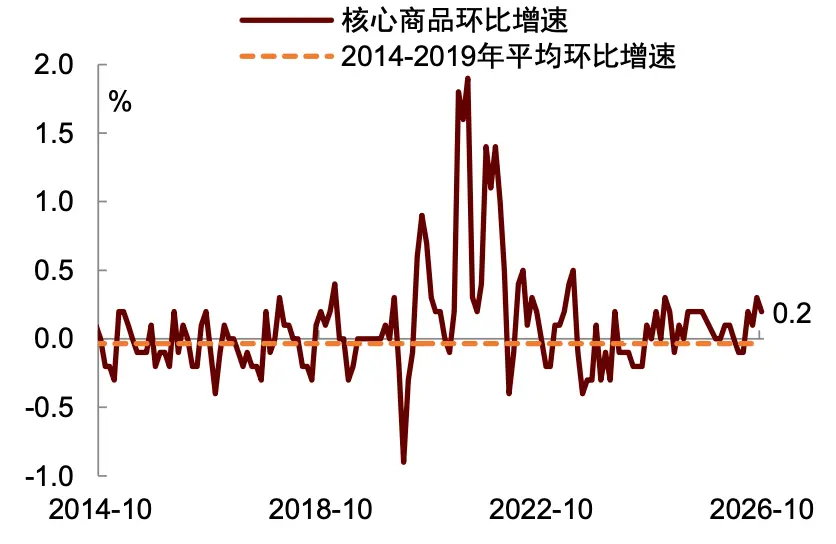
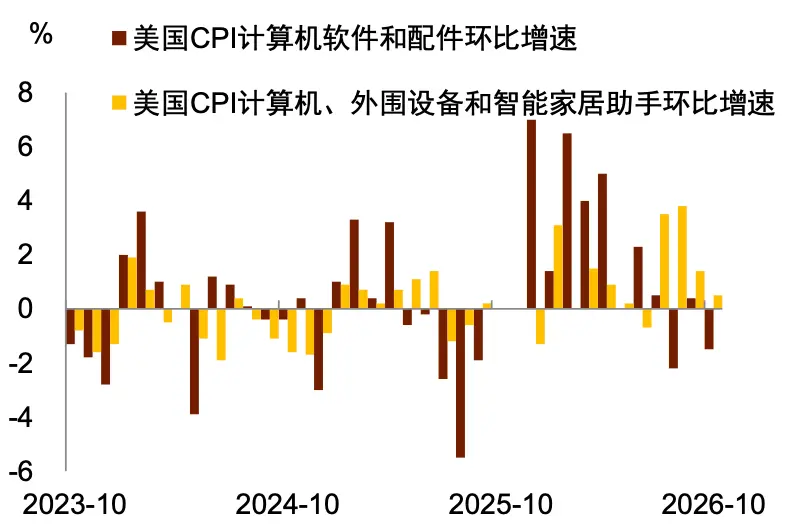
Core commodity prices remained overall moderate. Excluding energy and food, the core commodity prices rose by 0.2% in October, slowing from September's 0.3%. Among these, new cars (0.2%), furniture (0.7%), and medical goods (0.5%) continued to rise, while used car prices fell by 1.2%, the lowest level since February of this year. Prices for computer software and accessories decreased by 1.5%, and the growth rate of prices for computers, peripherals, and smart home assistants fell from 1.4% last month to 0.5%, indicating that AI inflation pressure has slightly eased. However, prices for AI-related hardware continue to rise, and future price increase pressures remain to be observed.
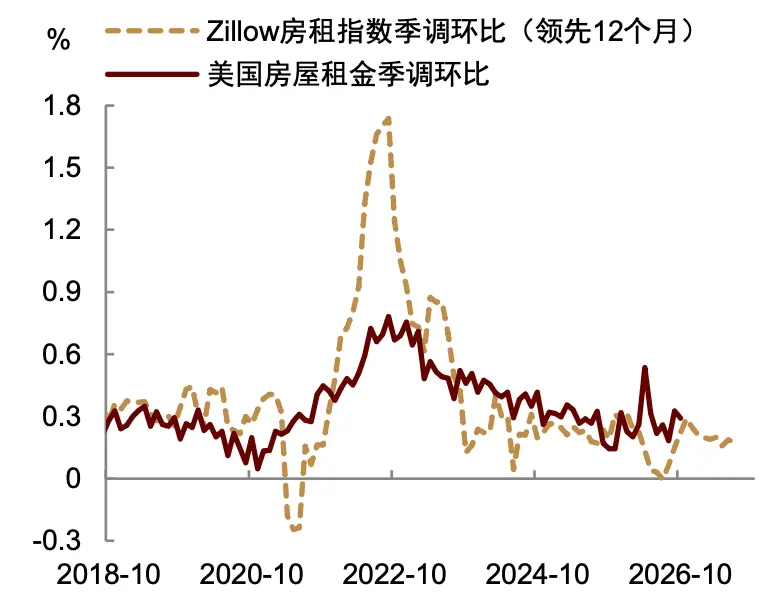
Rent inflation remained generally stable. In October, the housing CPI rose by 0.3%, slowing from September's 0.4%. Among these, the owner's equivalent rent (OER) increased by 0.3%, and actual rent rose by 0.2%, both unchanged from last month. From the forward-looking indicators of rent, there are no signs of accelerating rent inflation.
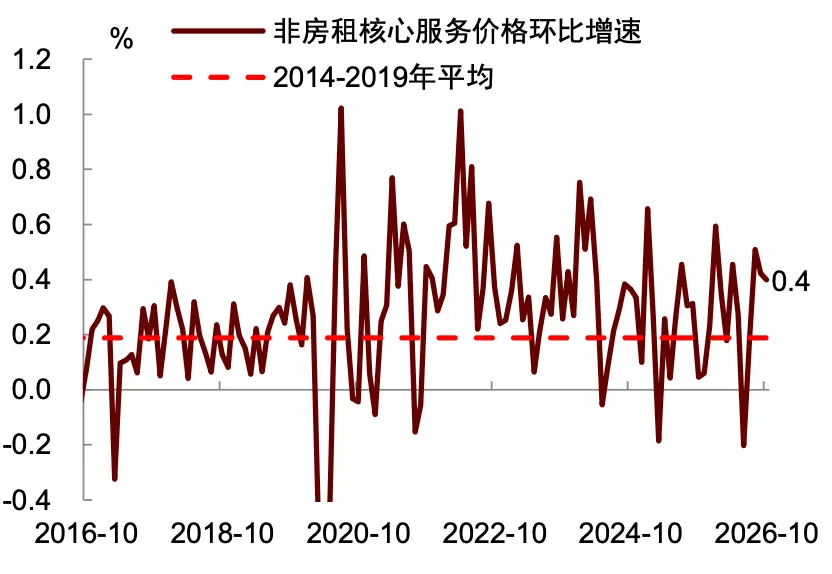
Non-rent core services inflation (supercore) remains sticky, with an expansion in transportation service price increases. In October, non-rent core service prices rose by about 0.4%, basically unchanged from last month. Among these, transportation service prices rose by 0.8%, higher than last month's 0.6%, but the structure of price increases has changed. Car insurance prices rose by 0.7%, public transportation prices increased by 2.0%, while airfare price increases slowed from 1.2% last month to 0.4%. Additionally, medical service prices rose by 0.3%, and entertainment service prices increased by 0.9%, indicating that the sources of service inflation remain relatively broad and overall quite sticky. Looking ahead, with recent international oil prices retreating, the pressure of energy costs further transmitting to transportation and other service prices is expected to ease, but wage growth in manufacturing and construction has accelerated, necessitating attention to whether the recovery in labor demand will further push up wages in labor-intensive service industries, creating a reinforcing pressure between wages and service prices.
We believe that inflationary pressures are relatively high, supporting the Federal Reserve's continued interest rate hikes, but the necessity for accelerated hikes is not strong. The core CPI rose by 0.3% for the third consecutive month in October, indicating that inflation remains sticky, supporting the Federal Reserve's further tightening of monetary policy. We also maintain our previous judgment: the Federal Reserve will raise rates again in December.
Before the CPI data was released, Federal Reserve Governor Waller stated that if the core CPI for October rose by 0.3% or more, a one-time 50 basis point rate hike should be considered to maintain the credibility of monetary policy. This data meets the conditions he proposed, which has raised concerns in the market. We believe that larger rate hikes typically imply a need for quicker policy adjustments to compensate for previous insufficient tightening, but recent marginal tightening of financial conditions indicates that earlier tightening is already having an effect; at the same time, the inflation growth rate over the past two months reflects more of a stickiness, with no signs of accelerating increases, and the Federal Reserve does not need to accelerate tightening. In fact, Waller himself supported pausing rate hikes at the October meeting; if he believed monetary policy was "behind the curve," he should have opposed inaction at that time.
One possibility cannot be ruled out: with the recent midterm election results in, the Democratic Party achieved a significant victory, alleviating the pressure on the Federal Reserve, and some officials may be inclined to take action sooner to alleviate persistently high inflation. However, whether there is a need for a one-time 50 basis point rate hike still needs to be assessed; even within the Federal Reserve, an aggressive rate hike strategy may not receive majority support, as the previously most hawkish Dallas Fed President Logan only believes that there should be two more rate hikes, each by 25 basis points. In summary, before more economic data is released, our baseline scenario remains a 25 basis point rate hike in December, with this tightening cycle still being gradual and relatively moderate.
Chart 1: Core and Overall CPI Month-on-Month Annualized Trends Rising


Source: Wind, CICC Research Department
Chart 2: Recent Decline in Crude Oil Prices
Source: Wind, CICC Research Department
Chart 3: Slight Decline in Core Commodity Inflation Month-on-Month Growth Rate
Source: Haver, CICC Research Department
Chart 4: Marginal Easing of Inflation Pressure Related to AI
Source: Haver, CICC Research Department
Chart 5: Increased Stickiness of Rent Inflation
Source: Haver, CICC Research Department
Chart 6: Slight Decline in Non-Rent Core Services Inflation
Source: Haver, CICC Research Department
[1]https://www.federalreserve.gov/newsevents/speech/waller20261110a.htm
[2]https://www.federalreserve.gov/newsevents/pressreleases/monetary20261028a.htm
Source
This article is excerpted from: "Inflation Stickiness Persists, Supporting the Federal Reserve's Continued Rate Hikes" published on November 11, 2026.
Liu Zhengning, Analyst, SAC Certification No.: S0080520080007, SFC CE Ref: BRF443
Xiao Jiewen, Analyst, SAC Certification No.: S0080523060021, SFC CE Ref: BVG234
Lin Yuxin, Analyst, SAC Certification No.: S0080526060003
Zhang Wenlang, Analyst, SAC Certification No.: S0080520080009, SFC CE Ref: BFE988