
Podcast Notes | Conversation with Peter Thiel: The idea that AI will destroy humanity is a false proposition; establishing monopolies through panic is the real apocalypse
Compiled by: Deep Tide TechFlow
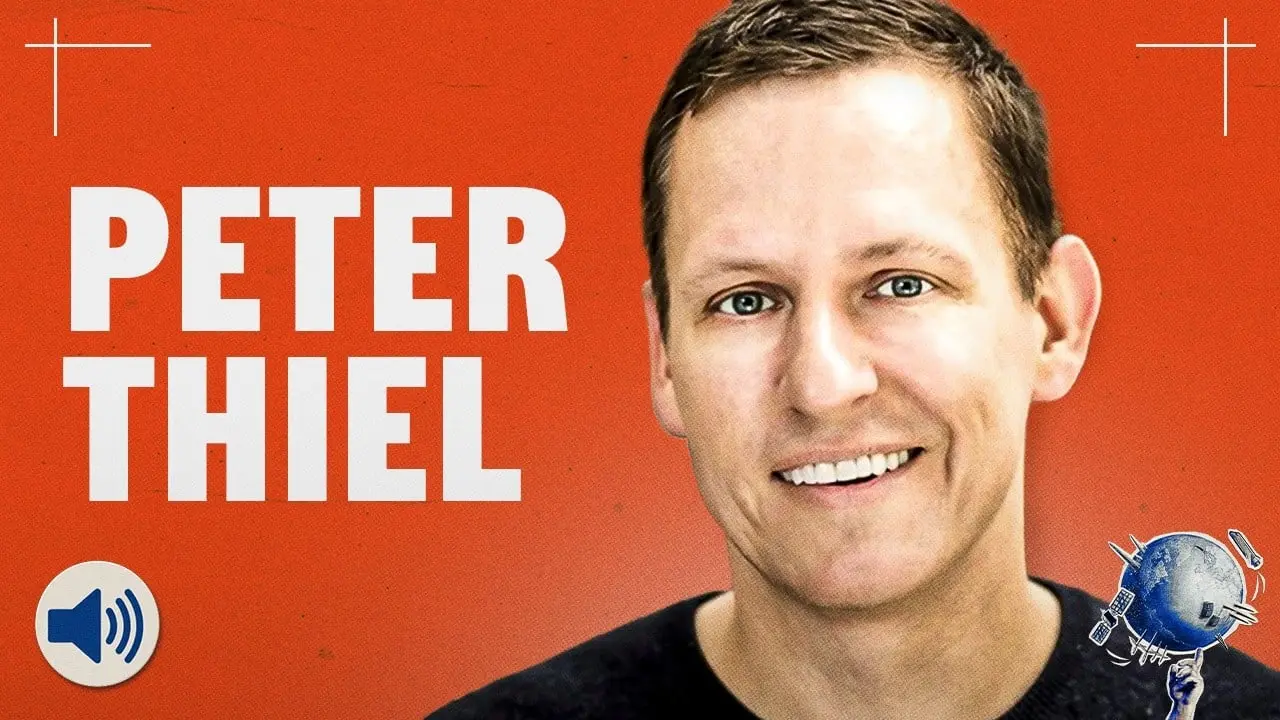
Deep Tide Guide: In an in-depth exclusive interview on the renowned New York media Kaleidoscope's heavyweight podcast "The Builders," the most controversial and forward-thinking patriarchal investor in Silicon Valley, Peter Thiel, co-founder of PayPal and Palantir, joined host Walter for a nearly one-hour intellectual storm spanning theology, philosophy, political economy, and cutting-edge technology. Thiel, with his signature contrarian first principles, fiercely tore apart the hypocritical veil of the current AI regulatory frenzy in Silicon Valley and effective altruism.
From Thiel's cold first-principle perspective, the current rampant "AI apocalypse theory" and the prevalent "effective altruism" in Silicon Valley are essentially a meticulously packaged moral kidnapping.
Thiel threw out a highly disruptive assertion: what is truly hindering human progress is not the so-called superintelligence that will destroy the world, but those mediocre rule-makers who, under the guise of "safety and morality," attempt to monopolize the technological development path.
At the same time, Thiel mercilessly criticized this "banality of evil." In his view, rather than entrusting the future of the world to a group of hypocritical and timid bureaucrats, he would rather hand the steering wheel to radical and unconventional figures like Elon Musk and Steve Jobs. Only these irreplaceable "madmen" can truly penetrate the homogenized mediocrity.
Guest: Peter Thiel (Co-founder of PayPal and Palantir, Founder of Founders Fund, Author of "Zero to One")
Host: Walter (Host of The Builders podcast)
Podcast Source: The Builders (https://www.youtube.com/watch?v=H9Bdv3t5VtQ)
Original Title: Peter Thiel: The Real Danger of AI Isn't What You Think
Broadcast Date: October 22, 2026
Key Points Summary
The real danger of AI is not apocalypse, but global totalitarian governments: The public is generally intimidated by the apocalyptic AI that physically destroys humanity, but Thiel points out that the real danger in the history of technology is the arrival of "The Antichrist": certain political oligarchs and hypocritical groups exploit the infinite fear of technological disasters, under the moral banner of saving humanity, to establish an omnipresent and unoverthrowable global regulatory authority. The civilization suffocation brought by global totalitarian governance is a thousand times more dangerous than the uncertainties of technology itself.
Unmasking the moral facade of effective altruism (EA): Effective altruism is not a true technological innovator but a moral preaching sect born in California's East Bay. From SBF to extreme AI safety advocates, they superficially claim to care for the well-being of all humanity, but secretly use apocalyptic panic to consolidate political influence and rent-seeking regulatory power.
Firmly oppose the pause button; AI must advance at full speed: Thiel clearly opposes the appeasement argument of putting the brakes on AI, emphasizing that in the face of international competition and global productivity stagnation, the West must accelerate. AI brings temporary pain and job restructuring, but ultimately will free humanity from tedious, monotonous labor to engage in truly creative and interpersonal valued endeavors.
Disruptive philosophy: Evil is better than mediocrity; virtue signaling is inferior to real vice signaling: Thiel raises the question of whether the antonym of "evil" is immorality or incompetence. Citing Goethe's "Faust," he points out that Faust makes a deal with the devil (evil) but accomplishes great things that benefit all and is ultimately saved; while Marlowe's Faust is merely a charlatan (incompetent) who falls straight into hell. Today's society is filled with mediocre and corrupt bureaucrats, and the Bill Gates-style false virtue and virtue signaling are nauseating; founders who dare to reveal their true ambitions and vice signaling are, in fact, more sincere and pragmatic.
René Girard's mimetic desire and unconventional founders: Humans are more adept at imitation than monkeys, and the vast majority of groups are trapped in homogeneous vicious cycles of imitation. The reason Elon Musk and Steve Jobs can change the world is that they completely detach from the temptation of public consensus and possess extremely rare non-homogeneous first-principle thinking (like Musk's obsessive bet on Mars colonization).
The ultimate boundary between humans and AI: The beauty of sunsets and social relationality: Language was once seen as a unique human trait, yet it has been easily conquered by large models in just a few years. Thiel insists on a Cartesian hard boundary of consciousness: AI will never possess subjective consciousness and experience; a computer seeing a sunset is just a pile of pixel codes, only humans can feel the grandeur and poetry of a sunset; moreover, the genuine affection, cooperation, and social bonds between people are the civilizational soul that machine intelligence can never replace.
II. Exciting Views
"People talk every day about the apocalyptic judgment of AI destroying the world, but everyone completely ignores the risk of the Antichrist. In modern society, the tyrant is no longer a madman creating bombs to conquer the world, but a totalitarian ruler who uses your fear of catastrophe to establish global unified control under the guise of saving humanity."
"If the choice humanity faces is simplified to 'apocalypse or global single totalitarian government,' we must not thoughtlessly rush to the latter. Both are equally deadly. We need to be wary of the apocalypse, but we need to fight desperately against the omnipresent global totalitarian surveillance state."
"I absolutely do not belong to the camp calling for a pause on AI. In the current era, facing global competition and economic stagnation, we must push the accelerator of AI to the floor."
"What is the antonym of evil? Is it moral good, or is it mediocrity and incompetence? A Lada car that breaks down after two kilometers is not morally evil; it is simply incompetent and garbage. In today's world filled with mediocre bureaucrats, a pragmatic person who is labeled as evil but can get things done is far superior to a thousand hypocritical bureaucrats who achieve nothing."
"Bill Gates is keen on virtue signaling, while Elon Musk often releases vice signals. But in our extremely hypocritical reality, openly displaying one's flaws and vices is far more honest than pretending to be a saint."
"Humans are essentially highly imitative beings. The masses are always trapped in endless conformity and homogeneous internal competition, while great creators must possess extreme obsession and even what seems to outsiders as irrationally unconventional visions."
"AI may calculate the optimal solution to everything in the world, but if humanity disappears from Earth, the beauty of sunsets will go unappreciated. A computer seeing a sunset is just a string of hexadecimal color codes; only the human soul can give this universe true meaning."
III. Main Text
1. Backlash and Anxiety: The True Roots of the AI Resistance Wave and the Mask of Effective Altruism
Host: Peter, thank you very much for joining The Builders. In the past few months, we have witnessed an extremely surging wave of resistance and panic against artificial intelligence from all sectors of society. Whether it is the public's criticism of energy consumption, copyright disputes, or the lamentations over unemployment and even human extinction. In your view, what is the true driving force behind this backlash?
Peter Thiel: I completely agree with your description of the current situation; the backlash against AI is indeed occurring violently. Exploring the reasons is always speculative, but I tend to think it is the result of multiple social anxieties overlapping excessively. First, there is great uncertainty about who will benefit from AI and who will be left out. While I believe it will bring a huge productivity increase to the macro economy, this growth unfolds in a highly disruptive manner. When people feel they cannot control the future, fear will transform into direct resistance to technology.
Host: Many people, including David Sacks, have publicly pointed out that there is actually some political ideology at play behind this, such as the so-called effective altruism (EA). The public's understanding of this rhetoric may still be stuck on the bankrupt SBF, but what role do these people play in the AI field?
Peter Thiel: This indeed has deep historical roots. If you trace back to the early 2000s in Silicon Valley's East Bay, such as Berkeley and Oakland, it was never a place that truly birthed great tech giants, but rather a breeding ground for this ideology. Effective altruism has always carried a strong moral savior complex: they do not engage in product development themselves but self-appoint as the judges of humanity's future. They superficially claim to pursue maximized benefits for doing good, but in reality, it has developed into an extremely narcissistic control freak culture.
In the field of AI, these people are best at selling existential risk. They constantly depict AI as an imminent threat to destroy all humanity in front of the public, and then logically package themselves as the only saviors, lobbying the government for vast regulatory powers. Essentially, this is not scientific concern at all, but a political rent-seeking and moral extortion disguised as a human survival crisis.
2. The Antichrist Theory: Beware of Global Totalitarian Rule Established Under the Pretext of Preventing Apocalypse
Host: This brings us to a highly impactful philosophical and theological framework you recently sparked widespread discussion about in the U.S.: the Antichrist theory. You have publicly stated a shocking remark: "The way the Antichrist seizes global power is not by directly causing an AI apocalypse, but by constantly proclaiming an apocalyptic crisis to everyone, allowing the world to voluntarily hand over power to him in extreme panic, establishing rule as a savior." Can you delve deeper into the core logic of this metaphor for us?
Peter Thiel: In traditional religious or medieval concepts, the Antichrist is usually depicted as a single tyrant ruling the world at the end of history. If we think about it from the perspective of modern political philosophy: how would such a global totalitarian ruler rise in different historical stages? In the early modern period of the seventeenth or eighteenth century, people would instinctively think that a tyrant is like a mad scientist, conquering the world through the creation of super bioweapons or nuclear bombs.
But in our late modern era, the logic of political operation has completely reversed. The fear of technological disasters is far more likely to plunge all humanity into collective frenzy and submission than the technological power itself. For example, extreme radical environmentalism constantly proclaims that the Earth is about to be destroyed; now in the field of AI, books published by people like Eliezer Yudkowsky have extremely alarming titles like "If Someone Creates It, All Humanity Must Die." In these works, the technical deductions about AI risks are written in great detail, but when it comes to what to do, the prescriptions are surprisingly consistent and vague: a global regulatory body for all humanity must be established.
Host: What you are truly wary of is this so-called global unified regulatory body?
Peter Thiel: Exactly! When human political issues are simplified to "either accept global single government rule or humanity faces total destruction (One World or None)," people often blindly choose the former out of fear without any deep reflection. But if you rephrase the question as "Antichrist vs. Armageddon," you will suddenly awaken: both outcomes are equally deadly abysses!
A global totalitarian surveillance entity established under the pretext of preventing technological risks, which thoroughly stifles human freedom, diversity of thought, and the vitality of civilization, is no less destructive than physical annihilation itself. We must not become fatalists; we need to closely monitor and guard against existential risks posed by technology, while also fiercely remaining vigilant against the global totalitarian tyranny that may arise politically.
3. Firmly Oppose the Pause Button: Why We Must Accelerate AI Development?
Host: In the face of calls from various factions in Silicon Valley to sign a letter to pause AI development and demand the government set red lines for large models, your stance is very clear. Why do you firmly refuse to press the pause button?
Peter Thiel: I not only firmly oppose the pause button, but I also want to loudly proclaim on your show: we must now fully accelerate AI development. Many people think pressing the pause button is a rational caution, but in the real world, this idea is extremely naive and deadly.
First, technological innovation has never been a story of the West working behind closed doors. It is a fierce battlefield of global great power competition. If we in Silicon Valley hit the brakes due to self-imposed moral anxiety, non-democratic competitors will not stop; they will only overtake us at a faster pace. Unilateral self-tying will ultimately lead us to lose all strategic initiative in setting future technological safety standards.
Second, from a deeper economic perspective, the biggest ailment in today's world is not that technological development is too fast, but that the broad physical world, aside from computers and the internet, has fallen into a prolonged stagnation. From housing and energy to healthcare costs, the global economy is severely hampered by sluggish productivity growth. AI is one of the very few general infrastructures we have seen in decades that has the potential for a leap in total factor productivity. We need the growth momentum it brings to break the economic stagnation. Technological transformation will certainly bring short-term job restructuring and pain, but it will ultimately liberate the workforce from mechanical mediocrity, granting humanity a broader creative space.
4. Good, Evil, and Mediocrity: Better to Have a Radical and Capable Villain than a Pious Mediocre Bureaucrat
Host: Peter, you often express views that break traditional moral common sense. You have explored an extremely intriguing topic: compared to mediocre and incompetent bad people, you are even somewhat more willing to tolerate aggressive evildoers. What philosophical logic lies behind this?
Peter Thiel: This is not about advocating for wrongdoing, but rather a cognitive boundary we must clarify when thinking about social issues: what is the true antonym of good? Is it moral evil, or is it incompetence and mediocrity?
Take a vivid example: a powerful but extremely fuel-inefficient Ferrari sports car may be seen as a morally flawed evil by extreme environmentalists; but the old Eastern European Lada cars that frequently stalled and were inferior even to golf carts represent incompetence and rubbish in terms of capability. In real life, what everyone endures daily is the pervasive mediocrity and incompetence across various industries. When you go to a government service hall or are tormented by cumbersome and inefficient bureaucratic institutions, they are not great villains; they are simply lacking in capability and numbness, and this mediocrity's harm to the overall vitality of society is astonishing.
Host: This reminds me of your unique contrast in evaluating literature and tech founders.
Peter Thiel: This is precisely the essential distinction between Christopher Marlowe's "Faust" and Goethe's "Faust." In Marlowe's depiction, Faust is a low-capacity charlatan and a fraudulent sorcerer, so he achieves nothing and ultimately falls into hell; but in Goethe's version, Faust makes a deal with the devil, acquiring deep dangers and moral flaws, yet with this immense power, he moves mountains and fills seas, ultimately achieving great deeds that benefit countless lives, and Goethe ultimately grants him salvation from God. I would rather choose Goethe's perspective than Marlowe's hypocrisy.
Look at today's big tech circle: people like Bill Gates are very keen on virtue signaling, dressing themselves up as saints saving the world; while Elon Musk often recklessly releases vice signals on Twitter, even deliberately appearing eccentric and unruly. But in today's world, wrapped in extreme hypocrisy by PR rhetoric, a pragmatic person who dares to openly display their real flaws and ambitions is a thousand times more honest than those pious hypocrites who speak falsehoods. What society needs are true creators who can break the deadlock and accomplish great things, not stable and mediocre bureaucrats.
5. René Girard and Mimetic Desire: Why Musk and Jobs Are Unreplicable Outliers?
Host: You were deeply influenced by philosopher René Girard during your time at Stanford University, and his theory of mimetic desire has always been a foundational element of your investment philosophy. In this era of rapid AI advancement, are Girard's insights still applicable?
Peter Thiel: Not only are they still applicable, but they are also more profound than ever. Girard liked to quote Aristotle's famous saying: what distinguishes humans from other animals is our far stronger capacity for imitation. You can view Darwin and Aristotle together: Darwin proved our common ancestry with apes, while Aristotle pointed out that we are better at imitation than apes, as this is the fundamental mechanism by which infants learn language and humans integrate into society.
However, this powerful instinct for imitation brings a deadly curse: the madness of the crowd and homogeneous competition. The vast majority of people do not know what they truly want; they are merely imitating the desires of neighbors, colleagues, or peers. When everyone desires the same crown, the same trend, they fall into vicious internal strife and destructive zero-sum games. The same is true in Silicon Valley, where most entrepreneurs blindly follow trends, creating a bunch of identical and worthless mediocre projects.
Host: Does this explain why individuals like Musk and Jobs are so rare and extremely irreplaceable?
Peter Thiel: Exactly. The rarity of great creators like Musk and Jobs lies in a unique immune mechanism within them: they can resist the gravitational pull of peer imitation. Musk insisted on developing reusable rockets and colonizing Mars, which seemed absurd from the perspective of conventional business logic. But he has persistently advanced this vision with an almost obsessive first-principles approach for decades. It is this non-homogeneous, unreplicable outlier quality that can break the fatal cycle of mimetic desire and open up a new dimension from zero to one for all humanity.
6. The Ultimate Boundary of Consciousness and Humanity: Computers Can Never Appreciate the Beauty of a Sunset
Host: At the end of the program, as AI intelligence is approaching or even surpassing human cognitive limits, what do you think are the unique values of humanity that machines cannot replace? If most intellectual work in the future world is replaced by AI, what is the ultimate meaning of human existence?
Peter Thiel: Discussing the essence of AI ultimately forces us to question ourselves: what does it mean to be human? For a long time, linguist Noam Chomsky from MIT firmly believed that the generation of complex natural language is the unique crown of human intelligence. However, this myth was completely shattered the moment large language models exploded two years ago.
But I still firmly believe in Cartesian philosophical judgment: there exists an insurmountable hard problem of consciousness. I do not believe AI possesses subjective consciousness, nor will it ever. The essence of machines remains an extremely sophisticated statistical computational architecture. What makes humanity truly unique is our ability to deeply experience the world with subjective consciousness.
Take the purest example: when you stand by the sea and witness an incredibly splendid sunset, your soul is profoundly shaken, experiencing grandeur and poetry that transcends time and space. For a supercomputer, a sunset is merely a matrix of hexadecimal numbers about light wavelengths, pixel colors, and brightness. If humanity were to be destroyed, even if the Earth were filled with superintelligences with faster computational speeds, the beauty of that sunset would be completely obliterated in the universe, as there would no longer be any being with divine perception to experience it.
Moreover, another core dimension revealed by Girard is the profound relational dimension of humanity. Our humanity lies not only in individual contemplation but also in the immeasurable warmth, loyalty, and emotional bonds among family, close friends, and the community of civilization. AI should become a powerful leverage tool to free us from the burdens of physical and mental labor, allowing humanity more leisure to embrace sunsets and deepen real interpersonal connections. This is the bright shore toward which technological evolution should sail.
Host: Profound and brilliant reflections. Thank you very much, Peter Thiel, for bringing us this high-level philosophical feast today, which is thought-provoking. Thank you for watching The Builders, and see you next time!