
Manus has just quietly released its 2.0 manifesto
Author: Hualin Dance King, Geek Park
Editor: Jingyu, Geek Park
On October 26, Zhang Tao (online name HideCloud), co-founder and product partner of Manus, recently wrote a lengthy article on his public account "Qianyun Thoughts," titled "Transforming Manus with Manus."
The article begins with a striking scene that left a deep impression on him. He provided several requirements and bugs to an engineer, and after a while, he checked the progress and found a row of Codex and Manus sessions open on the engineer's computer. Clicking on one, he saw the exact wording of the requirements he had just sent on Slack, unchanged.
What surprised him even more was that this engineer was simultaneously handling a dozen or twenty requirements. In today's Manus, this has become the norm.
This article is packed with information, and there are several key points worth noting.
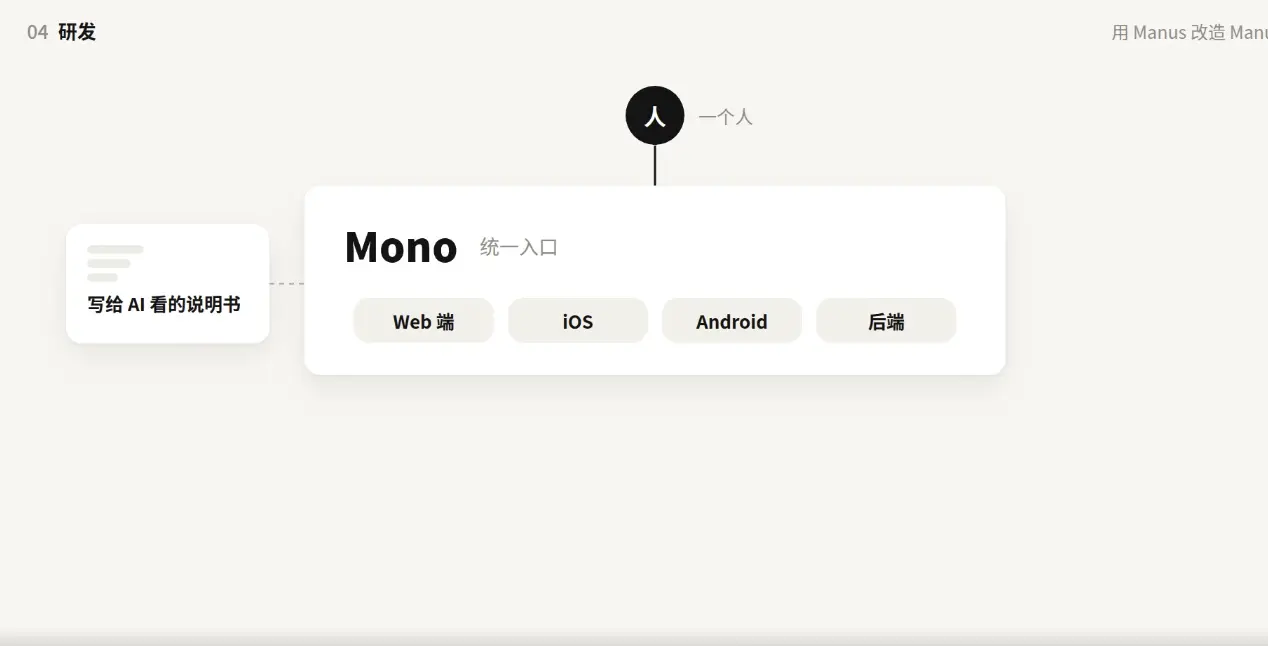
Internally, Manus has created a unified code entry called Manus-mono, accompanied by a manual written for AI, allowing AI to see the global picture across repositories. One requirement can be completed by one person across all ends. The mobile team has only seven people, simultaneously responsible for two products and four apps, with progress basically synchronized with the web version.
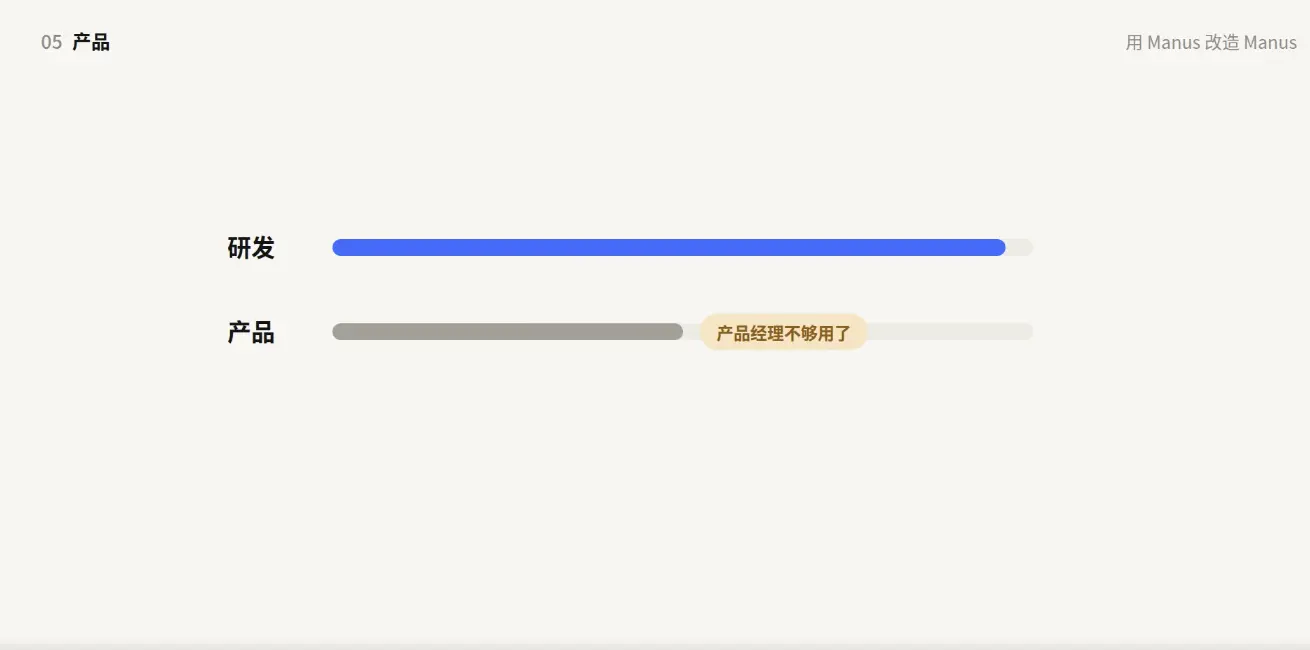
All product managers have submitted code to Manus, and about half can independently bring their requirements to launch. Some requirements submitted by product managers have transformed from documents into videos.
The marketing team has a "digital colleague" that arranges its own work, proactively reminds about project progress, and clarifies functional details across teams.
In September, the company's AI expenditure exceeded $10,000 per person, with a few individuals spending $70,000 to $80,000 in a month. Zhang Tao specifically addressed external doubts in one section.
The timing of the article's release is also subtle. At the end of September, Manus released version 2.0 and the personal AI application Cue; at the beginning of October, the parent company Butterfly Effect announced the completion of a new round of financing exceeding $500 million, while opening 17 positions in Beijing.
Viewed at this juncture, this article resembles a declaration from the Manus team entering the 2.0 era. It discusses how organizations can evolve using AI, revealing the company's product direction, cost logic, and hiring standards.
01 Manus itself is a model room for 2.0
If you compare the internal practices in the article with the feature list of Manus 2.0, you'll find they almost match up one by one.
The digital colleague in the marketing team finds the internal website inconvenient and can directly submit requirements through a feedback interface, automatically triggering Manus's development tasks as soon as a requirement comes in. This utilizes the 2.0 Automations, which automatically start a task upon receiving an external notification.
Product managers replace requirement documents with videos, relying on the significantly enhanced video capabilities of 2.0, which can generate videos from images and create animations from code. The story of the product manager working on the speech-to-text feature is quite typical. She first had Manus test over a dozen models, selected one for integration, then created a demo according to existing design specifications, allowing Manus to generate images for scenarios users might encounter, checking and modifying them one by one, and finally editing the demo into a video. Once the plan was clear, she simply completed the feature, with both the web and desktop interfaces designed by her.
Colleagues' Slack bots run on cloud computers. Non-development colleagues wanting to know how a feature is implemented, where the copy is, or whether it has gone live do not need to inquire about who is in charge; they can just ask it directly. This corresponds to the cloud computers that can be present 24/7 in 2.0.
Some features are currently only used internally. For example, members of the same project can see each other's sessions by default, and after engineers and AI complete most of the work, product managers can enter the same session to adjust spacing, styles, and copy.
Zhang Tao writes directly at the end that these are the things Manus needs to do well next, "We will try it ourselves first, then hand it over to users."
The phrase "eating your own dog food" has circulated in the software industry for decades. It is generally believed to have originated from an internal email by Microsoft executive Paul Maritz in 1988, titled "Eating our own Dogfood," which urged employees to use their own products more. A more famous example is Slack, which was originally a communication tool developed by the gaming company Tiny Speck for its game Glitch; when the game did not succeed, the tool became the main business.
Manus is taking a different direction. The product comes first, and then the internal usage is documented as the best model room for the product. For a company selling general-purpose agents, there is no demonstration more convincing than "our entire company works this way."
02 From one agent per person to one session per team
The most thought-provoking section of this declaration is "the opportunities we see."
In the past year, personal agents have become standard for large companies. Anthropic has Cowork, Meta's Muse quickly topped the free charts in the US App Store shortly after launch, and Tencent's WorkBuddy has surpassed 20 million monthly visits in the domestic PC office agent market. "Equipping everyone with an AI to work for them" is becoming something everyone is doing.
The three opportunities listed by Zhang Tao point to another layer.
The first is that sessions themselves will become collaborative work objects; one person raises a question, a designer proposes a solution, an engineer implements it, and a product manager operates it, all advancing in the same session.
The second is cross-device and cross-colleague collaboration.
The third is that once agents enter the company's systems and knowledge bases, they can proactively find solutions that people might not have considered.
All three points discuss organization, focusing on how multiple people and multiple agents can work together.
This aligns with the thinking behind Cue. Cue provides each agent with an independent email, phone number, wallet, and computer. CEO Xiao Hong stated at the launch that such a "thing" might be called a "person," and that there should be a group of many people and bots. Cue brings this idea into personal life, while the digital colleague in the article represents its form within the company.
Several details about the digital colleague are more vivid than any functional introduction.
Many colleagues will seek it out simultaneously, so it only converses with everyone in one "workbench" session, while specific tasks are distributed to other sessions for parallel completion. With many Slack messages, it first determines whether they are relevant to itself, categorizing them into "interrupting current tasks" and "to be handled after completion." Zhang Tao specifically mentioned that this set of rules was designed by the AI during the development process.
Once, colleagues were discussing two projects in Slack and couldn't remember which stage one of them was at. No one @ mentioned it, but it proactively reminded, "B is still in the testing phase; should we wait for A's results before looking at B?" After the product team launched 3D model generation and skeletal binding, it proactively asked about applicable conditions, clarifying that skeletal binding currently supports seven types of objects, including fish, snakes, and quadrupeds, so that it could provide accurate introductions externally.
Zhang Tao said that at that moment, it felt more like a colleague who had been attentively listening in on the meeting.
As single agents become standard, the next territory for general-purpose agents likely lies in team collaboration. Manus has turned its own company into a testing ground.
03 $10,000 per person
The most controversial figure in the article is the AI expenditure exceeding $10,000 per person in September. Zhang Tao mentioned it once at the beginning of the month, attracting considerable skepticism about "spending too much," and this time he provided three reasons directly.
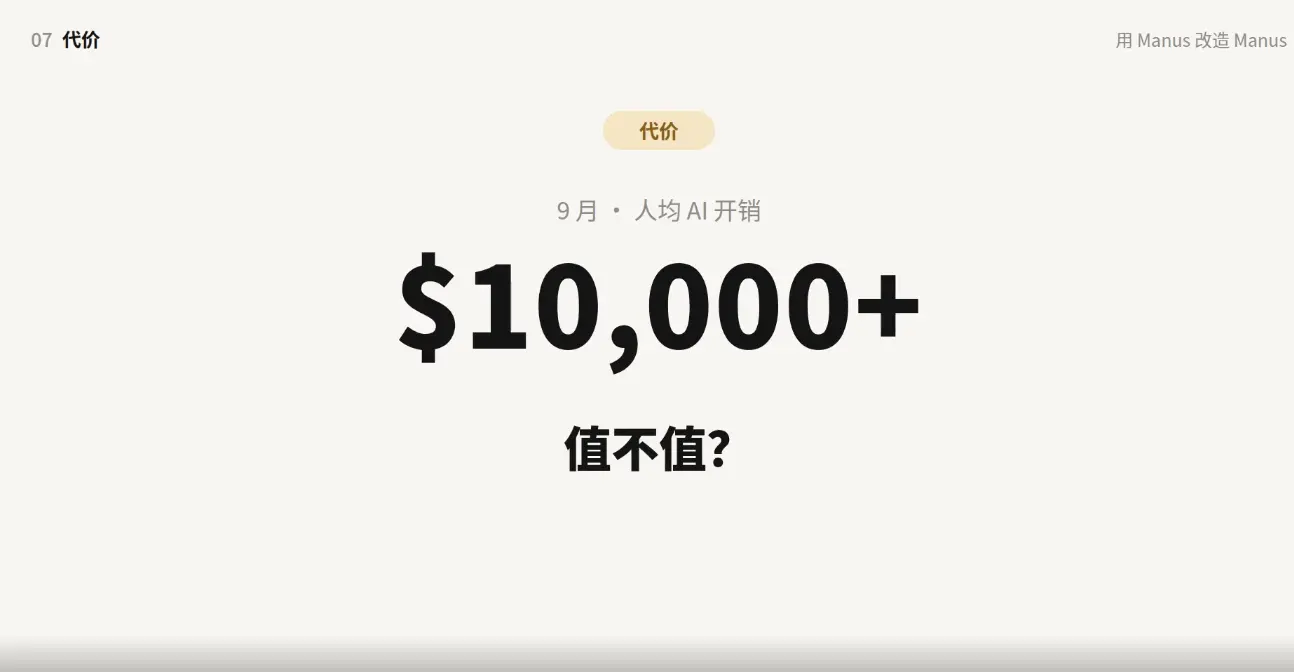
The first reason is that this money buys time and attention. As the team grows, communication costs rise, and AI saves each person's attention, allowing everyone to have a more complete grasp of their responsibilities.
The second reason is that it is expensive because the best models are used, which is a core method for understanding the boundaries of AI capabilities. He cited the example of a code review robot. A colleague responsible for development efficiency mentioned that they hadn't heard of any online failures caused by merging problematic code in the past six months, and after AI programming became widespread, the company's daily code submission volume became "very exaggerated." This colleague believes this might be the company's most cost-effective expenditure.
The third reason is the most interesting. Increasingly more development work is being completed on Manus Studio, which is Manus's own product. Every token consumed internally will turn into data that clarifies where token waste occurs. As products improve, waste decreases, costs drop, and users benefit as well.
This logic reframes a cost as an investment in research and development. Zhang Tao's judgment is that the work method achieved today for $10,000 per month may only require a few hundred dollars two years from now.
From another perspective, this calculation also reflects the common situation of application-layer agent companies. The engineer's screen at the beginning of the article was running not only Manus but also OpenAI's Codex. Manus's research and development rely on top-tier models, and the companies providing these models are also developing agent products.
Some comments have referred to this model as "dependent innovation," finding gaps between capabilities and users on platforms built by others, with the cost being that for every business transaction, a fee must be paid to potential competitors.
In this sense, the $10,000 per person simultaneously proves two things. First, the team has indeed touched the boundaries of model capabilities; second, Manus encountered the cost issue of agents earlier than its users, thus having a greater opportunity to solve it first.
04 Speed and Zhang Tao's unease
The other side of the declaration is the members of the Manus team.
In this article, almost every position has been rewritten. Engineers have shifted from writing code themselves to directing AI to work and being responsible for the results. Product managers must be able to bring features to launch, and most of the interfaces seen by users in Manus Studio, as well as the Video Editor, were created by product managers. Designers have recently begun writing code as well.
Zhang Tao used a phrase to summarize this change, from Human in the loop to Human on the loop. Previously, AI did about 70-80% of the work, with the rest supplemented by humans; now, humans design the rules, supervise multiple AIs, make judgments at critical points, and intervene when necessary.

The colleague in the team who uses AI the most has the most "exaggerated" work style. He has a general Manus Session, which is only responsible for listing the things that require his decision, along with recommended solutions. Everyone discusses passionately on Slack, and he can choose not to open Slack, just asking AI, "What do I need to decide now?"
These new definitions are, to some extent, also a job advertisement. The article concludes by stating that humans are still important, so "we are still hiring." Almost simultaneously, Manus opened 17 positions in Beijing, ranging from Agent Harness Engineer to Business Analyst. CEO Xiao Hong mentioned that they received thousands of resumes in just one day. GitLab has made its employee handbook publicly available online, and Netflix released its culture handbook years ago; the reasoning is similar.
Clearly explaining how a company works is itself a way to filter what kind of people will come.
However, what impressed Geek Park the most was the part where Zhang Tao was less certain.
He candidly expressed that his feelings are complex, with excitement and also unease:
"Is this pace right? Is it fast enough or too fast?"
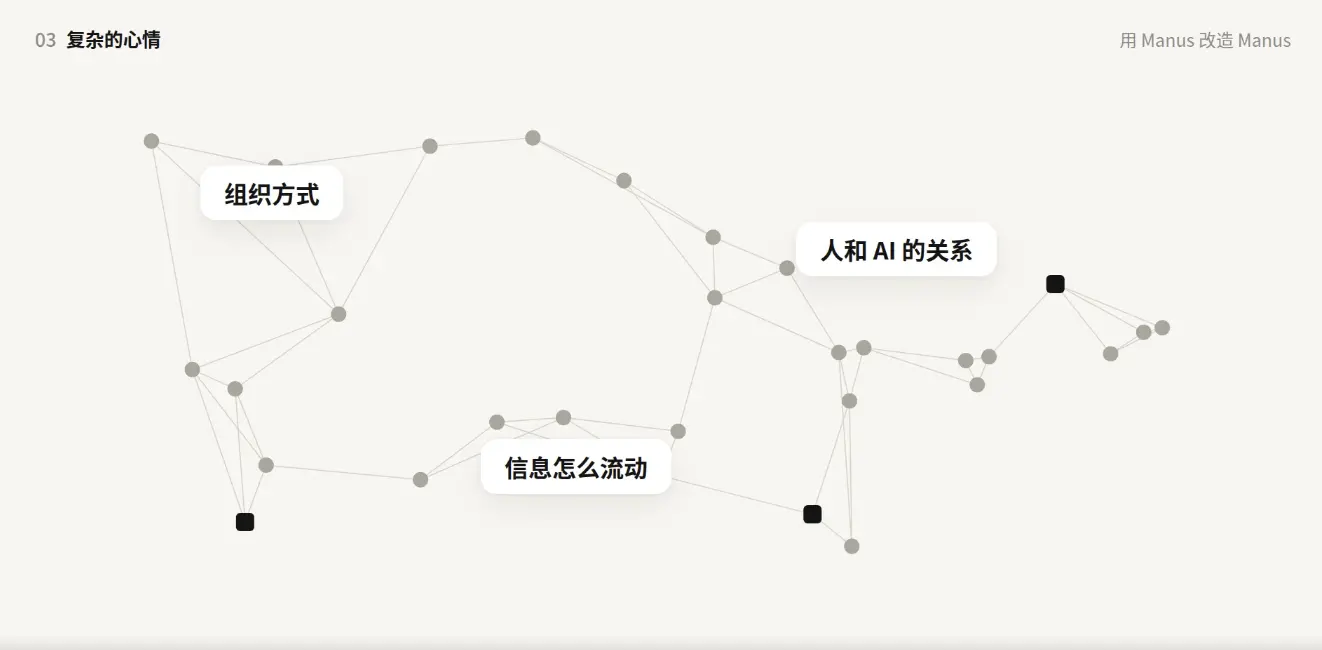
This question deserves further inquiry. How can one person handle twenty demands at the same time while ensuring quality, and how is accountability established when problems arise? "I haven't heard of any online failures for half a year," was a colleague's feeling, and it can't even be considered a statistic. Half of the product managers can already launch independently; how will the other half keep up? The article did not elaborate, and perhaps the answer is still being explored.
There is also a very personal segment. Zhang Tao wrote about having ADHD, with over twenty tasks daily, and the hardest part is "getting started." Now he hands all his tasks over to a dedicated Manus project, which can start on what it can do directly, ask him about uncertainties, and then conduct a round of research by combining Slack, Gmail, and Notion before handing it over to the corresponding product manager.
He said this has significantly reduced his daily anxiety of "not knowing where to start."
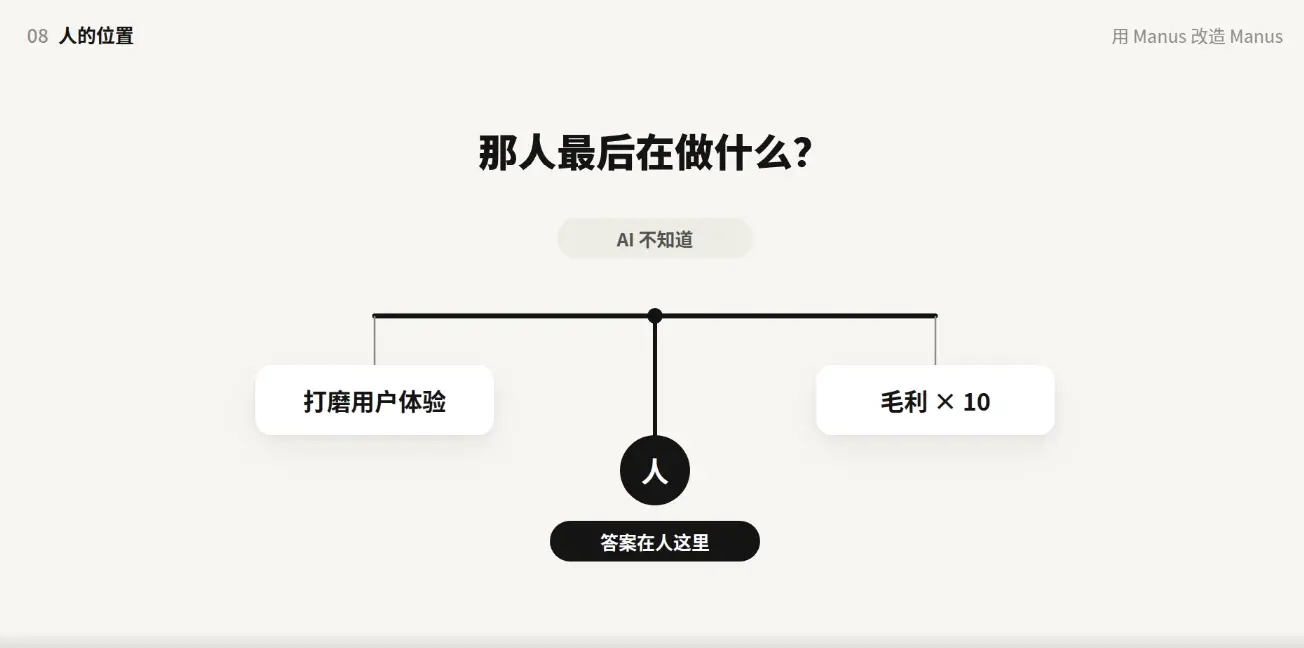
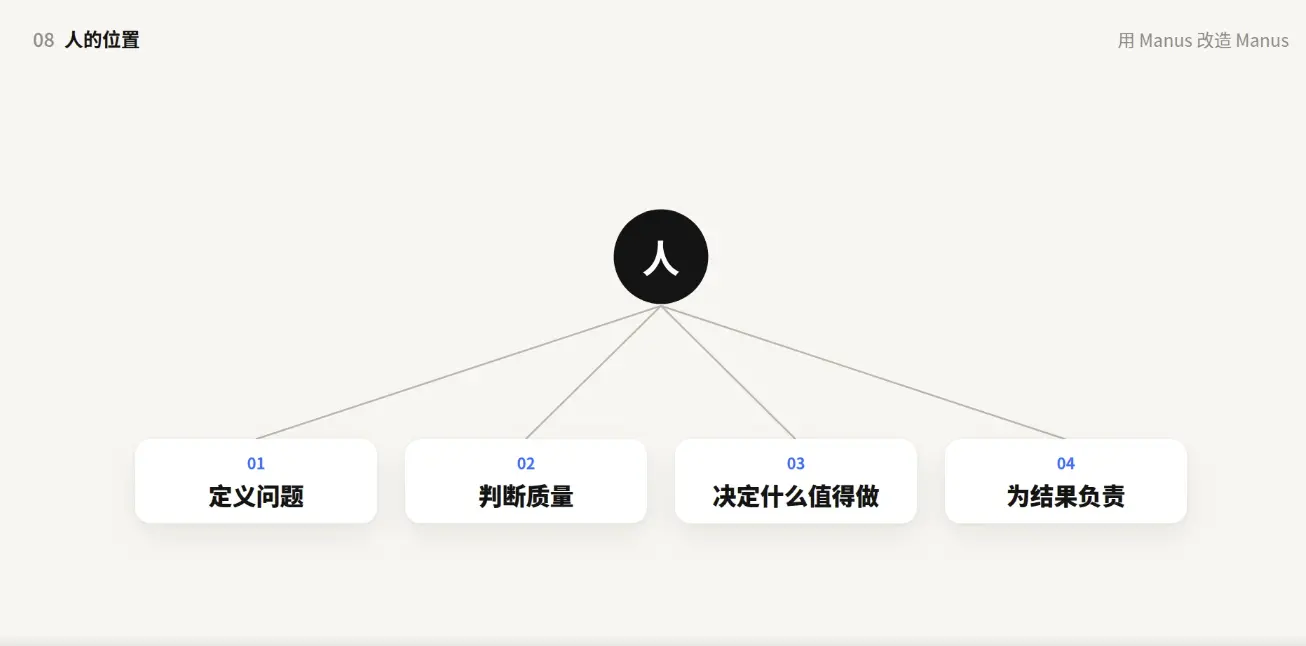
At the end of the article, Zhang Tao returned to the question of what humans ultimately do. His answer is to define problems, assess quality, decide what is worth doing, and take responsibility for the results.
In an AI Native organization, the role of humans has not diminished; instead, it has become more concentrated.
This declaration has already proven Manus's organizational efficiency. Whether it can become a product that others are willing to pay for will depend on when and in what form those features "only used internally" are delivered to users.
At the end of the article, Zhang Tao is curious about what their work style will look like if he writes on this topic again in six months or a year.
I think by then, looking back, we will probably know whether this article is a declaration or a preview.