
When will AI trading stop falling? The market is watching the "prisoner's dilemma" behind Meta's "massive bond issuance."
In the past week, AI trading faced a new wave of selling pressure, with the U.S. stock and bond markets coming under pressure simultaneously. The Nasdaq experienced its worst single-day performance in months, the risk premium on U.S. high-yield bonds rose to a 17-month high, and the yield on CCC-rated junk bonds climbed to its highest level since 2020. While the stock indices showed limited surface volatility, the re-evaluation of underlying asset risks accelerated.
One of the focal points raising market concerns is the massive financing plan released by Meta after announcing its third-quarter results. According to a research report released by Barclays on October 23, Meta chose to finance early, partly because other companies within the AI ecosystem have begun or plan to initiate financing, and the capital market's absorption capacity is becoming increasingly limited.
This reveals the "prisoner's dilemma" faced by AI giants: each company has the motivation to finance early, but if the giants collectively accelerate bond issuance, the new supply could push up financing costs, which in turn squeezes the financing space for all participants. Meanwhile, hedge funds continue to reduce leverage, and the spread of AI-related credit assets is also widening.
When AI trading will stop falling, therefore, depends not only on the earnings performance of tech giants but also on whether the market can digest the dense bond supply and whether the rising financing costs will further impact the AI industry chain.
Stock Indices Appear Calm, AI Positions Undergo Concentrated Liquidation
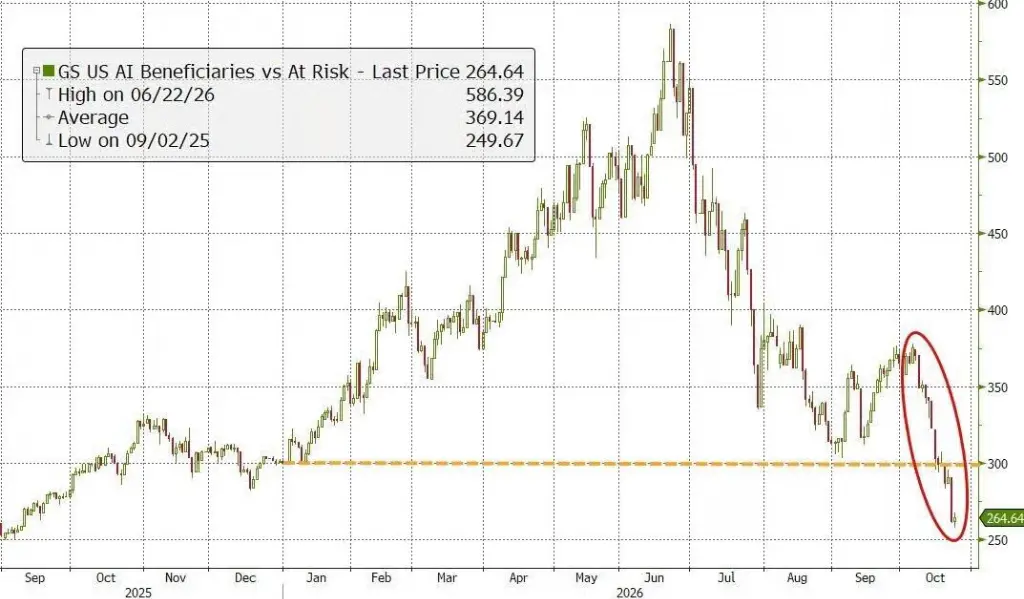
In the past week, the performance of indices masked the severe differentiation among individual stocks. Data from Goldman Sachs shows that its long-short combination of AI beneficiary stocks and risk stocks has fallen about 55% from the June peak, with all gains for the year fully retraced; momentum strategies also saw a significant pullback, dropping to extreme levels not seen since the 2008 financial crisis.
On Thursday, the S&P 500 index fell by 1.2%, yet 335 constituent stocks still rose; the equal-weighted S&P 500 index increased by 0.7%, while the market-cap-weighted SPY closed down. Goldman Sachs data indicates that hedge funds engaged in deleveraging operations on seven out of the previous eight trading days, with Thursday's sell-off entirely driven by long positions being liquidated.
This indicates that the recent adjustment is not only a re-examination of AI valuations but also involves the concentrated clearing of crowded positions. However, whether the adjustment in positions can lead to a sustained rebound still depends on whether the pressure in the credit market eases.
Credit Risk Concentrates on Low-Rated Borrowers
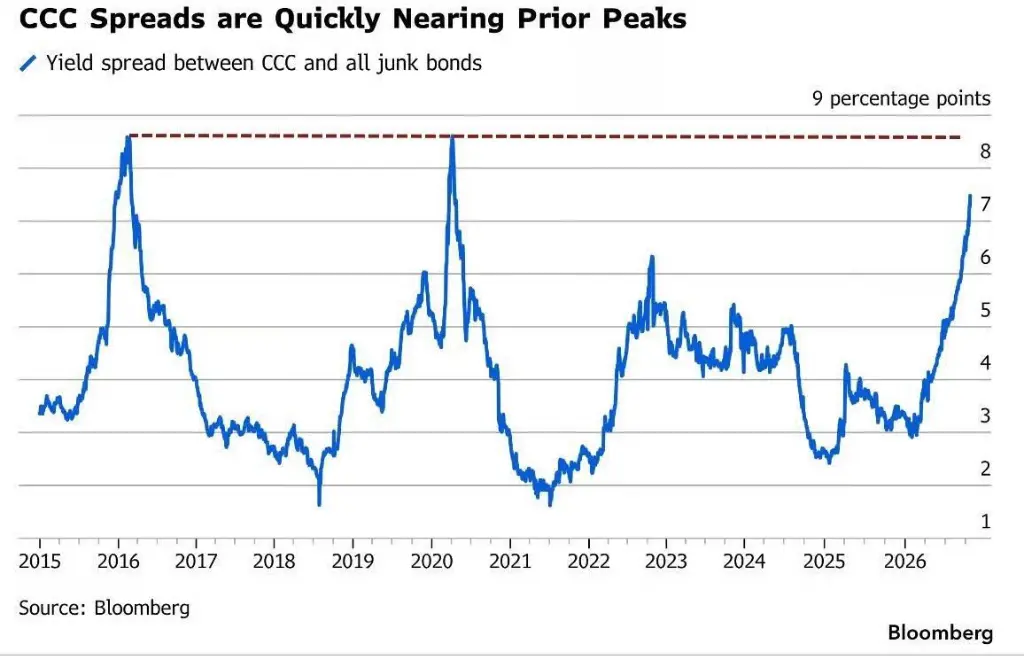
According to Bloomberg, the average risk premium on U.S. high-yield bonds has risen to a 17-month high, and the primary market is experiencing the largest wave of cancellations this year; the yield on CCC-rated junk bonds has risen to 15.85%, a new high since 2020, and the spread between CCC and BB-rated bonds is approaching the peaks seen in 2016 and 2020.
The leveraged loan market is also under pressure. The scale of deeply distressed loans priced below 60 cents on the dollar has risen to its highest level since March 2020. Data from JPMorgan shows that in the past 12 months, the volume of loans priced at 80 cents on the dollar or below has surged by nearly 90%.
Notably, as the spreads on CCC-rated bonds widen significantly, the overall credit market has not deteriorated simultaneously, indicating that risks are concentrating on issuers with weaker repayment capabilities. Robert Cohen, Director of Corporate Credit at DoubleLine Capital, pointed out that some CCC-rated borrowers may move towards debt restructuring, but this does not mean that the entire credit cycle has reversed.
Goldman Sachs data shows that spreads across multiple rating ranges, from investment-grade and high-yield credit derivatives to low-rated cash bonds, have all reached cycle highs in this round. R. Lakshmanan, Head of Credit at CreditSights Singapore, believes that after multiple global risks have consecutively impacted the market, the repricing of credit risk is gradually forming a sustained trend.
Meta's Bond Issuance Reveals the AI Financing "Prisoner's Dilemma"
Meta's financing plan has brought the contradiction between AI capital expenditures and credit market supply to the forefront. The company has narrowed its expected capital expenditures for 2026 to between $135 billion and $145 billion, expecting fourth-quarter expenditures to reach between $49 billion and $59 billion; after dividends, free cash flow is negative, and management also anticipates financing several hundred billion dollars starting this fall.
Barclays pointed out in its report that the revenue growth of super-large tech companies is being realized, but capital expenditures continue to rise, and the financing issue has shifted from "can we raise funds" to "when to raise, how much to raise, and how to raise."
Meta stated in its filing that given that other companies within the AI ecosystem have initiated or plan to initiate financing, the capital market's absorption capacity is becoming increasingly limited, making early financing a practical necessity.
However, when all companies choose to finance early, individual rational decisions can translate into overall market pressure: new bond supply flooding into the market pushes up issuance costs and limits the narrowing of credit spreads. To avoid excessive debt harming credit ratings, companies are also beginning to consider equity financing, convertible bonds, asset-backed securities (ABS), and off-balance-sheet financing channels.
Barclays believes that AI-related financing supply will continue to limit the space for narrowing credit spreads in the short term.
AI Credit Differentiation Intensifies, Market Shifts to Individual Bond Pricing
Barclays estimates that the scale of AI-related credit assets is approximately $680 billion, covering super-large tech companies, semiconductors, data centers, and hardware companies, accounting for about 7.5% of the investment-grade bond index market value, yet contributing about 13% of the index's duration risk exposure (DTS).
Overall, the spread premium of AI credit assets compared to the investment-grade index is about 35 basis points, with bonds maturing in over 10 years seeing premiums reaching about 55 basis points. Meanwhile, the spread dispersion among AI issuers has increased from 24 basis points to 65 basis points over the past year; even excluding Oracle and the data center sector, this metric has still risen by about 60%, reaching 37 basis points.
Since mid-September, the expansion of credit spreads for Oracle, Meta, SpaceX, and several data center operators has significantly exceeded the index; short-term bonds from Microsoft, Google, and Amazon have remained relatively resilient. The market has begun to differentiate based on issuers' financing needs, balance sheets, and long-term risks, rather than viewing AI as a unified credit theme.
The yield curve also reflects long-end pressure. Data from Barclays shows that over the past year, the average yield curve for super-large tech companies from 2-year to 5-year, 5-year to 10-year, and 10-year to 30-year has steepened by 137%, 140%, and 68%, respectively. Among them, Meta's 10-year to 30-year curve spread reached 68 basis points, the steepest among similar issuers.
The steepening of the long-end curve reflects an increase in investors' required risk compensation for long-term debt. As AI companies continue to expand capital expenditures, the market must not only judge whether investments can be converted into revenue but also assess the scale of financing, the timing of cash flow improvement, and the impact of new bonds on financing costs.
Therefore, whether AI trading can stop falling hinges on whether the massive financing can be absorbed by the market, whether credit spreads can stabilize, and whether the risk differentiation among AI companies continues to widen. Until these pressures ease, any phase rebound may still be constrained by rising financing costs.