
a16z Crypto investment partner: Blockchain is breaking through the development bottleneck of traditional finance
Author: Robbie Petersen, a16z crypto investment partner
Compiled by: Gu Yu, ChainCatcher
For most of financial history, the bottleneck has been the supply of new markets rather than demand. Blockchain eliminates this bottleneck. I believe this will unleash an explosion of net new markets.
Markets are mechanisms for transferring risk. Every transaction is merely two counterparties agreeing to transfer some exposure at an agreed price. Abstractly, risk can be expressed along two independent axes:
Underlying Unit: The underlying exposure (e.g., a company's cash flow, a barrel of oil, an election result, a borrower's credit, one GPU hour)
Instrument: The mechanism for transferring that exposure (e.g., spot, futures with expiration dates, perps, options, event contracts)
Almost the entirety of financial history is a story of slow innovation occurring only along one axis at a time. Spot grain markets have existed for thousands of years, but it wasn't until 1865 that Chicago listed grain futures. Currency began floating in 1971, with futures emerging in 1972. Stock options existed for centuries in the form of customized dealer contracts, but it wasn't until 1973, with the advent of the CBOE and Black-Scholes, that they became listed markets. ETFs only appeared in 1993.
New units of risk are even rarer. Interest rates only became widely tradable in 1981. Default risk had to wait until the credit default swap in 1994 for a tool. Volatility didn't see derivatives until the VIX in 2004. Event outcomes only became a real market in recent years through prediction markets.
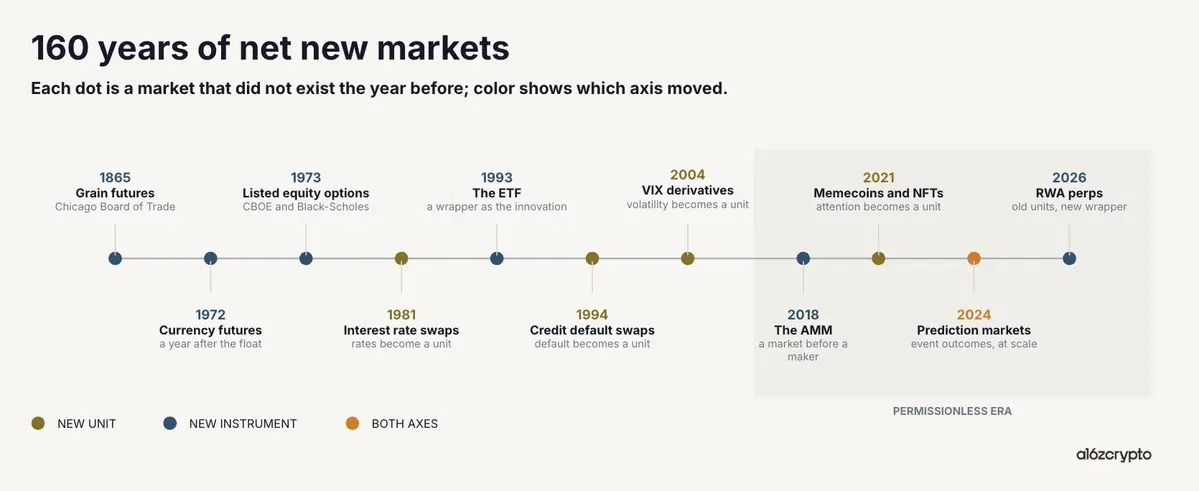
Demand for these markets has never been the issue. Farmers wanted to hedge their harvests long before the CBOT existed. Creditors wanted to transfer default risk long before CDS appeared. Instead, what slowed growth was the supply of these markets. Historically, two things have limited supply:
Listing committees and legal frameworks
Geographic fragmentation
Blockchain eliminates both. It allows for permissionless issuance and global distribution. In my view, this is its killer use case in its most distilled form: blockchain is the first technology that allows market supply to catch up with potential global demand.
This argument is also reflected empirically. Almost every defining category outcome in the crypto space is a downstream product of this killer use case. From perps and spot DEXs to prediction markets, lending markets, and even memecoins, NFTs, and tokenized real assets, value has flowed to those who have net new market issuance rights and/or trading venues on-chain.
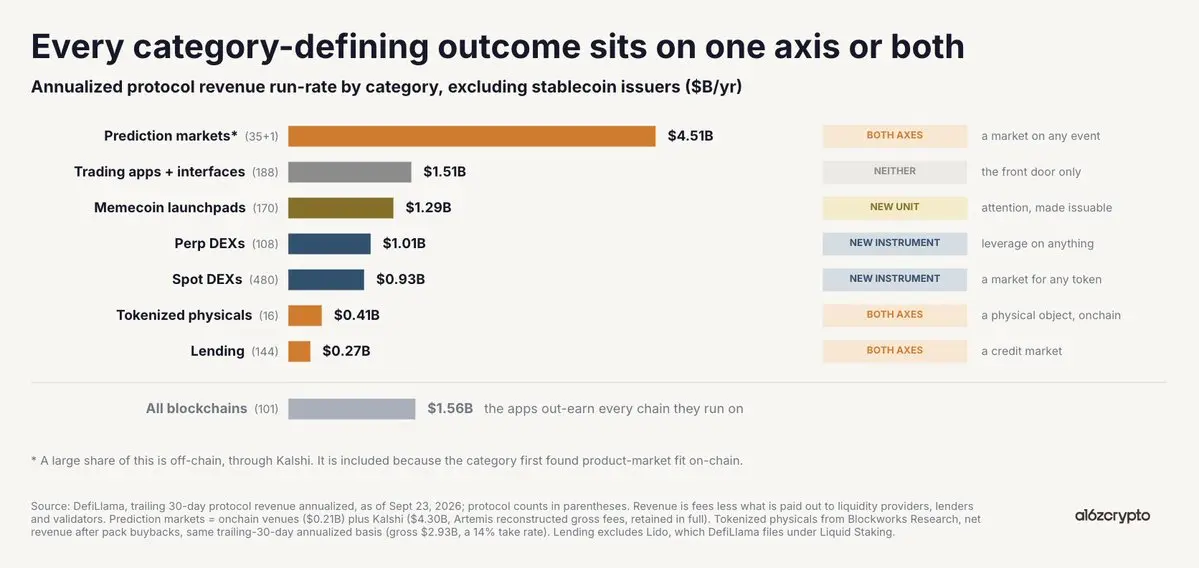
These respective categories have either created a net new unit of risk in a permissionless manner or created a new way to transfer that risk.
On the unit side, crypto engineering has produced exposures that previously had little or no financial expression. Prediction markets, while traceable back to Iowa Electronic Markets, found product-market fit on-chain, not through linear expansion, turning discrete events—an election, a Federal Reserve decision, a court ruling—into tradable units. Peer-to-peer lending markets transformed personal credit relationships into something with real-time continuous pricing. The Pre-IPO market turned exposures that were previously only open to a few secondary brokers into something users could trade and hold at scale. Even memecoins and NFTs have transformed abstract risk units like attention flow and cultural relevance into clear and tradable markets.
Moreover, crypto has either created—or scaled—new mechanisms for transferring these units of risk. AMMs allow markets to exist before market makers agree on quotes. Perps were first proposed in 1993, finding product-market fit on-chain by folding fragmented exposures with expiration dates into a contract balanced by funding rates. Binary contracts turned event outcomes into a tradable market of $1 or zero. Peer-to-pool lending replaced bilateral loans with shared funding pools and utilization curves. Joint curves fused issuance and price discovery, so an asset has a market from the first buyer onward.
Perps Are Proof
Nothing expresses this argument more cleanly than perpetual futures, and nothing proves it more cleanly than the recent rise in on-chain non-crypto trading volume.
Because perps are synthetic, listing constraints collapse into two things: a robust oracle and two counterparties willing to stand on the other side. As long as these two points are met, almost anything can exist in a leveraged market. In this sense, perps are one of the most effective coordination mechanisms ever.
By the same logic, Hyperliquid is the closest thing we currently have to a global financial coordination platform. HIP-3 and HIP-4 allow users to issue their own derivatives, access the global front end of that venue, and monetize accordingly. Reducing friction in launching markets means more markets, and demand will naturally select winners.
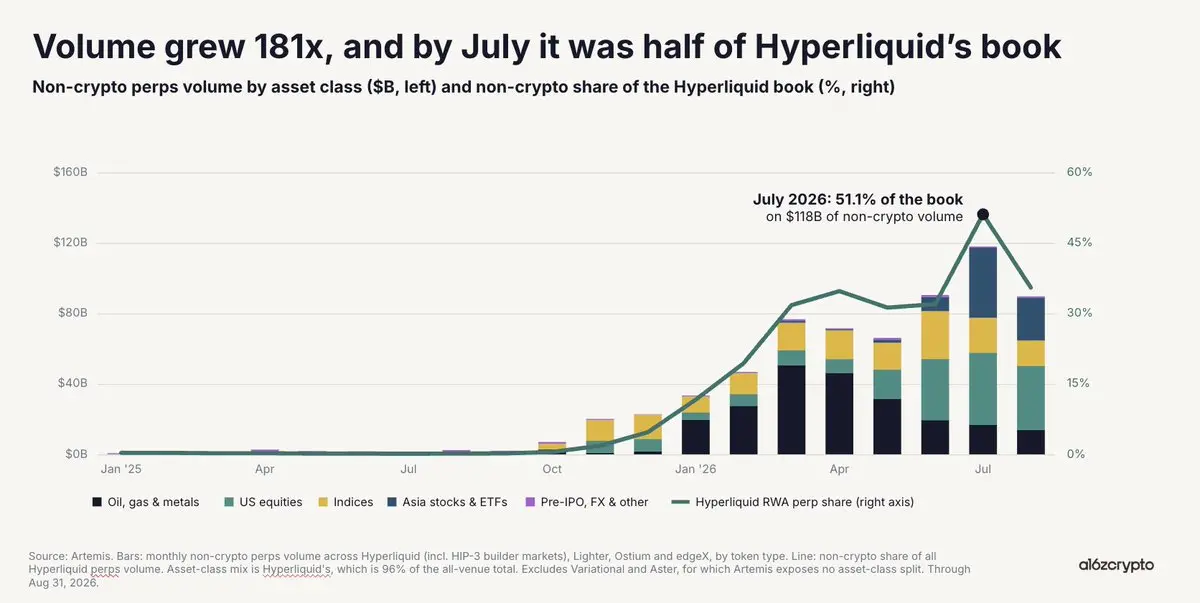
It is no coincidence that one of the fastest-growing markets in the crypto space—and increasingly across the entire financial sector—is permissionless issuance and global distribution on-chain. In July of this year, on-chain RWA perps trading volume reached an annualized run rate of $1.4 trillion, accounting for half of Hyperliquid's order book. Abstractly, this is merely existing risk units—stocks, oil, storage stocks—encountering a new transfer tool in a permissionless manner. Downstream, this reorganization has sparked an explosion in trading volume.
It is also worth noting that some net new market dominates each quarter. Q4 2025 is U.S. stocks and commodities; the first half of 2026 is oil, gas, and metals, while recently it has been semiconductors and storage stocks. This again reflects the core argument. The supply of net new markets is now catching up with whatever the world wants to trade in that quarter.
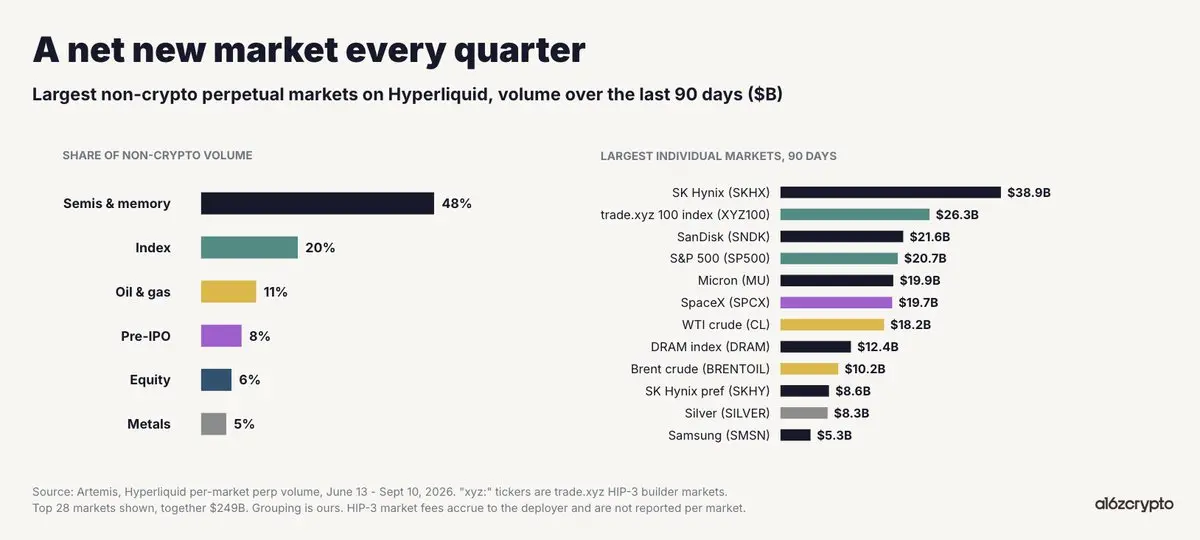
However, the deeper downstream implication is that permissionless and 24/7 trading have become wedges for price discovery to become authoritative on-chain. During the oil shock in February of this year, when CME was closed, WTI found price discovery on trade.xyz, becoming one of the most liquid markets globally. Similarly, we saw that the Pre-IPO stock market for Cerebras and SpaceX priced the IPO more accurately than bankers, with only marginal differences between the last hour of the Pre-IPO perp and the actual opening price.
Markets are increasingly indicating that the structural constraints of traditional markets—lack of 24/7 trading, geographic barriers, lack of Pre-IPO access, margin islands—are wedges for sustainable on-chain markets.
Looking Ahead
Markets transfer units of risk. It can be said that for most of financial history, markets have been constrained by geography, listing committees, and legal frameworks. Today, those constraints no longer exist. The reach of on-chain markets is no longer limited to existing asset collections but extends to any risk that anyone—or any institution—wants to trade anywhere.
This means we will continue to see explosive growth in new on-chain markets. This includes not only new ways to transfer old risks: commodity and forex futures, indices, all-weather stock exposures; but also new units of risk themselves: computational futures, those based on macro indicators (like CPI), music, social trends, sports, and any other underlying asset that can be predicted and traded bilaterally. The applications and protocols that create these markets, as well as the venues that trade these markets, are where true value can be captured.