What is RootData? How to Reduce Trust Costs and Build Web3 Asset Data Infrastructure?
RootData is a crypto data infrastructure platform for Web3 research and decision-making, building a complete data product matrix covering project fundamentals, financing context, on-chain tracking, exchange stock business and transparency rankings, and tokenized asset dashboards around the investor decision chain, aiming to become a trusted data layer for the Web3 ecosystem. This article introduces the problems RootData solves, the data it covers, and who it is suitable for.
Who is RootData suitable for?
- Investors who are tired of switching between multiple data tools and want a one-stop solution for investment research;
- Cautious users who need to verify project teams, financing authenticity, and exchange quality;
- Wallets, market, media, and AI product teams that integrate Web3 data through APIs;
- Project parties that hope to enhance information disclosure transparency and gain institutional visibility.
Why is there an overflow of data tools, yet investors remain trapped in information silos?
The crypto industry in 2026 still lacks trust. According to RootData, as of October 2026, over 350 crypto projects have announced shutdowns, bankruptcies, or ceased operations, including many trading platforms such as BitMart, BitMEX, and AscendEx. Blockchain analysis company TRM Labs reported that there were 207 hacking incidents in the first half of 2026, with total losses reaching $972 million. As tokenized stocks and other RWA assets rapidly enter crypto exchanges, the information gap further widens, and users piece together decisions from fragmented, unverifiable data, with mutual trust costs continuing to rise.
Reviewing the data tool market: On-chain, there are block explorers and on-chain analysis tools; market data is available on price aggregation platforms; financing information is scattered across databases and various crypto vertical media—each tool excels in its respective vertical, but the real decision chain for investors is continuous, not fragmented.
The differentiation of RootData lies here: it is not just another vertical tool, but integrates on-chain data, off-chain fundamentals, capital flows, market heat, and exchange evaluations into a single structured system, ensuring that every record is traceable and verifiable, and can reflect market changes in real-time.
What is unique is that it serves both sides of the market: after a project is included, data verification, transparency scoring, in-platform exposure, and API distribution covering over 220 platforms form a self-reinforcing cycle. Project parties are motivated to improve disclosure, and investors thus obtain more verifiable data. This bilateral dynamic transforms RootData from a query tool into a trust infrastructure that continues to compound over time.
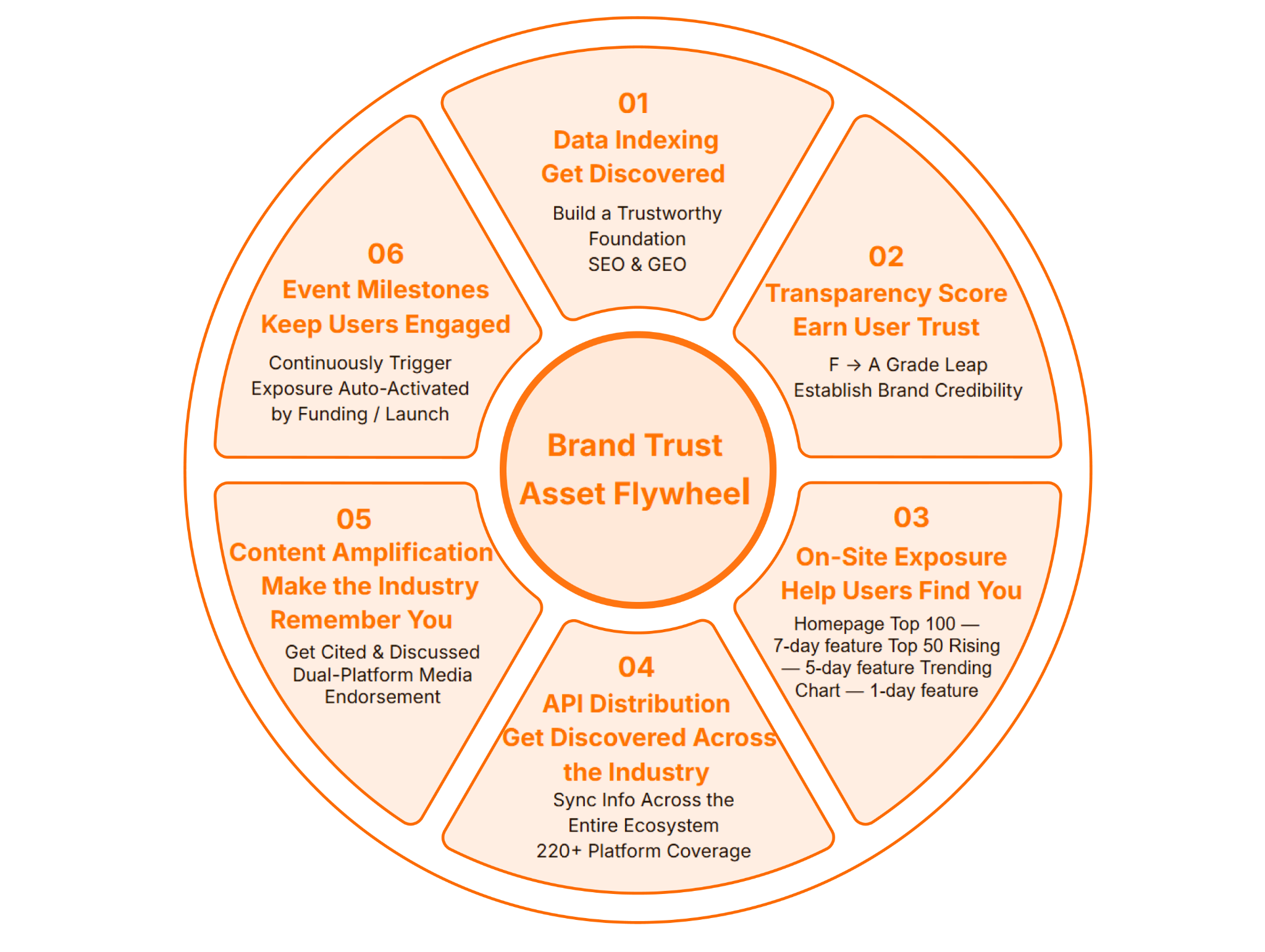
How does RootData rebuild trust in Web3 fundamentals?
In Web3 due diligence, the most time-consuming aspect is often not analysis, but collection: project information is scattered across official websites, X, Medium, Discord, white papers, and various announcements, with varying formats and unsynchronized updates, and anonymous founders and rug events further deter investors from engaging with the fundamentals. Most data platforms only focus on on-chain metrics, avoiding the hard work of off-chain information; RootData chooses to address this head-on.
As of October 2026, RootData has built over 22,000 project databases and over 21,000 personnel databases (according to the latest official disclosure from RootData), all based on in-depth collection and structured processing of off-chain information: an automated system monitors in real-time, while a manual team cross-verifies and deduplicates. This dual-track mechanism transforms off-chain fundamentals from a semi-blank state into traceable standardized archives, allowing investors to penetrate project backgrounds and personnel networks in just a few minutes.
How to penetrate the black box of capital flows?
Capital flows in Web3 operate on two parallel tracks: off-chain, financing events and institutional layouts are disseminated in a fragmented manner through announcements and social media; on-chain, large transfers and position changes are publicly disclosed in the form of anonymous addresses. The two tracks are disconnected—seeing financing news does not verify whether the funds have genuinely entered the market, and tracking on-chain anomalies does not reveal the entities behind the addresses.
RootData connects these two tracks. As of October 2026, off-chain, the platform covers financing data for 10,000 financing events (according to the latest official disclosure from RootData), supporting precise filtering by track, round, amount, and investor; on-chain, various addresses are tagged with entity labels, making roles such as exchanges, VCs, treasuries, and project parties clear, and position changes and capital flows are no longer isolated numbers but can be linked to specific projects and institutional capital behaviors.
How does the exchange ranking establish a new benchmark for transparency?
Capital flows ultimately converge at trading venues, but the quality of exchanges varies widely, especially in the realm of stocks and other real assets, where users lack objective criteria when choosing platforms. RootData addresses this issue through two independent rankings: the stock derivatives exchange ranking evaluates the comprehensive capabilities in stock derivatives (contracts) trading, while the stock spot exchange ranking measures spot trading performance, both accompanied by transparency rankings that cross-verify from the perspectives of information disclosure and compliance.
Unlike most aggregation sites, RootData directly collects primary data through official APIs from exchanges and public market data sources, without relying on third-party service providers; the evaluation discards the sole focus on trading volume and approaches from multiple angles that influence user decisions, helping investors quickly identify truly competitive trading platforms.
How does the tokenized asset dashboard bridge liquidity blind spots?
As tokenized stocks, bonds, and other RWA assets flood into crypto exchanges, new information asymmetries arise: how significant are the depth differences of the same asset across different platforms? Which sectors are heating up? How are on-chain whales positioning?
RootData's tokenized asset dashboard integrates cross-platform market shares, asset tag maps, and on-chain dynamics into a unified view: the TradFi market share visually presents the proportion of stock spot and derivatives across exchanges, the asset tag map displays sector heat by dimensions such as growth stocks, large-cap stocks, and healthcare, and the on-chain whale movements reveal the real-time flow of large funds, transforming RWA investment from blind trial and error to data-driven decisions.
How do research reports and visualizations provide systematic insights?
The ultimate value of a data platform goes beyond querying; it lies in continuously producing verifiable industry insights. RootData regularly publishes three types of reports: the "List of Dead Crypto Projects" tracks projects that have ceased operations, gone bankrupt, or become long-term unavailable, establishing a "negative signal" system; the "Crypto Exchange Transparency Research Report" is published monthly, integrating trading volume, reserves, listing performance, compliance, and transparency to establish an objective benchmark for exchange quality; the "Web3 Industry Investment and Financing Research Report" is published quarterly, covering total financing amounts, track distribution, institutional trends, and merger activities.
Beyond the reports, the watchlist and event calendar concentrate and actively push notifications for scattered nodes such as token unlocks and financing announcements; visual charts and the Top 100 heat rankings transform micro data into macro signals, helping investors assess cycles and dividends, completing the shift from single-point queries to trend insights.
What is the scale and ecosystem of RootData's services?
According to RootData, as of August 2026, the platform processes over 4.2 million search requests monthly, serving over 3.5 million registered users, and has been widely cited by mainstream media and research platforms such as The Wall Street Journal, CoinTelegraph, Binance Research, and The Block. To date, RootData has established strategic partnerships with over 220 well-known projects, including Binance Wallet, OKX Wallet, TokenPocket, Gate, Bitget Wallet, CertiK, Ethereum Foundation, Amber Group, CMT Digital, Blockworks, and ChainCatcher, providing in-depth services to top clients such as Sei Network, GMGN, TRON, Solana, and Tether, reaching over 25 million users globally through APIs. (According to the latest official disclosure from RootData)
This means that RootData is not just a C-end query tool, but is becoming a trusted data layer for the Web3 ecosystem, connecting investors, projects, capital, and market trends in a decision-making interface. As transparency becomes a hard threshold for institutional entry, RootData is building the infrastructure base to reduce the trust costs of Web3 business interactions.
Usage Restrictions
- The operational and cooperation data in the article (over 350 shutdown projects, 4.2 million monthly searches, 220+ partners, etc.) is as of August 2026 or at the time of writing, based on the current disclosure from RootData;
- The transparency rankings and research reports measure disclosure levels and data dimension performance, and do not constitute a guarantee of the safety of funds for exchanges or projects;
- Financing and project data are limited to publicly disclosed information, and undisclosed information is not included in the statistics;
- All content is presented as objective information and does not constitute investment advice.
Explore RootData
Welcome to visit RootData official website to experience a panoramic data platform covering projects, financing, on-chain, and tokenized assets.
